
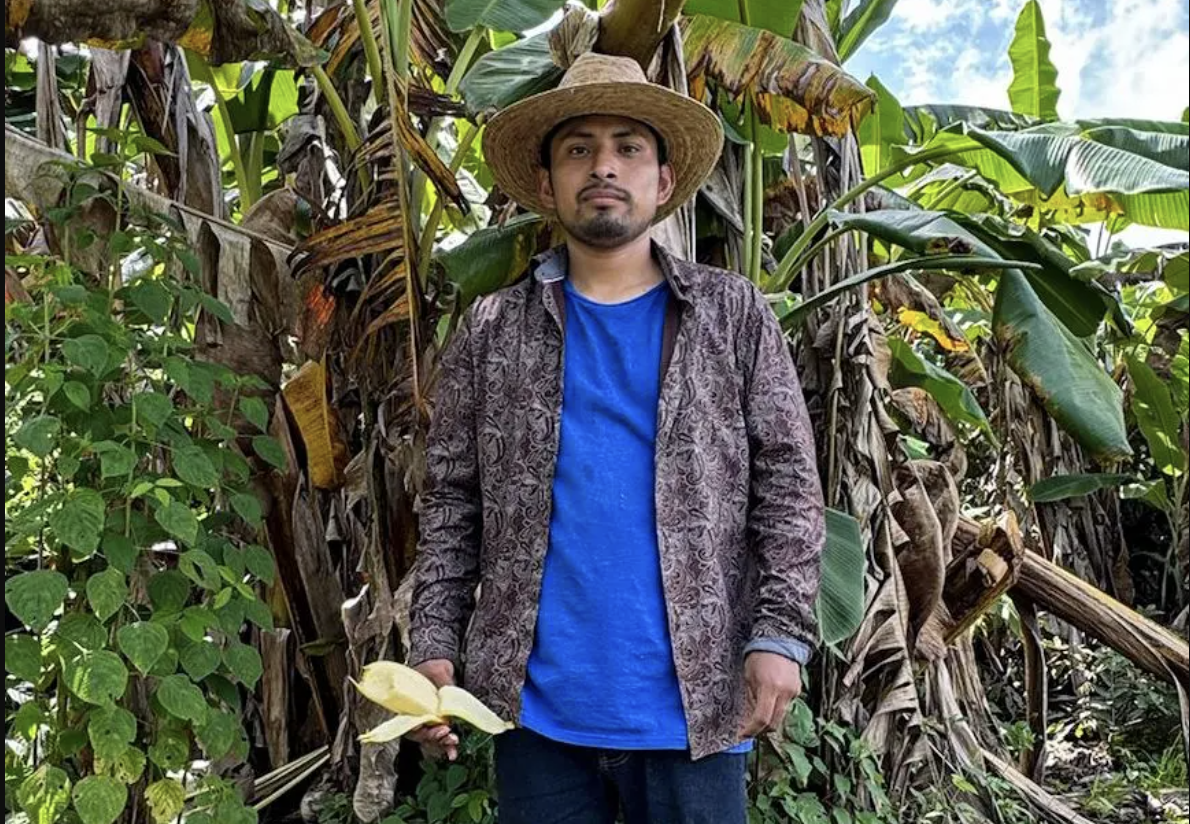
Alfredo Juarez Zeferino, known as Lelo, is a Mexican farmworker and co-founder of Familias Unidas por la Justicia, an independent farmworker union in Burlington, Wash. Harsh living and working conditions led Lelo to begin organizing at age 13, and since then he has led several successful campaigns on labor, rent, and migration rights. After ICE arrested him in March, held him for more than three months in detention, and subjected him to a removal order, Lelo decided to self-deport to Mexico. Currently working at his family’s banana farms in Santa Cruz Yucucani, he continues to mobilize against migrant labor exploitation under the H-2A federal visa program while planning his return to the U.S. Hammer & Hope spoke to him on Aug. 11 and 22.
This conversation is being co-published by three leftist magazines: Acacia, Hammer & Hope, and Lux.
Hammer & Hope Tell me about your childhood in Mexico. What was life like before moving to the United States?
Alfredo “Lelo” Juarez Zeferino I was born in 1999 and grew up in a town called Santa Cruz Yucucani, in the state of Guerrero. For a period, I worked with my grandpa in his cornfields and banana fields. Pretty much everybody here are small little farmers; they grow corn to make tortillas, and they also plant a bit of tomatoes and chili. We don’t have any agricultural companies here, so everybody plants stuff that they need and that’s it. I started before I was 8, helping with small things here and there, until I moved to the U.S. with my parents in 2008. They wanted a better life and to make money to build a house in Mexico in case things don’t work out in the U.S.
HHWhat was the experience of leaving Mexico and moving to the United States like for you?
LeloWhen I got to the U.S., my parents signed me up for school, but I only spoke Mixtec, my native language. I didn’t speak Spanish or English, so it was tough that first year. But I picked things up pretty fast. I got a lot of awards for reading and math and all that. But it wasn’t easy. Being a kid of a farmworker in the States is really hard.
HHWhere did your family first live in the U.S.?
LeloWe were mostly in Santa Maria in California and Mount Vernon in Washington, just going back and forth between them. My parents were always working on farms following the berry season. For me and my brother, it was hard because we’d get pulled out of one school and put in another, and then move to a different city again.
HHAt what age did you start working on farms in the U.S.?
LeloI was 13. The wages are really low for farmworkers, and it was tough for my parents to save money. I wanted to help, so I started working in the summer of 2013. In the U.S., farmworker families work really hard in the first few months of the year, because there’s plenty of work, but in the last three months, there’s not much except for some pruning. Those are tough times, so we try to save as much as we can before then.
HHDo you remember your salary and the work conditions back then?
LeloHonestly, I don’t remember the exact amount, but I remember the conditions: We didn’t get breaks and barely any restroom access. A regular workday meant clocking in at 5:30 in the morning and not leaving until we finished the field or it got really late — 11 or 12 hours of work per day.
HHHow was your experience at school in the U.S. as a farmworker?
LeloSometimes it was hard to concentrate. Sitting in class, I’d think about my parents working early in the morning until late at night — no breaks, no restrooms, no food. I’d hear classmates talk about weekends with their families or summer trips they took. I didn’t get to experience any of that. It was hard.
HHWhen you were working on those farms, where did you live?
LeloWe lived in labor camps in company-provided houses for employees. Every family lived in those houses, and all the parents went to work while the kids stayed home and played together. The conditions were really rough — those camps weren’t maintained well, the roofs leaked whenever it rained, and it got very cold since there were no heaters.
Once at work it started pouring. It was really cold, and I began to feel sick. The company didn’t provide proper rain gear, so we were working in regular clothes. We picked berries crawling on our knees, searching between the plants and putting them in buckets. I started feeling really bad. I asked my mom to talk to the supervisor, told him I was feeling sick, and asked to go home. We were living in temporary housing provided by the company, and the fields were just a few minutes away. The supervisor said I could go, but that everyone working in my family would need to turn in their work ID and find a new place to live “because you’re no longer staying with us.” There was nothing I could do, except go back to work and just shut up.
HHCan you tell us how the first strike started?
Lelo I took my first step in organizing in July 2013. That would have been after I first started working in Burlington, Wash. We had been asking for a price increase on the berries they were paying us. For every pound we pick, the company pays us a certain amount. The previous day, we made so little that we didn’t even reach the state minimum. We thought if we could get at least 3 more cents on the price, we could at least hit the minimum wage. But the company said no. They said, “All of you that aren’t willing to go back to work, we’ll just replace you. We’ll put in machines and replace you. We’ll bring in new workers.”
For all of us who had been working in that field, just remembering all the injustices, at a certain point we needed to do something. I did not know what organizing was. I had no idea what going on strike was, what boycotting meant — none of that. All we knew was that if none of us went back to work, the company could not replace or fire us all at once.
HHAnd what happened during the strike? Did you win?
Lelo After the first couple days of the strike, we listed our demands. We wanted breaks, access to restrooms, and lunch time so we could eat. The company agreed to those demands, but within one week it just got rid of the agreement. When that happened, we already had support from Community to Community, a grassroots organization that promotes farmworkers’ rights, food sovereignty, and agroecology through activities like an annual farmworker tribunal in Olympia, Wash., and an agroecological teaching garden in Bellingham. I’m still very much involved with the organization. We learned from them that the agreement wasn’t our best option — what we really needed was a union contract. So we launched a campaign to establish an independent union and fight for a contract. In 2013, we voted to become a union, and in 2015, the state of Washington officially recognized it. That’s how Familias Unidas por la Justicia was founded.
The main challenge was to keep up the strike to put on as much pressure as possible. That strike lasted about a week. But when we realized that wasn’t enough, we launched a boycott against Häagen-Dazs and Driscoll’s, the company in charge of distributing Sakuma Brothers farm products. We knew that would force the company we worked for to sit down and negotiate a contract with us. In June 2017, after three and a half years of campaigning, which included many strikes and work stoppages, as well as a two-year boycott, we finally got our first union contract. I was part of the bargaining committee; when we received an offer from the employer, we would take it to our union members and ask if they approve it or not. And from there we’ve just been updating the contract with more demands.
HHAnd what has been your role in this process?
LeloSince I speak Mixtec, Spanish, and English, for many years my biggest role was translating for folks. When we had presentations, we’d get our co-workers — a lot of them speak Mixtec or Triqui — to tell their stories at churches, universities, parks, wherever we were invited. I’d also help folks in the community with their daily needs, going to hospitals or court. More recently, I’ve also been working on policies and advising.
HHCan you talk more about that?
LeloI have advised state and local representatives and senators on the kind of language they should use when drafting new labor policies. A lot of them want to help, but often the legislation doesn’t actually help us.
In March, the weekend before I was arrested by ICE, I was at our state Capitol, talking to senators and representatives, asking them to pass a policy that would set a statewide cap, the maximum amount a landlord could increase rent. We need to set a cap so families have some predictability: if rent is going up, they know how much and can start preparing for it. That was a big focus earlier this year. When I was in the detention center, I got a newspaper article about it, and the good news was the governor signed it.
Before that, I helped write the Keep Washington Working Act, legislation passed in 2019 that blocks the state government, local police, and state patrols from turning personal information over to ICE or Border Patrol.
On the national level, I was representing my union and Community to Community on a coalition to pass a Registry Bill. The main goal is to set a new rule so that if you’ve been in the U.S. seven or more years, you could apply for legal status.
HHYou participated in strikes, led a very effective boycott, helped establish an association, created a union contract, and then moved forward with rent and migration-related legislation. Have you been targeted for your activism?
LeloVery early on, in 2013, the biggest threat, not just for my family but for all the workers, was that companies would call ICE on us.
There’s also a nonprofit called Save Family Farming that’s funded by a large farm corporation, and whatever small thing we do, they publish stuff online against it. For example, they don’t like that we have access to paid overtime, rest breaks, or even restrooms.
Since 2019, I’d been serving on an immigration advisory board for the Bellingham mayor. In 2025, after the new mayor came in, a rule was passed to shut our meetings down. The new administration really didn’t like how our community had gained access and influence with the government. And more recently, in March 2022, striking tulip workers were threatened by their employer. But as soon as those threats were made public through a video the workers made, the company quickly started negotiating with the group of workers. Around 100 farmworkers were on strike, and they selected seven representatives to negotiate on their behalf. Within a week or two, they reached an agreement.
They had gone on strike because the company didn’t provide clean restrooms or enough drinking water and didn’t pay overtime. I had worked at that company for many years and helped the workers organize. When the threat of calling law enforcement or deportation popped up again, we knew how to deal with it.
HHDid they also get a union contract?
LeloNo, currently they just have a work agreement, but if something happens or the company starts breaking those rules again, we could see another big strike or boycott and really push for a union contract.
HHCan you associate with the union Familias Unidas por la Justicia individually, as a rural worker from a particular farm, or do you have to be part of the local farmworkers’ association first?
LeloThe only place we have our union contract is with one company, the one we went out on strike against back in 2013. Our rules are very easy and clear. If you want to work under the union contract, all you have to do is fill out a union membership card at the company where we have the union contract. You become a union member, and we give you a membership card. If anything happens — if a supervisor starts to get aggressive, if anyone tries to fire you and you don’t want to speak to them alone — you can just call us. The phone numbers are on the back of the card. We have folks who speak multiple languages, Mixtec, Triqui, English, Spanish. There are a lot of benefits to being a member and having that representation.
HHIn 2015, you filed a lawsuit against the local police in Bellingham for racial profiling. Can you describe what happened?
LeloOne day in the summer of 2015, I drove me and my friends to a party in Bellingham, around 30 minutes from my house in Mount Vernon. But the place was closed, and we decided to go home. On the way home, I inadvertently went the wrong way on a one-way street. A cop pulled me over. I was 15 and did not have a driver’s license, so I told him I was 18, hoping to just get a ticket. But when I said I was 18, the cop started asking a series of questions about my nationality and legal status. After I answered all his questions, he went inside his car and made a call. In just a few minutes, Border Patrol showed up, and the cop gave them all my information. The same cop then told the Border Patrol agents, “I can give this guy a ticket and let him go, or I can take him to our jail and from there see more about his background. Or the third option: You guys can take him.” And the Border Patrol said, “Oh, we’ll take him.” But by the time I got to the Northwest ICE Processing Center in Tacoma, my union and other organizations had already started calling Border Patrol for my release. My parents showed up, and I was released. After that, I got a lawyer, and we filed a racial-profiling complaint against the Bellingham Police Department. Years after, we settled.
HH Your arrest took place the year before Trump was elected. What happened after he was sworn in for his first term?
LeloIt was hard and scary. There was a big fear that by filing the lawsuit, I could end up being deported. But I just couldn’t back down. We wanted to set an example for others who were victims of racial profiling. At that time, we did not have any state laws that prohibited communication between the local police and Border Patrol; the Keep Washington Working Act passed in 2019.
I was not threatened directly, but all the stuff that was happening around me and all the actions and the protests I was doing definitely felt like I could be targeted anytime.
HH How did that situation change under Biden?
LeloDuring Biden’s presidency, we wanted to bring law enforcement and our community together to make our community safer. I attended multiple city police department meetings and spoke about issues that exist in the community. We also grew very close with the sheriff’s department.
The fear that folks are feeling now is exactly what we did not want. Now our communities are afraid to ask for help because they don’t know if police could call ICE on them. As we saw Trump promising mass deportation, our team started meeting with multiple county sheriffs to ask them what they would do if they were asked to cooperate with ICE. The response that we got was very positive: They weren’t going to cooperate in rounding people up.
Even if those sheriffs and police don’t cooperate, ICE could just go in and pick people up, though. So starting in January 2025 we worked to set up rapid response teams. They’re all over the country now, made up of small groups of volunteers who have papers and are not at risk of getting deported. We have a whole team set up so that if they see ICE, they can move in quickly, record everything, ask for warrants, and provide whatever support is needed to the folks getting detained and their families, including legal assistance. We didn’t let fear stop us from organizing and protecting our community.
HHAfter Trump started intensifying the deportations, how did that impact your activism and your daily life?
LeloThe routine was the same — I was just more cautious. In March and April, I would usually be working picking tulips, but this season I decided to step aside and focus more on helping our community. When ICE detained me on March 25, I was working to gather more support for a new law that would allow Washington’s Department of Health and the attorney general’s office to go into private detention facilities, including the Northwest detention center in Tacoma, and do inspections to see if appropriate food and medical care, for example, were provided. The law passed and was signed by the governor on May 12.
The GEO Group won a preliminary injunction partially blocking a bill passed in 2023 that stipulated the Department of Health would oversee health and safety conditions in that detention center. But a federal appeals court just ruled that Washington has the right to do inspections within state limits. That’s something I wanted to focus on, pushing for inspections and holding ICE and GEO Group, the for-profit company in charge of the Northwest detention center, accountable.
HH Did you contribute to the new legislation as a member of Familias Unidas por la Justicia?
Lelo I’m very close with the union leadership, but I felt I could do a lot more as an active member than being on the board itself or part of the committee. Besides helping to mobilize the workers, I help the leadership take notes and explain the laws in Spanish or Mixtec.
HH Can you tell us about what happened on March 25 when ICE detained you again?
LeloAround 7:10 a.m. I left my house in Mount Vernon to drop off my partner, who was working picking the tulips in Burlington. Just a few minutes later, I was pulled over by an unmarked vehicle. The agent walked to the car, and I saw ICE on the front of his vest. He asked me to identify myself. As I was taking my driver’s license out of my wallet, I kept asking him why he pulled me over. He responded by asking me to step out of the vehicle. I told him to first give me a reason or show me a warrant. That’s when he shattered the window with a small gadget and put his hand inside the car.
My partner started crying, and at that point I knew they weren’t going to just let me go. So I opened the car door, and one of the agents quickly grabbed my driver’s license from my hand. I raised my hands up, and they put me against my car and handcuffed me. I think the operation had three or four vehicles with five or six agents in total.
HH That seems to be a massive operation to arrest someone who’s not involved in any criminal activity. Did you feel that you were being watched the days before?
LeloIn the days before my detention, I definitely saw some cars that were very suspicious just in how tinted the windows were. But again, I had no criminal history that justified ICE watching me. I had no reason to hide.
HHDid they provide any explanation for your arrest?
LeloAfter they picked me up, we arrived at ICE’s offices at Ferndale. Hours later, they asked me to confirm my personal information.
One of them said, “I don’t know why they asked us to pick you up because you don’t have any criminal history. I looked you up in our database and you have nothing.” At that point I knew that I was targeted for the political work I was doing. Because there’s no way there would be five or six agents going after one person unless they really didn’t like that person.
HH What happened when you arrived at the Northwest detention center? What were the conditions like?
LeloWhen your name is called, you go to a GEO officer who looks at your criminal history. Based on it, they give you a color of clothes. I got blue, which is for folks considered very low risk or no risk at all.
By law, detainees should get at least one hour of outdoor time daily. But in the whole three and a half months I was there — over 100 days — we actually went out only about four times.
We got water to drink from the same sink where we washed our hands. A lot of people complained about stomach pain and wouldn’t drink the water or would take very little. There was a shower in the cell, but it was open only for three hours, from 6 a.m. to 9 a.m., and the water was really cold.
In terms of food, they are supposed to provide three meals a day. But many times the third meal didn’t arrive until like one or two in the morning. It was hard to go to sleep with an empty stomach. And the food was really terrible. Meat was pretty much always undercooked, to the point where you could see the blood.
HH Did you experience physical violence?
Lelo Not directly toward me. There were some fights among detainees, and there were people protesting about the food or asking to change the unit officer — sometimes we’d get a really bad or mean officer. There was a bit of everything happening, but the overall feeling was just sadness.
I was only a couple hours away from where I live, from my family, but there were people whose family was in Florida. It was very sad to see migrants missing their families or losing hope of staying in the U.S. Sometimes those deported would get five-year, 15-year, or 20-year bans on returning.
HH Besides sadness, how did you feel under these circumstances?
Lelo It made me feel angry and also confused as to why I was going through this when I’ve given so much of my time, my life, to helping the U.S. economy. It’s hard to find the right words to describe what I was feeling.
I wanted to get out of that place and get back into the community to continue my work. I was hoping to see some kind of justice, to get released in the U.S. and fight the case from outside the detention center. But I was also thinking about all the support, all the letters I got from people, all the strikes they organized, all the visits. I could tell it was hard for the folks who visited me, too. Some of them were in tears, just like I was, when I told them about the conditions in the facility.
HH When did they start giving you information about your case?
Lelo I found out about the removal order two days or three days after my detention, when a lawyer sent by Community to Community came in and told me about it.
What happened was in 2017, the year we got our very first union contract, ICE had set up a court removal hearing for me. When it scheduled a hearing with the judge, what it needed to do was to serve me directly or in person, or notify me of the court date so that I could show up and defend myself.
But instead, ICE mailed a letter to the address that they had for me. The problem is that I wasn’t living at that address at that time, so the letter was returned to ICE. Since I did not get notified of the court session, the process should have been paused. ICE has to prove the person it is seeking to remove from the country receives the notice before the court date. But because it was the first Trump administration, they went ahead with the hearing, and a judge automatically signed an order to remove me.
The new judge responsible for my case in 2025 should have canceled this removal order and released me because I did not get a fair chance to defend myself. But the judge said no, you still have to be removed from the country.
HH What was your legal strategy going into this?
LeloOur strategy was to have the judge recognize that I didn’t have a fair process and either release me on bond or get rid of that removal order from 2017. After we tried for bond and got denied, our next move was to challenge the removal order so I could get released back into the U.S. From there, I could apply for some kind of legal status since I’ve lived in the country for many years and been paying taxes.
But on June 16 I had the last hearing and the judge sided with the government and agreed I should be removed. Then she asked, “Do you want more time or do you want to get removed right away?”
I asked for more time to figure out what I was going to do. She gave me three weeks, which ended on July 14. My only option then was to ask for voluntary departure and leave the country without anything bad on my record. Otherwise, ICE would remove me forcefully — a deportation.
HHWhat are your plans for the future?
LeloBy coming to Mexico, I was able to meet up with the organizations that supported me and plan how I could help the farmworkers’ struggles from here. I’ll look into visas soon. I’m researching multiple lawyers who specialize in the different visa options out there. But for now, the goal is to continue to meet with the organizations that supported me when I was detained by ICE and see how I can organize with them.
Being detained for all that time, especially under the conditions I described, made me see the full scope of how broken and unfair the U.S. immigration system is, especially if you don’t speak the language.
HH In response to pressure from farm and hotel owners, Trump has promised to create a new immigrant labor regime that would allow migrant workers to work with temporary legal status under the control of their employers. What do you think about that proposal?
Lelo That’s something I’m very familiar with; I’ve been leading campaigns talking about this. Even though he didn’t mention the name, the model he’s talking about is called the H-2A federal program. The purpose of that program is to help agriculture companies, like dairy farms, when they don’t have enough local workers. Let’s say they need 100 workers and put the word out in the community that they’re hiring, and only 80 people show up. They’re still missing 20 people. That’s the purpose of the program, to help those farm owners bring in guest workers from other countries for those 20 missing spots so they can get all their crops picked.
That’s how the program should work. But what we’ve been seeing over the years as we’ve been organizing is that farm owners have been pushing to increase their ability to bring H-2A workers from other countries instead of hiring local workers. Because local workers — people who have lived in the U.S. for years — have learned their rights. They have made connections in the community with organizations or churches they trust, people who can help defend their rights.
Farm owners don’t like that. What they want is full control over their employees. We describe the H-2A program as modern-day slavery, because that’s what it is when you take people from other countries and bring them to a place they don’t know, and their only purpose is to work. If they speak out about their working conditions, that farm owner has their passport and visa, and they can deport them the very next day.
HH So it’s not only mass deportation.
Lelo Definitely. The goal is to talk to the community about it. When I was in Washington, we’d do frequent tours around the state to different churches, parks, and organizations hosting events where we’d ask people, “Hey, do you know about this program? This is happening in your area. How has this affected you?” We’d talk to local farmworkers in the cities we traveled to.
If you’re young, you’re strong, you can work many hours, you can lift heavy things. But as you get older, you can’t do all that same stuff. When you’re young, the company hires you every year. But as you get older, they say you can’t produce the same amount you did when you were younger. Instead they import younger workers from outside the country, and you don’t have the job anymore, even though you’ve put so much of your life, your family’s life, into helping grow this company. Now that you’ve gotten older and can’t produce as much, they’re just going to replace you.
ZNetwork is funded solely through the generosity of its readers.
Donate