
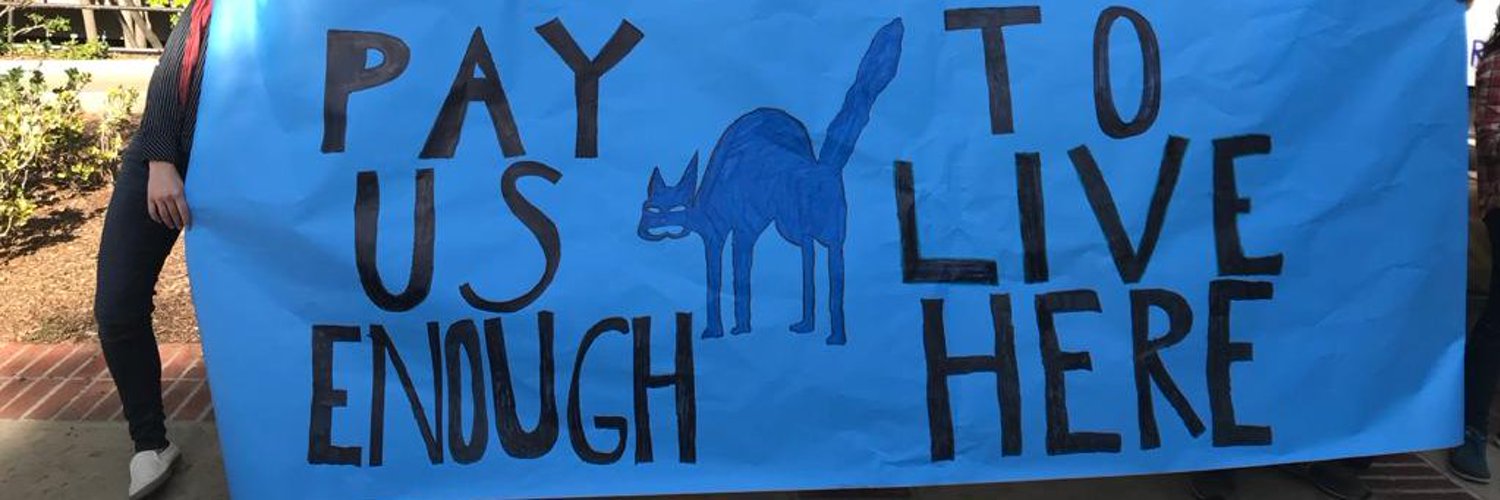
Twenty-four years ago, I was a poorly paid graduate student who walked out of my unprotected academic job as a teaching assistant and joined a picket line at the entrance to the University of California’s Santa Cruz campus. I now enjoy the relative privilege of being a tenured professor but have returned to that very same spot to support the current graduate-student labor action.
The largest higher-education strike in US history is now in its fourth week. On November 14, almost fifty thousand University of California (UC) academic workers began an Unfair Labor Practices strike. Teaching assistants, postdoctoral researchers, and other scholars are withholding their labor. They are demanding substantial raises, a cost-of-living adjustment (COLA), increased parental leave, and other measures to cope with California’s prohibitively expensive housing market.
Not Enough to Live On
COLA is at the center of this strike. Amid soaring rents and rising inflation, the people who provide much of the instruction for the system’s 230,000 undergraduates, including grading mountains of exams and papers, can’t afford to live near most of the ten UC teaching campuses.
Located in cities such as Berkeley, La Jolla, and Santa Cruz, the UC campuses are in some of the least affordable communities in the country. UC Santa Cruz sociologist Steven McKay described the rental conditions around his campus for many as “obscene,” with median rent over $3,000 per month.
McKay and his coauthors Miriam Greenberg, James Sirigotis, and Thao Le published a study detailing their findings, the “No Place Like Home” report, in 2021, concluding that Santa Cruz “is one of the least affordable metropolitan areas in the United States and globally to live.” With the salary band of a UC dean starting at $200,000 a year and going as high as $800,400, and campus chancellors receiving between $522,000 to $640,000, administrators may not be feeling quite the same anxiety as a teaching assistant earning $24,000.
Despite their low pay, these academic workers are essential to the university. In large lecture classes with hundreds of undergraduates, professors obviously can’t do the grading themselves. They are reliant on graduate student labor.
This strike reveals how important the least compensated and most vulnerable academic employees are to higher education. With universities increasing enrollment as they squeeze the salaries of teaching assistants and adjunct lecturers (who recently threatened their own strike against the UC system), the crisis in American higher education is moving toward a breaking point.
In the past week, the labor action has escalated with building occupations on several campuses. On Monday, December 5, strikers staged a sit-down occupation at the UC office in Sacramento. The university had police cite seventeen protestors for trespassing, and at least one striker sustained injuries.
Things are likely to get more interesting as we approach finals week. It will be impossible for the UC faculty to grade the hundreds of thousands of exams and term papers without the labor of these workers.
The 2019 Strike
There’s a history behind the current strike. Within the past few years, the UC administration has met efforts to obtain appropriate wages with a heavy-handed response.
Frustrated with the situation, UC Santa Cruz graduate students staged a wildcat strike (meaning it was not sanctioned by UC grad student union UAW 2865) in December 2019 to demand a COLA. As the action entered its third month, the administration responded with a brutal police presence and seventeen arrests.
“No Place Like Home” coauthor Sirigotis, who was then a doctoral student in sociology working with Steven McKay, was thrown to the ground, stomped on, shoved into an Alameda County police van, and detained offsite.
UC president and former US secretary of homeland security Janet Napolitano, herself under a cloud of controversy for other scandals, fired eighty-two striking graduate students. As the situation became more tense, the COVID-19 lockdowns and campus closure provided a temporary distraction from the crisis.
Organizing Teaching Assistants
The 2019–20 wildcat strike and today’s sanctioned strike are the most recent chapters in a longer history of labor organization within the UC system. In 1938, the first efforts to organize teaching assistants began. In the 1960s, Academic Student Employees (ASEs) sought union recognition, but the UC administration held that they were students and not workers.
However, teaching assistants kept on pushing. In 1979, the Higher Education Employee-Employer Relations Act (HEERA) granted public university employees collective bargaining rights. During the following decade, ASE support for unionization grew.
When I took part in the 1998 action, our goal was to force the UC system to recognize that ASEs had voted to affiliate with the United Auto Workers (UAW). We shut down the UC teaching campuses, but it was the support from our fellow unions that made all the difference. The city’s municipal bus drivers and truckers bringing construction material refused to cross our picket line.
We won that strike. While I earned my doctorate in 1999 and subsequently became a poorly paid adjunct lecturer at UC Santa Cruz, I looked on with pride as the graduate students overwhelmingly voted for representation as UAW Local 2865, the largest ASE union in the country.
UAW 2865 now has the support of prolabor California State Assembly members. Many of them have urged the current UC president to bargain in good faith with the union.
Crunch Time
Looking back to 1998, I will never forget the thrill of a union brother stopping his massive truck at our picket line. He stared at us in mock surprise and then sounded his horn in solidarity before making a show of slowly turning around, “accidentally” blocking traffic for a few minutes. Ever the pedant, I mentioned to my fellow strikers that Mike Davis was a long-haul trucker years before he joined the faculty of UC Irvine and then UC Riverside.
That was my first experience with labor solidarity. That’s why, as a member of the California Faculty Association (CFA) who enjoys union protection, I have donated my time to supporting the union we built for today’s UC academic workers.
I’m proud of my small contribution to gaining UAW 2865’s recognition and proud of the CFA’s support for this labor action. It’s going to be a tough battle for the strikers to win, and they need all the solidarity that the wider labor movement in California and the rest of the United States can offer.
ZNetwork is funded solely through the generosity of its readers.
Donate