

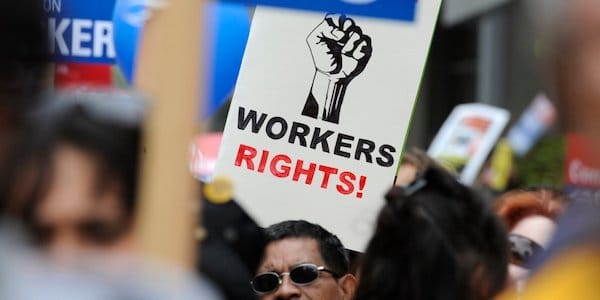
One of the encouraging things this long-time labor activist has been watching over the past several years is the emerging development of unions across the world and in the United States. We’re hearing about new organizing efforts in Argentina, China, Iran, Mexico, South Africa, Vietnam, and other places, including the United States. And while I’m aware of the global context, I want to focus this article on developments in the US.
The union movement in this country is reviving. We have seen the emergence of new unions—such as in Amazon, Starbucks, and many other companies—across the country; not only in “liberal” California, Massachusetts and New York, but in conservative areas such as Alabama, Florida, and Texas. We’ve seen some unions that have been more militant and who have used the strike to fight for their demands. We’ve seen unions that have not only struck but held on for months to win. We’re facing a potential national railroad strike. This is exciting, and I think it shows a determination to resist the increasing corporatization of our economy and country, and the domination of working people.
(There have also been things like “the great refusal,” where people have individually refused to take on or stay in excretable jobs, especially at lower pay levels; job rejections during the COVID-19 pandemic due to burnout or exposure to unnecessary risk; refusal to go into other jobs, such as teaching, where the occupation has been denigrated by right-wing politicians; etc. These appear to be largely individual responses to worker mistreatment/oppression. They provide some of the background to more collective efforts, but I want here to foreground efforts where workers respond collectively to their situation, while knowing that individual responses exist as well.)
Where I think this movement—and it is broader that just a few exceptional cases here and there—has shown how much it has congealed was at last June’s (2022) Labor Notes conference in Chicago. Over 4,000 rank and file unionists from the US and Canada—and some from other countries—came together for several days of talking, sharing, and discussing where the movement was going; and how to help it move further, faster, and farther than it had to date. And tied to this dynamism was the presence of younger activists; we have a new generation of labor activists emerging.
This, in my opinion, is all to the good. And I celebrate it!
However, while exciting and encouraging, it is not enough.
The strength of Labor Notes network—and for those who don’t know of it, it is a loose network of labor activists who are linked around a monthly newsmagazine by that name which has been publishing since 1979 (www.labornotes.org) and who gather biannually in conference —is that it has focused on and celebrated rank and file, bottom-up trade unionism that is militant. The journal’s slogan, “putting movement back into the labor movement,” tells much of what they are about: they want workers to organize collectively, decide what they want, and then be willing to fight to get it, whether it’s greater pay, democracy in their union, fighting racism, sexism, and other oppressions, whatever. The larger idea is to improve the lives of workers wherever they are willing to struggle. And that’s all to the good.
Unfortunately, however, that’s about the extent of the Labor Notes program. And I argue that, while necessary for activists, it is not sufficient.
For my following comments to make sense, I’ve got to share some of my experiences, as they are the basis for my argument below. I am a forty plus-year labor activist, having been a member of the Graphic Communications International Union (GCIU, now part of the Teamsters), the American Federation of Teachers (AFT), the National Education Association (NEA) and, currently, a member of the National Writers Union (NWU). After getting out of the US Marine Corps (1969-73) with the rank of Sergeant—staying in the States, I got politicized and “turned around” against the military and the war in Vietnam while on active duty—I’ve worked in a number of jobs in 13 different states across the US; most of my work has been in the printing trades and most of that time working on printing presses themselves. I left the Bay Area and spent 18 months in Kentucky and Tennessee during 1981-82, trying to independently organize printing factories. I’ve also worked as a high school teacher and, for a number of years, as a secretary and desk top publisher. After returning to Oakland, I volunteered for 6 ½ years with the Plant Closures Project, fighting plant closures and economic dislocation, and I later served as the Executive Director of The Calumet Project in Northwest Indiana in 2002-03, addressing the same issues. I’ve never had a paying job as a union officer, but I was elected and served as the head of the Chicago Chapter of the NWU for two terms, from 2011-15, which put me on our (amalgamated) union local’s National Executive Committee. I also promoted an international labor journal from England here in the US, International Labour Reports, carrying news and information about workers from around the world between 1984-89. However, after getting out of the military, I completed a Bachelor’s Degree, then 15 years later, a Master’s, and finally—at age 51—a Ph.D. in Sociology. I’ve taught undergraduates for the last 18 ½ years at Purdue University Northwest in Westville and Hammond, Indiana. And in the meantime, I’ve published four books and over 250 articles and book reviews—overwhelmingly on working people—in the US and in 11 different countries. (A list of my publications, many with links to original articles, is on-line for free at https://www.pnw.edu/faculty/kim-scipes-ph-d/publications/). I’ve made nine research trips to study the KMU Labor Center in the Philippines, traveled to South Africa and Venezuela, and I’ve taught two summers (2017-18) at a university in Ho Chi Minh City, Vietnam. As you can see, I’ve combined years of practical, front-line level work experiences with union and pro-worker community activism, and with the highest level academic training, international research and teaching, and extensive publication.
Now, what I say is directed toward other labor activists, people who are taking responsibility for developing these unions and this movement. Ideally, it will make sense to “ordinary” rank and filers, but I’m speaking here primarily to activists.
First of all, understand that you are not the first wave of union activists. We have a long history, a proud history, and a lot of experience, both good and bad. Many of us are no longer alive. But we have an established and extensive literature that you need to access and read.
Yes, you need to read. You need to read involved and complex articles and books. Yes, that’s right; you need to get off your cell phones, video games, etc., and you need to read books and articles; you cannot get this knowledge off social media.
You need to learn about the “left,” the wide range of people who have fought for a better world, usually much more than just earning more money per hour, although at times focusing on this. You need to recognize that these activists have operated in many, if not all, countries of the world, and many have worked in other countries if not around the globe. You need to develop a global consciousness: you have allies around the world! And you need to know when the left has helped the union movement, and when it has hindered it.
You also need to learn from workers and labor activists from around the world. How do they understand trade unionism; how do they conceptualize it? I have been profoundly influenced by the women and men of the Kilusang Mayo Uno (KMU-May First Movement) Labor Center of the Philippines. They created one of the most developed and dynamic labor centers in the world, developing under a dictator and then surviving physical assaults and threats from over 200 identified death squads throughout their country; in 1988, when I made my second trip there, I was told that every union leader on islands south of the big northern island of Luzon was listed by name on death squads hit lists! They have survived in this environment for over 42 years. (My 1996 book on the KMU, the only national study to date, has held up quite well and is on-line in its entirety for free on my publications page below my books.)
And you might consider going out for the KMU’s annual “International Solidarity Affair” (ISA), which is held around May Day, beginning in late April and going beyond. A project unique in the world as far as I can determine, the ISA is part of the KMU’s efforts to build global labor solidarity. The KMU invites workers and labor leaders for a ten day visit to experience first-hand some of the reality of Filipino workers, which means traveling to different parts of the country, visiting work sites and unions, and learning from KMU’s experiences while sharing your own. For information, e-mail the KMU International Department at [email protected].
There is also much to learn from COSATU, the Congress of South African Trade Unions, and particularly its predecessor, FOSATU (Federation of South African Trade Unions). It was the labor movement of South Africa that enabled that liberation movement to prevail in its fight against apartheid, the government program of enforced racial segregation, and that elevated Nelson Mandela into the presidency after serving 27 years in prison. I recommend you check out the excellent South African Labour Bulletin.
You also need to learn from labor activists from this country. The CIO (Congress of Industrial Organizations) of the 1930s and ‘40s is one place. However, you have to realize that the CIO was not the glorious “crusade” that it is often projected, but that it consisted of two different sets of unions that were based on radically different conceptualizations of trade unionism. (This is based on research I did for my Ph.D., and is included in a manuscript currently under consideration at an academic press.)
Quickly, my study was of unionization in the steel and meatpacking industries in the Chicago area (including Northwest Indiana) between 1933 and 1955, basically the “CIO years,” and how they addressed racial oppression in the workplace, union, and local communities. What was amazing was that the two unions took qualitatively (night and day) different approaches to the same issue: the steelworkers basically ignored racial oppression while the packinghouse workers directly confronted it: by 1939, in racist, segregated Chicago, eight out of 14 packinghouse locals were headed by African Americans!
What made this even more interesting is that both unions shared the same member demographics: their members were mostly white ethnic immigrants from Eastern and Southern Europe, African Americans from the rural southern US, and a smaller group of Mexicans. This meant they shared the similar immigration histories, languages, cultures, religious backgrounds, educational levels, skill levels, etc. The two organizing projects were initially placed under the exact same leader, Van Bittner, although the packinghouse workers soon rejected him. In any case, why the different organizational behaviors toward the exact same issue?
To make a long story short: it was the conceptualization of trade unionism that differed; how labor activists and union leaders thought trade unions should operate. The steelworkers developed what we call “business unionism,” where they saw the union controlled by the top leaders and their lawyers—and not the rank and file—and their vision of trade unionism was basically limited to the shopfloor and workplace-related issues such as seniority, layoffs (when necessary), vacations, etc. Yes, they improved things, but at the cost of a passive and largely marginalized rank and file, and they ignored larger social issues.
On the other hand, the packinghouse workers’ union was built by an active rank and file (with formal leaders being controlled by them), with an expansive vision of trade unionism. They dealt with workplace-related issues, but also were involved with and concerned about their respective communities; for example, the Chicago local in the Armour Corporation was so strong that they forced the Armour to desegregate its Birmingham, Alabama plant two years before Rosa Parks refused to give up her seat on the bus in Montgomery! This broader form of trade unionism is now known as “social justice unionism.”
So, I would argue that any new unionism that hopes to succeed would adopt the broad social justice unionism conceptualization to guide its future development, rejecting narrow business unionism. This won’t come automatically, but is more likely to be adopted by members when they get to talk, read, and discuss these ideas; this needs to be actively advanced and advocated by activists. Any union that values community support for their struggles—and I argue that all unions will need this should they choose to fight—must also be involved with and fight for those communities when necessary.
However, this requires one read some of this history, to try to understand how it’s been developed in the past, so one can better advocate for it today. This suggests learning about the experiences of the United Packinghouse Workers of America (UPWA), the United Electrical, Radio and Machine Workers (UE), the International Longshore and Warehouse workers Union (ILWU), and the United Farm Equipment Workers of America (FE), as well as perhaps a few others.
Yet you should also read about the efforts to revitalize the US labor movement in the late 1960s-early ‘70s; efforts such as in the mineworkers, autoworkers, and steelworkers, as well of individual activists who entered industry in efforts to reach the “working class,” whether on their own or at the request of a political organization.
This, however, requires one to read articles and books that try to theoretically understand and advance our understanding of trade unionism. It requires us to think more critically—about what is being said and what is not being said—than we have been encouraged to do in the past. How does this trade unionism fit together, and how can we merge it with larger social justice and environmental efforts in the US and around the world; i.e., how can we transform the trade union movement into a labor movement that fights for social and economic justice for everyone, and not just union members, in the United States and around the world? Or, conversely, what are the union organizations, such as the AFL-CIO, that are opposing the spread of radical and progressive trade unionism around the world and why are they doing that? And what can we do to stop that?
Now, that’s a big agenda: where to start? I’m going to suggest that you start with my 2014 on-line article, “Social Movement Unionism or Social Justice Unionism? Disentangling Theoretical Confusion within the Global Labor Movement.” This article has been published by the journal Class, Race and Corporate Power, has been downloaded around the world over 3,600 times, and is at https://digitalcommons.fiu.edu/classracecorporatepower/vol2/iss3/9. There’s a lot to learn from this article, although the title might suggest something else. Starting here will take you to my work, obviously, but will also introduce you to a range of important work by a number of other labor activists and pro-worker scholars. It also discusses ideas and issues that you won’t generally find in Labor Notes or other progressive publications. And, I argue, you need to see these. [And for a larger range of my writings, see my latest book, listed below, and well as my “Contemporary Labor Issues” bibliography, accessible through my “Publications” web page, for a wider range of writings.]
Further, besides simply reading articles is not enough. You need to gather other labor activists in your local area and meet regularly to discuss what you are reading. What are the sources that help you confront issues/problems that you are facing? You need to think together collectively, as well as just act. You need to circulate these ideas and bring more people into the discussions; you need to identify and develop other potential leaders. You need to network locally, regionally, nationally, and globally with other labor activists.
In other words, I’m arguing it is not enough to create a new union or revitalize an established one; to me, that’s just the beginning. I want to encourage labor activists to not be satisfied with a “lowest common denominator” version of labor activism; it is a good starting point, but there is so much more to learn, and to develop oneself and one’s comrades will only help expand and develop further this emerging labor movement that we all need.
I wish each of you luck! Determination and perseverance are important, as is audacity. But the key to the work is conscious organization, based on a strategy to advance the struggle for a better world.
ZNetwork is funded solely through the generosity of its readers.
Donate