
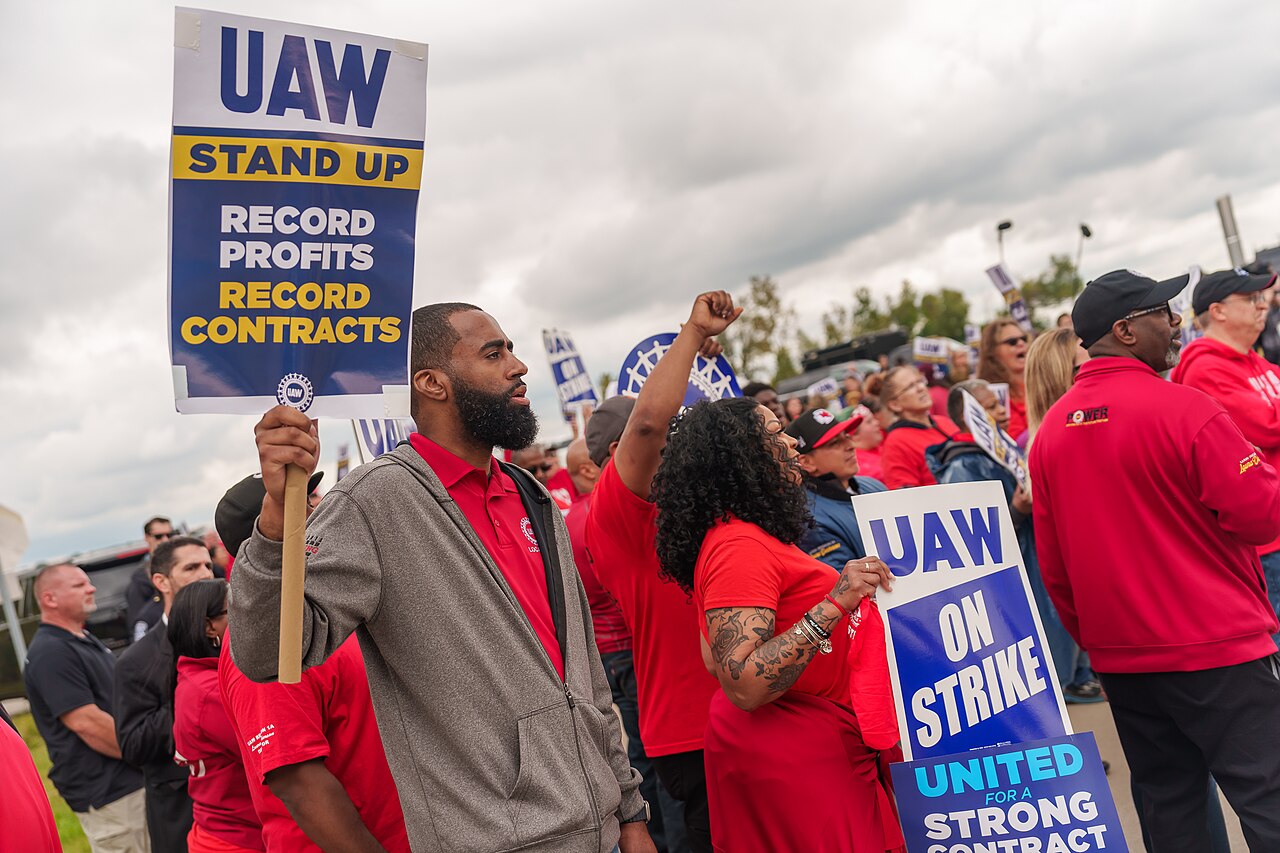
At an auto plant in Vance, Alabama, nineteen miles east of Tuscaloosa, workers at the Mercedes-Benz US International (MBUSI) plant make the Mercedes GLE, GLE coupé, and GLS model series as well as the all-electric EQS SUV and EQE. They’ve also started building something else: a union. On the heels of the United Auto Workers’ (UAW) victorious strike against the Big Three automakers last fall, the union has gone on the offensive, vowing to organize some 150,000 nonunion autoworkers at thirteen companies across the country.
The union has tried to organize some of these plants before — and failed. The South has proven an almost entirely impenetrable citadel for the entirety of modern US labor history. Yet the UAW is heeding these workers’ calls, directing its focus and $40 million in extra resources to try again, and on a far larger scale.
The UAW has failed before, but now, the context has changed: members’ success at the Big Three has ignited a sense of possibility in their nonunion counterparts, and the union’s new leadership, determined to cast off the corruption of old and trust in the power of the membership and the desire to organize across the entire working class, is encouraging precisely such ambitious thinking. If workers were ever going to pull this one off, now is the time.
The first shop where a majority of workers signed union-authorization cards was Volkswagen’s plant in Chattanooga, Tennessee, which employs some 5,500 workers and was the site of previous failed UAW campaigns. On February 27, MBUSI’s workers announced that they were the second plant to reach that milestone, with a majority of the shop’s roughly six thousand employees having signed union cards. (Workers at Hynduai’s plant in Montgomery, Alabama, have also gone public with a UAW campaign, announcing last month that 30 percent of the plant’s four thousand workers have signed union cards.)
“There comes a time when enough is enough,” said MBUSI worker Jeremy Kimbrell while announcing the news. “Now is that time. We know what the company, what the politicians, and what their multimillionaire buddies will say. They’ll say now is not the right time. Or that this is not the right way. But here’s the thing. This is our decision. It’s our life. It’s our community. These are our families. It’s up to us.”
“Enough is enough”: Michelle Eisen, a Starbucks barista whose store in Buffalo, New York kicked off a nationwide organizing drive, said the same words to me while discussing her union’s breakthrough in forcing the multibillion-dollar corporation to the bargaining table last week. Against the ropes after decades of stagnant wages, rising health care costs, and a pandemic that heightened the stakes of employer carelessness, it’s a slogan of sorts for the workers who have decided to fight back. If ever there were a time that a fighting union like the UAW could break through in the anti-union South, it’s now.
Union-Busting Reaction
The opponents Kimbrell referred to have wasted no time in trying to defeat the union. Alabama, as is the case for much of the anti-union “right-to-work” South, operates as a zone of low-wage labor. UAW locals sprouting inside their jurisdiction threaten that status quo, so the state’s business and political elite are mobilizing to defend it.
On Thursday, MBUSI leadership tried a novel approach, bringing in University of Alabama football coach Nick Saban to speak to workers at what the company described as an all-team member meeting to honor the newly retired coach. Mercedes is a partner of the Saban Center, a STEM and performing-arts center that is centered around a charity run by the famed coach, and Saban owns several Mercedes car dealerships himself, giving him plenty of reason to assist the company in defeating the organizing effort. The move sparked fears of a repeat of 2019, when Volkswagen had Tennessee governor Bill Lee speak directly to the workers in a mandatory meeting at the company’s Chattanooga plant during a prior UAW organizing drive.
But Saban has also supported college athletes unionizing, stating that he has “no problem” with it. “Make it like the NFL,” Saban has said. In another conversation, the coach pointed to the UAW itself as evidence that unionization should be no cause for alarm: “It never scares me that people are organized. I think there’s some good in that. General Motors and the automotive industries had unions for a long time, and they survived fairly well.”
In a recording of the meeting obtained by Jacobin, Saban did not directly address the organizing drive — it’s unclear if he was even aware of it — and the event felt like a retirement party and pep rally. Perhaps most relevant to the Mercedes workers’ union drive, he stated that workers should think about “all the things that we have and not the things we don’t have. Just say to yourself: I’m glad to be here.” It all added up to an odd scene, and one wonders if Mercedes had wanted Saban to make more explicitly anti-union comments (I tried to contact Saban to find out, but as one veteran sports reporter told me, “That’s like trying to get an audience with the Pope.”)
Enlisting Saban to vaguely union bust may be unusual, but Mercedes has also carried out a more traditional anti-union campaign. Despite the company’s Principles of Social Responsibilities and Human Rights stating, “In the event of organization campaigns, the company and its executives shall remain neutral,” MBUSI held a captive-audience meeting at the plant on February 23 to argue against unionization. In another recording obtained by Jacobin, MBUSI CEO Michael Göbel can be heard telling employees, “I don’t believe the UAW can help us to be better.”
Göbel took particular issue with a UAW video from December 2023 that helped launch the ambitious new organizing drive. The video opens with autoworkers, including Mercedes’s Kimbrell, holding their hands up to the camera, stating, “These hands punch the clock. These hands work the lines. These hands build the cars, and every dollar in profit these companies make is made by these hands.” The video is powerful — and clearly struck a nerve with executives.
“I believe that the UAW’s slogan ‘Our hands build the cars’ is not a message which is strong enough,” Göbel said, “because I think it takes everyone: the folks in material handling who are delivering the parts, the folks in maintenance who make sure the equipment is running, payroll specialists in HR who make sure that we get the bonus payout on time, but also an engineer who’s working for the new car-line integration, our guys in finance who make sure we have enough money in our bank account to get the parts.”
Göbel also rehearsed standard anti-union talking points, expressing outrage that workers would pay dues or “have to go through strikes.” But autoworkers just saw in the Big Three strike that rather than an imposition, strikes are a way for them to win big, and quickly. It’s hard to imagine Göbel’s message landing the way it might have in the past.
“It’s not the defense that is winning a game or the offense. It’s always every function that is important, and we are only successful if we work all together.” Göbel said. “Folks, specifically in an election year, it is really important that we are respectful of different viewpoints and that we are not letting society or this team be divided.”
The CEO’s words don’t sound particularly threatening, but it’s the format of a captive-audience meeting itself that constitutes intimidation. These meetings are coercive, a means of making workers listen to their employer’s propaganda and promises while the pro-union among them are barred from airing their perspectives. Meanwhile, union organizers are not allowed on company property and have no right to equal time with workers — not to mention that the UAW has no power to, say, punish or fire autoworkers should they vote against the union. That’s why National Labor Relations Board (NLRB) general counsel Jennifer Abruzzo is seeking to ban such meetings, finding that they “inherently involve an unlawful threat that employees will be disciplined or suffer other reprisals if they exercise their protected right not to listen to such speech.” The boss doesn’t have to make a threat to get the point across, which is that the person who controls your employment doesn’t want you to have anything to do with the union.
The union-busting campaign isn’t confined to Mercedes management. Shortly after the organizing drives at MBUSI and Hyundai went public, Alabama governor Kay Ivey wrote an op-ed vowing to resist the union campaigns. Speaking to Montgomery’s Chamber of Commerce last week, she continued her fulminations, characterizing the worker organizing as a “threat from Detroit.” And the governor isn’t the only one waging war on Alabama’s workers: in January, Alabama Department of Commerce secretary Ellen McNnair said that if the union wins, the “days of Alabama being a premier destination for industry investment may be coming to an end.” The Business Council of Alabama (BCA), the state’s chamber of commerce, has launched a full-court press against the union.
“If [the UAW] are successful, Alabama, and states like ours, could soon see their automotive industry quickly recede like a falling tide,” BCA president Helena Duncan wrote in an op-ed headlined “Unions mustn’t do to Alabama what they did to Detroit.” She went on to claim that “Alabama’s automotive companies already offer generous salary and benefits packages across the board,” adding strangely that, “Giving the UAW a toehold within the state is the same as dumping a large and toxic dose of castor oil into a delightfully delicious economic development recipe.”
Alabama Strong, a website set up by the BCA, offers familiar anti-union talking points and suggests “ways all of us can take a stand and discourage the UAW from making our state its main battlefield.” Members of the BCA’s 2024 Board of Directors includes Mercedes-Benz’s Steven Nichols; Toyota Motor Manufacturing, Alabama’s Jason Puckett; and Honda Manufacturing of Alabama’s Allen Cope.
This has all happened before. When the union tried to organize the Volkswagen plant in Chattanooga in 2019, the employer ran a vicious anti-union campaign, with the CEO and plant supervisors insinuating that the union was to blame for Volkswagen plant closures and outside groups springing up to carry the union-busting campaign beyond the factory walls. In addition to the governor’s visit to a mandatory meeting, workers at the shop received messages from the “Center for VW Facts” warning against unionization. Local business interests funded “Southern Momentum,” which published videos of anti-union Volkswagen workers. Donald Trump’s NLRB, too, was central in the 2019 loss, delaying the vote at the company’s request, a reprieve Volkswagen used to continue spreading fear and confusion among workers.
Those in power understand that a strong labor movement in their jurisdiction wouldn’t just mean that employers would have to pay workers better wages and benefits. It would also be hostile to Republican power. That’s why they pour money and resources into campaigns to try to stop workers from winning even a modicum of power.
If Alabama’s local ruling class is all-in on trying to stop autoworkers from exercising their right to unionize, so are national anti-worker organizations. The Center for Union Facts, a misleadingly named anti-union outfit with a long history of targeting the UAW (among other unions) is unrolling a national blitz. According to Bloomberg, that plan includes placing “billboards in cities including Chattanooga advertising a website that criticizes the union’s political stances, contracts, and past corruption scandals.”
The website for the National Right to Work Legal Defense Foundation, another key player in the decades-long assault on workers, currently displays a “Special Notice for Volkswagen Group of America Chattanooga Plant Employees,” which in addition to standard anti-union talking points, invites Volkswagen workers to contact the foundation for free legal advice.
The avalanche of anti-union propaganda is no joke, but it’s also to be expected. The capitalist class has exploited workers in the South since the country’s founding. The National Labor Relations Act (NLRA) doesn’t cover agricultural and domestic workers because Robert Wagner, the bill’s author, offered those carve-outs to secure support from southern politicians who wanted to maintain control of their region’s formerly enslaved workforce. Manufacturers have built up their operations in southern states in recent years because while the typical southern worker is no longer in agriculture, labor still comes cheap as a result of most unions’ inability to break through in the region.
It will be hard for the UAW to overcome the offensive by business leaders and elected officials, but a campaign grounded in the plant and buttressed by coalition-building with the community, unabashed about the justice of its cause, might be able to do so.
Standing Their Ground
“Ithink people are proud that they’re standing their ground against a big powerful company,” Jeremy Kimbrell told me when I reached him by phone on Thursday. He was speaking to me from the UAW office in Coaling, a few miles west of the Mercedes plant. The office, next to a smoke shop in a strip mall by US-11, a stone’s throw from several dollar stores, is an unassuming site for such an audacious campaign.
Kimbrell and his fellow pro-union workers had handed out 1,800 UAW hats to the plant’s workers over the prior forty-eight hours, outfitting them to show their support for the union even in captive-audience meetings. Earlier on Friday, Kimbrell had gone down the lines inside the plant to hand out hats, and he came across an encouraging sign: some of his young coworkers were wearing the hats while working on the line.
“Man, it just made me proud,” Kimbrell said. “I haven’t seen anything like this before in my time out here.”
Young people are a crucial group for the campaign. In Alabama, very few young workers have ever been in a union, and their lack of familiarity with organized labor can prove a major stumbling block. While young people across the United States are particularly pro-union, their generational remove from the movement in the Deep South was a central factor in why workers voted against unionizing with the Retail, Wholesale and Department Store Union (RWDSU) at an Amazon fulfillment center in Bessemer, just twenty-five miles up the road from MBUSI.
As to why young workers at Mercedes are supporting the organizing effort, the company’s implementation of two-tier pay may be the most important factor. Tiered pay, in which more newly hired workers’ wages top out at a significantly lower wage than their more senior colleagues, was a major complaint among UAW members who struck the Big Three automakers last year. They agreed to the introduction of tiers and an expanded temp workforce during the Great Recession, as the Detroit automakers were in dire straits. But at MBUSI, there are no such arguments for the introduction of a lower-paid and less secure workforce: according to the union, Mercedes’s profits have increased by 200 percent over the past three years, and last year, the company spent $1.9 billion on stock buybacks.
“Mercedes never hurt [economically], yet in 2020, they decided, you know what, I think we’re going to try that two-tier pay,” Kimbrell explained. “If you’re hired under that change, you look around and see other people here who top out make $5 an hour more than me, and we do the same job and work for the same place.”
Kimbrell said that inequality laid the foundation for the organizing. When speaking with his younger coworkers, he draws on stories from his long tenure at MBUSI to make the case for organization: the Vance shop was the first auto plant in Alabama, making its first car in 1997, and he’s been at the plant for twenty-four years.
Reap What You Sow
“We had the Great Recession, and the company decided to cut jobs, so they got rid of the workers and wouldn’t let them come back,” Kimbrell said. “You had no recall rights; they just kicked you to the curb and replaced you with temps.” Some temporary workers spent eight years at the plant without being offered full-time jobs. During the same time period, according to Kimbrell, MBUSI only granted workers a 42-cents-an-hour raise, despite making record profits. Rising health insurance rates and co-pays, too, have aggravated the MBUSI workers.
“Mercedes is our best organizer,” Kimbrell said. “They did it to themselves.”
When I asked him about Governor Ivey and the BCA’s claims that the campaign is the work of outsiders, he noted that he was at the union hall as we spoke, and there were no staff organizers from the UAW there.
“So who’s the outsider?” he joked. “I communicate with my workers, and we do our work inside the plant. I text with them and do emails, we’ve done a few Zooms, and we just talk about strategy and plans for the next step. Of course if I need a flier printed, the UAW prints it for me.”
His assertion that the campaign is especially worker-led isn’t an exaggeration. Previous UAW campaigns to try to organize southern auto plants involved more staff organizers, and they failed. The union, led by newly elected reformers, is trying a different approach, one that empowers workers to move quickly to organize among themselves while there is still momentum from members’ successful Big Three strike.
At MBUSI, a core group of some twenty union supporters like Kimbrell got the ball rolling. Rather than meticulously, slowly building a representative organizing committee, as organizers do in most union drives, the supporters focused on finding the “talkers” and those with jobs that provided them with mobility inside the plant, respected workers who could spread the word quickly. While organization with representatives from each department and each shift inside the plant is still a necessity, the workers made use of social media and the UAW’s momentum to flip the traditional order of operations, handing out union-authorization cards without wasting precious time.
The union busting from both company executives and outsiders like Governor Ivey is sure to accelerate once MBUSI workers file for an election with the NLRB. Such fearmongering and threats are aimed at eroding widespread support for a union. But if the workers could vote on unionization today, Kimbrell said the outcome would not be hard to predict.
“The mood inside the plant is that if we had an election today, Mercedes would lose at least three to one,” he said. “They would get their doors blown off.”
While Kimbrell is far from the only worker organizing inside the shop, a fact he is quick to point out in conversation, he has become its public face, the worker willing to be quoted in interviews and appear in union videos and on cross-company organizing calls. Seemingly all of his free time is spent organizing. Kimbrell, a lifelong Alabamian, has never been in a union before, though his father was in the United Mine Workers and his great-grandfather was union too, driving a coal truck.
When I asked him why he had committed to such an enormous task, he said that when his two sons were growing up, he’d devoted his time to attending their games and fishing with them. He’d worked a lot of overtime at the plant in the repair department so he could buy them their own cars. But now, they’re in their early twenties, and he has moved to a less time-consuming position at MBUSI — a change he attributes to the lessons of the pandemic, which “taught people that there’s more to life and work.”
As Coach Saban told Mercedes workers last week, “You reap what you sow, and there can be no great victories without overcoming adversity.” The company may have hoped bringing Saban in would spur pro-company sentiment among the attendees, but his talk of overcoming enormous odds brings to mind what Kimbrell and his fellow workers will have done should they unionize MBUSI. As Saban put it on Friday, “Leadership is about helping someone else for their benefit” and being “someone that somebody can depend on.” You’d be forgiven if you thought he was describing what makes a good union organizer.
ZNetwork is funded solely through the generosity of its readers.
Donate

