
I am frustrated. I’ve written an article, and I know it’s good because the editors who rejected it actually loved it. They were ready to publish — if only the future I described had already arrived.
This is the “Speculative Trap”: the institutional gatekeeping that prevents an idea from becoming reality by refusing to let us talk about it first. We are witnessing a strange, paralyzing caution. We want to solve global crises, but please, let’s not use any methods that challenge our comfort zones.
Why was this article ghosted or dismissed as ‘too speculative’ — along with a litany of other ‘toos’— that managed to contradict each other at every turn? Because I suggested solving these crises by involving the very actors we usually demonize. Because Systemic Thinking is messy; it refuses to stay in its lane. It is too technical for the theorists and too political for the engineers. It is inconvenient for everyone because it demands we look at the whole picture.
So, what is this idea that is apparently too much for the modern editorial mind?
The Concept: A No-Tech-Talk Overview
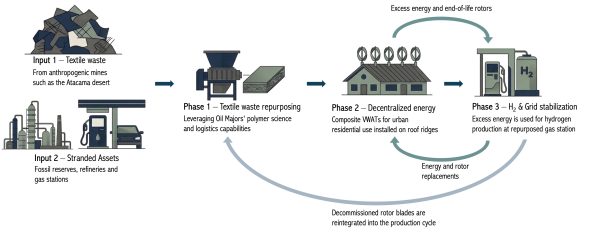
In the Atacama Desert, there is a literal mountain of “Fast Fashion” waste. It’s a monument to our failure. My suggestion? We treat that mountain as what it is: a massive, human-made mine of “frozen oil.”
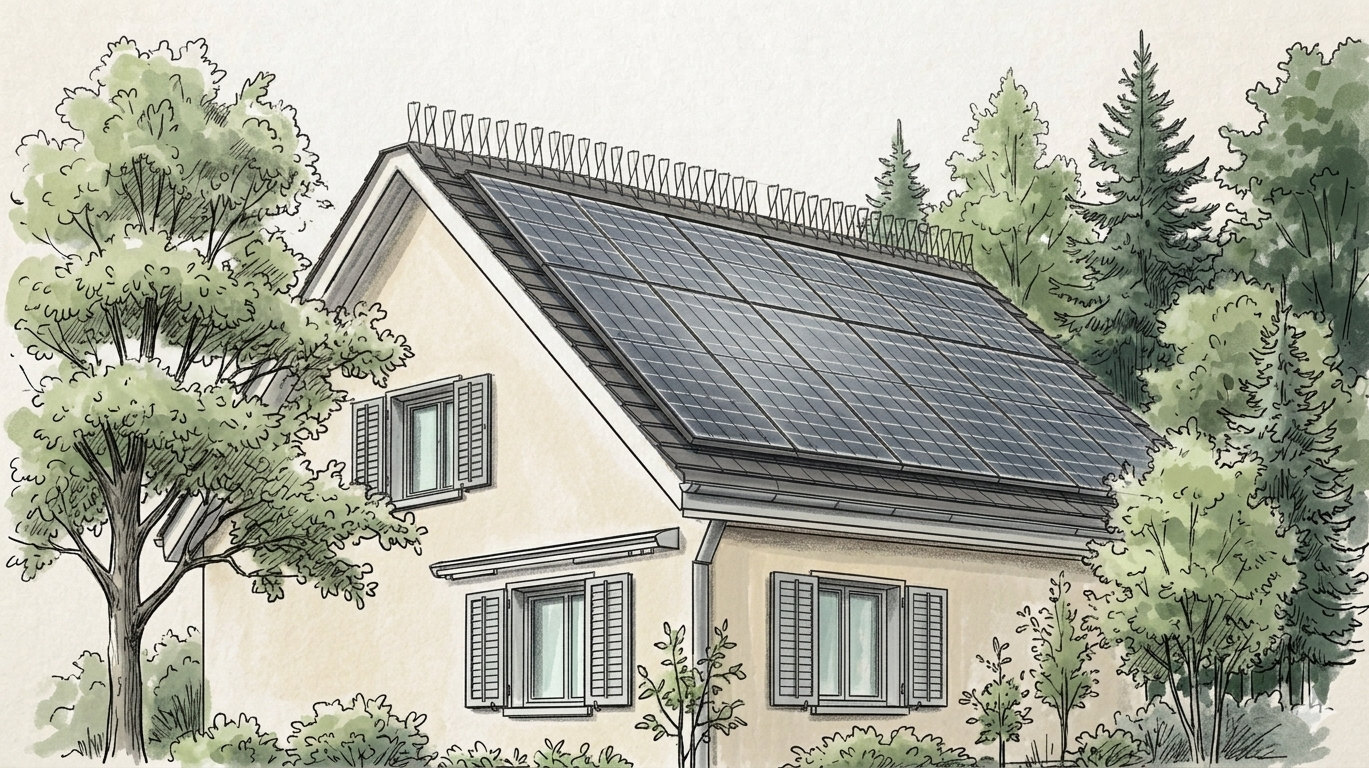
We take those clothes, give them a rough clean, sort them, and process them back into fibers. We then cast these fibers into biopolymer composites to create wind turbines. Not those gargantuan, bird-slicing propellers, but vertical units — about 30 cm high. You can fit a whole row of them on a single roof ridge, right where solar panels usually can’t go.
This setup distributed across many roofs could generate a massive amount of electricity. And crucially, it works at night while our solar panels are “sleeping.” A single roof ridge could power a household’s refrigerators. Imagine what many roofs could power together. That’s not nothing. And best of all? We don’t need to destroy more nature; the roofs are already there.
But what do we do when it’s stormy and the August sun is blasting, and we have too much power? We send it to the local, converted gas station to produce hydrogen. Sure, you lose energy in the conversion. But this is about grid stabilization and making use of “free” wind. You can tank the hydrogen or store it to turn it back into power later. Even if this exact configuration never materializes, the point is the recombination of existing capacities — waste as resource, rooftops as infrastructure, and surplus as opportunity rather than loss.
The “Villains” in the Room
Who should build this? My favorite candidate: The Oil Industry.
Not as saviors, but as regulated actors under strict public oversight — compelled to repair part of the damage they helped create. It is easy to demonize them, but it is also hypocritical if we aren’t prepared to discard everything in our lives that contains petroleum. Instead of a messy divorce, I am proposing a forced evolution. Think about it. They are experts in mining (and the Atacama pile is a giant anthropogenic mine). They are experts in the polymers needed for the turbines. They have the money, the infrastructure, and guess what? They already own the gas stations. We don’t have the time to build a new global industry from scratch while the old one rots. We need to pivot their existing power.
The technology for all of this exists or is currently in testing. What’s missing isn’t the science; it’s the willingness to start repurposing. Of course, there will be technical hurdles. Of course, it’s not a “silver bullet” — there’s no such thing. But it is a start. And even if the concept isn’t implemented exactly like this, it might inspire someone to tweak it, improve it, and bring something even better into the world.
The textile industry is more than welcome to join as a sponsor. “Polluter Pays” should mean something. They can hand their textile scraps from their factories in Asia directly to the people building the turbines instead of letting them rot further in a landfill.
The Courage to be “Speculative”
This is what it comes down to. Ideas like this fail because of gatekeepers. They fail because of a lack of visibility. They fail because magazines are stuck in the “we’ve always done it this way” mindset. If we limit ourselves to solutions that are already fully validated, we effectively outsource the future to those who benefit from the present.
If we want to clean up our mess, save the climate, and stop our oceans from becoming plastic soup, we need the courage to walk new paths. We need to try the unusual. We need to involve the actors who currently — rightfully — have a terrible reputation.
If anyone is interested in a more technical deep dive – the polymer chemistry, the technical framework, the pilot economics – I’m happy to share those materials separately. Feel free to reach out. Because if we wait for the “perfectly safe” idea, we’re just waiting for the end.
ZNetwork is funded solely through the generosity of its readers.
Donate

