
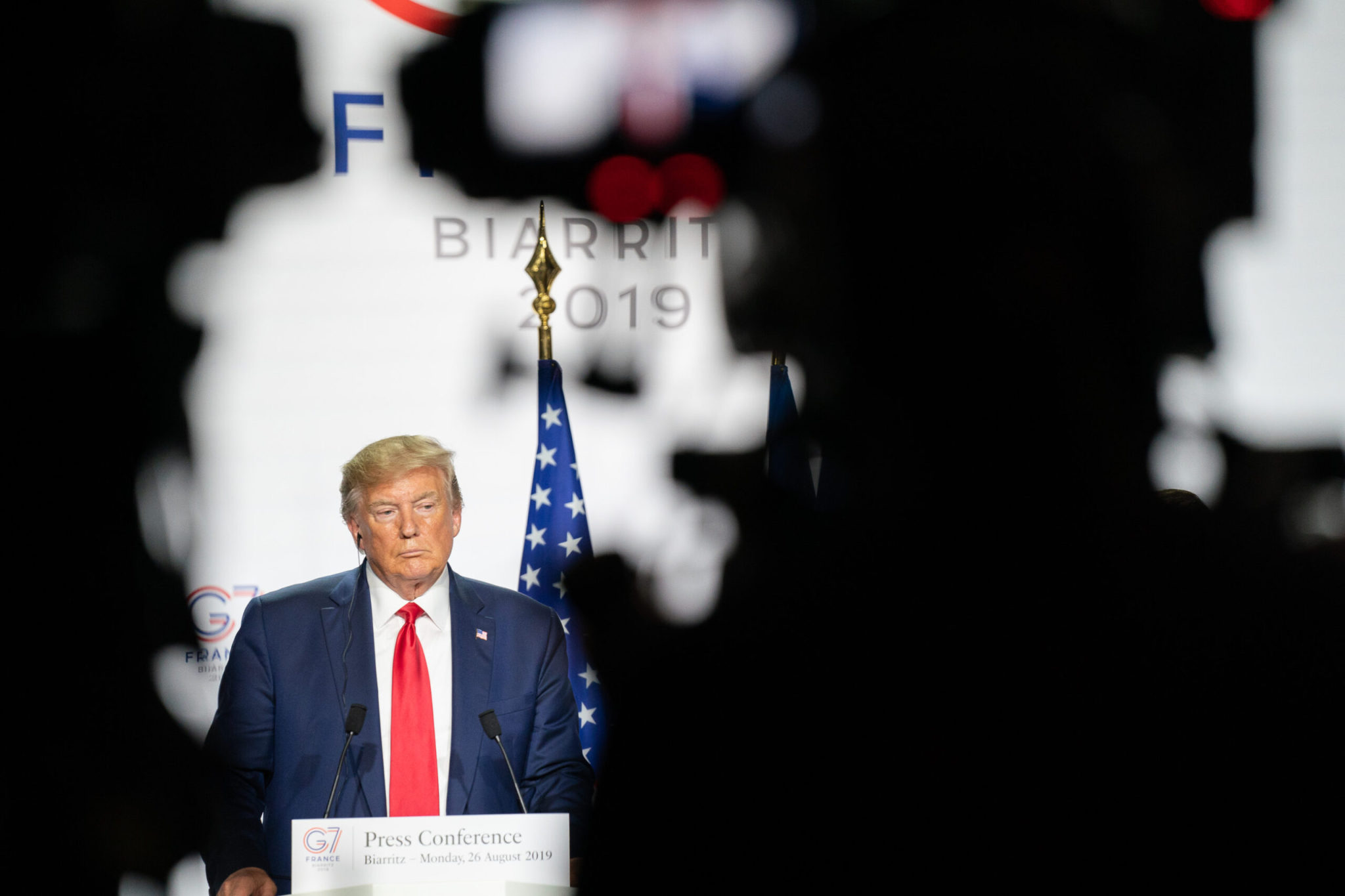
When the executive branch summarily stripped MS NOW, CNN, and Politico of their White House journalistic credentials, it enacted far more than a bureaucratic adjustment. It launched a direct assault on the institutional free press, transforming democratic infrastructure into a closed theater of unilateral power. This unprecedented purge stands in stark, dangerous opposition to the foundational framework established by Justice William J. Brennan Jr. in the landmark 1964 case New York Times Co. v. Sullivan, which guaranteed that debate on public issues must be “uninhibited, robust, and wide-open.” By replacing Brennan’s vision of “vehement, caustic, and unpleasantly sharp attacks” with declarations of “FAKE NEWS,” the current administration seeks to insulate itself entirely from critical inspection, forcing the First Amendment to face its sharpest modern structural test. In a rare, historic show of solidarity against this purge, the five major television networks—ABC, CBS, NBC, CNN, and Fox News—unanimously suspended all White House TV pool coverage today, leaving the lenses empty and refusing to broadcast executive actions until constitutional access is restored. This unprecedented friction serves as a vivid reminder that power to the press is fundamentally power to the First Amendment; when major established institutions clash in defense of structural checks and balances, the ultimate benefits trickle down to protect the liberties of common people.But what is this structural overreach really about? Is it merely another volatile wrinkle from geopolitical tensions in the Strait of Hormuz, causing oil prices to spike and everyday life to harden for Americans just as upcoming mid-term elections approach in November? Even without external macroeconomic shocks, the domestic ink is not yet dry from the shootings of Renee Good, an innocent housewife, and Alex Pretti, an ICU nurse, nor from the subsequent casualties, Lorenzo Salgado of Houston, Johan Sebastian of Maine, and this week, Wilber Rafael Garces Perez, shot once in the torso by a federal Immigration and Customs Enforcement (ICE) agent on the streets of North Austin. A U.S. citizen in suburban Chicago was left with injuries to his head, neck and teeth after he was mistakenly detained by federal immigration agents over the weekend. Aren’t the people exhausted by this? Yes. They have taken to the streets again and again, refusing to be silenced even in the freezing cold. This is about vulnerable people from affected communities standing up and saying “no” to stop the echelons of power sitting comfortably on high pedestals, weaponizing the law and government machinery. They ask: where is the rule of law and the First Amendment when ICE clamps down on them, or when the White House purges adversarial journalists to insulate itself from critical inspection? In a profound structural irony, the executive branch imposes these restrictions at the exact moment the nation celebrates the 250th anniversary of the founding of America and its grand Declaration of Independence.Defiance and protest are celebrated as the high-minded mantras of Dr. Martin Luther King Jr. Yet, these rebellious movements are systemic and universally manifest throughout our history, deeply woven into the American fabric through the civil rights movement, the Vietnam War protests, and the Black Lives Matter movement. Nor are they alien to this soil, as proven by historical rebels like Washington, Hamilton, Jefferson, and Adams. Once categorized as dangerous, treasonous traitors under the strict mechanics of British colonial law, they were instantly retrofitted into celebrated patriots the moment their revolution succeeded. Civil disobedience and the First Amendment are the true, original lifeblood of American society. I analyzed this exact structural friction in a 1990 legal treatise, quoting Henry David Thoreau and Thomas Aquinas while dissecting the precise legal loopholes regarding the “doubtfulness of law” posited by legal philosopher Ronald Dworkin.If institutional dissent is not protected by the First Amendment, how can a democracy survive and its constitution stay stable? Once the state isolates the press corps—relying on procedural pretexts reminiscent of the Acosta and Associated Press litigations—it leaves citizens with no choice but to absorb the shock of governance through direct friction. The administration’s brief, hours-long defiance of Judge Kelly’s temporary restraining order at the White House gates—which forced the media back to court before the executive branch ultimately retreated—evokes the ultimate constitutional ghost of Marbury v. Madison, which successfully established the principle of judicial review—the power of the Court to declare acts of Congress as well as executive orders unconstitutional. Yet, even as physical hard passes are restored under judicial duress, the executive branch immediately pivots to a dangerous new procedural loophole: utilizing arbitrary “guest list restrictions” to explicitly deny the three reinstated networks admission to cover the high-profile state dinner for Chinese President Xi Jinping. This calculated evasion proves that the First Amendment functions not as an abstract ideal, but as an active, mechanical “shock absorber” that must continuously handle direct executive manipulation as the constitutional battleground shifts from the security gates to exclusive event perimeters.Unilateral executive declarations are never carved in stone, despite what conservative judicial majorities prefer. When an administrative regime is fully weaponized to blindfold the institutional press, the First Amendment functions as the essential, mechanical shock absorber that keeps the entire social contract from shattering into pieces. Walking through Harlem, I recently heard a young child shouting a single word: “Freeeeeedom!” That exact cry still resonates across Gaza, Minneapolis, Houston, Maine, and every backstreet of this country including the halls of news media now. The First Amendment must absorb this cry and protect the vital infrastructure of dissent. If it doesn’t, the entire Constitution will crumble.Voltaire, attacking state-sponsored censorship in his Philosophical Dictionary (1764), observed: “There are books which are tedious, but I know of none which have done any real harm… Is it then with books as with fire-arms, which we must not use without a permission? … Suppress them, and you suppress the human mind.” When a government bars journalists and confiscates hard passes, it attempts to suppress the human mind. The shock absorbers of democracy must hold.
ZNetwork is funded solely through the generosity of its readers.
Donate