
Americans have tolerated much from Donald Trump. But for many, the leaked 2005 video in which he is heard bragging that “when you’re a star, you can do anything” to women—including “grab ’em by the pussy”—was a bridge too far.
The comment set off a collective gag across social media. Some women were so horrified that they tweeted stories of their first sexual assaults late into the evening. As the video hit the internet Friday, The New York Times started a running tally of Republicans defecting from his campaign. As my colleague David Graham wrote, women and Independent voters in particular have bailed on him.
But many Trump voters—38 percent, according to the latest Politico/Morning Consult poll—are refusing to abandon Trump. That choice raises a few questions: What exactly do they see in him that can sustain their loyalty? And how can they stomach what he’s said?
For some voters, Trump’s boasting about sexual assault doesn’t mean he’s unfit to run the country. And for the men among them, what Trump’s candidacy offers seems more important than his comments 11 years ago.
Many men, in fact, see Trump as the candidate who can restore men’s status in society. According to several recent analyses, about half of men feel American culture has become too soft and feminine, and they feel men are suffering as a result. Many seem to find comfort in Trump’s talk of male dominance and success.
Trump supporters are more likely than Clinton supporters to feel that society punishes men just for acting like men, while Clinton supporters are far more likely to “completely disagree” with that statement, according to an analysis of likely voters in a poll conducted by PRRI and The Atlantic between October 5 and October 9.
Those who identified as Republicans or conservatives were also more likely than Democrats or liberals to agree with that statement.
Not all the men surveyed could stand by Trump after his hot-mic comments on women, which were made public as pollsters were still collecting their data. Wiley, a 60-year-old in Hurst, Texas, liked Trump’s stance on jobs and immigration. But the Access Hollywood video was too much for him—and he now plans not to cast a vote for president. “His mouth, the cussing, the vulgarity,” he said. “My father’s a preacher, and we just have a very strong faith, so it’s not something we can live with.”
Meanwhile, 65-year-old Ed in Summit, Wisconsin, still plans to vote for Trump. “It was inappropriate and unprofessional,” he said, referring to the Republican nominee’s remarks on women. But, “having been in a number of locker rooms in my years … there’s always somebody in there that’s trying to be more macho than the guy next to him. Ms. Clinton couldn’t control her husband in the past. How is she going to control the country?”
In the PRRI/The Atlantic survey, education level and gender played a role in whether respondents felt men are punished unfairly by society. Men—and less-educated men in particular— were more likely than women to agree. Among Americans with a high-school degree or less, 25 percent “completely agreed” that men are punished just for being themselves.
The education gap seems even more striking when pollsters asked people if they think “society as a whole has become too soft and feminine.” White, working-class Americans—a crucial part of Trump’s base—were more likely to agree with that statement than white, college-educated respondents were.
Overall, half of men agreed with that assertion, compared with 32 percent of women. Republicans, conservatives, and Trump supporters were also far more likely than liberals, Democrats, or Clinton supporters to say society is becoming soft.
The PRRI/The Atlantic results—gleaned from 1,327 U.S. adults reached by cell and landline phone—mirror other recent analyses of the impact of male anxiety on support for Trump. In an August Pew poll, a slight minority—45 percent—of all respondents believed that the obstacles that made it hard for women to get ahead are largely gone. But among Republicans who felt that way, support for Trump was overwhelming, at 91 percent.
Meanwhile, an analysis published in the Harvard Business Review by Dan Cassino, a political science professor at Fairleigh Dickinson University, showed that Republican men increasingly feel discriminated against. According to the American National Election Study, nine percent of Republican men said men faced “a great deal” or “a lot” of discrimination in 2012, but that figure rose to 18 percent in 2016, Cassino points out:
If we add in those men who say that men face “a moderate amount” of discrimination, 41 percent of Republican men now say that men are being discriminated against.
According to Cassino, the more independent and Republican men support Trump, the more likely they are to feel discriminated against. And the more marginalized they feel, the more negatively they view Hillary Clinton:
Perceptions of Discrimination and View of Hillary Clinton
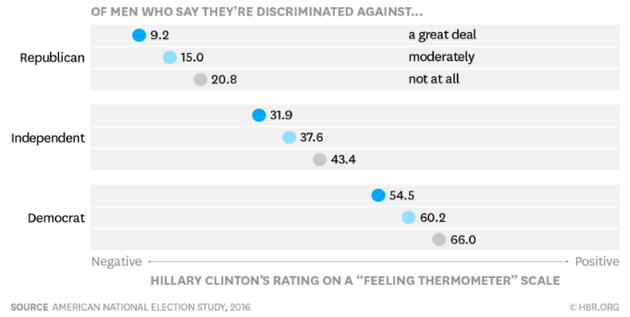
“Men used to run everything,” Cassino told me. “And now they don’t, and Hillary Clinton is the apotheosis of these fears.”
The problem, Cassino writes, is that many men see social gains as zero-sum. Women have notched progress toward equality in the workplace, parenting, and other domains in recent decades, and men see these advances as coming at their expense. “Men who perceive discrimination against men are more likely to oppose mandatory employer coverage of contraception and parental-leave laws,” he writes. It doesn’t matter that free birth-control pills won’t affect men—other than positively, if they don’t want children.
“There’s this tendency as social change takes place — you see it with whites, too — the privileged group says, ‘We’re the ones being discriminated against,’” Peter Glick, a social sciences professor at Lawrence University, told The Washington Post. “Any policies that favor minority groups or women, there’s backlash: ‘They’re getting special breaks, and we’re getting screwed over.’”
In a separate study, Cassino found that even asking men whether they made “more, less, or about the same as their spouses” before asking them about the election increased their support for Trump—even among those who earned more than their wives. The question simply primed them to think about how good women supposedly have it. As Cassino explains, again in the Harvard Business Review:
Men who weren’t asked about spousal income until late in the survey preferred Hillary Clinton over Donald Trump in a hypothetical general election matchup by a 16-point margin; men who were asked about spousal income only a few questions before being asked about the Clinton-Trump matchup preferred Trump by an eight-point margin—a 24-point shift in preferences.
Men who fear the rise of women can bask in the reflected glory of Trump’s testosterone-revved, macho persona. Even prior to Friday’s leaked video, he has repeatedly made statements praising traditional gender divisions, such as saying the extent of his parenting would be “supplying funds.” Trump hearkens back to a time when men were on top. Clinton-supporting women see that nostalgia as a threat. But to many Trump-supporting men, his rhetoric is a promise of status restored.
ZNetwork is funded solely through the generosity of its readers.
Donate