

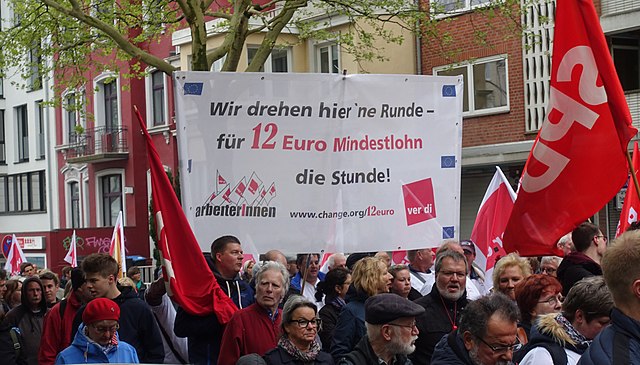
Very unfortunately for the apostles of capitalism, capitalism needs workers: no workers: no capitalism. Worse, these workers also need wages, which, in turn, reduces the profits of capital. For capitalism, workers are a costly affair.
Ever since the rise of capitalism, the question of how much workers should be paid has been entangled with the ideological writings of Thomas Malthus (1766–1834).
The ideology of Malthusianism postulates that the number of workers grows exponentially, while the food supply increases only linearly.
This mismatch, Malthus argued, would lead to a decline in living standards, eventually triggering a population collapse. He called it the “Malthusian catastrophe“: when the number of workers outpaces agricultural production, starvation, famine, and war will inevitably follow. It never happened.
Mass poverty and inequality will increase as asset prices and scarce resources skyrocket due to fierce competition. Societal collapse – the proverbial end of capitalism – becomes a possible outcome.
To prevent this, workers should be given just enough wages to sustain themselves and reproduce – but no more.
This ideology tells capitalists that a living wage is needed, but only barely. It is the minimum income required for workers to meet their basic needs – similar to a subsistence wage, a biological minimum based on food, housing, and other essentials like clothing.
The goal of a living wage is to allow a worker to afford a basic but decent standard of living through employment – without relying on government subsidies.
This system functioned until capitalism mutated into consumer capitalism. Now, capitalism needs workers not only to work but also to consume massive amounts of senseless, unwarranted, and unnecessary goods to keep the engine running. Initiatives like “Buy Nothing Day” are disastrous for consumer capitalism.
In line with the “let’s cushion capitalism” logic, even the International Labour Organization (ILO) supports the concept of a living wage – defined as the amount needed to ensure a decent standard of living for workers.
Closely linked to this is the minimum wage, which is often regulated by law. The aim is simple: to prevent companies from hiring workers for less than a legal minimum hourly, daily, or monthly wage.
To secure even the bare minimum, over 90% of all countries have adopted some form of minimum wage legislation. Germany is no exception.
Germany’s minimum wage law – the MiLoG (Mindestlohngesetz) – came into effect on 1 January 2015 – relatively late by international standards.
Interestingly, it was a small country at the edge of the world – New Zealand – that introduced the world’s first minimum wage law, in 1894.
That Germany needed a legal minimum wage at all was hardly a triumph for German labor relations or its much-praised ideology of “social partnership.”
Since the post-war years, collective agreements between German trade unions and employers had formed the backbone of the country’s economic system.
Through these agreements, most workers received decent wages, gradually enjoyed more time off, improved protection from dismissal, and in some cases even gained access to company pension schemes.
Until the advent of neoliberalism, these agreements gave workers a – perhaps even a fair – share of corporate success. But neoliberalism severed the link between productivity and wages – even in Germany. Productivity rose, wages stagnated.
By the 1980s and early 1990s, collective bargaining and wage-productivity alignment began to fade – capitalism won while workers lost.
Perhaps the symbolic turning point in the triumph of capital over labor came in 2007, in East Germany, where Western neoliberal capitalism had decimated an entire industrial landscape, exposing previously shielded workers to the brutal logic of the free market.
In East Germany, even fewer workers were – and still are – covered by collective agreements. In 2007, even the pro-business newspaper Handelsblatt was forced to admit that East German workers were grossly underpaid.
The issue became impossible to ignore. The wake-up call was a woman known as Frau Hain, a hairdresser in the East German state of Thuringia.
She earned a pitiful wage of just €3.18 [$3.70] per hour. For example, she had to work more than an hour just to afford 250g of butter (€3.73). Her pay amounted to just 37% of Germany’s first legal minimum wage (€8.50).
But at least socialism was gone – and Frau Hain could now enjoy a capitalist wage theft of roughly 63%. Freedom under capitalism worked out great – if you didn’t mind earning a wage that couldn’t even cover a bit of butter. These are the wonders of capitalism.
Perhaps Christian-conservative Chancellor Helmut Kohl, rather than falsely promising “blooming landscapes,” and his successor, the even more Christian-conservative Angela Merkel, should have done a bit more to protect the most vulnerable in newly annexed East Germany.
The Frau Hain case sparked nationwide debate. Eventually, public outcry reached the Bundestag, Germany’s parliament, forcing Merkel’s government to act.
A full seven years after Frau Hain made headlines, Merkel’s government introduced Germany’s first nationwide minimum wage – €8.50 ($9.88) per hour – in 2014.
To avoid hitting German employers too hard – forcing them to pay not peanuts but a “handful” of peanuts – Merkel’s conservative government delayed implementation until 1 January 2017 – a full decade after Frau Hain’s scandal. It is not really a problem to live on a wage that is 63% below the minimum wage – thanks Frau Merkel.
Since then, the minimum wage has been updated every two years by a Minimum Wage Commission, with final approval by the government.
Today, studies show that a minimum of €16.60 ($19.30) per hour would be necessary for a halfway decent life. But wages should not be determined statistically, they should reflect what people actually need to live.
Nobel Prize winner David Card (2021) analyzed the effects of minimum wage increases. The results are clear: higher minimum wages do not lead to job losses.
Perhaps that explains why countries with high minimum wages perform better than those with low ones – think Mexico vs. France, or Guatemala vs. Spain.
In Germany, a wage just above €10 leaves many workers at risk of poverty. Roughly one in six workers earns less than two-thirds of the average hourly wage – defined as low wage.
Women in East Germany – like Frau Hain – are particularly affected. Still. Once pushed into the low-wage sector, escaping poverty becomes incredibly difficult. Workers are trapped – even in supposedly wealthy Germany.
About 14 million workers in Germany are considered at risk of poverty. Without additional – though steadily shrinking – welfare benefits, this figure would rise to a quarter of the population.
The consequences of neoliberal capitalism are plain to see: More than 800,000 employed people must supplement their income with state support, costing the government around €7 billion annually. Is this what capitalism calls self-reliance?
Alternatively, a sound economic policy could simply aim for good wages. This would ease pressure on Germany’s shrinking welfare state, as more workers could support themselves independently.
Reconnecting wages to productivity can ensure good jobs and solid contributions to the social security system. The distribution of the economic pie is not fixed. Germany’s minimum wage proves it.
After its introduction, it became increasingly clear that minimum wages are not job killers. Facts challenged the neoliberal myth. Even conservative economists now admit it. A recent study showed that a €16 minimum wage is perfectly feasible – without harming employment.
Good wages, moreover, are a yardstick for economic success – beyond the narrow lens of the labor market or neoliberal dogma.
Against neoliberal hegemony, rising wages drive productivity. Well-paid workers are more motivated. Time-saving corporate investments become more worthwhile.
Economists have known this for a long time. Yet good wages remain neglected in industrial policy. Employment is still vital – but Germany lacks a forward-looking strategy. Many sectors could afford to pay good wages in the future.
That’s why wages should become a benchmark for successful economic policy. When the economy is well-utilized, wages rise. When people are shielded from social decline and the labor market functions fairly, wages increase.
If Germany invests in future industries and good social infrastructure, wages will go up. So the question remains: What is a good wage?
Unfortunately, Germany’s wage policies still rely on arbitrary reference values – not on workers’ actual needs.
For example, the poverty line set at 60% of median income is used across Europe, including in the EU’s Minimum Wage Directive, as a benchmark for fair pay.
But even the EU acknowledged long ago – back in 1984 – that this reference doesn’t reflect real needs. This is where Germany’s idea of a “minimum quality of life wage” – the Lebensqualitätsminimum – the comes in.
In focus groups, people discuss what financial resources are needed in areas like housing, transport, and food to achieve a basic quality of life. This hybrid method combines statistical analysis with public participation. It’s not new.
International models like the UK’s Minimum Income Standard (since 2006), and similar models in Ireland and Portugal, show how it can be done.
These models emphasize participation – not just politics. The British Living Wage is one such example. Here, focus groups evaluate goods and services to create a step-by-step “shopping cart approach” – ensuring transparency and legitimacy.
Still, defining needs at the level of individual goods can be tricky. Preferences vary, and a truly universal benchmark is hard to pin down.
On the other hand, purely statistical approaches – like Germany’s subsistence minimum – remain detached from real-life needs and lack normative legitimacy.
The proposal here goes further: A quality of life minimum wage based on democratic focus groups and statistical surveys.
Instead of judging single items, people evaluate entire expense categories, considering their own spending and reaching consensus on a fair standard. This is democracy in action.
It also avoids overemphasizing individual preferences or creating unrealistic standards. Based on the UK’s model, Germany’s minimum hourly wage should be at least €16.60 ($18.60) – as a starting point for a wage that ensures a basic quality of life.
This amount would be necessary for a typical workweek to meet that minimum standard. In a pilot study, researchers found that people’s expectations often reflected a middle-class standard, and that sustainability was considered an essential part of a decent life.
New, regular provisions are necessary. Germany is in the middle of historic shifts – global warming, digitalization, demographics, geopolitical instability.
To strengthen social cohesion, Germany must ensure good wages – guided by a clear, democratic compass. A normative income standard, like the quality of life minimum wage, could be that compass.
ZNetwork is funded solely through the generosity of its readers.
Donate