
OAKLAND, Ca.—If the term “labor union” conjures up the image of older white guys stepping off the assembly line and into the bar, you might be confused by the scene in RoseAnn DeMoro’s office.
Four women, all dressed in red, sit in a semi-circle, moving in hyperdrive as they prepare for a strike they’ve just announced. Then there’s the radio ad that needs to be released on California’s Prop. 45, and banners to be chosen for the afternoon’s press conference.
“You can do it, you’re a Jill-of-all-trades,” DeMoro tells one woman, who is dispatched to prepare for a rally.
“I used Mom organizing,” another jokes, about her strategies of getting people to arrive on time.
This is the hub of one of the smallest, but most powerful unions in the country. Just 190,000 members strong, National Nurses United is growing while other unions across the country are shrinking. When the autoworkers were agreeing to have some members’ pay cut in half, the nurses fought Arnold Schwarzenegger on patient-to-staff ratios—and won. While public employee unions in states like Michigan and Wisconsin were getting decimated by laws restricting theircollective-bargaining rights, the nurses were pushing bills in the California legislature that eventually became law.
National Nurses United may be proof that unions are not all on their way out: Some are very much alive, although they may look a little bit different than they used to.
“Nurses United is among the most innovative and bold of U.S. unions,” said Harley Shaiken, a labor expert at Berkeley. “They’ve emerged as a powerful voice in defense of people who receive health care treatment.”
Last year, 14.5 million workers were members of unions, that’s about 11.3 percent of wage and salary workers, according to the Bureau of Labor Statistics. In 1983, by comparison, there were 17.7 million union workers, or about 20.1 percent of workers.
Yet the nurses have organized 20,000 new nurses in 50 new hospitals since 2009. Some of those new nurses are in right-to-work states such as Texas, where just 4.8 percent of workers are represented by unions. In California, 16.4 percent of workers are unionized.
“We are organizing Texas—and we’ll organize all of the United States,” DeMoro told me. “There’s no question in my mind, that’s a given. I say that with absolute certainty.”
NNU was formally created in 2009, but its origins go back further than that, to 1995, when the California Nursing Association, led by DeMoro, broke off from American Nursing Association. It wanted to more aggressively fight hospital management for better working conditions for nurses. The new union soon became a force in California politics, battling Arnold Schwarzenegger when he tried to block a law that would increase the numbers of nurses in hospitals, an effort he eventually dropped. The nurses outed former gubernatorial candidate Meg Whitman for hiring an undocumented maid, who contacted NNU for help after being fired. The union advocated for stimulus dollars and against Wall Street in the debt talks of 2010.
The California Nurses Association joined two other groups to form National Nurses United in 2009. DeMoro still leads the group from a building in downtown Oakland, right next to the regional headquarters of Kaiser Permanente, which the nurses have taken on with particular vitriol. Thousands of Kaiser nurses are planning to strike on November 12th to protest insufficient Ebola protection; Kaiser and NNU are in the middle of bitter contract negotiations.
On the day I visited DeMoro, we could hear faint chants of women’s voices outside in the sunny Oakland morning, coming from the direction of the Kaiser building.
“Did someone forget to tell me we were protesting?” DeMoro asks one of her staffers, who explains that the nurses, here for a press conference later in the day, just decided to wander over to Kaiser and march around for a bit.
It is perhaps not surprising that the nurses have done so well—after all, healthcare is a growing field. The recent Ebola epidemic has helped them gain even more traction: Nurses at Texas Presbyterian, who are not unionized,contacted NNU out of frustration with the lack of advanced preparations for Ebola patients.
Since then, NNU members have appeared on cable news outlets and in numerous news stories, protesting about the subpar gear nurses are being given to protect themselves from Ebola. It’s not that NNU wants nurses to walk around hospitals wearing hazmat suits from now on, DeMoro explained, it’s that they need to have such suits—and training to use them—available should a person with Ebola symptoms come in to the hospital.
“I literally—I was was tearing up about it the other night, and my husband said, ‘strong leaders don’t cry,’” DeMoro told me. “I just don’t get it: How can we send these people out to take care of one of the most highly-contagious pandemics in history and not give them appropriate protection?”
On November 12th, Amy Glass, a nurse from Modesto, will go on strike for the first time in her life, alongside thousands of other first-time strikers. She doesn’t want to, but her employer won’t give her the safety equipment she needs, she said, and so she’s ready.
It’s perhaps worth nothing that there were only 15 strikes or lockouts of more than 1,000 workers last year. During the 1980s and 1990s, there were usually three times as many every year. In 1974, there were 424 such strikes or lockouts.
DeMoro’s militant tactics could earn her some enemies. In 2011, a patient died when a one-day strike at California hospitals turned into a five-day lockout. The California Hospital Association called the nurses “inappropriate and irresponsible.” The nurses said that the hospital was at fault.
“With Rose DeMoro and the nurses, their whole history and tradition and culture has been in confrontation,” said Nelson Lichtenstein, a labor historian at UC Santa Barbara. “They’ve been quite aggressive, but they have been successful.”
Their approach works in union-friendly states like California, New York, and Illinois. But it could be tougher in other states, especially in the South, where hospitals won’t hesitate to hire firms that specialize in defeating union drives.
“It’s not like they have an easy road ahead of them,” Lichtenstein said.
The Economist in July called nurses “the new auto workers,” and not necessarily in a good way. Hospitals are looking for ways to save money, health care workers are ready to fight to avoid cuts. That could lead to some bruising battles, the magazine argued. “Just as the car industry was the 20th century’s main battleground for fights over labour, it is increasingly clear that health workers will be at the center of the latest bitter conflict,” the magazine wrote.
But to DeMoro, there’s something that differentiates the nurses from the autoworkers, and really, from any unions of the past half-century. Her nurses aren’t out for better wages or pensions, she says, they’re out for their own safety and the safety of their patients.
“You can’t poison the air because your company won’t give you more money per hour,” she said. “You’ve got to fight for safety standards for the public, and you’ve got to fight in the public’s interest. If unions don’t connect with the public interest, there’s not going to be unions.”
It’s a strategy that other unions have tried recently, most notably the AFL-CIO, led by Rich Trumka, which is seeking to represent the rights of all working Americans, not just its members. The fast food strikes of the past year have also sought to draw attention to the larger problems created by the minimum wage, rather than just a union. And the most successful unions these days organize from the bottom up, not the top down, said Julius Getman, author of Restoring the Power of Unions: It Takes a Movement.
“What I see is that the unions are organizing on a much more sophisticated basis,” he said.
But the nurses might be most able to lead a labor resurgence because of the fact that they’re highly-skilled workers, and not easily replaceable. Nurses are less afraid to strike than fast food workers, for instance, because they know their employer won’t have an easy time finding someone to replace them. That’s made it easier for them to speak their minds on things not necessarily related to their union. NNU has spoken out in favor of a financial transaction tax, protestedwater shut-offs in Detroit, and supported Occupy protesters.
The percentage of workers in the healthcare field represented by unions has ticked up in recent years, to 10.3 percent in 2013, from 9.3 in 2011.
The nurses “have had, in many ways, a pioneering role,” said Shaiken. “Simply by showing that a small union can have a very large impact if it is able to define the debate, and if the message resonates with the public.”
There’s another reason the nurses are a different type of union, DeMoro says, and that’s because they’re women. That type of comment could get an outsider in trouble, but DeMoro means it in only the most complimentary way. After all, she has a giant Rebel Girl flag and framed print in her office (Rebel Girl is a song written in by Joe Hill about Elizabeth Gurley Flynn, a labor activist of the early 20th century), and a framed sign above her desk that reads “Well Behaved Women Rarely Make History.”
“There’s something in the culture of women that’s collective and cohesive and not competitive,” she said. “They play for each other and their organization, and the patients in a way that’s in their social structure really. It’s an extension, in some ways, of the family—and I think that’s why its devalued by employers.”
Women are generally more willing to join unions, said Lichtenstein, because they have experience being discriminated against, and are more likely to need union protection. Minority women are even more likely to join unions, which could be a boon for the labor movement as the U.S. population becomes more diverse.
DeMoro should know what women could bring to a labor movement: She was the first female organizer for the Western Conference of Teamsters, which she said was an unpleasant experience. She had belonged to unions growing up, including her first job as a shoe clerk at age 16. While getting a degree at UC Santa Barbara and organizing on campus, a professor told her she should join the labor movement.
“Fifty thousand—that’s all?” DeMoro asks. “I want a different number.”
Someone else hands her a class-action lawsuit filed against the makers of protective medical gowns that did not protect workers from Ebola. She’s furious that her legal team hadn’t thought of it first, and asks a staffer to send her lawyers the lawsuit.
“Why didn’t we do this?” she says. “I thought we should do it to scare them.”
Then she turns to another staffer.
“I want to send that lawsuit to Jerry. Jerry Brown,” she says, to clarify. “I’ll send it from my email personally to make sure he gets it, but make sure it gets to his people, too.”
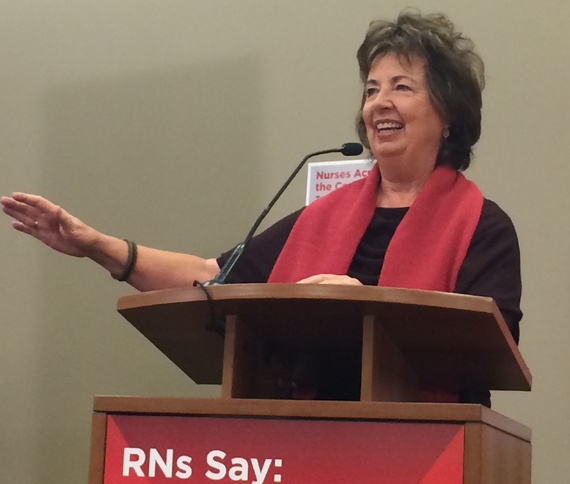
Later, DeMoro stands in a room full of hundreds of women in red NNU shirts, some of whom have driven from hours away to attend the strike announcement. They are a collegial bunch, chatting with one another while snacking on boxed Panera lunches, volunteering to tell their stories to the whole room, responding to DeMoro’s speech with applause. They seem to have learned from their leader, scoffing at confusing questions from reporters on the phone, groaning when they hear the name Kaiser.
“The fact is—the message the nurses across the nation have been getting is that they’re expendable,” DeMoro tells them.” At first I think there was shock, and then I think there was anger, and now we’re turning to dramatic action.”
It’s a message spoken to nurses, but perhaps applicable to other union members too: If you don’t want to be expendable, you’re going to have to put up a fight.
ALANA SEMUELS is a staff writer at The Atlantic. She was previously a national correspondent for the Los Angeles Times.
ZNetwork is funded solely through the generosity of its readers.
Donate