
These are insecure times. My relatives in Tehran are bracing for bombs to fall again. Fighter planes screamed through the skies here in Athens a few weeks back — it was an airshow, technically, but it didn’t feel like one.
War talk is on TV panels every night; algorithms serve images of conflict straight to my eyeballs. Europe is sliding towards militarization without debate: the fear is Russian aggression, and the response is more money for weapons, talk of reviving the draft. And the nearest hot war zone – Ukraine – is still 900 miles from where I live. How must those guys be feeling?
Maybe the threats I’m sensing are inflated; maybe they’re imaginary. But as a father, will I take that chance?
And yet. Here’s what the left offers me to address that fear: marches under the banner of “Welfare Not Warfare,” demands that Europe halt its rearmament and critiques of the hawkish propaganda push. Calls to dismantle NATO. Articles tracking the share price gains of weapons manufacturers Rheinmetall and Lockheed Martin.
I know all this. And I agree with much of it, including the case for leaving NATO. But none of it speaks to what I’m feeling: that my family here could end up on the wrong end of someone else’s escalation, soon. And that if the worst happens, I need to know there’s something here to defend us. The left’s response addresses what’s morally wrong about war. It says nothing about what could protect me from it.
These fears are real, and they are shared. Across the West, the left has a chronic inability to meet them.
I’ve sat in the rooms where left organizations have made calls like these. I’ve made some of them myself. And I have a few thoughts on why it keeps happening, and what we can do about it.
Maximal demands = minimal impact
Let me sharpen this. Our problem on the left is much broader than how we argue against militarization. It’s that on topics that make the public anxious, we make maximalist demands. And we make them at exactly the moments when people need the opposite: something concrete.
“Abolish ICE” came in 2018, at a time when Americans were nervous about immigration and a chaotic border. It was read by its audience as “no enforcement at all.” Only a quarter of Democrats backed eliminating the agency when the slogan launched. See also: calls for “open borders” in most of Europe.
“Defund the police” came in 2020, when Americans were worried about rising crime. It landed with the public as “less safety,” and fewer than 1 in 5 Americans supported it a year later.
“Just Stop Oil” came in 2022, when Britons were facing the worst energy bills in a generation. The policy demand itself (no new oil and gas licenses) was defensible. But to ordinary people worried about who pays for the transition, it was received as “make your bills worse.” Sixty-eight percent of Britons disapproved of the campaign.
Three demands, three fears, three failures. Each came out with a position that didn’t just fail with the public, it failed with the constituencies the movement claimed to speak for. A campaign that can’t build the coalition needed to move power can’t deliver what its slogan promised. Yes, these slogans raised awareness — but awareness is not a theory of change.
Meanwhile the right acknowledges people’s fears, exploits them and wins elections. Again and again and again.
Why we keep doing it
I can give you three reasons.
We think we’re being radical. Extraordinary times, extraordinary measures. In strategy discussions I often hear some version of “we must meet their radicality with our own.” I agree with the spirit, and many of the goals. But the strategic approach is the radical one. Radical means bringing about radical change, not just talking about it. The values-first, maximalist position shifts nothing. It’s a luxury belief.
We tell ourselves the maximalist demand is a negotiating position — ask for the moon, settle for half. But we’re not in a negotiation. Power doesn’t move when it sees a placard. It moves when it feels threatened.
And lastly, we have the wrong audience in mind. Too much of our communication is signaling to other activists, not to people who might be persuaded. We’re showing the room that we’re loyal members of the tribe — which is not the same thing as winning.
What to do instead
We need to run on two horizons, separating our ambitious end goals from our next public demand. The end goal stays underneath, guiding the work. The public demand answers what people are actually scared of today — it should be winnable now and accessible to majorities now, even when the end goal is neither, yet.
So start with the fear. Whatever propaganda planted it there — about Russia, migrants, crime or the cost of going green — we must accept that it’s already taken hold, and respond to it. We may disagree that the fear is justified; we may think the establishment is whipping it up. But it exists in our audiences’ heads and we have to take it seriously. We can’t argue it away. We can offer a better explanation of where it comes from, and a demand that follows from that.
Not every fear deserves a response, though. The ones worth answering have a particular shape: they’re material, not abstract — cost of living, war, jobs, housing, crime, not “fear of decline” or “fear of cultural change.” They’re shared by majorities, not just activists. And they’re something the state can deliver on in the short term, not in a decade.
Once you’ve isolated the fear, formulate a demand that meets it directly. For example:
- On migration, the fear has two parts that get conflated: fear of newcomers competing for scarce resources, and fear of the unfamiliar. So we should answer the concern that “they take our jobs” without scapegoating the workers being underpaid. We should be calling for labor law to be enforced for every worker, like the Independent Workers’ Union of Great Britain does in the U.K. When no one can be paid below minimum wage, no one can be undercut. We should demand integration for everyone who arrives, especially language courses, as Germany does (not to preserve cultural sameness, but to enable practical inclusion in shared institutions). Plus the processing of every asylum claim within six months — which would address the anxiety of a “broken system” that the right exploits, while protecting people from being left in legal limbo for years.
- On militarization, the fear of war is real. So we should be naming what would actually defend us — the things that keep a country standing in a crisis. Not just the military readiness that the right keeps pointing at, but secure energy, cyber resilience, robust democracy and climate adaptation. And conversely, we should call out what is being sold as defense, but isn’t. We should be saying no to putting soldiers’ lives at risk for no defensive purpose — no to the draft, no sending troops to wars that we didn’t vote for. We should be refusing to serve as a base for U.S. operations in the Middle East. And calling for European security to be in European hands, publicly owned and democratically accountable, rather than handed to the shareholders of American and German arms companies who profit from more war. These are first-step demands, of course. The deeper, patient work is building civilian-based defense: nonviolent capacity to deter aggression and resist occupation or repression — without war.
The test for every demand is the same: Could someone scared vote for this without feeling they’re voting against their own safety? If not, we have to find the version of it that they could.
The right will accuse us of going soft, and offer its own version of safety — enforcement, deportation, tougher borders, more police. These can look like quick fixes that calm fears. But they aren’t, and they don’t. Trump’s mass deportations haven’t reduced crime, lowered prices or made anyone materially safer. France’s headscarf bans haven’t reduced extremism. Stop and search in the U.K. didn’t reduce crime. Performed safety usually fails the delivery test. The left has a chance here to offer a real alternative.
Precedents with two horizons
It’s been done before. Bayard Rustin, a key architect of the U.S. civil rights movement, explicitly named the tension between end goals and immediate demands. The moderate who only pursues what’s politically achievable, Rustin said, is in practice telling people to accept the status quo. But the radical who only demands the end goal, with no program to win it, is something worse — what Rustin called a “moralist.” Someone who substitutes shock for strategy and “seeks to change … hearts by traumatizing them.”
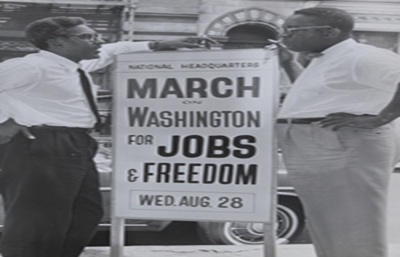
Rustin also understood that minority causes are only won by connecting them to majority ones. He argued that civil rights couldn’t be won by Black Americans alone; they needed “a coalition of progressive forces which becomes the effective political majority in the U.S.” That’s why the 1963 march, the largest civil rights demonstration in American history, was officially called the March on Washington for Jobs and Freedom. It put jobs first.
The civil rights movement succeeded because it kept two horizons. Its end goal of full racial equality wasn’t hidden — but the public demands spoke to the economic fears that most Americans shared.
Zohran Mamdani is doing something similar right now. He has talked inside socialist meetings about seizing the means of production, but his demands and his rallies don’t call for it. Instead, he won the NYC mayoral election running almost entirely on affordability — a rent freeze on stabilized apartments, free city buses, universal childcare and public grocery stores. He made the distinction explicit in a speech back in 2021:
“There are also issues we firmly believe in — whether it’s BDS or the end goal of seizing the means of production — where we do not have the same level of support right now. It is critical that we do not leave any one issue for the other … meet people where they’re at, and organize for what is right, and ensure over time we can bring people to that issue.”
Two horizons — one for the immediate demands of the moment, one for the end goal.
None of this means maximalist demands never resonate. “Abolish ICE” is polling better today than it has in years, because Trump’s overreach has finally given it an audience. The point isn’t that the demand was wrong when it was first launched in 2018. It’s that its moment hadn’t yet come — and the left can’t will that into being by shouting harder. We can only fight on the terrain we actually have.
The here and now
Back to where I started: my family in Tehran. The planes over Athens. The shared fear, real or imagined, that something is coming.
If the left wants to be heard, it has to answer the fear. With a demand that meets the moment — not the end goal underneath. The goal is important, but it can wait. The fear can’t.
ZNetwork is funded solely through the generosity of its readers.
Donate


1 Comment
Brilliant. The Left has to answer why the Right is on the ascendant now and the Left is not? And it is fear-insecurity of jobs, personal safety, affordable housing, healthcare. A greater portion of our wages/salaries are going in just getting by. The Right are often better in a crisis because their simple ‘Them and Us’ message both stokes the fear and provides an answer that perpetuates it. In the UK some of the Left have placards demanding ‘Stop the War’ (Russia in Ukraine). Most Europeans see Russia’s aggression and demands like ‘Stop the War’, is an example of merely signalling to other activists, as Mehran Khalilli so brilliantly expressed it. Great last-paragraph summary.
My concern to you and your family, Mehran.