
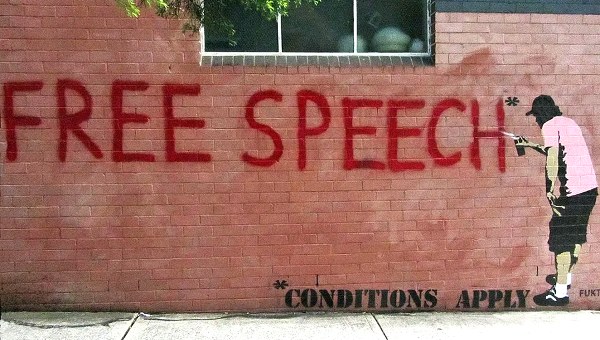
The outrageous assaults on the free speech rights of the pro-Palestine movement are well-known. Trump’s broader assaults on the First Amendment are also well-known and understood to be a major pillar of his fascist impulses. However, all of these assaults must be understood to be happening in the context of a broader free speech repression that started well before Trump and the Gaza genocide. The repression of the pro-Palestine movement started with the Biden administration. In the name of fighting misinformation, Democratic governors like Gavin Newsom passed laws that likely violate the First Amendment.
The issue goes beyond governments to include public attitudes, best illustrated through the well-known but poorly understood phenomenon known as cancel culture. Consider the following facts. As reported by the organization FIRE (the Foundation for Individual Rights and Expression), there have been more than 1000 professor cancellation attempts in America since 2014. Of these, one fifth, i.e., about 200, resulted in the professors losing their jobs, sometimes even after getting tenure.
Overwhelmingly, this was for political views expressed by the professor, that is, views that would otherwise be protected by the First Amendment. Now, the First Amendment does directly apply to public universities. Although it technically doesn’t apply to private universities, it is widely understood to be a cornerstone of academic freedom, which private universities claim to uphold.
Perhaps the most relevant recent examples involve professors, like Maura Finkelstein, getting fired for their pro-Palestine views. But the pattern predates the Gaza genocide, and is often initiated by students on putatively progressive grounds. Here is a typical example. Prof. Erika Lopez Prater lost her job at the Hamline University in St. Paul, Minnesota for showing a painting depicting the Prophet Mohammed in the art history class that she was teaching. The painting in question was commissioned by a Muslim king and painted by a Muslim. Prof. Prater knew that depictions of the prophet are considered sacrilegious by some Muslims, and as such, gave her students a heads up of what was coming; the content of the class in question was no surprise. In reaction, the Muslim Student Association organized a protest condemning Prater’s act as Islamophobic, and the university administrators agreed, causing Prater to lose her job. Whatever one may think of Prater’s conduct, it was squarely within the ambit of the First Amendment and academic freedom as generally understood.
What is cancel culture?
The term “cancel culture” is used to mean many things. Here is Merriam-Webster’s definition: “the practice or tendency of engaging in mass canceling as a way of expressing disapproval and exerting social pressure”. This is an unsatisfactory definition since it’s not even clear that it includes the above example (which did not entail a “mass” cancellation). Further, many examples of “mass cancellation” are quite appropriate. For instance, Andrew Cuomo deserves the public shaming that he gets as a result of his sexual harassment allegations, and his attempts to portray himself as a victim of cancel culture are an exemplar of its cynical misuse.
For the purposes of this article, I will borrow the definition used by the organization FIRE, which links cancel culture directly to the First Amendment, defining it as “campaigns to get people fired, disinvited, deplatformed, or otherwise punished for speech that is – or would be – protected by First Amendment standards”. Under this definition, much of the repression of pro-Palestine protests, and the example of Prof. Prater above qualifies as examples of cancel culture.
The First Amendment does not protect harassment (and certainly not sexual harassment), incitement or defamation. Accordingly, public shaming of Andrew Cuomo as a result of his sexual harassment allegations would not qualify as cancel culture. Here is another illustration. Students shouting down a speaker invited to campus in order to express their criticism of the speaker’s views is an example of cancel culture. But students organizing a counter-event criticizing the invited speaker’s views, or holding banners during the speech and staging a walkout do not qualify as cancel culture.
Cancel culture is a direct threat to free speech and happening at an unprecedented scale
It is important to be clear that cancel culture is quite real and a direct threat to free speech. Free speech is one of the biggest achievements of American democracy, distinguishing it from all other democracies (e.g., most democracies to this day have hate speech laws). As such, it constitutes an attack on democracy.
Further, cancel culture is happening at an unprecedented scale in American history. As noted above, FIRE reports over 1000 cancellation attempts in US academia since 2014, of which about 200 have resulted in the loss of a job. To put this number in perspective, it is generally reported that in the decade spanning the peak of the McCarthyite period, about a 100 professors lost their jobs for their political views. In other words, the impact of cancel culture has been about twice that of the McCarthyite period. As another example, there were three firings of professors in the wake of 911. The data on professor firings for their political views is just one illustrative example. FIRE’s faculty and student surveys are quite telling. For instance, 16% of faculty surveyed report being disciplined or threatened with discipline for their speech, teaching or academic research, 29% report being pressured by administrators to avoid controversial research, and about two-thirds of students surveyed are worried about damaging their reputation because someone misunderstands something they have said or done.
Cancel culture justification and/or minimization
In the broad progressive circle, there isn’t even agreement that cancel culture is a problem. This was perhaps most noticeable in the reaction to the letter titled “A Letter on Justice and Open Debate” in Harper’s magazine in 2020, which lamented the “intolerant climate that has set in on all sides”, rejecting the “false choice between justice and freedom”. AOC wrote in this context that the term “Cancel Culture” itself “comes from entitlement” and is bemoaned by “spicy contrarians who want to play devil’s advocate w/ your basic rights in the NYT.” There was a significant strain of opinion on the left claiming that cancel culture is either justified as a form of accountability for the powerful or an overblown moral panic. As noted above, there are cases of powerful people cynically claiming to be victims of cancel culture when they are legitimately being held accountable. But there is no denying that the broader environment of cancel culture denialism indicates an erosion of free speech values.
Other indicators of public attitudes point in the same direction. For instance, recent polls conducted by FIRE show that 69% of undergraduate students think speakers who say “From the river to the sea, Palestine should be free” should be allowed on campus. This is a tribute to years of dedicated pro-Palestinian activism. However, only 35% think that speakers who say “Collateral damage in Gaza is justified for the sake of Israeli security” should be allowed on campus. We are not referring to speakers who justify the Gaza genocide being exposed or publicly shamed, but them not even being allowed on campus. Free speech protections mean nothing if they are not applicable to views that are despised. When it comes to views that are despised, students over the past decade support strong restrictions on campus, like the idea of having speech codes and free speech zones. They even believe that physical violence can be justified in order to prevent what they term as hate speech (which is protected by the First Amendment.)
In short, while there are of course significant differences in degree between the left and right when it comes to toleration of dissent, we have to face the sobering fact that they share the common principle that free speech protections ought to apply for themselves, but not for others.
This is a recession from the past
It is forgotten now, but a principled defence of free speech, including of those whose views we despise, was an integral part of the civil rights movement. A telling indicator of this recession in values was Grandin’s recent characterization of Chomsky as a “free speech absolutist”, whose support for holocaust-denier Faurisson’s freedom of speech was treating “emotionally wrenching matters as if they can be defused through adherence to abstract principles”. Chomsky’s defence of Faurisson’s freedom of speech indeed appears outlandish in today’s intellectual environment, but that is because we are living through a period of recession in free speech culture. At its time, in fact Chomsky’s defence of Faurisson’s freedom of speech was rather anodyne. It came in the wake of the Supreme Court decision on the Brandenburg v Ohio case, which — at least legally — defines the incitement standard of the First Amendment to this day. Clarence Brandenburg was a white KKK member, who made the following speech at an armed KKK rally (quoted from court documents):
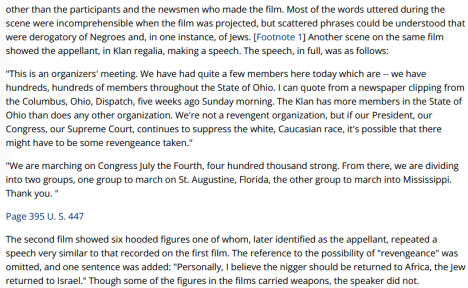
Brandenburg’s speech was defended unanimously by the Supreme Court including by Thurgood Marshall on the grounds that while it was a racist and anti-semitic call to violence, the violence wasn’t imminent, and thus ought to be protected by the First Amendment. It can be assumed that Thurgood Marshall was not a fan of the KKK. Brandenburg’s defence was conducted by the ACLU, including SNCC organizer and civil rights icon Eleanor Holmes Norton, a Black woman, and Allen Brown, who is Jewish.
There are a few points worth noting: (1) Brandenburg was “a monster”, (2) Norton and Brown chose to defend him, (3) as a part of defending him, they would surely be required to provide Brandenburg advice on how to interact with the media; in other words, we can assume that Norton and Brown provided Brandenburg “PR” advice. It ought to be quite clear that what Norton and Brown did was heroic. The Civil Rights movement not only rejected “the false choice between justice and freedom,” but understood that “without freedom of speech and the right to dissent, the Civil Rights movement would have been a bird without wings”, as John Lewis put it, and that a robust defence of free speech requires protecting the rights of “monsters”.
One shudders to think how this would be received today. Perhaps as an instance of treating “emotionally wrenching matters as if they can be defused through adherence to abstract principles”. Perhaps with endless virtue signaling of how Norton and Brown didn’t owe “a monster” a defence, or with condemnations of their moral depravity for offering “a monster” PR advice.
Describing a dedication to free speech principles as “free speech absolutism” is just a way to caricature the principles. Chomsky’s dedication to free speech arose from first principles, not from ideological commitments. In fact, he was not a free speech absolutist, e.g., in the wake of the coup attempt on Jan 6, 2021, he supported a temporary ban of Donald Trump from Twitter/X.
Pro-democracy/anti-fascist movements ring hollow without a robust commitment to free speech
Free speech is one of the biggest victories of American democracy. Absent a robust commitment to free speech, what exactly are the pro-democracy/anti-fascist movements fighting for? Maybe these movements should first rise to the elementary level of not castigating those who are fighting against cancel culture as apologists for various horrors like white supremacy and genocide, and then act shocked when a fascist uses cancel culture against them. Maybe they should be more familiar with the Weimar fallacy. Free speech is sometimes described as the “eternally radical” idea. That sentiment has rarely held more strongly than it does right now.
ZNetwork is funded solely through the generosity of its readers.
Donate

