
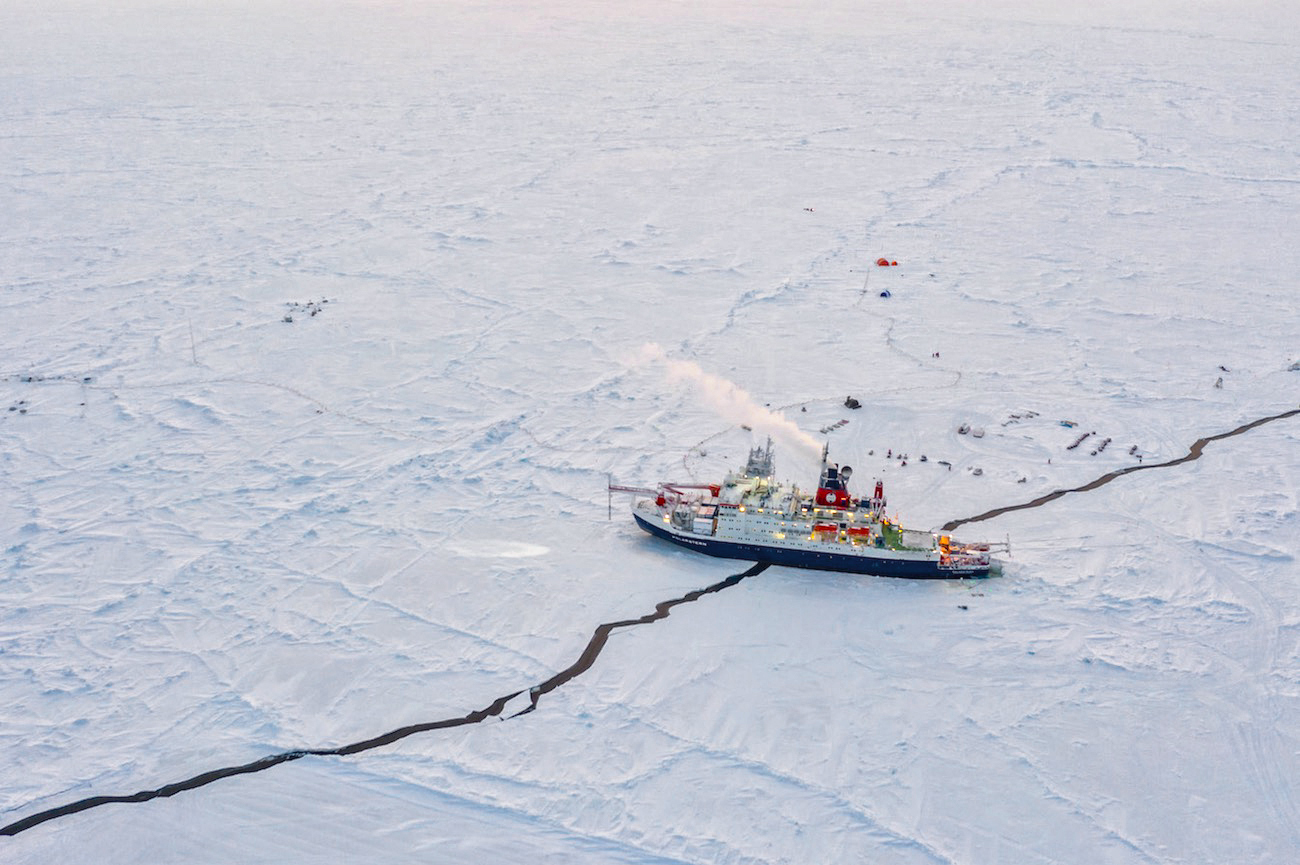
The Arctic had once been a largely peaceful zone, harboring cooperative international scientific research. But today, it is swiftly becoming one of militarized power politics.
Heavily armed nations surround the melting Arctic Ocean, with its unstable environment of eroding shorelines, accessible natural resources, and contested maritime passages.
This February, the U.S. launched little publicized, month-long military exercises in the Arctic, hosted by Finland and Norway.
The Pentagon’s European Command described the exercises – named Arctic Forge 23, Defense Exercise North, and Joint Viking – as a way “to demonstrate readiness by deploying a combat-credible force to enhance power in NATO’s northern flank”.
The exercises bring together more than 10,000 military personnel from the United States, United Kingdom, Germany, the Netherlands, Denmark, Finland, and Norway.
Actual hostilities could have potentially broken out earlier in February, when the U.S. military shot down an unidentified object over Alaska, soon after a U.S. fighter jet brought down an alleged Chinese spy balloon over the Atlantic.
The balloon over Alaska turned out to belong to a U.S. hobby club, but a sense of menace was maintained.
One way people become aware of impending conflicts is through the entertainment industry, which is important in the process of manufacturing consent.
Right now, a Danish series called “Borgen – Power & Glory” is doing just that, revealing the growing importance of the Arctic as a “geopolitical hotspot in world politics.”
Borgen addresses the topic of natural resources in the Arctic, which roils up contention between the United States, Russia and China.
The series centers on Greenland, a Danish possession with an independence movement that gains strength from the discovery of a vital resource. In the drama, that is oil. In reality, it is rare earth elements.
In the drama, this creates tension for the Danish government, caught up in a great power struggle between the U.S., China, and Russia. In reality, Greenland is only one part of a looming conflict in the Arctic, not only about resources, but also about passage through the ocean, which has become more navigable due to accelerated climate change.
The sinister presentation of China’s representative in Borgen creates the fear of China’s actual presence in the Arctic. It has a uranium and rare earths mining joint venture with Australia in southern Greenland, which allows two Chinese firms to lead in processing and marketing the materials. China is also exploring zinc, iron and oil deposits in Greenland.
Not only has this activity raised concerns about competitive access to rare earths, but, in the case of Greenland, it has raised security issues for Denmark, a member of NATO.
As a result, Denmark has revised its security policy, in what Foreign Policy magazine described as a new “geopolitical battlefield”.
Echoing U.S. security concerns, Denmark has increased its military budget with a so-called “Arctic capacity package” to enhance surveillance with drones, satellites, and radar.
Greenland is relatively autonomous from Denmark and shares a seat with the kingdom at the Arctic Council, but it does have an independence movement that could fulfill its goal with the wealth offered by the mines.
This would cost Denmark its seat in the Arctic Council, and, with it, the presence of another NATO member.
The Arctic Council, established in 1996, defines itself as “the leading intergovernmental forum promoting cooperation, coordination and interaction among the Arctic States, Arctic Indigenous peoples and other Arctic inhabitants on common Arctic issues”.
Thus, a bid by China to build an airport in Greenland was prevented by the Danish government. This was despite the fact that Greenland’s fishing industry was open to the marketing opportunity it presented, and to the eventual promise of independence.
China, however, having its own concerns over foreign intervention in Tibet, Xinjiang, and Taiwan, is unwilling to interfere politically in Greenland.
Furthermore, intervention from the U.S. was likely – as dramatized in Borgen – given the U.S. air base at Thule, which is home to the U.S. Space Force and a global network of missile warning sensors.
A successful independence movement in Greenland would cause Denmark to lose its status as an Arctic State, as well as potentially threaten Washington’s continued use of the base.

Climate change impacts the geopolitics of the Arctic
Besides the question of Greenland, the navigability of the Arctic Ocean, due to its thawing, has created several geopolitical issues. It now greatly shortens China’s trade route with Europe and offers a backup to the Malacca Straits, which U.S. warships could blockade in case of a conflict.
Indeed, in 2012, a Chinese icebreaker made full transit through the Arctic to Iceland. And in 2023, China tested its third trip, proving its trading capability and enhancing scientific cooperation between the two countries.
While China is not itself an Arctic state, it has laid out its claims in international terms in its Arctic Policy of 2018: “The Arctic situation now goes beyond its original inter-Arctic States or regional nature, having a vital bearing on the interests of States outside the region… with global implications and international impacts.”
Beijing claims “rights in respect of scientific research, navigation, overflight, fishing, laying of submarine cables and pipelines in the high seas and other relevant sea areas in the Arctic Ocean, and rights to resource exploration and exploitation in the Area.”
It further claims that, geographically, China’s climate system and ecological environment are affected by Arctic events, and therefore deserves to be consulted in matters of security and global governance.
More assertively, China expects to play a major role in expanding the network of shipping routes in the Arctic in the form of a Polar Silk Road “to facilitate connectivity and sustainable economic and social development of the Arctic.”
These ambitions have alarmed Western countries, despite China’s disclaimers of intent: respect, cooperation, win-win result, and sustainability.
On the other hand, even some Western military observers validate China’s interest in and contribution to resource development and scientific cooperation in the Arctic. They assuage fears of China’s use of the right of passage through Arctic waters.
Furthermore, China has yet to invest in any Russian Arctic port, and no joint naval exercises have been held in Russian Arctic waters.
Finally, China’s position as an accredited observer to the Arctic Council constrains any political challenges it may mount. As a 2022 academic article published by the U.S. Air Force put it: “China Is Not a Peer Competitor in the Arctic.”
China-Russia partnership
The growing closeness of China and Russia, nevertheless, raises new questions about a shifting balance of power in the region.
Russia’s northern border occupies over half the shoreline on the ocean, which gives it claims to offshore resources like oil. The North Sea Route, hugging the length of Russia’s northern border, offers a shipping lane for Chinese trade with Europe.
Historically, Russia has seen the route as within its sphere of influence and has not accepted China’s term of a Polar Silk Road.
The Ukraine war, however, has made Russia more dependent on China. Their partnership may change the balance of power in the region.
As of 2021, Russia chaired the Arctic Council for a two-year term stint. But the Arctic Chiefs of Defense meetings and the Arctic Security Forces Roundtable have excluded Russia since a democratic referendum with more than 90% approval led to the annexation of Crimea in 2014.
Claiming to perceive a threat, NATO has revived an old Cold War expression, referring to the “northern flank” for this area, and exploring its potentially conflictual relationship with Russia in that context.
For Moscow, defense of its northern border is a prime security issue. But with the revival of Cold War tensions, the U.S. and NATO consider Russia’s militarization to be a threat, and they are remilitarizing as well.
As Vijay Prashad has shown, NATO’s so-called “Centre of Excellence – Cold Weather Operations“, based in Norway, brings Western allies together for biannual military exercises in the Arctic.
Should Finland and Sweden join NATO, Russia would be confronted with a phalanx of opponents on the Arctic Council and be encircled north and west by hostile forces.
Consequently, the stability of the Arctic region is now endangered.
The Arctic: a treasure trove of natural resources
In addition to its geostrategic location, the Arctic is crucial for its natural resources.
90 percent of Russia’s current gas production and 60 percent of its oil production take place in the Arctic. The region has a staggering 60 percent of Russia’s gas and oil reserves.
The Russian Arctic also has large deposits of coal, petroleum, and natural gas, as well as diamonds, gold, nickel, cobalt, copper, palladium, platinum, zinc, and rare earth metals.
In addition, Russia aspires to make the region more hospitable, even tourist friendly. It plans to build new cities, as well as harbors, airports, and IT equipment.
These plans include ways of preventing the negative impacts of this development on climate change, to which the Arctic is highly vulnerable.
Finally, the Northern Sea Route, made passable by the Russian fleet of 40 icebreakers, including four nuclear-powered ones and a new series planned, is a bone of contention in maritime law.
Russia considers this a national waterway. But if foreign ships are to pass through for trade, it would have to become an international route, possibly open to hostile warships as well.
The conflict in Eastern Europe, on Russia’s western border, has increased Moscow’s fear of encirclement, including in its north.
U.S. and NATO threaten to upset the balance in the Arctic
Denmark, with its autonomous region Greenland, as well as Norway jockey for position in the Arctic. As members of NATO, they have participated in maneuvers they consider a form of deterrence.
Should Finland and Sweden also join NATO, Russia’s northern border would face a militarized front including Canada, the United States, and Iceland.
A delicate balance to avoid war has so far been maintained within the Arctic Council. However, this equilibrium is increasingly being challenged by a heightened diplomatic and military presence of the U.S. in the Arctic, which has created the position of “Ambassador-At-Large for the Arctic Region,” and is developing Army Arctic Special Operations Forces.
A stated mission of these U.S. Special Forces is to leverage the specialized Arctic knowledge of Indigenous peoples for military purposes and to prevent their “vulnerability to other influences.”
Given the malign neglect suffered by Alaskan and Canadian Inuit people and by Sami people in the other Arctic nation-states, this is a real concern.
A 2021 U.S. Army document announced that Washington must “regain Arctic dominance” and “win” in the region.
The chief of staff paper anticipated northern routes from which troops could be deployed from Alaska to points around the globe. It also recognized the importance of Arctic resources, like rare minerals needed for components of aircraft engines and advanced weapons.
A new NATO Arctic Command expects to establish a formal Arctic Security Forum that includes the U.S.-led military alliance.
While civilian observers acknowledge Russia’s right to defend its northern border, and urge case-by-case management of disagreements to maintain stability, the U.S. military recommends serious strategizing in the Arctic Council with its NATO allies, which may soon include Sweden and Finland.
Not only is the Northern Sea Route along Russia’s coast contested in maritime law but so too are the Northwest Passage in the western Arctic, adjoining Canada, Greenland, and Alaska.
In this case, Canada agrees with Russia that maintaining national control is a matter of sovereign right.
Other states with heavy commercial maritime traffic, however, such as Germany, Japan, and South Korea, claim international right of passage under the UN Convention on Law of the Sea.
China could also claim this right, regarding the Northern Sea Route, though it would conflict with Russian interests.
The rights of Indigenous peoples in the Arctic
The heightened tension over the Northwest Passage has led the Canadian government to court its Inuit population, whose settlement area encompasses most of the Northwest Passage routes.
The land claims agreement of 1993, however, does not give the Indigenous people authority over marine areas, only consultation.
This agreement was successfully employed in the Inuit statement supporting Canada’s rebuttal to former U.S. Secretary of State Mike Pompeo, who bluntly denounced Ottawa’s claim over the Northwest Passage as “illegitimate.”
Environmental issues and the lives of Indigenous peoples gain attention in this political whirlpool, but mainly rhetorically.
The damage wrought by the fossil fuel industry and more recently by new technologies of “green” mining continue to push First Nations further off their lands, imperiling their natural foods.
But they are assuming a stronger political voice in the upcoming rivalries between their respective nation-states.
Both the Inuit peoples of the western Arctic and the Sami of the eastern Arctic have developed circumpolar organizations that participate in the governance of the Arctic.
The states that colonized them and in which they are now minorities are taking a greater interest in maintaining their loyalty and in acquiring their knowledge of Arctic conditions in case of conflicts.
The Inuit of the western region of the U.S., Canada, and Greenland total an estimated 180.000 population.
16,500 are in Alaska, organized into the Alaska Federation of Nations. The resolutions of its October 2022 annual meeting reflect resentment of many hardships: the decline in stock of fisheries threatening native food security; a drug epidemic of fentanyl, heroin, and methamphetamine; a high incidence of domestic violence, sexual violence, and missing and murdered people; waste and contaminants left by the military and other governmental agencies; ongoing seizure of native lands; and insufficient access to education and business.
Especially poignant is a resolution “imploring the state of Alaska to end its practice of requiring tribal waivers of sovereign immunity as a condition for receiving grant funds.”
The more than 70,000 Inuit in Canada are largely urbanized, due to a long history of forced assimilation. With high unemployment, low wages and substandard housing, they have significant food insecurity, a high rate of imprisonment, and youth suicide.
In the 1970s, an organization of Inuit was formed to protect their individual and cultural rights, as well as land claims. It is part of the Inuit Circumpolar Council, which connects with Inuit in Alaska and Greenland, and has connections with the United Nations.
The Sami are a historically nomadic herding people who once roamed freely and are now divided with approximately 20,000 in Sweden, 50,000 in Norway, 8,000 in Finland and 2,000 in Russia.
In all of these states, they suffer from ongoing land grabs, which interfere with reindeer grazing routes; discrimination; and violent racism. The deliberate killing of reindeer herds have plagued the Sami in Sweden, despite government attempts at reconciliation and some funding.
The Sami in Finland similarly suffer loss of land, inhibition of reindeer herding, and lack of power over access to resources on their remaining land. Finland now touts cultural tourism of the Sami.
The Sami in Norway have organized against infrastructure projects that threaten even more land loss, to little avail.
The Sami in Russia, the smallest group, reestablished contact with the others in 1991. Their urban conditions are not better than that of the Sami elsewhere, but their reindeer herding has a unique problem.
They had been organized into cooperatives which now have difficulty readjusting to new conditions of ongoing industrialization. As elsewhere, this development continues to usurp their pasture lands. In addition, tourist fishing has reduced their food supply.
Like the Inuit, the Sami have a circumpolar organization for common interests, a Sami Council consisting of three Parliaments representing the indigenous peoples of Sweden, Norway, and Finland. The Russian Sami are represented by NGOs.
The war in Ukraine has created a split among the Sami. In April 2022, the Council suspended formal relations with the Russian group, which supported the Russian Federation, portending the incursion of sub-Arctic politics into the polar region.
The relatively peaceful days of the Arctic are over. Its warming is turning up the geopolitical heat in the polar region, bringing to mind an old adage: “What happens in the Arctic doesn’t stay in the Arctic.”
ZNetwork is funded solely through the generosity of its readers.
Donate

