
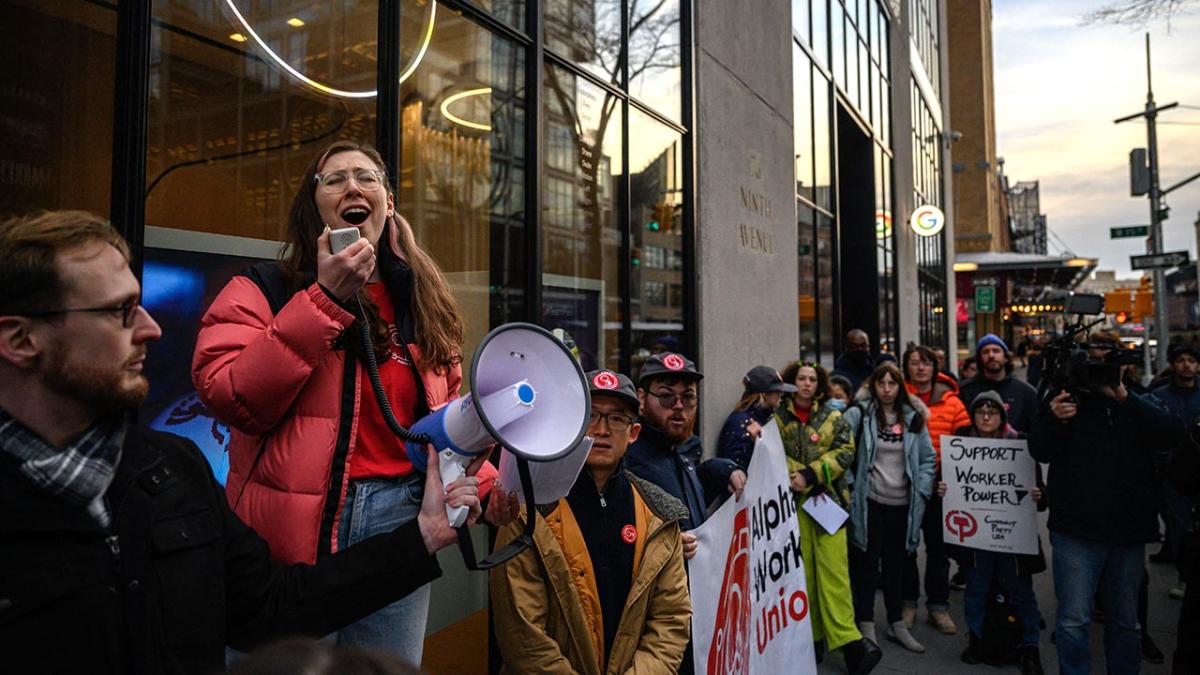
In January, amid mass layoffs across the tech industry, Google laid off 6 percent of its workforce, or about 12,000 workers. In protest, dozens of tech workers crowded the sidewalk outside of Google’s Chelsea offices on February 2, sharing stories of laid-off coworkers and urging each other to join the union. The protest took place while executives at Alphabet (Google’s parent company) were on an earnings call with investors, announcing billions in profits.
The workers highlighted the cruelty of how workers were told they’d lost their jobs. One anonymous worker shared that they were laid off via email while eating breakfast in the office. Another worker, who is three months pregnant, shared that because of the conditions of her severance, she is barred from accepting roles or income until April 28, when she’ll be six months pregnant, and is worried that even if she gets a new job that day, she won’t qualify for parental leave so soon at a new company. Her severance will run out before her due date, leaving her without another paycheck until months after her baby is born.
Over 85,000 tech workers have been laid off since the beginning of 2023, by companies including Meta (13 percent of employees laid off), Lyft (15 percent), DoorDash (6 percent), Spotify (6 percent), and Microsoft (5 percent). These numbers don’t include contracted employees, who often work overseas and are more likely to have been getting paid much less (with much worse benefits) than full-time employees to begin with; if these tech companies decide not to renew their contracts, these workers are also effectively laid off, even if they aren’t included in these official numbers. Also unreported are the number of laid-off workers who were on work visas and who have not only lost their income but must now race against the clock to find another visa-sponsoring job or else face the threat of deportation.
According to executives, these layoffs result from “overstaffing” or represent necessary cost-cutting in the face of a looming recession. Most of these companies, however, are profitable or sitting on enormous piles of cash. Microsoft, Amazon, and Meta pulled in billions in profits last quarter alone. Google, as one worker at the rally pointed out, made $17 billion in profits in the third quarter of 2022, and it expected similar results in Q4. And as any tech worker will tell you if they were at a company that has gone through layoffs, these companies are not “overstaffed”; some workers left behind are now being asked to do the work of two or three people to keep productivity as high as it was before they lost thousands of coworkers. As one Google software engineer put it, “if executives tell you that layoffs had to happen at google, they are lying.”
Why Are Tech Layoffs Happening?
For the past decade and a half, tech workers in high demand in a tight labor market have commanded high salaries and benefits, and they have been assured some measure of job security. Tech companies that wanted to hire scarce and in-demand tech workers had no choice but to compete with each other, offering higher and higher salaries and cushier perks to attract them. In the eyes of tech executives, this has gone on for far too long.
The execs are using the current economic situation — an expected recession, rising inflation, and general anxiety — as cover to create an artificially tight job market. Doing so may offer a “reset” for bosses who are desperate to regain some dominance over workers by curbing compensation and weakening labor power, as tech labor researcher Ben Tarnoff wrote on Twitter. Workers’ power, in this case, primarily means the power that individuals with in-demand skills have been able to wield in their negotiations with employers.
This “reset” has been particularly necessary, in the eyes of the bosses, because in the past few years, tech workers have relied on their job security to take risks, like taking collective action and protesting their employers’ shady behavior and unethical government contracts. Tech workers at Kickstarter, the New York Times, Code for America, NPR, Alphabet, and several other companies have even formed unions. Individual workers have realized that even with their in-demand skills, they don’t have real bargaining power, so they’ve begun to band together collectively to win what they could not win alone. Sector-wide layoffs raise the stakes of organizing, and may scare some workers into taking fewer risks.
Tarnoff’s comparison to wage fixing is quite apt, since the layoff trend appears to be based, not on companies’ financials, but on tech executives’ playing follow the leader — that is, simply copying each other. It wouldn’t take explicit collusion for bosses to realize that if they all lay off workers at the same rate, conditions become more favorable for them. As one anonymous software engineer put it during Spotify’s layoffs in mid-January, “Wall Street demands its 6 percent sacrifice.”
There is no good financial reason for most of these layoffs. The Tech companies aren’t using the money that they are saving by laying off workers to keep the company afloat or invest in capital projects: they are simply, as MarketWatch put it, “shipping the proceeds from their layoffs straight to Wall Street.” After announcing $17 billion in earnings in Q3, Google used almost all of it to buy back its own stock. The same day workers rallied outside Google’s offices, Meta announced plans to purchase $40 billion of its own stock after laying off 11,000 workers. These stock purchases do nothing to increase productivity — they merely boost the company’s stock price and line investors’ pockets.
You might be interested in: Google’s New Union Is a Historic Moment for Labor
Even just the announcement of layoffs can send a tech company’s stock price skyrocketing, because it signals to investors that the company’s executives are serious about disciplining workers and driving wages down. This isn’t a new phenomenon — tech companies (and other companies) are notorious for laying off workers solely to boost their stock price. When wildly profitable companies become slightly less profitable (or future projections have them becoming slightly less profitable in the future), investors panic, and then CEOs panic and pull the closest lever they have to signal that they are “cutting costs,” becoming more “efficient,” and righting the ship. This is because capitalism is not altruistic: major shareholders don’t buy shares because they want to invest in these companies’ visions or provide startup capital for them to become more productive. They buy shares because they believe those shares will be worth more money in the future; this is their only pursuit as capitalists; it is the only way they make money. If it looks like their shares won’t be gaining in value, they pressure the executives of these companies to make changes until they do. This is a central reason why the capitalist system produces inequality and exploitation: the capitalists themselves must give in to the demand of profit accumulation. Stock buybacks reduce the number of shares in circulation, making them rarer and more valuable. Buying back stock does nothing to boost the productivity of a company, and it does nothing for the social good. The cost of these stock buybacks alone would’ve paid the salaries of every laid-off worker for decades. The executives are just using rising inflation and expectations of a recession as a propaganda tool to justify their greed.
If this trend follows the tech industry’s usual cycle of layoffs, we can expect to see each of these companies begin hiring again as soon as a few months from now. The problem wasn’t too many workers; it was that workers were gaining too much confidence. The task, then, was to cultivate an atmosphere in which workers are scared — too scared to organize — and investors feel secure and powerful.
What Can Tech Workers Do?
As Google workers put it during their “Googlers Against Greed” rally, the only way workers can secure power for themselves and protect themselves against layoffs is to organize en masse. In 2020 unionized tech workers at Kickstarter negotiated strong severance packages and “recall rights,” meaning that once Kickstarter began rehiring workers, the laid-off employees would get invited to fill their old roles before the company could hire anyone else. Unions can protect workers in other ways too, by requiring bosses to negotiate with them over financially necessary layoffs, giving workers the opportunity to negotiate for better severance, fewer layoffs, or for job-sharing or other schemes to protect jobs.
It is understandable that tech workers who are now feeling precariously employed (potentially for the first time ever) may begin to have cold feet about unionizing. A software engineer who could have previously said, “What are they gonna do, fire me?” may now think signing a union card comes with a higher risk. But this is also one of the largest mass-agitation events in the tech industry in the last decade — for the average tech worker, talking to coworkers about organizing for stronger job security and protections and more control over the workplace is easier today than it’s ever been before, because everyone is already talking about it. Tech workers must seize this moment, before CEOs can realize their dream of a scared, pliant, and endlessly disposable workforce. Tech workers must organize to say they won’t lose what the best-paid ones already have, and to win those good working conditions for everyone else. They must organize so that they don’t lose the small amount of power they’ve begun to wield over choosing what their companies will build and what contracts they’ll take.
Workers in the tech industry are strategically placed, given that the industry sits at the nexus of every other part of the economy, from communication to healthcare to finance to logistics. For this reason, organized tech workers could have a massive impact not only on their own job security but on what they make and how it gets used. An organized tech workforce, in collaboration with workers across the globe, could demand not just better conditions for themselves but better conditions for the entire working class. Tech workers — because of their high wages, key place in the economy, and (until now slightly more certain) job security — are in a unique position to organize with workers in other sectors and coordinate actions in solidarity around issues facing the entire class in the face of a recession.
ZNetwork is funded solely through the generosity of its readers.
Donate

