

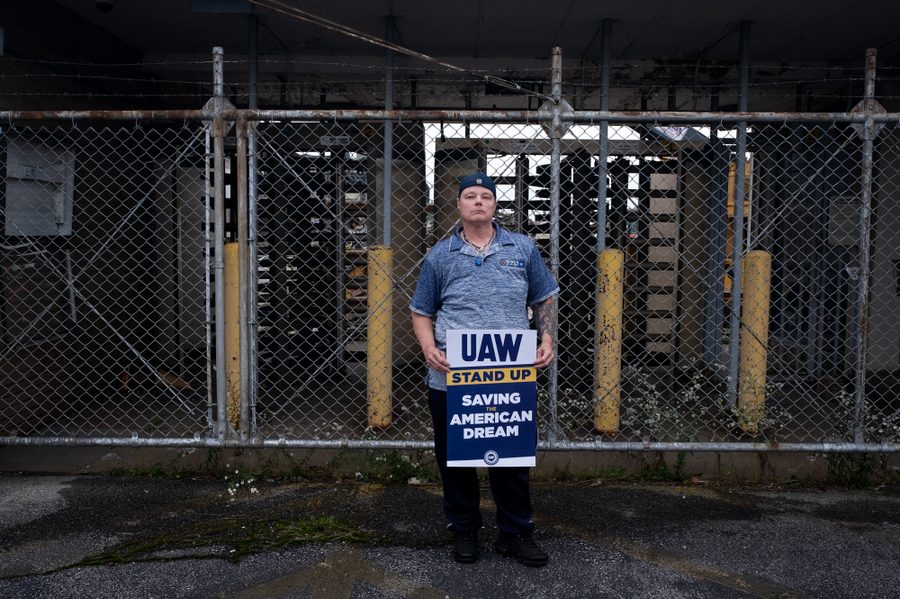
Dawnya Ferdinandsen worked odd jobs for years to make ends meet. She drove cars as a valet, worked in building maintenance and took restaurant gigs.
That changed in 2006: With the referral of a family friend, Ferdinandsen landed a job as a technician at an auto plant producing wheel bearings in Sandusky, Ohio. Working closely with engineers for long hours on the floor, she found the job physically intense but intellectually satisfying.
Most importantly, the job offered membership in the United Auto Workers union.
“I always wanted to be affiliated with a union somewhere, and that was my opportunity to get in,” Ferdinandsen says.
With the union contract came pensions, solid wages and healthcare for retirees, benefits Ferdinandsen viewed as a necessary exchange for laboring in a rough industry. “You come out with messed up backs, legs, feet, everything else,” she says. “You need medical, and they know that.”
In 2007, those promises were shattered. Delphi, a parts company that employed thousands of UAW members — including Ferdinandsen — had filed for bankruptcy two years prior. The agreement it reached with the UAW in 2007 made sweeping cuts to wages and pensions.
Ferdinandsen’s pension disappeared.
“We got played,” she says.
That same year, as the Big Three U.S. automakers — Ford, GM and Chrysler — argued that union benefits made competition with foreign manufacturers impossible, the UAW agreed to slash healthcare contributions and establish a second tier of work, along with lower wages and no pensions for new hires. The yearslong crisis in the auto sector culminated during the 2009 recession with the dramatic bankruptcies and federal bailouts of GM and Chrysler. In bailout talks, the UAW agreed to deals that deepened cuts to retiree healthcare plans, eliminated job security provisions, did away with annual cost-of-living adjustments and relinquished the right to strike until 2015.
The UAW and the Big Three are once again in contentious contract negotiations. As autoworkers began a rolling strike in mid-September, the bailout of 2009 came back into focus as a symbol of workers’ previous sacrifices for the companies.
“I want to see them return what they promised to the workers that saved the company,” striking worker Bonita Burns told In These Times reporter Amie Stager on a Plymouth, Minn., picket line outside a Stellantis (formerly Chrysler) plant on September 22.
The 2009 givebacks have also become shorthand for the concessions the union made just before the crash, says labor historian and journalist Jeff Schuhrke.
Even President Joe Biden, who joined a picket line in Belleville, Mich., on September 26, opened a speech to striking workers by calling out the recession-era bailouts, which occurred when he was vice president. “The UAW, you saved the automobile industry back in 2008,” Biden said. “The companies were in trouble, but now they’re doing incredibly well, and guess what. You should be doing incredibly well too.”
For former Delphi workers like Michael Gale, the cuts began with the lost pay and reduced pensions from the 2007 bankruptcy deal. Those losses carried over for him and others who became GM workers when GM reabsorbed their plants during the 2009 bailout. On the pretext of saving jobs, the recession-era concessions traded away the wages, pensions and healthcare benefits that had characterized UAW contracts since the 1930s and ’40s.
For generations, workers had joined the auto sector for the assurance of a place in the middle class and a comfortable retirement. Within just a few years, that guarantee disappeared.
Many UAW members considered it a betrayal by union leadership.
But with Shawn Fain at the helm — the union’s first democratically elected president — workers say they see a tentative possibility for a turn of fortune.
“I just want them to make it right,” says Melanie Granger, who transferred to a GM body shop in Texas after Delphi went bankrupt, losing six years of seniority — the marker of tenure that confers preference in consideration for promotions, among other benefits. “If they don’t, things are just going to keep on going the way they have been … not looking out for the union or the membership as a whole.”
At the time of publication, a reversal of past concessions was on the bargaining table, with the union ramping up rolling walkouts across the United States.
The UAW peaked at approximately 1.5 million members in 1979, the beginning of an era that would be marked by offshoring, Reaganomics and union concessions.
A 2008 Los Angeles Times obituary of former UAW President Douglas A. Fraser describes Fraser’s effort to keep Chrysler afloat through two recessions, capturing the bleak circumstances: “Fraser considered his finest achievement the UAW’s campaign to obtain $1.5 billion in federal loan guarantees for Chrysler Corp. in 1979.”
The deal, formed as part of a federally negotiated bailout, cost the UAW roughly $1 billion in concessions and led Ford and GM to successfully demand the same treatment in 1982. The union’s concessionary posture, the LA Times wrote, was “opposed by many UAW members but contributed to the U.S. auto industry’s recovery” — a preview of what would become a pattern.
President Ronald Reagan’s move to break the air traffic controllers’ strike in 1981 sent another warning: Strike, and you may be replaced — permanently.
Historian Schuhrke notes, too, that when NAFTA passed, in 1994, fears that the automakers would relocate to facilities in Mexico prompted yet more union concessions.
Looking back, workers see the very creation of Delphi in 1999 — now a footnote in the history of the auto industry — as a kind of concession itself, a prelude to the industry-wide crisis to follow.
The decision to spin Delphi off from GM, which UAW leadership publicly opposed, meant that some of GM’s parts facilities would form a separate, independent company. Those companies, GM argued, would run more efficiently and work out competitive union contracts, a win-win.
In fact, Delphi was either unprepared or unable to succeed as an entity separate from GM. Once an in-house provider of parts for GM, Delphi was forced to compete for contracts.
“No sooner than they spun off, they were experiencing all of this [trouble], and filing bankruptcy,” recalls Lavenia Clinkscales, a UAW member who was working at a GM assembly plant that reabsorbed Delphi workers in the bankruptcy.
Delphi expanded its operations abroad where labor was cheap. By 2010, fewer than 20,000 of the company’s 146,000 workers lived in the United States — while Delphi workers in India labored for little more than $1 an hour.
“This was all designed — the fissuring of the corporation … and then turning everyone into a subpart of the supply chain, which has to compete with each other,” says Nelson Lichtenstein, director of the University of California, Santa Barbara’s Center for the Study of Work, Labor and Democracy. “And then it goes bankrupt.”
Delphi declared bankruptcy in 2005, just six years after its founding.
Bankruptcy was becoming a “tool” for cost cutting, explains Stephen F. Diamond, a legal scholar whose work focuses on corporate governance and labor. And “since bankruptcy allows you to basically restructure all of your contracts, that includes your union agreement.”
Three years later, as car sales plummeted following the 2008 collapse, GM, Chrysler and Ford teetered on the brink.
Executives at the automakers panicked. Ford, anticipating losses, imposed cuts in early 2009.
The mood within the union was grim, as the existence of the biggest automakers in the United States seemed suddenly, unimaginably, unsure.
“The companies were going to be liquidated and they wouldn’t exist anymore, and everyone was going to lose their jobs, and everyone was freaking out,” Schuhrke says. “It happened so fast.”
In Overhaul, an insider’s account of the auto bailout, Steven Rattner, a financier who led the Obama administration’s negotiations with UAW and the Big Three, describes the rush to rescue the automakers as an operation motivated by fear: “The continuing deterioration in the auto business was terrifying for all of us.”
To Rattner, it was also an opportunity: “More than once, I would think of Rahm Emanuel saying, ‘Never let a crisis go to waste,’ as we used the growing economic catastrophe to achieve changes and sacrifices that would have been impossible in another environment.”
In a successful bid to Congress for more than $30 billion in aid to Chrysler and GM, the union volunteered to reopen its 2007 contracts for more concessions. Congress said the loan would be voided if the union struck. After another bailout and federally negotiated cuts, Chrysler, failing to raise capital from Wall Street lenders, filed for bankruptcy on April 30, 2009. On June 1, GM followed suit.
The injection of $80 billion into the auto industry under Bush and Obama saved the companies from going under, preserving jobs for an estimated 2.6 million workers.
In exchange, the UAW let go of right to strike until 2015 and cost-of-living adjustments, among other 2009 concessions.
President Barack Obama congratulated UAW leadership for its compliance, calling the revision of the union’s contracts a “serious set of plans” to benefit the industry.
But for union workers who saw their livelihoods undermined, the bailout was hardly a cause for celebration.
“I wish we would have looked at it a little bit better at the bargaining table,” Tony Totty, president of UAW Local 14 in Toledo, Ohio, tells me during the union’s special bargaining convention this spring. “We gave up all these things just to remain in existence.”
No company illustrates the devastation of the bankruptcies more clearly than Delphi, where thousands of union and nonunion workers lost seniority, wages and some (or all) of their pensions through the restructuring.
“It was a scam,” says Dawnya Ferdinandsen, hired by Delphi in 2006, who now works at a GM plant in Toledo. “It’s the UAW who did that to us. There’s just no way around it.”
For Clinkscales, the federal government was “ just as complicit.”
Between GM and Delphi, 47,600 workers accepted buyouts or retired early, worried that prolonging their employment would lead to bigger cuts later.
Other Delphi workers uprooted their lives and accepted jobs at GM plants across the country, often accepting new seniority dates and losing out on pension dollars already accrued. Most workers received partial pensions from the Treasury’s Pension Benefit Guaranty Corporation — often a fraction of what they had anticipated from Delphi before the restructuring.
Ferdinandsen was one of the workers who lost their pensions entirely. Wages for hourly workers, who made up to about $27 per hour, were slashed to as little as $14.50.
Salaried workers, who were not represented by the union, were left in the cold, without buyouts, government-backed pension plans or the offer to move into GM facilities with GM-backed pensions. The discrepancy between union and nonunion retirees at Delphi has been captured in news reports, congressional hearings and remarks by politicians courting autoworkers. One 2021 article in a Detroit newspaper depicts a nonunion retiree’s wonder as his neighbor, a UAW retiree, buys a Mercedes-Benz.
It’s a narrative that workers say obfuscates the losses union members suffered at Delphi, GM and Chrysler.
“A lot of people don’t know our true stories,” says Michael DeLucas, president of UAW Local 686. DeLucas — and, by his estimation, more than 600 others at his facility in Lockport, N.Y. — lost his pension amid the Delphi bankruptcy. “One day, I’m walking in making $30 an hour,” he adds. “And then the next day that I walk in, I’m making $18.50.”
Michael Gale, who works in the radiator plant that DeLucas represents, echoes the sentiment.
“I had a pension when I came on,” Gale says. “All that went away overnight. I got a 50% pay reduction, and I have no more pension. I have no more healthcare after I get out. I have nothing.”
Employment at the plant began to feel like any other nonunion factory job.
“You’re treated like a piece of shit,” Gale says. “The plant’s not air-conditioned. So when it gets to be 90 degrees outside, it’s 110 in that plant, and then all you have is these big fans on the ceiling that are blowing hot air on you.”
In the wake of the bailouts and concessions, corruption scandals plagued the UAW.
The Department of Justice found, in 2017, that officials had stolen more than $1 million from the union, splurging on golf trips, villas in Palm Springs, Calif., and approximately $13,000 in cigars in a single day.
The revelations, which unfolded publicly over the course of months, left members stunned and disillusioned.
The prosecutions of top union leadership on corruption charges solidified a growing sentiment among UAW members that the auto companies’ restructuring plans had screwed them while union officials looked on, too busy frittering away the pension fund on cigars and expensive vacations to be bothered to fight back.
“They were so corrupt,” Michael Gale says. “They would sell us a bad deal and make it sound terrific.”
In a 2020 settlement between the UAW and the U.S. government, the union agreed to install a monitor to oversee the union’s selection of leadership by popular vote, a historic first.
“We all need to light a candle to those wonderful UAW officers that stole the money,” Judy Wraight, a retired Detroit union activist, joked after Shawn Fain was elected this spring. “That’s basically what got us one-member-one-vote.”
During his campaign, Fain vowed to push for the restoration of strong retirement benefits during contract negotiations and revive UAW’s fighting spirit.
In June, during a live-streamed message to members, Fain addressed the bankruptcies and bailouts directly. “We took cuts in hard times to save these companies,” he said, enumerating the UAW concessions made between 2007 and 2009. “We lost pensions, we lost post-retirement healthcare, plants are still closing and jobs have disappeared.
“Now business is booming, so it’s time we set things right.”
Workers who lost seniority and pensions at Delphi have spent years filing grievances and proposing resolutions to their local union leaders, hoping to push them into contract negotiation points.
“It was like a battle with me trying to dispute what my seniority was,” says Melanie Granger, whose union seniority date was shifted, after the Delphi bankruptcy, to six years after her hire date. “We were fighting the union.”
Year after year, they have seen no sign of re-establishing their seniority and pensions.
A full restoration of pensions for UAW members could be a long shot; as of the time this article was published, the automakers have called it a nonstarter. And that goal is not the only bold demand the union has put forth. Other opening demands included a “work-life balance” provision (guaranteeing a 32-hour workweek), 40% pay increases (to match the steep rate of pay raises for CEOs) and an end to “tiers” (the practice of stratifying workers by allocating less benefits and lower pay to newer hires).
And on October 6, the union earned a substantial concession from GM. The company agreed to bring its electric vehicle battery plants into the UAW’s national contract. In August, In These Times published “Will the Clean Energy Economy Be Built on Factory Floors Riddled With Toxic Chemicals and Safety Hazards?” an investigation by Luis Feliz Leon about an Ultium Cells plant in Ohio that underscored how important this concession could be.
The demands line up with Fain’s campaign promise to fight for more radical goals: a full reversal of the conciliatory approach the UAW has taken for years. Fain’s attitude echoes a general sense of possibility in the labor movement, with public approval of unions reaching around 70% in 2022.
As Dawnya Ferdinandsen says, “It’s now or never.”
Looming over the UAW’s current negotiations is the historical role of the federal government in negotiations between the union and the Big Three.
Ahead of the strike deadline, Biden noted he was “not worried” about the possibility of workers walking off the job, a comment that drew rebuke from Fain and rankled workers preparing to strike. In a quick reversal, Biden joined workers on the picket line Sept. 26 in Wayne County, Mich., thanking them for their sacrifices in 2008 and urging them to “get back what we lost.”
It was a stark pivot for Biden, who in December 2022 signed legislation blocking rail workers from striking.
The decision to stand with autoworkers reflects the high political stakes a year ahead of a presidential contest. A September poll found that a majority of U.S. adults support the striking workers and agree with their demands.
Biden’s historic picket line moment still might not be enough to earn him the UAW’s endorsement: Fain publicly withheld the nod in May, arguing that the Biden administration would need to consider union job protections when subsidizing the production of electric vehicles.
Clinkscales believes the fear of losing autoworkers’ votes is what motivated Biden to walk the picket lines: “If you aren’t showing up for us, we won’t be showing up for you.”
ZNetwork is funded solely through the generosity of its readers.
Donate

