
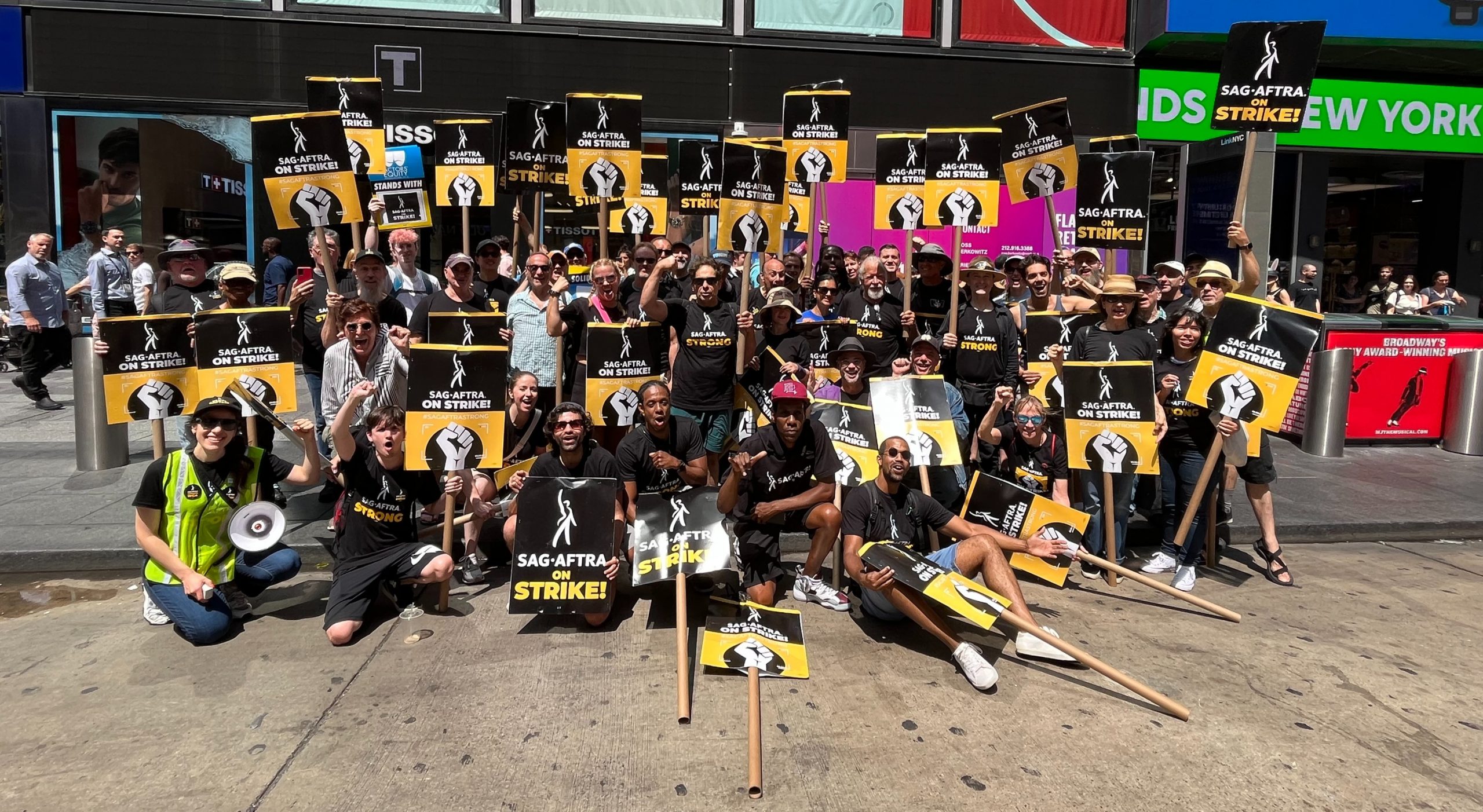
The eyes of America are on Hollywood this summer, but not for the usual reason: writers and actors for film and TV are shutting down production with their first joint strike since 1960. The Writers Guild of America (WGA), representing 11,500 writers, went on strike May 2 and were joined on the picket line July 14 by the 160,000-strong Screen Actors Guild – American Federation of Television and Radio Artists (SAG-AFTRA).
In the public imagination, strikes are often considered to be fights where workers demand better pay or more generous benefits. These are common reasons for strikes, and indeed higher wages and residual payments are among the central demands in the current Hollywood walkout. But strikes are also one of unions’ most powerful weapons for fighting back against business owners and corporate managers who claim the right to run workplaces like private dictatorships.
Unions, in other words, need not only use strikes to demand a larger share of the pie that workers produce — they can also wield them to affect how workers make that pie. WGA and SAG-AFTRA are doing that, too, in fighting for contract provisions that shape the nature of the work process. Writers are demanding that studios increase the minimum size of writers’ rooms on TV shows and agree to prohibitions on the use of artificial intelligence (AI) in the writing process. Actors, meanwhile, want protections against the use of AI-generated likenesses and limits on the use of self-taped auditions.
Explaining the union’s position on AI, SAG-AFTRA president Fran Drescher told PBS News Hour, “When [the studios] offer us a deal, and they say that a background person will get paid for one day is work, we will scan their bodies, and then we can use their likeness in perpetuity, what is going to happen to that background person? He’s out of work. He’s been replaced by A.I. That’s unacceptable.”
Workers have economic reasons for these demands, of course: all of the practices they’re seeking to regulate are relevant to their ability to earn a sustainable livelihood. But because they have to do with what the labor process looks like, such demands go beyond concerns over salaries and benefits. They strike at the heart of our private enterprise system, which grants investors and owners nearly exclusive rights to decide what their workers do all day and how they carry out their assigned tasks.
This particular regime of workplace authority emerged from a long and contentious history. Over the course of the 19th and 20th centuries, labor radicals — including anarchists, socialists and communists — frequently contested management’s claim to have unilateral authority over their employees, instead advocating visions of workplace democracy and collective ownership of firms.
Our current undemocratic employment arrangements are the product of the ultimate defeat of this alternative vision of work. But when workers go on strike to demand a say over their work processes, they are expressing a core insight of the labor radicals: that bosses shouldn’t be able to rule the workplace like petty tyrants.
The right of management
Contract provisions having to do with control of the work process are not uncommon in the United States. At UPS, for instance, the Teamsters workforce recently leveraged a credible strike threat to reach a tentative agreement that blocks the company from installing more surveillance cameras in its trucks to monitor drivers on the job, among other wins. Yet historically, employers have resisted attempts by unions to impinge on their “prerogative” to determine how work gets done.
The question of which aspects of the labor process get to be decided exclusively by management and which aspects workers can have a say over has been a matter of intense debate and struggle since the early days of American unionism in the aftermath of the Civil War. When workers assert control over how production is organized and how it gets done, they are challenging what have traditionally been considered the rights of business owners to make use of their resources and hired labor as they see fit.
Employers insist that those rights are fundamental and inalienable. Under this perspective, attempts to limit management’s prerogatives are illegitimate attacks on the free enterprise system itself. But many militant unionists — especially socialists and left-wing radicals in the labor movement — have taken a different viewpoint. In their study of American communists and industrial unions in the 1930s through 1950s, sociologists Judith Stepan-Norris and Maurice Zeitlin write: “For working-class radicals or socialists, ‘management rights’ are neither ‘inherent’ nor legitimate; on the contrary, such alleged rights constitute, in their view, a quasilegal form of illegitimate class power.”
We don’t accept that the state has unchecked authority to tell us what to do, without any democratic control from the people they govern. Why should we accept the unchecked tyranny of employers on the job? This question has long animated socialist and radical members of the labor movement, who have turned to unions as one of their chief defenses against workplace despotism. And strikes — workers’ ability to stop the flow of production to impede their bosses’ profits — are in turn unions’ main tool to achieve their demands.
Unions, strikes and workplace democracy
Throughout U.S. history, unions have too often conceded to the management-side view in this dispute. American employers won a major battle in this war in 1950 when the United Auto Workers (UAW), under the leadership of staunch anti-socialist Walter Reuther, signed contracts with General Motors and Ford that conceded major areas of authority to management, in exchange for regular wage increases. The union gave up its prior demands to be a part of decision-making about production and have access to the company books, for instance, and agreed not to strike for the duration of its five-year contracts with the automakers.
The “Treaty of Detroit,” as the UAW-GM contract was called, signaled a turning point in the conflict over whether workers should have democracy on the job. “It rejected a vision of citizenship that included the workplace. That would remain management’s sovereign domain, with certain civil rights spelled out and enforced via a bureaucratic grievance procedure,” labor scholars Barry Eidlin and Micah Uetricht write. “What rights were not spelled out were reserved to management, as the soon-to-be-ubiquitous ‘management rights clause’ in nearly every union contract would stipulate.”
In the 1980s, union concessions to management accelerated, with unions like the UAW embracing “labor-management cooperation” schemes that used false promises of worker participation to speed up assembly lines and squeeze more labor out of workers. These methods of getting workers to speed up their own jobs have since been extended from manufacturing to other industries, like education and healthcare.
The retreat from challenging the tyranny of the boss marked the beginning of a long decline in labor’s ambitions and militancy, and, ultimately, the ability of unions to organize workers and demand wages commensurate with productivity. Since the 1970s, declines in union density have led to wage stagnation. Though there have been attempts at legislation in recent years to revive the labor movement and increase employee power in the workplace — like Sen. Bernie Sanders’ (I-Vt.) Workplace Democracy Act and the PRO Act—these bills have never seen the light of the day.
A new day?
Things may be changing. Along with the massive Hollywood strike in which control of new technology is a major issue, there has been an uptick of union organizing at giant corporations like Starbucks and Amazon, as well as a wave of new unions and strikes among workers in higher education. Public favorability of unions and interest in unionizing are also at historic highs (though union membership is still on the decline, and workers who want to unionize face an uphill climb because of the United States’ fiercely anti-union labor law regime.)
And earlier this year, in its first-ever direct election of international officers, the UAW kicked out its long-running, Reuther-founded leadership group and elected reformers dedicated to rank-and-file democracy and militant unionism. The union has started contract negotiations with the “Big Three” automakers: GM, Ford and Stellantis. The new leadership is aiming, among other things, to reassert some amount of control over the organization of production, such as by preventing the farming out of electric vehicle production to nonunion plants and subsidiaries. UAW’s ability to win those demands, like the recent gains made in the Teamsters’ tentative agreement with UPS, will likely depend on a credible strike threat, if not an actual strike.
Hollywood actors and writers on the picket line are withholding their labor to claw back control over their lives on the job. For workers seeking rules around studios’ use of AI, the effort to have a say over the work process is about having control over their own likeness and person. “The thought of not having control over yourself and allowing other people to do whatever they want [to] you and your voice is terrifying,” actor Kate Comer told Jacobin’s Alex Press. “We just want regulations. We just want to have power over our own bodies.”
These strikers are also carrying on a long tradition of American workers refusing to go along with a system where autocratic bosses call all the shots.
ZNetwork is funded solely through the generosity of its readers.
Donate