
The leading national Democrat and presidential candidate Bernie Sanders says some strange things and some sensible things too. The sensible statements are not hard to discern. They include reasonable observations about: the moral obscenity and undemocratic political consequences of the extreme over-concentration of wealth and income in the United States; the grave threat posed to life on Earth by anthropogenic climate change; the inadequacy of the current federal minimum wage; the desirability of large-scale federal jobs programs to build environmentally sustainable infrastructure and provide decent employment; the need to make health care a human right through the introduction of universal single-payer national health insurance (Improved Medicare for All), and more (I could go on). All of this is consistent with longstanding majority progressive public opinion in the U.S. It’s not for nothing that the U.S. corporate media, a critical One Percent asset, has downplayed Sanders’ large rallies while hanging on every word and gesture from the buffoonish, arch-reactionary, and white-nationalist Republican presidential candidate and media personality Donald Trump.
“Take on the Military Industrial Complex…That’s What I Do”
If you listen closely to candidate Sanders, however, you can also hear some odd and disturbing things. Earlier this summer, for example, he told the Southern Christian Leadership Conference that “I take on virtually every element of our current ruling class – from Wall Street, to the insurance companies, to the drug companies to Big Energy, to the Koch Brothers to the Military Industrial Complex. That’s what I do.” But it was preposterous for him to claim to take on “the military industrial complex.” As the World Socialist Website recently observed:
“Sanders is not only generally aligned with Obama administration foreign policy, he has refused to specify a single weapons program or Pentagon project that he would cut or eliminate if elected in 2016. He is a longstanding backer of the most expensive US weapons program, the $1.4 trillion F-35 fighter jet, some of which are to be based in Burlington, Vermont, his hometown….The so-called ‘socialist’ has voted repeatedly for vast Pentagon appropriations bills, maintaining funding of the wars he was (rhetorically) opposed to, as well as funding for the CIA, NSA and the rest of the vast American intelligence apparatus, the infrastructure for police-state spying against the American people…Sanders is a longtime proven defender of US imperialism, not a half-hearted or inconsistent opponent.”
The policy record that contradicts the campaign statement is no minor matter, as in (to paraphrase something Sanders supporters have said to me more than once) “well yes, he can’t be perfect.” Sanders’ attachment to the imperial project gravely undermines his progressive domestic policy agenda. Accounting for nearly half the world’s military spending and maintaining more than 1000 military installations across more than 100 nations, the giant Pentagon budget swallows up 54 percent of U.S. federal discretionary spending. It must be very significantly rolled back if the U.S. is going to fund the ambitious social and environmental programs that Sanders rightly advocates on the campaign trail.
By the way and for what it’s worth, Sanders said on ABC News last Sunday that if elected president he will not end the United States’ controversial and mass-murderous drone program in the Middle East. He said he would maintain the targeted killing campaign but suggested he would adjust the program so that “drones don’t kill innocent people.” The military-industrial complex was pleased, no doubt.
For Increased Saudi Militarism
Another strange utterance from Saint Bernard is his curious and repeated call (when pressed on international relations) for the murderous House of Saud to boost its military profile. While Sanders has done his best to avoid foreign policy in his campaign, he has been heard telling voters and journalists that the viciously reactionary and monarchical, jihad-fueling state of Saudi Arabia needs to step up its military aggression in the Middle East to help make the region and world more secure from terrorism and to “save the soul of Islam.” It’s a bizarre and alarming position to take. As Sam Husseini recently argued at CounterPunch:
“What? Why should a U.S. progressive be calling for more intervention by the Saudi monarchy? Really, we want Saudi troops in Syria and Iraq and Libya and who knows where else? You’d think that perhaps someone like Sanders would say that we have to break our decades-long backing of the corrupt Saudi regime — but no, he wants to dramatically accelerate it….[this even] after the Saudis started bombing Yemen with U.S. government backing earlier this year, killing thousands and leading to what the UN is now calling a ‘humanitarian catastrophe,’ and suffering that is ‘almost incomprehensible.’ Progressives in the U.S. are supposed to look toward the Saudi monarchy to save the soul of Islam? The Saudis have pushed the teachings of the Wahabism sect and have been deforming Islam for decades. This actually helped give rise to ISIS and Al Qaeda. It’s a little like Bernie Sanders saying that the Koch Brothers need to get more involved in U.S. politics, they need to ‘get their hands dirty.’”
“My Good Friend Hillary”
Then there’s Bernie’s repeated reference to Hillary Clinton as a “good friend” and his related refusal to offer any substantive criticism of her. Why would a “socialist” and “independent” politician and “activist” be “good friends” in a supposedly adversarial political culture with a fabulously wealthy and notoriously mendacious arch-corporatist and militarist major party politico like Hillary Clinton, who forcefully backed George W. Bush’s invasion of Iraq and applauded her husband’s sadistic elimination of public family cash assistance for poor families through a vicious welfare “reform” (elimination) that has had disastrous consequence for the nation’s most vulnerable citizens.
Mrs. Clinton helped lead the development of the neoliberal “New Democrat” movement, which pushed the Democratic Party to abandon its last lingering commitments to labor unions, racial and social justice, and environmental protection. She voted (as a US Senator) for legislation
 advanced by Wall Street to make it more difficult for poor families to use bankruptcy laws to get out from under crushing debt. She called (as Secretary of State) the richly corporatist, regressive, anti-worker, secretive, authoritarian, and eco-cidal Trans-Pacific Partnership (TPP) “the gold standard’ in agreements for “open free, transparent, fair trade, the kind of environment that has the rule of law and a level playing field.” She “operates,” in the words of New York Times reporter Carolyn Ryan, in “a world awash in money and connections and a very privileged place” – this while deceptively posing as a “populist” who is “in touch” with the concerns of everyday working Americans. She gives speeches to leading Wall Street firms (and the Chicago Mercantile Exchange) for more than $200,000 each – more than four times U.S. median household income – as part of her effort to build a preemptive “money machine” to block rivals from making serious primary and caucus challenges.
And Hillary Clinton said the following – in her role as the head of the Clinton administration’s failed corporatist health reform initiative – to a leading national physician and health care activist when he told her in 1993 that “Canadian-style” single-payer health insurance was supported by more than two-thirds of the U.S. populace and was certified by the Congressional Budget Office as the most cost-effective plan on offer: “tell me something interesting.” (Along with the big insurance companies that they deceptively railed against, the “co-presidents” Bill and Hillary Clinton decided from the start to exclude the popular health care alternative – single payer – from the national health care “discussion.” Obama would do the same exact same thing in 2009).
Spoiling Not to be a Spoiler?
Early in announcing his campaign, Sanders pledged that he would never play the role of “spoiler” by running as a third party candidate against the presidential candidates put forth by the capitalist Democratic and Republican parties in November of 2016. But why would a progressive candidate sincerely concerned with helping poor, working, and middle class people give away in advance his capacity to extract commitments on those people’s behalf by reserving the right to inflict real electability damage on a corporate Democrat candidate in the general election if no progressive policy and/or political concessions were agreed to? The other thing is that a strong Sanders campaign – and the Sanders sensation must (unsurprisingly in my view) be judged as successful as this point (his giant rally turnouts and climbing poll numbers speak for themselves) – could well inflict significant “spoiler” damage on Hillary Clinton’s capacity to defeat her Republican opponent next year. Sanders might actually be damaging Hillary’s chances of beating Jeb Bush or Marco Rubio by helping push her rhetoric left (thereby costing her moderate voters), by compelling her to go negative, by exposing further her chronic inauthenticity and elitism, by defeating her in the early primary and Caucus states, and perhas by forcing her into an extended nomination fight. As Bloomberg’s Mark Halperin noted last July, “Not long ago, few would have imagined that Sanders could have posed any sort of threat to Clinton’s political fortunes. Sanders might lose in the end, but his successes thus far and going forward make it more likely that Clinton will lose in the end too.”
A clever neighbor of mine in Iowa City is a left Democrat. Every four years he Caucuses with the Republican Party in an effort to help give campaign momentum to a candidate who he thinks is very likely to cause general election problems for the GOP. My guess is that a few devious Iowa Republicans will be doing the same for Sanders in the Iowa Caucus next January – with some reason.
Is there a problem with helping undermine Hillary Clinton from a radical perspective? Perhaps yes, actually. Having a Republican in the White House seems to make it easier for Democrats to channel people’s organizing energies into inherently dysfunctional (see the next section of this essay) major party electoral campaigns on the theory that Republicans in power are the main cause of the nation’s ills. The theory is of course woefully and dangerously false. The U.S. oligarchy gets what it wants through both parties, including the Democrats. The capitalist, sexist, racist, imperialist, and eco-cidal profits system and plutocracy are the real and deeper source of the evil that afflicts us. And here’s a key point: popular understanding of that very basic fact seems to have a much better chance of gaining traction when Democrats hold the White House than when Republicans do. Democrats in power help demonstrate to workers and citizens that the not-so “leftmost” of the two reigning capitalist parties is just as captive (in its own devious ways) as the more transparently business-owned GOP to the nation’s unelected and interrelated dictatorships of money, empire, and eco-cide. If that leads to the tactical conclusion that a Hillary Clinton campaign undamaged by a potentially debilitating Sanders challenge is desirable next year, then so be it. Be shocked, dear reader, but it’s not my fault: God knows I didn’t invent this crazy fucking system.
Magical Manipulation?
Sometimes Sanders combines the strange and the sensible in the same statement. Listen to this following repeated reflection from Sanders’ stump speech thus this summer:
“…let me tell you something that no other candidate for president will tell you. And that is [that] no matter who is elected to be president, that person will not be able to address the enormous problems facing the working families of our country. They will not be able to succeed because the power of corporate America, the power of Wall Street, the power of campaign donors is so great that no president alone can stand up to them. That is the truth. People may be uncomfortable about hearing it, but that is the reality. And that is why what this campaign is about is saying loudly and clearly: It is not just about electing Bernie Sanders for president, it is about creating a grassroots political movement in this country.”
Sanders is quite right that a genuinely progressive US president would get nowhere, policy-wise, without a vast popular movement backing him up and pushing the nation to the left – in accord with majority progressive public opinion. That’s a very elementary fact, straight out of Howard Zinn’s brilliant People’s History of the United States. As Zinn wrote in March of 2008, in an eloquent essay penned against the major party candidate-centered “election madness” he saw “engulfing the entire society, including the left” (sound familiar?) in March of 2008:
“Would I support one candidate against another? Yes, for two minutes—the amount of time it takes to pull the lever down in the voting booth. But before and after those two minutes, our time, our energy, should be spent in educating, agitating, organizing our fellow citizens in the workplace, in the neighborhood, in the schools. Our objective should be to build, painstakingly, patiently but energetically, a movement that, when it reaches a certain critical mass, would shake whoever is in the White House, in Congress, into changing national policy on matters of war and social justice. -Let’s remember that even when there is a ‘better’ candidate (yes, better Roosevelt than Hoover, better anyone than George Bush), that difference will not mean anything unless the power of the people asserts itself in ways that the occupant of the White House will find it dangerous to ignore…. the Democratic Party, unless it faces a popular upsurge, will not move off center…The Democratic Party has broken with its historic conservatism, its pandering to the rich, its predilection for war, only when it has encountered rebellion from below, as in the Thirties and the Sixties. We should not expect that a victory at the ballot box in November will even begin to budge the nation from its twin fundamental illnesses: capitalist greed and militarism. So we need to free ourselves from the election madness engulfing the entire society, including the left.”
There are two basic problems with Sanders’ reflection, however. First, the nation’s “unelected dictatorship of money” (Edward Herman and David Peterson) and “hidden primary of the ruling class” (Laurence Shoup) has and will exercise the power not only to block a hypothetical progressive president’s progressive agenda. It also has and will use that power to block a progressive from becoming president in the first place. The notion of Sanders ascending to the White House in the name of single-payer insurance, genuinely progressive taxation, giant federal green jobs programs, a financial transaction tax and the like is fairly fantastic under the current U.S. corporate-managed “democracy.”
As Arun Gupta recently and sensibly noted on CounterPunch: “If Sanders miraculously wins the nomination, he will be buried in the general election by an avalanche of corporate money and a right wing that will make him out to be the second coming of Stalin, who will abolish private property, ban marriage, outlaw religion, destroy the economy, and ship you off to a forced labor camp….” Let’s be serious: the two major parties, the corporate-media-elections complex, and the broader system of empire and inequality that they serve are not about to let a “socialist” – even a merely nominal one (see below) who backs the U.S. imperial project like Bernie Sanders – become President of the United States.
Second, Democratic Party politics, electioneering, and presidential (and other) candidates have long been cold-blooded anesthesiologists and gravediggers for the militant grassroots activism and the great “rebellion[s] from below” (Zinn) that alone have compelled the “occupants of the White House” (and of Congress and of state and local offices) to pay attention to popular needs and aspirations. American History is littered with once great popular movements that have been crushed and/or co-opted by the Democratic Party and Democratic elected officials. The Cemetery includes the populist agrarian rebellion of the 1890s, the industrial workers’ uprising of the 1930s, the Civil Rights struggles of the 1960s, the antiwar movement in 1972, the feminist movement of the 1970s, the gay rights movement of the 1990s, antiwar movement in 2004 (finished off by Obama in 2008), the Wisconsin worker rebellion of early 2011, and the Occupy Movement of later that year. The Democratic cooptation movement is well underway with regard to Black Lives Matter.
Sanders may appear to be the friend of social movements with his campaign rhetoric, but his crusade is by its nature primarily about “election madness” and “who’s sitting in the White House,” not building militant grassroots organization and “who’s sitting in the streets” (Zinn’s well-known dichotomy). If he seriously intends to help build a militant left popular movement beneath and beyond the latest quadrennial candidate-centered major party presidential election spectacle (something I very much doubt), he has little history to cite on behalf of a successful outcome in that regard. “Progressive Democrat” presidential campaigns are notorious for making promises along these lines and leaving nothing serious in the way of real popular movements beyond their electoral focus. Here again I concur with Gupta:
“After 2016 Sanders is not going to turn over his organization with its apparatus, lists and expertise to the left. Past experience — Jesse Jackson’s Rainbow Coalition, Howard Dean’s Democracy for America, Barack Obama’s Organizing for Action — shows candidates retain tight control over their organization. Even in 2000, when Ralph Nader ran as the Green Party’s presidential nominee, but did not exert control over the organization, he failed to benefit the party despite the 2.9 million votes that he garnered…Expecting a presidential campaign to solve the problem of organization is magical thinking…. If America is the land of the get-rich-quick scheme, the American left is the province of the get-power-quick scheme. It’s always looking for the one tactic, the one protest, the one election that will change everything. [In reality, however], Building power that’s strong and flexible takes years in the trenches developing organization, trust, community, leadership, action, and theory. Taking an electoral shortcut to power means fracturing movements as those with the least power are pushed to the sidelines. Leftists may thrill at finding a ‘socialist’ horse on the electoral merry-go-round, but if they hop on board they’ll be the ones taken for a ride” (emphasis added).”
Is it impossible that Sanders’ campaign could break the historical mold in that regard and transform a major party candidate-centered presidential campaign into a powerful and militant grassroots movement for bottom-up progressive change? No, of course it isn’t. Just like it’s not entirely impossible that Sanders could win the Democratic presidential nomination and even the presidency. Nothing in politics (or sports or countless other areas) is 100%. The Chicago Cubs are making a serious run for their first World Series appearance in 70 years this summer and fall. But the odds against Sanders doing these things are very small (certainly much worse than those against the Cubs). Given the rich historical record of how presidential campaigns and the Democratic Party negatively impact popular movements in the U.S., it is hard not to suspect that St. Bernard’s radical-sounding reflection is less about real rank-and-file sociopolitical movement organizing than it is about enticing (“sheep-dogging,” to use Bruce Dixon’s clever phrase) disgruntled voters and ex-voters who are understandably skeptical about the progressive effectiveness of U.S. electoral politics and the Democratic Party. The most cynical observer might add that that it is also about providing cover (as in “it’s your fault U.S. citizens, you didn’t make me progressive enough!”) for the inevitable deep accommodations he would have to make with organized wealth and power were he to (semi-miraculously) succeed in his quest for the White House.
“Bernie is Turning Hillary Into a Progressive”
Sanders’ dreamy enthusiasts have been saying some strange things to me as well. “Bernie,” they tell me, “is pushing Hillary Clinton to the left.” No, he isn’t. Not really. Nobody is about to move the died-in-the-wool neoliberal corporatist and militarist Hillary Clinton to the left in any serious way beyond the margins of her campaign verbiage. Democratic Party candidate rhetoric has long been largely about “the manipulation of populism by elitism” (a still-Left Christopher Hitchens, 1999) – a devious art the Clintons mastered decades ago. Insofar as Mrs. Clinton’s language has moved “left,” this is due largely to the longstanding populist and progressive state of majority public opinion in New Gilded Age America, where, as Sanders likes to note, the corporate and financial top 1 percent owns more wealth than the bottom 90 percent of Americans along with a roughly comparable percentage of the nation’s not-so democratically elected officials. Americans are quite naturally mad as Hell about the ridiculous and dangerous over-concentration of wealth and power in the U.S. No Democratic candidate who seeks to attract enough Caucusers and voters to win her party’s presidential nomination can fail to pay significant progressive-sounding lip-service to that anger. But words and deeds are of course two very different things. At the same time, the “shadow candidate” and U.S. Senator Elizabeth Warren (D-MA) is probably just as relevant as the Sanders challenge in nudging Hillary’s words in a progressive direction.
“Bernie is Making Socialism Legitimate”
“Bernie,” other Sandernistas tell me, “is making socialism legitimate in America again.” That is a highly dubious assertion. Well before the Sanders sensation, the end of the Cold War (which sadly identified the liberating and democratic socialist ideal with the dungeons of Stalin and Mao), the decline of the Soviet Union and bloc, and the frankly terrible performance and plutocratic authoritarianism (and spiritual nothingness) of Neoliberal Age global and U.S. financial-state capitalism combined to make “socialism” less of a dirty word in U.S. life and political discourse than in any time of recent memory. That said, candidate Sanders does not actually call for socialism. He is not running as a “socialist” at all. He does not criticize or even refer to capitalism or the profit system, the underlying political-economic regime that is wired for the endless upward distribution of wealth and power and the ruination of livable ecology. Sanders rails against “the billionaire class,” against economic inequality, against the Republicans, against FOX News, against the Citizens United decision, and against the terrible Koch brothers.
He’s running as a strident populist Democrat. In that regard, he’s not really all that different from Dennis Kucinich in 2003-04, Jesse Jackson in the 1980s and even John Edwards in 2007-08, all of whom struck strong populist chords in efforts to reach the Democratic Party’s progressive primary base. When quizzed by reporters on what socialism means to him, Sanders simply says that the United States can learn a few things from Scandinavian states when it comes to having a stronger welfare state, socialized health care, stronger unions, and the like. He seems to be diluting the meaning of the word socialism (which for actual socialists refers to workers’ control of production and the democratic running of the economy for people and the common good, not the profits of a capitalist elite) as much as advancing it.
“He’s Like Obama in 2007-08”
“Remember where Obama was in 2007,” more than a few Sandernistas have told me in Iowa City (ground zero for Berniemania this year and for Obamania eight years ago). “Nobody thought he could win and he did. Bernie will do the same. He’s like Obama!” That one really makes my jaw drop, and not just because I picked Obama as next U.S. president (as irresistible to the aforementioned “hidden primary”) the minute John F. Kerry lost to George W. Bush (with some help from GOP shenanigans in Ohio and elsewhere) in 2004. It betrays shocking ignorance of key differences between the former and fake-progressive non-Hillary candidate (Obama, Inc.) and the latter, actually progressive non-Hillary candidate.
Candidate Obama enjoyed remarkable corporate media approval. He began accumulating what would be a record setting Wall Street-funded campaign war chest more than five years prior to the 2008 presidential election. He wore the deceptive but popular (with the Democratic primary base) mantle of being the “antiwar candidate” at a time when George Bush’s invasion of Iraq was still a key issue for primary voters. Sanders is far less favorably situated on all these scores. To make matter worse, his white maleness, age, and grumpy-frumpy persona help make him far less popular than the telegenic and young Obama was with huge demographic components of the national Democratic presidential voting base: Blacks, Latinos, Asians, women, and youth. Not that the deeply conservative fake-progressive and neoliberal imperialist Barack Obama is a good thing to be, but Bernie Sanders is no Barack Obama.
“You Are Too Cynical and Pessimistic”
“You are too cynical and pessimistic,” Sandernistas tell me and other “negative” and “alienated” “ultra-radicals” who don’t wish to leap aboard Bernie’s magical electoral merry-go-round on the standard top-down and quadrennial schedule for “that’s politics.” The charge is ill-founded. I fully acknowledge being thoroughly jaundiced about the promises of politicians and about U.S. major party electoral politics as currently constituted. The former strikes me – yes, I admit it, I confess – as empty, self-serving hot air fit for high Shakespearian mockery. The latter strikes me as a dollar-drenched racket richly deserving of complete contempt. “Colored lights can hypnotize,” I say to electoral-politicking carnival barkers: “sparkle someone else’s eyes” (apologies to the Guess Who?).
But so what? If U.S. major party candidate- and voting-centered politics and its “highly personalized quadrennial electoral extravaganzas” (Noam Chomsky in late October of 2004) were the total universe of all the politics and activism that matters, then, yes, I would be a completely cynical and negative pessimist. In a similar vein, if U.S football (which I now just call “Brain Mash”) was the only sport in the nation, then I would be a “negative” opponent of all U.S. sports. But guess what? Such politics is not the only game in town, just like proto-fascistic “Brain Mash” (U.S. “football”) is not the only sport for me to follow. How many times I have heard a fellow American respond to the latest betrayal of a campaign promise to voters by an elected official with the statement “oh well, that’s politics”!
Well, yes, that’s one kind of politics, but there’s a different and more urgent politics beneath the voting rituals and the steeply staggered election cycles. I remain remarkably, even spiritually optimistic about the capacity for workers and citizens to engage in relevant popular historical agency through non-electoral organizing efforts like Black Lives Matter, Occupy Wall Street, the immigrant rights movement, and the low-wage worker organizing efforts that have recently made real social change and perhaps forced the Democrats somewhat to the left. Let my progressive critics charge cynicism and despair. There’s a deeper and actually optimistic logic here, one that places far greater significance on the longer term ground game of grassroots organizing than on the momentary thrills provided by probably doomed electoral efforts that tend to distract workers and citizens from the more urgent politics of militant grassroots movement-building.
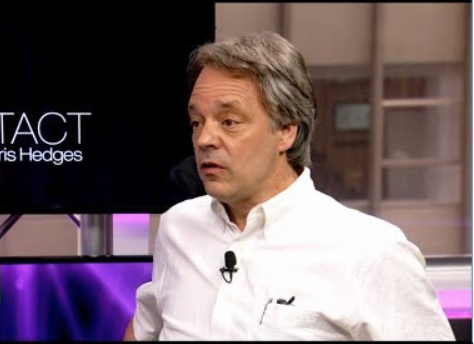
Paul Street is an independent radical-democratic policy researcher, journalist, historian, author and speaker based in Iowa City, Iowa, and Chicago, Illinois. He is the author of more than ten books and numerous essays. Street has taught U.S. history at numerous of Chicago-area colleges and universities. He was the Director of Research and Vice President for Research and Planning at the Chicago Urban League (from 2000 through 2005), where he published a highly influential grant-funded study: The Vicious Circle: Race, Prison, Jobs and Community in Chicago, Illinois, and the Nation (October 2002).
ZNetwork is funded solely through the generosity of its readers.
Donate

