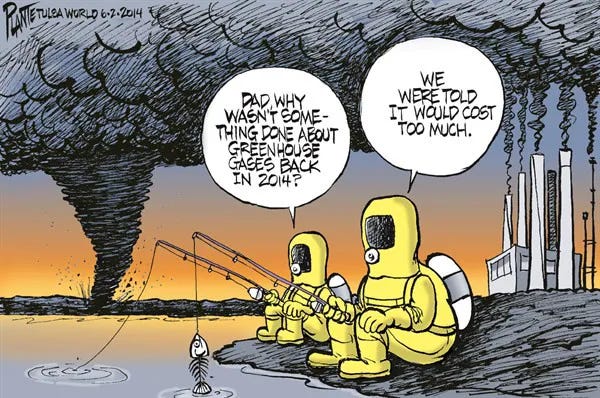
So, it’s more than ten years since the celebrated 2015 Paris Climate Agreement – and humanity remains totally unprepared for the cataclysmic consequences of accelerating climate change. In truth, our efforts to respond meaningfully have gone backwards. Live evidence everywhere of increasing, collapse-threatening risks is being ignored by governments, corporations and a global media transfixed by a chaotic circus of brutal geopolitics. At the time of writing Donald Trump is at war in Iran and no-one is facing up to way-more-dangerous, climate threats hurtling towards us, way faster than expected.
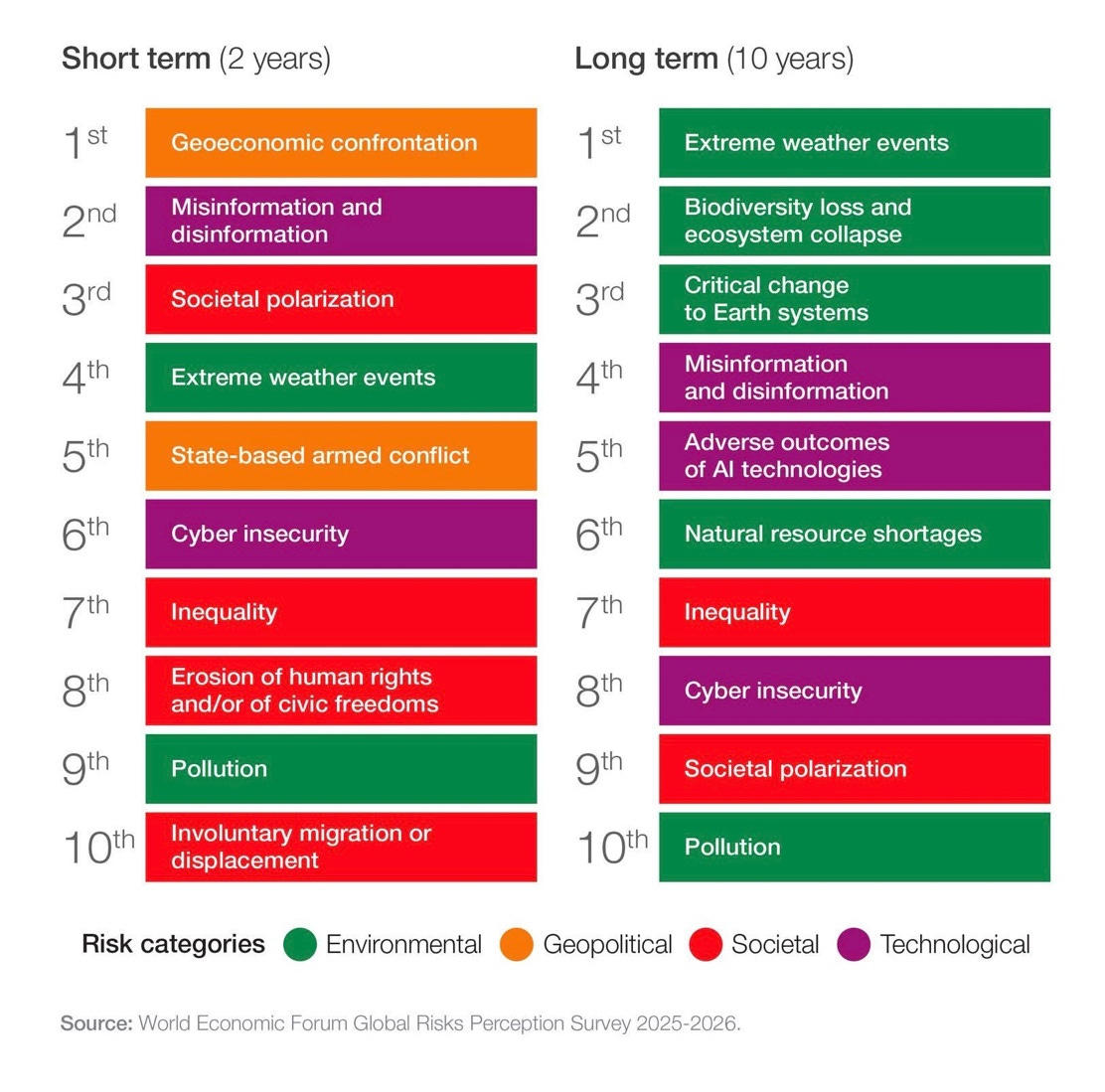
And it’s not, to be clear, as if those with any influence don’t know. In advance of their January 2026 meeting at Davos – where all the attention was on Trump’s performative threats to Greenland – the World EconomicForum (WEF) published their updated assessment of the threats facing humanity.
WEF Global risks ranked by severity as at 2026:
The WEF recruited 1300 leading experts from academia, business, government and wider society for this task – none of them were climate ‘doomers’. Their conclusion that the most serious global problems, in just 10 years, will be extreme weather, critical changes to Earth systems and eco-system collapse, aligns with those few climate scientists brave enough to talk publicly about what’s actually happening. These include Klaus Richter, president of the German Physics Society (past president Einstein) and Frank Böttcher, head of the German Meteorology Service, who warned in September 2025 that we are heading towards +3.0°C above pre-industrial average global temperatures by 2050. Asexplained to Die Zeit, they based this conclusion on simple calculations of the observable speed of change and the fact there was no reason, including war, to expect this to slow down.
No serious scientist ever said the impacts of +3.0°C by 2050 could be manageable, or even survivable for billions of us – theParis Agreement set a ‘safe limit’ of +1.5°C by 2100, with some arguing for an outlier maximum of +2.0°C. Two more with the guts to speak out, marine biologists and IPCC authors Greta Pecl and Bill McGuire, give humanity between 5 and 15 years before climate chaos and related agricultural shortages provoke global societal breakdown, i.e. more or less in line with WEF predictions.
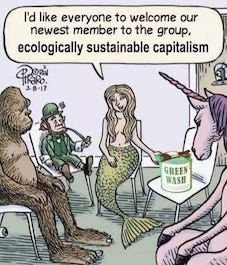
By contrast, the UN’s Intergovernmental Panel on Climate Change (IPCC), and most mainstream scientific commentators including the pre-eminent Michael E. Mann still won’t admit to the failure of their slow-paced methods to predict recent temperature accelerations, nor where we are undeniably heading. They remain, inexplicably, dependent on these same methods to forecast possible temperatures for 2100 starting at +2.0°C, while pretending under +1.5°C remains achievable. Worse, these climate minimisers continue to inform the blatantly-inadequate ‘solutions’ of governments and the ‘green’ sector to our desperate climate reality – as co-ordinated by the UN’s Conference of Parties (COP) process.
COP30, in November 2025, played out against a backdrop of global temperatures already exceeding +1.5°C during the period 2023 to 2025, with 2026/27 forecast to hit yet more extreme highs. This did not stop delegates referring to national climate targets and related ‘net-zero’ solutions that, ‘remain largely unchanged’ according to the energy thinktank Ember in July 2025 – because they are still based on under-estimates the IPCC provided in 2015.
This article will summarise these solution-delusions, before considering the psychological reasons for our collective avoidance of climate reality.
What energy transition?
The UN, most governments and the green sector still insist the, ‘transition to renewable energy’ is the big answer. They ignore the fact this has had no meaningful impact to-date on either emissions or accelerating temperatures, and broadcast instead the myth we are closing in on a fictional tipping-point, where renewables ‘overtake’ fossil fuels.
They always gloss over the fact this overtaking refers only to global electricity consumption which, as per the World Energy and Climate Statistics Yearbook,accounts for only around 20% of global energy usage –with the rest still coming from fossil fuels. And they never mention that half of even that electricity is still fossil-fuel driven.
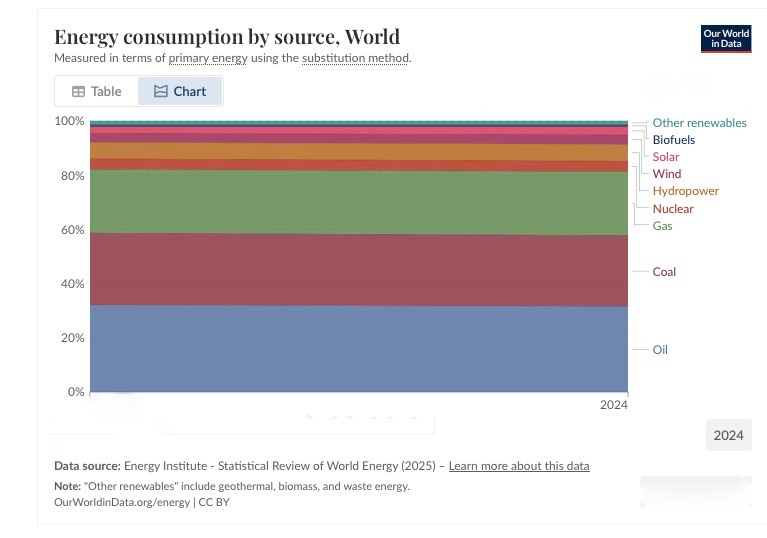
This misrepresentation also masks the reality of global primary energy consumption i.e. before 20% of it is converted to electricity, which looks like this:
This is the data that matters to greenhouse gas emissions, and it shows 82% of global primary energy consumption was sourced from fossil fuels in 2024. Only 4(FOUR)% of the 2024 total came from wind and solar, increasing to near just 5% in 2025. This ‘good news’ of a ‘20% increase!’ was highlighted by the Global Energy Monitor, and enthusiastically picked up by news agencies.
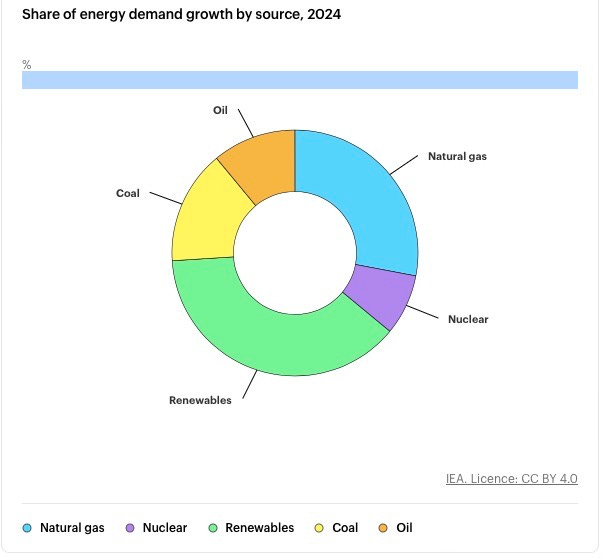
Other deliberate distortions include the claim renewables are close to powering most of ‘world energy demand’, when this only refers to demand for increases in energy use, as per this graphic from the International Energy Agency.
This looks positive but what it means is, ‘renewables’ didn’t even produce enough energy to power most of the increase in energy demand during 2024.
Similarly, China’s ‘progress on renewables’ is relentlessly championed along with pictures of vast areas covered in solar panels, but China still emits the most CO2, is responsible for more than 50% of global coal consumption and is second behind only the US in oil. China may get close to 10% of primary energy use from wind and solar by 2035, but this is meaningless in the context of accelerating climate threats.
Perhaps nothing better illustrates the fiction of this ‘transition’ than Electric Vehicles (EVs). In 2015 the world’s total vehicles in operation (VIO) was around 1 billion, nearly all petrol or diesel powered. In 2026 this VIO has risen to around 1.65 billion of which only around 65 million are EVs – i.e. around 4%. The public are duped into believing EVs are meaningful as a response to global heating, when the truth is the sector forecasts a VIO of 2 billion by 2035, with at least 1.75 billion of these being fossil fuel powered. The breathless announcements of higher EV numbers refer only to sales of new vehicles in specific markets, and mask the truth that EVs sustain nothing except the auto-industry.
Even-more-delusional solutions…
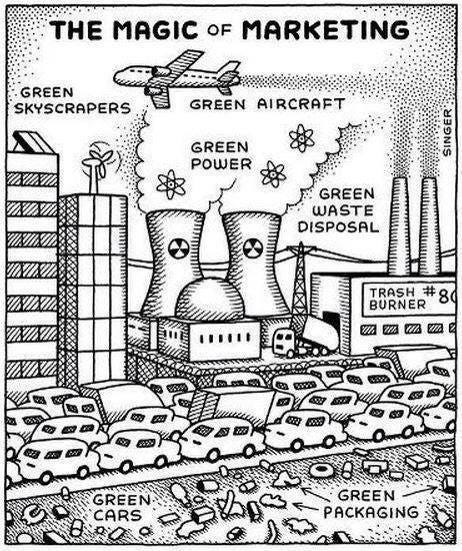
In addition to the lie – an unavoidable word – of an energy transition, there are a growing number of other offenders including:
1. Carbon Dioxide Removal (CDR) and Capture Capture and Storage (CCS).
On the other side of the worthless, ‘net-zero’ coin from the energy transition, CDR is the removal of atmospheric greenhouse gases we already put up there while CCS ‘captures’ new ones. These are both supposedly achievable by new technologies – but nothing has been developed capable of doing either on a remotely meaningful scale.
Even the most financially-invested supporters of CDR do not envisage capacity hitting more than 5billion tonnes p.a. before 2050. For context, the CDR figure claimed for 2024 was 20 million tonnes, while humanity emitted a record-high, 38 billion tonnes of CO2 in 2025alone, in addition to the 1550 billion we’ve added since industrialisation began.
Meanwhile, most of the equally-negligible projected capacity of CCS, has already been bought up by fossil fuel companies and BigTech, to ‘offset’ projected increased emissions from new oil extraction and AI projects.
2. ‘Net zero’ itself.
Where carbon emissions become equal to carbon re-absorption, net-zero is still cited as a solution – in spite of the energy-transition and CDR/CCS interventions supposed to deliver this being so inadequate. Similarly ignored here, is the rapidly reducing capacity of natural ‘carbon sinks’ – mostly oceans and forests – also as a result of climate change impacts.
3. Carbon ‘management’.
The lucrative ‘green’ space is full of consultancies with environmentally-friendly names, who are anything but. They include, for example, ‘Better Earth’ who employ the disgraced, former UK Prime Minister Boris Johnson, and offer their expert climate ‘advice and assistance’ to the likes of the Saudi Arabian government.
4. Personal action.
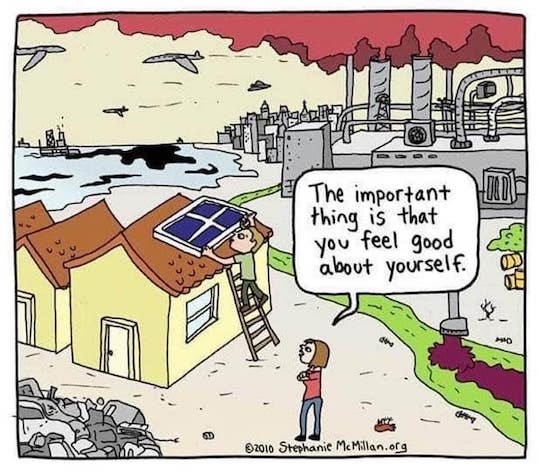
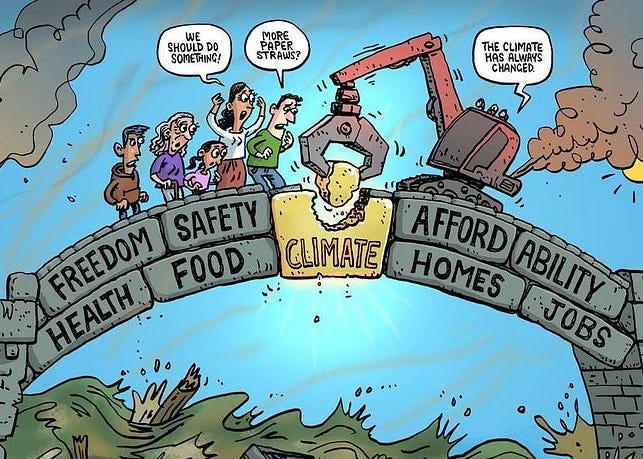
Ongoing exhorting of people to ‘do their bit’, as the BBC website says, could not be more misleading. People are not told, ‘recycling’ packaging achieves little – it’s the needless consumption that has to stop. They are not told that behind ‘re-usable’ campaigns – global plastic production reaches all-time highs. They are not told that while individual action does make us feel better – it makes zero difference to our trajectory; it’s choosing the vegan option on The Titanic.
5. Small community action.
Featuring fantasies of resilient communities, promoted by such as ‘The Raft’ in the UK who acknowledge ‘this civilization is dying’, but assert ‘there will be seeds of a new civilisation to survive it’. They do not make clear how, ‘your town’ will survive the violence and disease provoked by an absence of food and clean water – because it won’t.
6. Tree planting.
Popular but ineffective, as per ecologist Ken Caldeira of the Carnegie Institution of Washington who confirmed in 2007, “To plant forests to mitigate climate change outside of the tropics is a waste of time.” COP30 pledged to deliver protection of tropical rainforest, but the host government Brazil reneged on their related commitment within days of the closing ceremony.
7. Ludicrous techno-fixes.
With dismal records of achievement, these are usually funded by guiltily-aware foundations of the super-rich, and embody the fantasy we can ‘invent’ ways to control the forces we have unleashed.
Examples of this grandiosity appear in the journal TCD (The Cool Down) which champions, ‘the coolest tech shaping our cleaner future’ aimed at ‘refreezing the Arctic’. For context, a University of Oslo study found the Svalbard Arctic archipelago lost 600% more than the average of its ice cover, in just six weeks of 2024. As co-author Thomas Schuler said, “It was shocking.” All the ‘cool’ ideas in TCD combined would likely not offset the 60 gigatons of ice lost in this one heating event.
8. Solar geo-engineering to reverse ‘overshoot’.
The ultimate techno-fix involving injecting particles into the atmosphere to deflect sunlight back into space, deployed from aircraft – for as long as the flights continue. Obviously temporary, it aims to buy time for other ‘solutions’. For most scientists the idea of blocking out the sun is, as Frank Biermann of the University of Utrecht says, ‘crazy for a variety of reasons.’ Pilot schemes of this incredibly-dangerous intervention are endorsed by the IPCC and funded by the US and the UK – proving if nothing else, how dire many senior people know the situation is.
9. False-hope and anti-doomerism.
Championing ‘hope’ as a solution in itself is mandatory for all minimisers, from political parties to the IPCC and the green sector. This toxic-positivity relies on the psychologically-stupid concept that rational alarm must not be raised, to avoid provoking some form of imagined paralysis. This goes hand-in-hand with condemning those being realistic about climate threats as dangerous ‘doomers’. Accelerating temperatures and a cascade of related extreme events both prove the doomers right, and show it is these ‘hopeful’ minimisers who dangerously inhibited meaningful responses.
Accelerating consequences and the un-speakable truth.
In the real world, unmitigated by any ‘solutions’, no land mass or ocean is escaping the destructive consequences of man-made climate changes happening at bewildering pace.
Some of the more serious examples, in 4 months of 2026 alone, include: record flooding causing thousands of deaths and millions to be displaced across Afghanistan, Peru, South Africa, Indonesia, Mozambique, Zimbabwe, Morocco, Tunisia, Portugal, Hawaii and Guandong China (where 600,000 were also displaced by flooding in 2025); record Southern Hemisphere heatwaves and fires from Argentina to Australia; drought threatening major cities, like Sao Paolo and Tehran (down to 10% water reserves before the impacts of war); and an extraordinary ‘heat-dome’ across the USA threatening more drought and another extreme fire season.
All this live evidence blows away our delusional, green smokescreen to reveal 2 simple, undeniable truths no-one dares publicly admit:
1. Our climate solutions have failed to meaningfully reduce emissions – and they never will.
2. The only way humanity can meaningfully reduce emissions is via drastic reductions in activity, which means reversing economic ‘growth’. This ‘growth’ is in fact no such thing; measures like Gross Domestic Product are instead indicators of increasing environmental destruction i.e. what we must stop doing to survive.
Again, it’s not as if our leaders don’t know. The UN’s Antonio Guterres, even working on IPCC understatements, announced in 2024 the world needed to reduce emissions by 7% (more than occurred during Covid19) every year, to stay under +1.5°C by 2030 – a rate no-one could claim is realistic without reductions in activity.
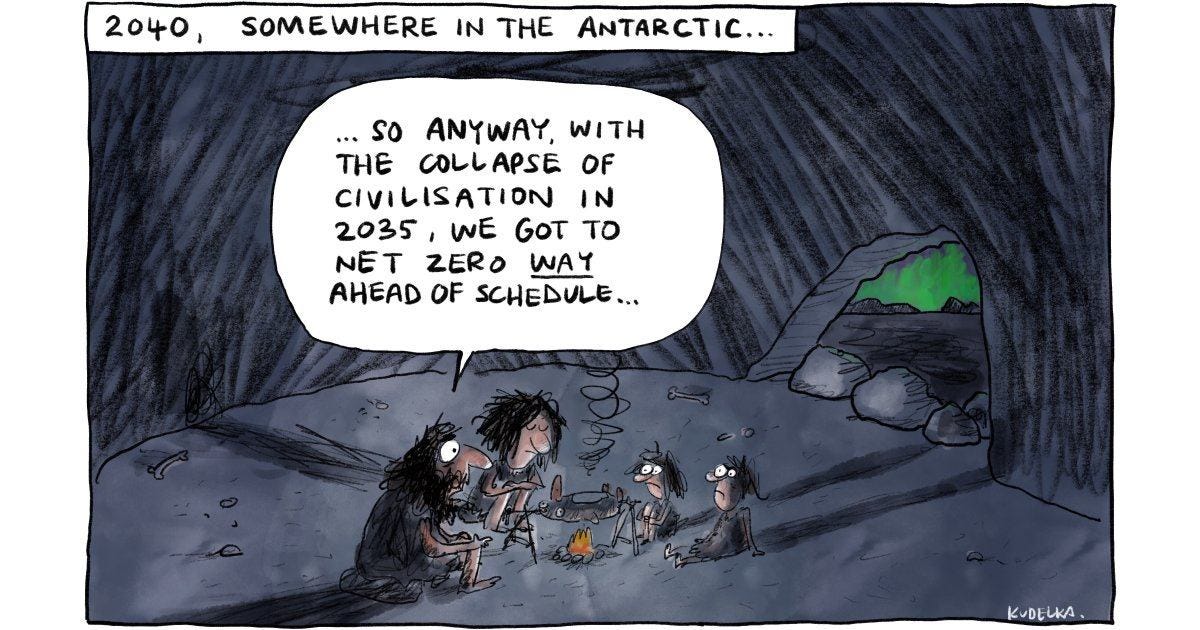
Needless to say, no leader is going anywhere near the unspeakable but inescapable fact the only meaningful ‘transition’ we could make now, is to a system designed to meet only our essential needs, while diverting other resources to urgent adaptation and preparation.
This collective avoidance of the radical climate actions we must take, is a form of collective psychosis – where psychosis is defined as being ‘out of touch with reality’. Understanding this allows us to see the apparent insanity of our avoidant behaviours as collective psychological defences, occurring across all human groups.
In the US, even the term ‘climate-change’ has been suppressed by a media in thrall to the denialism of Trump’s asinine regime. Other governments and their opposition parties, including those on the left and the greens, pay lip-service to ‘net-zero’ plans but in truth none of these is closer than the US to abandoning ‘economic growth’ – nor are any global corporate, media or civil organisations.
The problem is, although many leaders must know the incredible dangers highlighted by WEF predictions etc, they also know they would be unemployed if they try to act on these. Thus they suppress their awareness and distract themselves with the demands of hectic day-jobs.
Our lily-livered scientists have no such option – the climate is the day-job. Those few who face the public increasingly obfuscate, as per the IPCC burying itself in convoluted processes or the ‘debate’ about when average temperatures can ‘officially’ be declared in excess of +1.5°C – when such discussion is statistically-invalid in a rapidly accelerating context. Or, like Michael Mann, Katherine Heyhoe and IPCC chair Jim Skea, they make public shows of attacking denialists, to deflect from their responsibility for misinforming the public about the pace of change and the responses needed.
Kevin Anderson, another IPCC contributor, suggested in 2020 that senior scientists were, ‘running scared of calling for fundamental changes to both our energy system and the lifestyles of high-energy users’, given they themselves belonged in this privileged group. Probably more significant, is that most scientists put paramount value on their professional status. This creates the problem that telling climate truths ‘live’ – i.e. in a timeframe of practical use to humanity – means abandoning their sacrosanct principle of not saying anything, until ‘scientific method’ has ‘proved’ it. Breaking this rule risks painful ostracization from the academic in-group, and they avoid this at all costs, literally. Hence virtually all scientists still follow the IPCC’s astonishingly-negligent, slow-paced lead and bury themselves in academic studies, they know cannot keep up.
Many scientists also rationalise their endorsement of non-solutions under the unscientific banner of promoting false ‘hope’. Michael Mann supported the Biden administration’s futile, ‘IRA’ climate policy, while IPCC Executive Secretary Simon Stiell, in September 2025, declared as ‘hopeful’ that, ‘the clean energy transition is booming’. At ground level, all climate studies end with entreaties to reduce emissions, as if current options to do this meaningfully exist.
All the defences of our leaders and experts not in actual denial of climate change, protect their guilty consciences from the fact they might as well be – because their behaviours also prevent meaningful action. Their rationalisations are a form of ‘collective bargaining’ with the non-negotiable laws of Nature. Bargaining is a phase people often go through on the way to acceptance of an extreme psychological impact – and climate change is the collectively-terrifying, daddy-impact of them all. It is nonetheless remarkable, that so many still prefer avoidance to acceptance of reality, and the task of at least trying to reduce harm including to themselves.
Follow the leaders – public ignorance
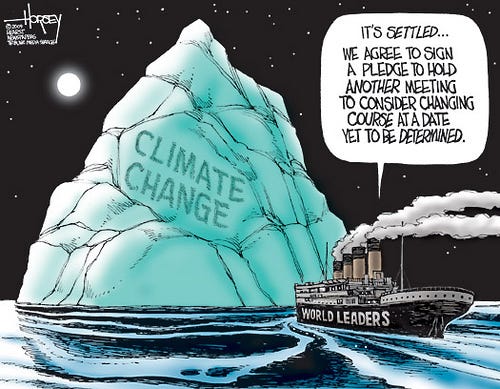
Given the behaviour of our leaders, it is unsurprising the vast majority of the general population have no idea of the imminence and scale of climate threats. The green sector highlights surveys showing climate-change ‘awareness’ is increasing, but these mask blanket ignorance of how bad and how soon. Western consumers are clueless about what the realistic prospect of +3°C or more by 2050 actually means. A YouGov November 2025 survey reported most of the UK public supported the goal of ‘net-zero by 2050’, i.e. equivalent to the Titanic’s passengers supporting a plan to change direction after hitting the iceberg.
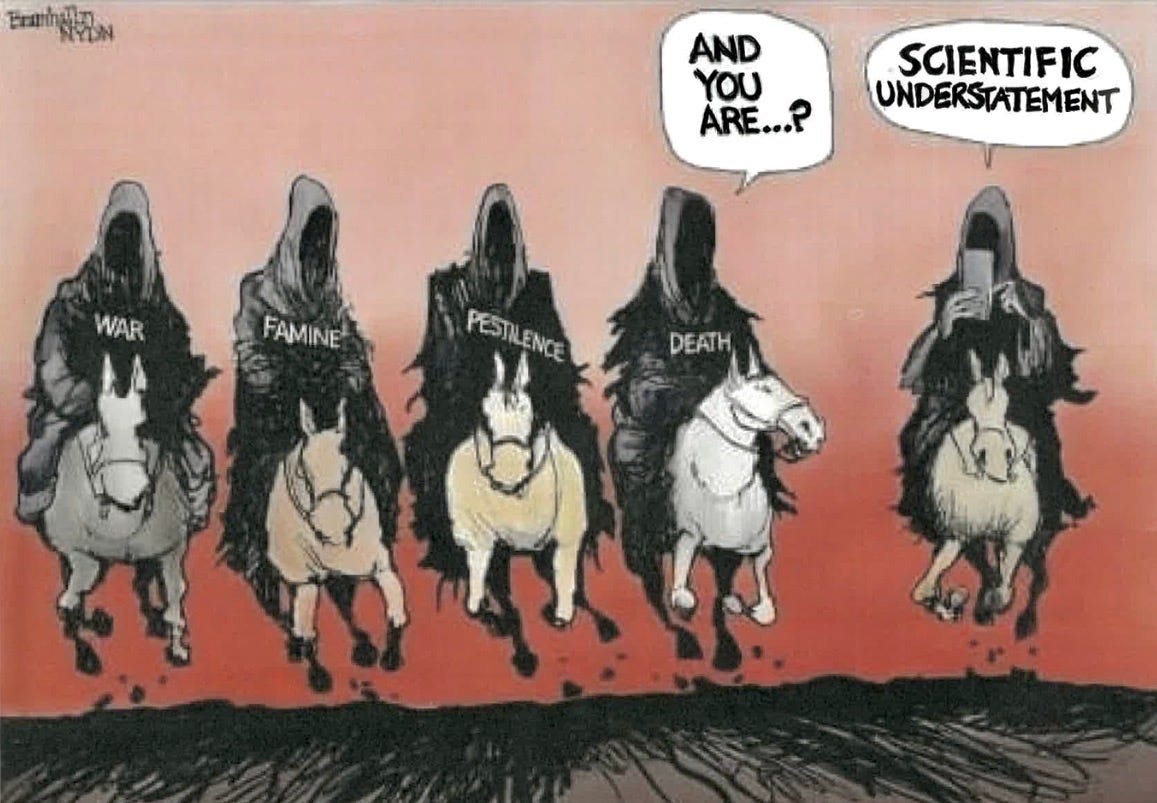
Global media discourse continues to be led more by the concerns of ‘financial markets’ operating in a climate la-la-land, reliant on the absurd assumptions of the economist William Nordhaus – who predicted +3.0°C warming (by 2100) would cause only a 2.1% loss of global GDP. This nonsense is epitomised by the example of JP Morgan recommending investment in ‘aircon’ in advance of a +3.0°C world. The disparity between what real scientists know but won’t say and the false assumptions of outspoken economists was described as, ‘a big mismatch’ by Dr Jesse Adams of the University of Exeter ‘Climate Tracker Initiative’ in January 2026 – with typically-unhelpful, academic understatement.
Many ignorant commentators attack even the useless plans we do have. The influential Jeremy Clarkson, writing in The Times in February 2026, described ‘net-zero’ as ‘inhuman’. Clarkson represents vast numbers so entrenched in our consumerist culture this has become ‘natural’, and protecting our essential habitat therefore, ‘alien’. Like many on the right, Clarkson has shifted from denial to sneering at warnings for being alarmist, hence his sarcastic reference to preventing the planet ‘turning into a fireball’. He was likely aware of a January 2026 warning from the Potsdam Climate Institute – themselves shocked by accelerating heating after decades of minimising complacency – that we were in danger of creating a ‘hothouse earth’. Clarkson’s mockery is common among macho men (usually), whose reckless behaviours led us to this extinction-threatening precipice. No doubt this assuages any uncomfortable feeling of responsibility they are too infantile to accept. This group also salivates over technology advances and reassures themselves the human intellect can ‘fix’ the climate. In this delusion, they have a lot in common with our scientists.
Liberal, left-wing and green commentators however, to be clear, are effectively no better; they also broadcast a ‘we can fix it’, false-hope narrative that blocks meaningful action.
In September 2025 an editorial in the UK Guardian, a global leader in climate change reporting, stated, ‘renewables are booming, but fossil fuels need to shrink too’. This followed decades of coverage promoting IPCC etc. under-estimates and ‘hopeful’ solutions. Recent articles suggest some Guardian journalists understand accelerating temperatures invalidate previous predictions, but they still resist reporting what these signify.
The popular liberal, UK talk radio host James O’Brien, proclaims climate change is serious and derides denialists. Again however, like the Guardian – and the denialists– O’Brien goes nowhere near the fact ‘growth’ aka destruction must be reversed, instead stating in December 2025, ‘the necessity of growth is something on which everyone agrees’.
O’Brien hosts phone-ins about why, ‘we all find it hard to change our climate behaviours’, and suggests climate change threats are difficult to grasp because they are too complex or remote. Such cod-psychological analysis avoids the obvious, real explanation – that 99.9% of people have no clue how dire climate threats really are, because commentators they trust, like O’Brien, are not telling them. If their media sources joined the global dots between increasing catastrophic impacts and climate changes, people would understand, would be appropriately frightened and would support system change. When such connecting-up occurs in the context of major threats like war and pandemics, this leads to significant behaviour shifts.
O’Brien has few guests but he welcomed Arthur Snell, a formerdiplomat, in March 2026 – as opposed to say, the President of the German Physics Society – to promote his new book, ‘Elemental: The New Geography of Climate Change and How We Survive it’. Snell acknowledges +1.5°C has gone, anticipates agricultural shortages and even that ‘a breakdown of the old social orders’ is expected. Like O’Brien, however, he embraces the delusion that an energy transition remains ‘the answer’ and we should follow China’s ‘example’. In the context of the threat to oil supplies posed by the Iran war, O’Brien even fantasises about the ‘transition’ magically creating enough extra capacity to ensure UK ‘energy security’.
All these commentators have been misinformed by the underestimates of the IPCC and the scientific community. Their failure to interrogate how these experts got recent accelerations so wrong, however, or to engage with how this obviously negates existing ‘solutions’, seems indefensible. All media outlets promote ever more economic growth, including via commercials ‘to pay the bills’ as O’Brien quips. Nonetheless, it’s unimaginable that he and the likes of Snell, who complimented them both on being concerned for their children’s futures, are cynically championing ‘growth’, while knowing the terrors this will bring their families. More likely, they are subconsciously repressing the truth in order to stay blinkered, within the irrational parameters of an Overton window of acceptable debate, that excludes both climate reality and meaningful responses.
Whatever their motivations, if even our non-denialist media outlets still won’t communicate the facts – how can a public, already overwhelmed by chaotic news and threats to their immediate livelihoods, possibly know what’s happening?
Understandably-madder-still…
Humanity faces other major threats – ‘collapsologists’ divert a lot of attention to AI, pandemics, wars etc. – but climate change overwhelms them all because without our essential habitat, nothing else matters. The public, although misinformed about specifics, rationally feels collectively-threatened; a context that provokes other dangerous, defensive group behaviours including:
– Supporting ‘strongman’ leaders, however flawed.
– Belonging to powerful ‘in-groups’.
– ‘Othering’ of ‘outsiders’ – increasing fascistic and anti-immigrant sentiment coincides with the prospect of millions, even billions, of climate refugees.
– Increasing religious fanaticism, like the US Christian sects welcoming end-times and ‘The Rapture’.
The strengthening of all these defences, however unhelpful, is psychologically-inevitable. In the absence of systemic shifts allowing engagement in meaningful action, they’re all we’ve got.
The End?
So here we are; impending global societal collapse caused by the climate we have changed is, ‘not a matter of opinion, it’s counting’, as James O’Brien likes to say. But still we cling to denial or the minimising lies of an energy-transition and other hopeless, non-solutions.
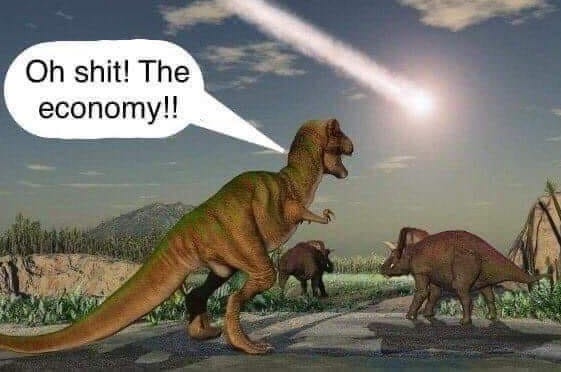
The pathological hold the gospel of ‘economic growth’ – aka essential-habitat-obliteration – has on our collective psyche seems stronger than our will to protect our loved ones. Underpinned by a delusional faith in our own cleverness and driven by our basest instincts, abandoning this is even now unimaginable, especially to those with any power or influence.
This is all made psychologically worse, because our collective delusions are reinforced as the existential threats grow, by our maladaptive defences and our in-groups.
More scientists are publicly acknowledging this now, in contrast to the ongoing obfuscation of the spineless IPCC. And more people, even if nothing like enough, get it too – because the basics of accelerating climate change and the devastating consequences are simple, once you have found your way to them. But we few are just conscious Wiley Cayotes; we know we are all way out over the cliff edge and that no-one can doanything meaningful without system change.
Humanity desperately needs a collective shift away from denialism, minimisation and all our tremulous defences, because unprecedented harms are coming but these can always be lessened. The trigger could be our scientists but in their shrinking absence, perhaps popular influencers like O’Brien, Jeremy Clarkson and their international peers, need to step in from their privileged places on the side-lines. They are perfectly capable of understanding our predicament, and could use their superior communication skills to provoke both appropriate alarm and support for meaningful responses.
Goodness knows we need something to enable a mobilisation towards the more loving elements of what it also means to be, ‘human’. If this doesn’t happen then both our brutal conflicts and all our clever achievements will soon be as nothing. Only our philosophers and poets will be relevant then, as we collectively learn the answer to the Palestinian poet, Mahmood Darwish’s question,
‘where will the last birds fly, after the last sky?’
This article was originally published by The Psychology of Climate Change; please consider supporting the original publication, and read the original version at the link above.
Excellent article. It’s a long time due and is very uncommon even on this progressive pro-socialist website. What is more common is a very optimistic and rather superficial view of Jeremy Brecher expressed in https://znetwork.org/znetarticle/the-greentech-revolution/
We live through a critical historic period, a poly-crisis, of which the climate (and natural degradation in general) is only one factor, albeit the most important from the perspective of the future of human civilization. Unfortunately, evolutionary and, therefore, genetically, we developed in a very different natural and social environment. Therefore, we, as a species, are living through this crisis without full realization (ability and desire to connect the dots) to preserve our sanity and “normal” behavior, which is very human and has always served the evolutionary purpose of preservation of our social life. Unfortunately, it may not work this time.
If hurricane Sandy hit NYC every other year or the water level on Miami Beach rose at least a foot, and all the climate scientists and the left media and politicians were ringing all bells, leading climate change protests, initiating bills, legal actions, etc., it could have made a positive effect.
The most fundamental fault with all the climate change argumentation is that it’s not linked to the direct experience of the population majority, especially in the developed countries, who rarely realize they suffer from its consequences. The majority of climate scientists, who limit their “public activity” by conference speeches, some collective letters and press releases, and poll participation, and the Left do terrible job (if any at all) to establish this link. Unless millions of people feel (not think) the same way as the Extinction Rebellion members apparently do, no significant progress should be expected. Also, the main 2100 reference point is conveniently remote enough to safely speak about. If they shifted it to at least 2050, it could be much more relevant for many people. In this situation, it’s much easier and more psychologically sound to simply ignore the problem that cannot be addressed in a practical way by a regular person rather than lament or build projections.
You keep coming back for a reason: serious political analysis, movement reporting, and debate beyond the priorities of corporate media. Today, Z is in a precarious financial position. If Z is part of how you understand the world, help keep it going. The readers who give monthly are the reason this work survives between fundraisers.
Z is in a precarious financial position. If it’s part of how you understand the world, help keep it going.
Your reading count is stored only in your browser and is never sent to us.
Sound is muted by default. Tap 🔊 for the full experience
CRITICAL ACTION
Critical Action is a longtime friend of Z and a music and storytelling project grounded in liberation, solidarity, and resistance to authoritarian power. Through music, narrative, and multimedia, the project engages the same political realities and movement traditions that guide and motivate Z’s work.
If this project resonates with you, you can learn more about it and find ways to support the work using the link below.
Z is in the most precarious financial position in its history.
Z is a place to think beyond the limits of the present.
For decades, Z has brought together political analysis, movement reporting, debate, and visions of a different future from writers and activists around the world. That work is more than journalism. It is movement infrastructure: movements need places to develop ideas, test arguments, learn from experience, and imagine what comes next.
In the first two days of this fundraiser, 19 donors and 8 new monthly sustainers stepped up. Help us reach 1,000 donors who keep Z independent, for everyone.
For decades, Z has published the analysis, debate, and visions movements need, free of paywalls, ads, and billionaire owners. If that work should continue, Z needs your support now.





1 Comment
Excellent article. It’s a long time due and is very uncommon even on this progressive pro-socialist website. What is more common is a very optimistic and rather superficial view of Jeremy Brecher expressed in
https://znetwork.org/znetarticle/the-greentech-revolution/
We live through a critical historic period, a poly-crisis, of which the climate (and natural degradation in general) is only one factor, albeit the most important from the perspective of the future of human civilization. Unfortunately, evolutionary and, therefore, genetically, we developed in a very different natural and social environment. Therefore, we, as a species, are living through this crisis without full realization (ability and desire to connect the dots) to preserve our sanity and “normal” behavior, which is very human and has always served the evolutionary purpose of preservation of our social life. Unfortunately, it may not work this time.
If hurricane Sandy hit NYC every other year or the water level on Miami Beach rose at least a foot, and all the climate scientists and the left media and politicians were ringing all bells, leading climate change protests, initiating bills, legal actions, etc., it could have made a positive effect.
The most fundamental fault with all the climate change argumentation is that it’s not linked to the direct experience of the population majority, especially in the developed countries, who rarely realize they suffer from its consequences. The majority of climate scientists, who limit their “public activity” by conference speeches, some collective letters and press releases, and poll participation, and the Left do terrible job (if any at all) to establish this link. Unless millions of people feel (not think) the same way as the Extinction Rebellion members apparently do, no significant progress should be expected. Also, the main 2100 reference point is conveniently remote enough to safely speak about. If they shifted it to at least 2050, it could be much more relevant for many people. In this situation, it’s much easier and more psychologically sound to simply ignore the problem that cannot be addressed in a practical way by a regular person rather than lament or build projections.