
Inspired by Chris Spannos’ essay “Reimagining Social Services for a Participatory Society,” this is the first in a series of articles examining, and trying to continue the conversation about, the profession of Social Work and the provision of social or human services in the US, and the current and potential relationship of these professions/activities to Participatory Society.
Part 1: Radical vs. Reformist, or Jane Addams vs. Mary Richmond
This first article is an interpretation of the development of social work as following two major paths: radical and reformist. It pulls from two books, Under the Cover of Kindness: The Invention of Social Work by Leslie Margolin, and The Road Not Taken: A History of Radical Social Work in the United States by Michael Reisch and Janice Andrews.
Each represents an alternative to mainstream analysis of the history of social work, although through two very different lenses. From Margolin’s perspective, social work has always been dominated by the reformist approach, and radicalism basically died with social work pioneer Jane Addams, whom he points out was opposed to the idea of the professionalization of social work in the first place (Margolin p. 4). Margolin believes that “new, radically different understandings” are the only escape from the trap of the power-serving and power-exercising reformist machine. Reisch and Andrews recognize the same split between radical and reformist approaches, but trace the thread of radicalism through to the present day, and believe that “the values that guided radical social workers of the past have not been invalidated” by events of the last century-plus. (Reisch&Andrews, p.235).
Both books contrast Jane Addams and Mary Richmond, early figures in the development of modern social work, each a pioneer of one of the two paths.
I. Addams: Solidarity, Diversity 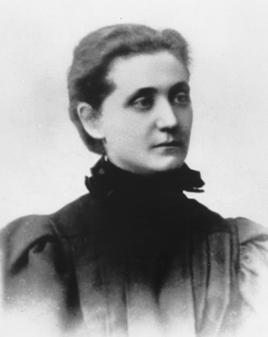
Addams is most famous for her work at Hull House, a settlement house for immigrants in Chicago, co-founded by Addams along with Ellen Gates Starr in 1889. The project initially served primarily immigrants, but eventually branched out into broader efforts to alleviate poverty.
Addams’ approached her work with the poor and marginalized was as a “neighbor.” She noted the “emotional kindness with which relief is given to one poor neighbor by another poor neighbor,” in contrast to “the guarded care which with relief is given to a charity worker by a charity recipient.” (quoted by Margolin, p.4). Through her work, Addams developed a philosophy characterized by a belief in “the solidarity of the human race (Reisch&Andrews, p. 16),” and which, while focusing in large part on direct relief to individuals, also “aim(ed) to change institutions and culture (Margolin, p.4).”
Addams was a radical, not having begun her work as such, but having been radicalized by the work itself (Reisch&Andrews, p.7). Influenced early on by her father’s adherence to and interest in Quaker beliefs and Christian Socialism, (Reich & Andrews, p. 14), she later developed anarchist sympathies.
While Addams become broadly popular for her work at Hull House, her social change-oriented writings and activities, particularly opposition to World War I, led to devastating persecution; a “fall from grace unparalleled among public figures in American history,” (Reich&Andrews, p.14).
II. Richmond: Hierarchy, Homogeneity 
Mary Richmond, a contemporary of Addams, was a leader among Charity Organization Societies, a Social-Darwinist influenced movement which pushed for the professionalization of social work. Richmond defined social work as the “attempt to change individuals and families,” in contrast to work towards institutional or societal change (Margolin, p.4).
Richmond promoted certain practices over those of Addams and other radical social workers. The first of these was the collection of information obtained by charity visitors in a “case file,” and the subsequent transformation of the family or individual into a “case,” in opposition to the view typified by Addams of the relationship between the giver and receiver of relief as one of solidarity, mirroring neighbor-to-neighbor mutual aid. The second was the selection of the “home visit” as the preferred method for interfacing with recipients of aid, contrasted with the settlement house approach, or similar models such as the provision of aid through an office or church.
To Margolin, the selection of these practices over others represented the making of a family or individual into an object to be examined and judged, and access to the most private space of all, the family home, in order to better examine and judge. To Reisch&Andrews, they justified the condescending and superior position of the charity worker over the charity recipient, and cemented the position of the charity worker as the official distinguisher between the “deserving” and “undeserving” poor. The home visit facilitated this and devalued the radical social work concept of a community space where mutual education occurs, mutual interests are recognized and developed, and mutual benefit is derived.
III. Radicalism vs. Reformism in Social Work: Differences in Social and Political Viewpoints
While Richmond and the COS model presented itself as apolitical, it was anything but; in fact, the movement was part of “an attempt by elites to avoid class conflict, in part through discouraging the indiscriminate distribution of relief (Reisch&Andrewsp.21).” The refusal to make distinctions between deserving and undeserving poor that characterized radical social work implied societal injustice, rather than personal defect, as the primary cause of poverty, and therefore threatened the existing capitalist order.
This is not to suggest that defense of capitalism was the only or even primary intention of the reformist movement; many of its proponents “shared aspects of the socialist utopian vision,” but they “avoided any reference to class analysis,” and “equated indiscriminate almsgiving with socialism or anarchism.” (Reisch&Andrews, p.21-22). In the case of Richmond specifically, she is often praised for carefully studying the growing phenomenon of charity work in order to determine what practices resulted in the best outcomes for charity recipients, and calling for charity workers to be professionally trained in order to standardize the best practices. However, it's possible to acknowledge the benefits gained from Richmond's efforts while recognizing how they also served to elevate the reformist point of view, characterized by 1) the belief, whether explicitly or implicitly expressed, that personal defects were the primary cause of poverty and marginalization, and 2) the subsequent devaluing of both the radical approach of solidarity mirroring mutual aid between neighbors, and the radical awareness of institutional and societal causes of poverty and marginalization.
Why did the radical practice of social work make many middle-class reformers uncomfortable? In contrast to the Social-Darwinist basis for the organized charity movement and its chosen practices, Progressive Era radical social work used social science methods to analyze poverty and community problems, attributing them to “industrialization, slum housing, and the rapid changes in social relations they produced, instead of individual moral deficiency,” and sought “radical transformation of US society through intergroup interaction, research, analysis, and debate.” Radical social workers became heavily involved in the labor movement; they “contributed to unions’ strike funds, provided space for union meetings, and participated in the public defense of radical trade unionists… (Reisch&Andrews, p.24).”
Addams and her colleagues made Hull House a place where “radical intellectuals and activists mingled,“ and which “nurtured the development of radical ideas,” including feminism, as well as anarchism: Chris Spannos quotes Addams’ autobiography in his essay Reimagining Social Services for a Participatory Society: "In this wonderful procession of revolutionists, Prince Kropotkin, or, as he prefers to be called, Peter Kropotkin, was doubtless the most distinguished (Spannos, 2009).”
Settlement workers and like-minded social scientists challenged prevailing conservative views fearing and denigrating immigrants, and blaming poverty on moral deficiency and bad behavior. Unfortunately, Reisch&Andrews point out, even among settlement houses, people of color were rarely included; the ideal of the “solidarity of the human race” was applied primarily to White Europeans (p.26).
Despite the connections between radical social work and radical ideologies, however, most radical social workers were focused less on class conflict than on the possibility of class reconciliation, and the development of a democratized, multicultural society through education and debate. However, for the reformist movement, the radical approach to working “with” rather than “for” people in the interest of mutual aid, and the inevitable focus on radical change of society that followed, could only lead to the dreaded class conflict of socialism.
In summary, examining social work as a profession and social work, social services, human services, etc. as practices in light of the values of Participatory Society should start at the beginning. During the Progressive Era in the US, we can see not only the connection between “radical” social work and radical ideologies and movements, but also the beginning of the domination of reformist elements, made up of moderates and more palatable to conservatives (a fate that has befallen many a radical movement).
Within the practices and attitudes of early radical social workers, we can also recognize aspects compatible with Participatory Society, including strong commitments to solidarity, diversity, justice, and participation. However, the experience of the last century-plus shows us that more often than not, social workers "may claim Jane Addams as their source of inspiration, but they do Mary Richmond (Margolin, p. 4)."
My intention on subsequent articles is to look at modern practices, what a Participatory Social Service Agency might look like in the US in 2011, and then maybe building on Chris Spannos’ essay and some of the comments made on it, to do some more imagining of what social work/social service looks like in a future Participatory Society.
Anybody have any comments or ideas about these topics? I’d love to hear them!

I'm a social worker and nonprofit organization employee living in the Colorado Rockies.
ZNetwork is funded solely through the generosity of its readers.
Donate

