
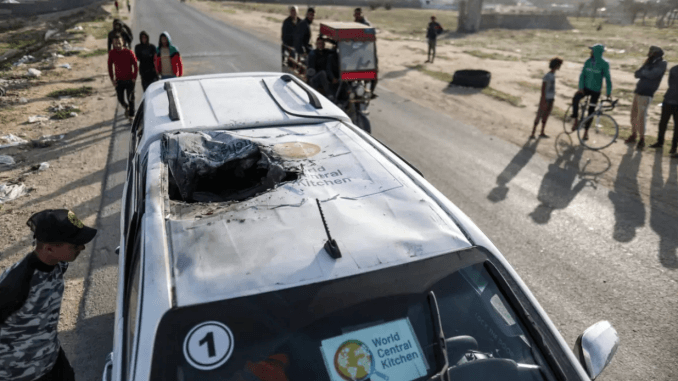
In September 2025, nine countries launched the Declaration for the Protection of Humanitarian Personnel. Australia explained its important if dark inspiration in pursuing it: the slaying of Zomi Francken, along with six of her colleagues from the World Central Kitchen charity on April 1, 2024 by Israeli forces in Gaza. All perished to an attack consisting of three missiles fired from a Hermes 450 drone in a stated “deconflicted” zone, despite clear logo markings on the convoy vehicles and extensive coordination regarding their movements with the Israeli authorities.
The declaration, while lacking teeth, is at least a concession that individuals dedicated to protecting and preserving the vulnerable in conflict deserve a heftier shield of protection in international humanitarian law. It is all the more important given the systematic, weasel-worded libelling that the IDF have pursued against the WCK workers. Behind the cover of bureaucratic plausibility and spread-sheet analysis, the Israeli authorities have conveniently packaged the charity worker with combat or terrorist groups, giving them equal standing in targeting.
The disgraceful nature of this is evident in the refusal to consider any legal action for the events of that April. On August 19, the IDF announced that it had found “no reasonable suspicion of criminal misconduct that would justify opening a criminal investigation or the taking of additional measures against any of those involved in the incident”. The spokesperson’s remarks initially gave ballast to the worthiness of the General Staff Fact-Finding and Assessment Mechanism (FFAM), charged with making “factual assessments of exceptional operational incidents, while using a range of tools and methodologies.” It became very clear that these methodologies were heavily slanted to conflating combatants and humanitarian workers on mere inferences.
Consider, for instance, the IDF’s alleged identification of “a gunman on a truck in the humanitarian aid convoy while it was on route to a warehouse for the unloading of the aid.” The troops had “identified vehicles surrounding the trucks in a manner that, in their assessment, and based on accumulated operational experience, corresponded to a scenario in which the Hamas terrorist organization had taken control of the convoy.” Despite “serious failures in the process that led to the assessment that Hamas operatives were travelling in the vehicles”, the decision to strike the convoy raised no “reasonable suspicion of criminal misconduct”. There had been, in the circumstances, a sufficient number of “suspicious indicators”.
Much is done to shift the blame to the humanitarian workers. They had, for instance, “hired an armed security force to accompany the convoy until the completion of the operation in order to protect it from seizure by armed actors in Gaza.” This “was not coordinated with the IDF authorities.” The IDF had also “attempted to contact WCK representatives in order to verify their assessment that the people in the vehicles were indeed not members of WCK.” These efforts – so it is claimed – were made during the half-hour period that the vehicles were being tracked. (The assumption had already been made that they were Hamas operatives or workers in league with them.) The someone sickening insinuation here is that these humanitarians brought it upon themselves.
Much the same view was expressed by the chief commander who ordered the strike, Colonel Nochi Mendel. He has faced no legal proceedings, merely administrative action in the form of dismissal from his role as chief of staff of the Nahal infantry brigade. Mendel had been remiss on the IDF’s rules of engagement and standard operating procedures.
In an interview with the Australian Broadcasting Corporation conducted in October 2025, Mendel had not favoured killing the WCK employees but was “not sorry” for what happened. Echoing the eventual findings of the investigation, the Colonel blamed “an intermingling between the WCK and Hamas operatives” that took place in an environment of evolving complexity. The suggestiveness, and the euphemisms, are all standard: that WCK had also made mistakes; that it was not “really a neutral organisation. Not really an organisation you can say is innocent and completely clean.” This lack of political sanitation was evidenced by “ties to Hamas.”
The apologia is accordingly built up and inflated: operational fuzziness, the expediency that a conflict situation demands. No mention of the protocols governing such humanitarian convoys seemed to warrant discussion. Instead, Mendel could see, in a video feed, “armed terrorists getting out and firing from the trucks.” After the convoy arrived at a warehouse at Deir al Balah to unload the aid, “We see them all mixed together – both the WCK guys and the Hamas terrorists with weapons.” He cites a claim to being noble: that he could have ordered the attack there and then but preferred to wait “so as not to harm the WCK.” That turned out to be a cautionary note with little effect.
Mendel then claims that the IDF did contact the WCK – but not those in the convoy. A WCK representative from Europe was reached. The answer came: “there aren’t supposed to be armed guards.” The WCK personnel, after leaving the warehouse, then deviated from a coordinated prearranged route – so says Mendel. This aided the decision to strike, but an investigation into the events by Australian Air Chief Marshal Mark Binskin suggests that the decision had already been reached by that point. It came as no surprise that WCK, in a statement on Mendel’s ruminations, regarded them as “slanderous” and lacking “credibility”.
The decision not to initiate criminal proceedings, or to conduct a truly independent inquiry, baffled the governments whose nationals had died in the attack. The Israeli ambassadors of several countries were called in to give answers. A joint statement by the foreign ministries of Australia, Canada and the United Kingdom called the decision to close the case “shameful”. The Polish foreign minister Radosław Sikorski was almost livid. “Partnership requires respect,” he stated. “The humanitarian catastrophe in Gaza, as well as the failure of accountability for IDF’s excessive use of force are undermining public support in even pro-Israel nations.”
ZNetwork is funded solely through the generosity of its readers.
Donate

