
Since the U.S.-backed military coup in 1954 brought back to power Guatemala’s racist economic, military and political elites, and through the next six decades of western-backed repression, spiked with massacres and genocide in the late 1970s and 1980s, the institutions of the Guatemalan State (judiciary, police and military, congress, executive branch) have been characterized by corruption and impunity.
Corruption and impunity are not a “crisis” in Guatemala; they have been and remain the “norm.”
In this harsh context, the on-again, off-again genocide trial against former General Efrain Rios Montt is all the more extraordinary. The most important aspect of the efforts to re-start the genocide trial against Rios Montt are … the efforts! Even if Rios Montt is never re-tried for the crime of genocide, even if the 89-year old dies before the trial is re-started, the very fact that the Mayan Ixil surviving victims, their lawyers and supporters continue to make every effort to use Guatemala’s corrupted legal system to hold Rios Montt legally accountable is extraordinary and, in and of itself, a measure of justice.
On May 10, 2013, Rios Montt was found guilty of genocide and other crimes against humanity. His co-accused, former General Mauricio Rodriguez Sanchez, was acquitted. They had been on trial for genocide, including massacres, rape, torture and violent, illegal displacement of thousands of Mayan Ixil campesinos during the peak of Guatemala’s “cold war” repression.
In a country dominated by the same economic, political and military sectors that planned and carried out the decades of repression and genocide, this guilty verdict was an astounding and legally sound decision. Sadly, but not surprisingly, the corrupted Constitutional Court annulled the guilty verdict 10 days later, and ordered a retrial.
Since that time, the Mayan victims, lawyers and supporters have not wavered in their efforts to retry the genocidal general. In Guatemala, this is no small feat. With the trial finally set to begin again on July 23, 2015, defense lawyers began another round of delays, presenting a motion that Rios Montt suffered from dementia and/or other health problems related to his advanced age, and could not be fairly tried. After a month of legal wrangling, and after Rios Montt underwent an 8-day psychiatric evaluation, the lawyers presented their arguments in a Guatemala City court on August 18.
For the defense, “psychiatrist Walter Rinze […] concluded […] that Rios Montt suffers from vascular dementia, which is irreversible and will continue to worsen. He also noted that Rios Montt’s capacities to hear and see are considerably reduced, and that he has trouble understanding complex situations and situating himself in time and space.”
“The national hospital’s head cardiologist, Edgar Rolando Rodriguez, testified for the defense that [Rios Montt] suffers from hypertension, that the drugs given to him do not successfully control his high blood pressure. […] Further, Doctor Rodriguez concluded that Rios Montt has an aneurysm, meaning that any stressful situation could raise his blood pressure to dangerous and potentially fatal levels.”
Based on this, defense lawyers argued that the case against Rios Montt be closed.
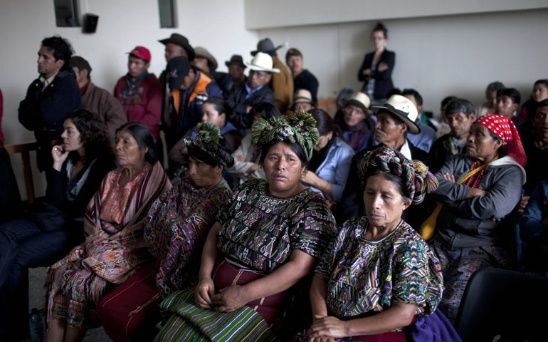
For their part, the prosecution requested that “the court accommodate the defendant’s lack of fitness for trial through application of special procedural rules. These would include the appointment of a guardian, the conduct of the trial behind closed doors, and a declaration of security measures instead of a criminal sanction. They also requested that the court order the appointment of specialized doctors to ensure an appropriate treatment to the defendant, arguing that there was evidence of medical negligence from his current doctor.” The court will rule on August 25 whether Rios Montt can stand for re-trial, or not. Don’t hold your breath; assuredly there is more legal wrangling to come.
Legal manipulations and judicial corruption aside, it is the fact of publicly pursuing Rios Montt in Guatemalan courts that counts. The May 2013 guilty verdict and the on-going trial are a regular, public reminder that the Guatemalan elites planned and carried out massacres and genocides and they were not able to get away with it or cover it up. The utterly honourable victims, surviving victims and children of the victims will continue to tell the truth, and struggle for justice and serious reform for as long as it takes.
Connecting The Dots
Moreover, this extraordinary trial is taking place in the context of weekly protests related to the “La Linea”, a multi-million dollar organized crime corruption ring headed by Vice President Roxana Baldetti and President Otto Perez Molina.
In June, Baldetti was forced to resign her office. This week, she was served with an arrest warrant on corruption charges. Meanwhile, efforts are being made to impeach President Otto Perez Molina; it is now widely accepted that he, along with Baldetti, oversaw the stealing of tens of millions of dollars in import taxes.
In the Mayan Ixil region where one of the genocide campaigns was carried out, for which Rios Montt was found guilty, Otto Perez Molina was Rios Montt’s highest ranking military officer in that region at the time.
In fact, in 2013, Hugo Reyes, a former soldier, testified via video during the Rios Montt’s trial that: “The soldiers, on orders from Major ‘Tito Arias,’ better known as Otto Perez Molina … coordinated the burning and looting, in order to later execute people.” Reyes served in Nebaj with Perez Molina.
A Deafening Silence From the “International Community”
As the genocide trial continues against Rios Montt, as the organized crime, corruption scandal explodes all around the presidency and ruling elites, there is a deafening silence from the governments of the United States and Canada, from the World Bank and Inter-American Development Bank, from the global mining industry, etc.
As tens of thousands of Guatemalans take to the streets every week, demanding justice for the war crimes of the past and government crimes of the present, and demanding serious political reforms to their corrupted system, who will hold to account the “international community” that for decades has maintained military, political and economic relations with Guatemala’s elite sectors, participating in and benefiting from the corruption and impunity?
Grahame Russell is a non-practicing Canadian lawyer, author, adjunct professor at the University of Northern British Columbia and, since 1995, director of Rights Action: [email protected], www.rightsaction.org
ZNetwork is funded solely through the generosity of its readers.
Donate

