
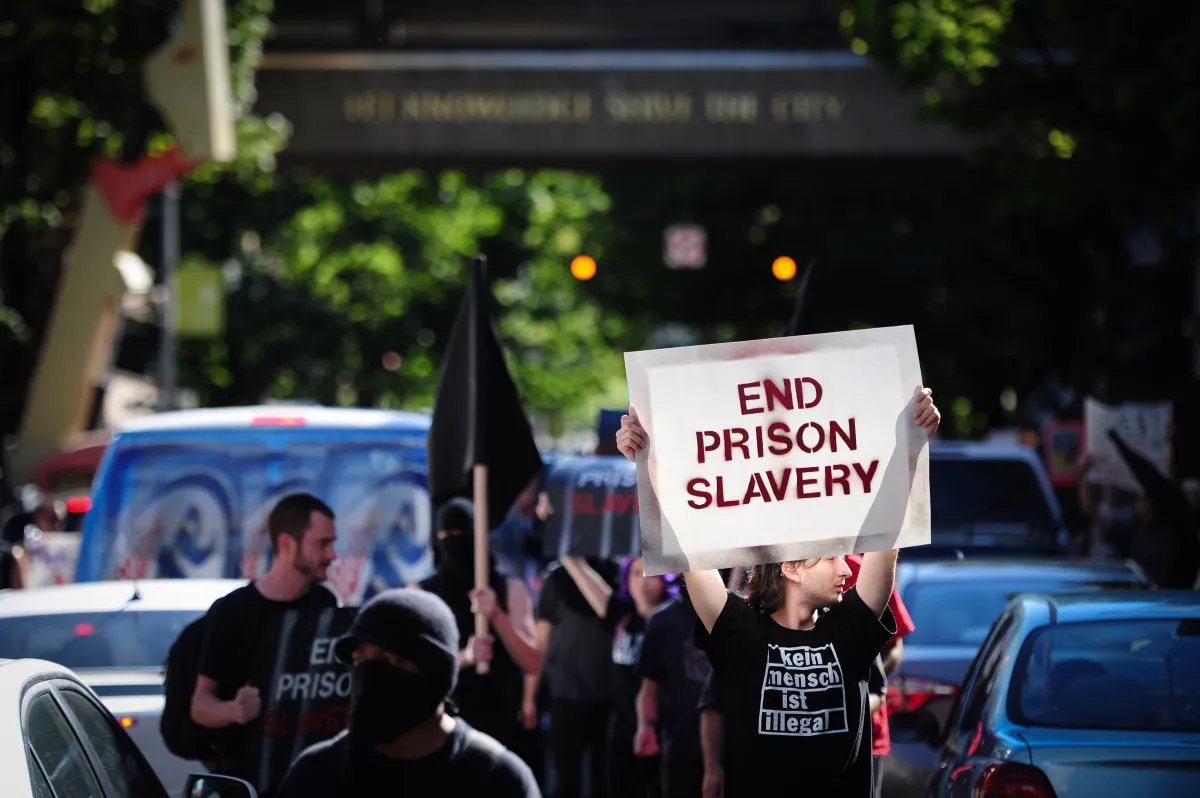
On a foggy day inside the Franklin Correctional Institution 10 years ago, prisoners refused to go to work, the chow hall and the canteen store.
Robert Powell, who was incarcerated in that prison in Carrabelle, Florida, at the time, told me he never had a job of real significance, but he helped ensure everyone in his dorm remained down for the cause.
In advance of this self-organized prisoner action, the institution had rolled out an exclusive menu to be served the day of the strike, he recalled. That food, never seen in the chow hall before or since, was offered in an “attempt to sway the men from partaking in the work stoppage as a whole,” Powell surmised.
For their part, incarcerated organizers, including Powell and a few others, went to the canteen a week or so before and purchased enough food to distribute to their entire wing on September 9.
Inside Franklin, the strike, along with the dining hall and commissary boycotts, had an impact.
“I believe even though that was small scale and we didn’t have the adequate time to actually prepare for this event in full as well as educate the men on the importance and benefit of it, I saw that it really did shake up the institution,” Powell told me in response to questions I sent him after I began working on a book about the first nationally coordinated prison strike.
A Strike Against Prison Slavery
This September 9 marks the 10th anniversary of the 2016 work stoppage and concomitant actions that involved or impacted between 20,000 and 60,000 prisoners and affected an estimated 46 or more facilities.
Between 20,000 and 60,000 prisoners participated in or were impacted by the prison strike that formally kicked off on September 9, 2016, and affected an estimated 46 or more facilities. The 10th anniversary of the strike marks an occasion to commemorate the collective action as recalled by those who helped make it happen and to highlight the lessons learned in the arenas of organizing, mobilizing and prisoner support work.
The September 2016 strike came after incarcerated rebels put forward a call to end slavery by withholding labor and shutting down prisons across the US on the anniversary of the uprising of prisoners who took control of Attica prison in 1971.
According to Kevin ‘Rashid’ Johnson, a prison rebel who helped organize and publicize the September 9 action while incarcerated inside the William P. Clements Unit in Amarillo, Texas, the 2016 “strike was against prison slave labor.”
“Slave labor continues inside U.S. prisons, which grew out of the old chattel slave system. When chattel slavery was abolished after the U.S. Civil War (1865), the prisons became the new plantations and the new site of racialized slavery,” he told me in an interview. “It was then that the U.S. saw its first wave of mass imprisonment and criminalization of Blackness.”
Jason Renard Walker, an incarcerated organizer and intellectual who was also inside the Clements Unit in 2016, emphasized to me the connection between 21st century incarceration and the past enslavement of his ancestors, and he suggested prison slavery encompasses the involuntary carceral labor along with other aspects of the penal system.
“It is a lot deeper than a prisoner working for free or by force through reprisals,” Walker told me. “When I think about prison slavery I also think about the conditions, the prison’s mission, the little rights we have and the level of repression that is built into the criminal justice system. There are bobwire fences and walls to prevent escapes, there are disciplinary rules and punishment for those who break any of these rules. Yet, there is very little to gain, except parole perhaps, for those that are model inmates. We are expected to behave, not because it’s a part of rehabilitation, but because we are under the control of the state and they want to remind us who’s in control.”
The September 2016 strike represented a cross-state exercise in collectively refusing to reproduce that system of imprisonment with its vestiges of chattel slavery.
Walker told me he sees the strike tactic as effective because it gets the attention of prison administrations the fastest, though he added it could be coupled with novel approaches.
Similar to the more than 30 other facilities that instituted some equivalent around the time of the strike, Clements Unit went on lockdown, so the commissary boycott that was planned couldn’t take place. Walker shared that “during a lockdown everything becomes symbolic, kinda like how people observe Black August,” but parallel to future work stoppages, he suggested prisoners who stay locked in while locked down could consider staging “a massive hunger strike” in solidarity with strikers, provided they are willing to “become more sacrificial.”
In the same vein, he noted that those who are not in positions to withhold labor can provide storage for the food and personal belongings of strikers “because we know the retaliatory shakedowns and bogus disciplinaries are coming” and “destruction and confiscation of [strikers’] property is inevitable.”
To be sure, retaliation was severe. Organizers and leaders were targeted for retribution and even those who participated or were otherwise wrapped up in what transpired faced retaliation.
Strike-related repression intensified months before September 9, but so too did collective action among incarcerated persons.
In Texas, incarcerated workers had kicked off events in 2016 early by participating in rolling strikes throughout April 2016, which according to Walker was made possible in part by the use of contraband cell phones.
As detailed in the 2025 documentary, The Alabama Solution, prisoners with the Free Alabama Movement (FAM), namely Kinetik Justice (a.k.a. Robert Earl Council) and Bennu Hannibal Ra-Sun (a.k.a. Melvin Ray), used phones to co-organize work stoppages in their state starting in 2014. They learned from incarcerated organizers in Georgia who in 2010 relied on contraband digital devices purchased from guards to coordinate what was then the largest prison strike in US history, involving at least four facilities.
Members of FAM also practiced critical popular education, posting updates and videos recorded inside on YouTube, on what was formerly Twitter and on their website leading up to September 2016. And in, “LET THE CROPS ROT IN THE FIELDS,” an essay that circulated widely prior to the coordinated work stoppage, FAM connected the unpaid or incredibly low paid and oft-forced or coerced carceral labor to the involuntary work done on plantations in the Antebellum South during the period of chattel slavery. To end prison slavery, they argued, “which only those caught up in the slave system can do,” incarcerated persons needed to “Unify nationwide from inside of these prisons” withdraw labor and do as the title of their essay indicated.
FAM and Kinetik were wont to connect withholding prison labor to refusing to actively reproduce the profit-driven exploitation and relations of neo-enslavement intrinsic to capitalism and the carceral system that feeds and fuels it—and, importantly, they stressed the collective agency, organization and self-direction of prisoners as indispensable.
“When we stopped working, the money stopped flowing,” Kinetik, who co-organized the September 2016 strike from inside solitary confinement, shared, later adding: “And that’s what this system is really about: money. Alabama’s prison system is not just a warehouse for bodies—it’s a capitalist machine built on forced labor. People working for pennies, or for free. Every mop pushed, every tray served, every field cut is a dollar saved for the state and a profit made for private vendors.”
Shortly after midnight inside the Holman Correctional Facility in Atmore, Alabama, all incarcerated workers “refused to report to their prison jobs without incident,” according to Kinetik. “With the rising of the sun came an eerie silence as the men at Holman laid on their racks reading or sleeping. Officers are performing all tasks.”
Kinetik told me they “built unity across racial, gang, and regional lines” and used that to launch “the most dangerous tactic possible to a system built on exploitation: work strikes.”
That shared sense of purpose among the prisoner class, as incarcerated rebels were consciously referring to themselves at the time, was key to executing the coordinated action on September 9, and so too was getting gang members involved.
Powell told me that, after learning about the plans for the strike from the primarily Florida-focused Campaign to Fight Toxic Prisons, he went to the guys with influence in the gangs inside Franklin to get them on board first.
“That was the most important factor,” he told me. After Powell spoke with “the gang leaders or men of influence or those respected” to ask them to commit, each proceeded to do strategic planning and outreach in their respective areas, he explained.
The approach echoed the old organizer credo premised upon finding common ground to overcome divisions, and it mirrored the time-tested labor organizing approach involving identification and recruitment of organic leaders of already existing groups who can influence others to participate.
The Role and Potential of (Anti-)Prison Movement Unionism
Additionally, a committee birthed by part of a longstanding staple of the anti-capitalist wing of organized labor in the US, the militant members—also known as Wobblies—of the Industrial Workers of the World (IWW), played a not-insignificant role in the 2016 strike too.
Since the IWW’s founding, the union has connected the coercion characteristic of enslavement to capitalism’s employer-employee class divide and the related system of wage labor. The January 1905 manifesto that gave rise to the IWW invoked “the possibility of establishing an industrial democracy, wherein there shall be no wage slavery,” with workers instead owning and self-managing the means of production in common.
About two years before the 2016 strike, at the urging of Lorenzo Kom’boa Ervin, a former Black Panther who authored the first edition of Anarchism and the Black Revolution while incarcerated, the IWW formed the Incarcerated Workers Organizing Committee (IWOC) and invited imprisoned persons to join.
Ben Turk, an outside organizer with IWOC back in 2016, cut his teeth doing prisoner solidarity work several years before the coordinated action. Turk told me he started talking with Kinetik and others with the Free Alabama Movement back in 2014. They indicated to him they thought the time was ripe to mobilize for an action at the national level. He said he and Kinetik worked together on the aforementioned call to end slavery that served as an announcement about the strike planned for September 9.
“In Alabama they seemed to be kind of demonstrating the validity of the tactics of going on strike,” Turk told me. “But I think … in many places it’s both more complicated and [not] universally as effective of a tactic.”
Not all prisoners work, he pointed out. According to reporting at the outlet WIRED published the day the coordinated strike commenced noted that of the about 2.4 million prisoners approximately 900,000 were working circa 2016, whether it was labor for the upkeep of the institution, in public sector jobs or for corporations making billions contracting prison labor. Based on those numbers, 1.5 million imprisoned persons were then jobless. Based on a more recent June 2022 report from the ACLU, some 800,000 of the 1.2 million people incarcerated in federal and state prisons have formal jobs inside—a not trivial number—but that means approximately 400,000 in those institutions do not.
Turk, however, said the economic impact of withholding labor might not be quite as significant as the public-facing analysis of some incarcerated organizers at the time seemed to suggest.
“What does matter about a prison strike,” in Turk’s view, “is just the resistance and the way that it makes the prison not functional.”
Ostensibly, “the most effective manifestations,” with respect to the September 2016 efforts, all involved “mass organization of prisoners,” Turk said. That included outright revolt with rebels tearing up cells—as, we’ll note, happened about a month before the day of action inside Holman Correctional Facility in Alabama, and inside the Kinross Correctional Facility in Michigan the day after the work stoppage. But it also took the form of sustained withdrawal of labor needed to maintain penal business per usual, Turk said.
He also alluded to some of the tensions within the IWW and IWOC in the wake of the strike.
At some point in the fall of 2016, Turk recalled, he received an email from Zack de la Rocha, the vocalist and artist of Rage Against the Machine fame, who inquired about where he could donate money to support strikers. According to Turk, de la Rocha ended up donating $50,000 to the IWW. Then, disputes arose among those in the union about what to do with the money. Some of it went to FAM, Turk said, but not all of it. In his recollection, there were Wobblies who wanted to err on the side of frugality and were wary of blowing the windfall they received right away, thinking it ought to be used to buttress organizing efforts longterm. Others like Turk believed the funds needed to go to support prison rebels in real time. Perhaps that was more of the intent of the donation, though Turk isn’t sure what message de la Rocha relayed to the Wobblies when he contacted them to give the money.
“I reached out to him a couple times via that email since then, and he hasn’t replied,” Turk said. “Yeah, because, you know, he’s busy and he’s famous and whatever.”
And although Turk is no longer active in IWOC, he affirmed that the outside support the organization provided during the juncture was critical, even if issues had to get worked out.
“I feel like this happens in movement a lot, where, when there’s a big mobilization, everybody’s on board, everybody’s, like, enthusiastic about it, and so problems don’t really arise,” he said. “And then the problems arise later, when things have calmed down, when the wave has crested, and you have to actually work out some complex issues, instead of just doing nothing but mobilizing.”
Walker, who continues to challenge the prison system, now while confined inside the Joe Corley Detention Center in Conroe, Texas, previously spelled out some of the missteps made during the 2016 strike wave, but he also underscored to me the importance of IWOC circa 2016 and the still mostly untapped potential of unionism inside.
“I think the biggest impact of 9/9 was the IWOC participation in communicating with prisoners around the clock,” Walker shared. “This changed the landscape in a way that boosted courage in those who really didn’t want to participate. If there was no IWOC, there wouldn’t have been a 9/9 that streaked across the US. This was an example of what organizing in prison can really be like if we had our own legal labor unions, and why prison authorities forbid them.”

James Anderson is from Illinois but now resides in Riverside, California. He has taught college courses as an adjunct professor and he has authored articles for a number of outlets. He’s a member of the IWW Freelance Journalists Union and UC-AFT Local 1474.
ZNetwork is funded solely through the generosity of its readers.
Donate