

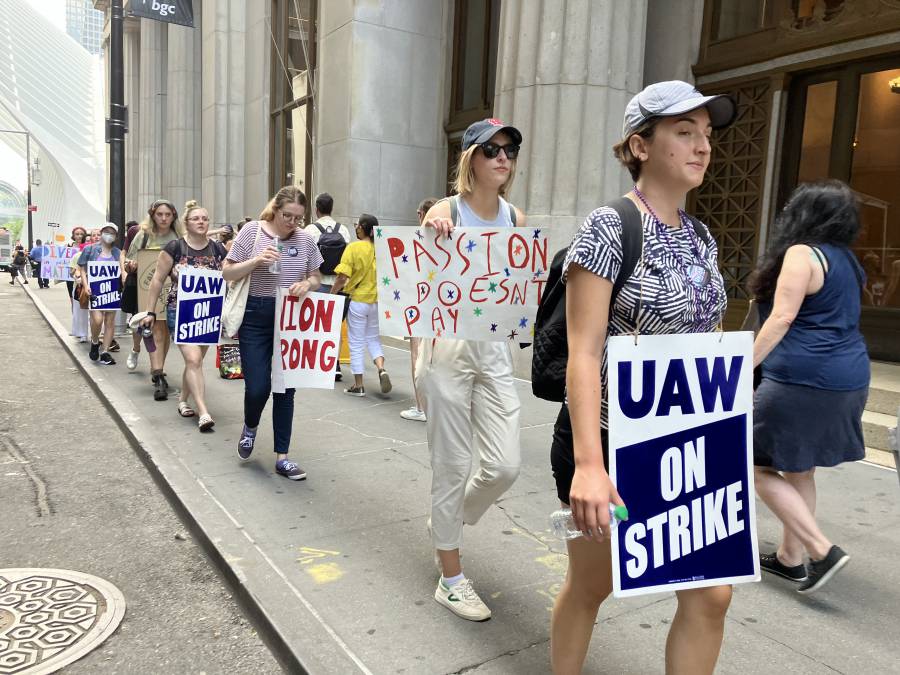
Immediately after exiting the Fulton Street subway station on July 20, one could hear the chants of striking HarperCollins workers, picketing outside in the sticky New York City heat. Workers at HarperCollins, a “big five” publisher with $515 million in profits in the third quarter of fiscal year 2021, are demanding fair wages, more diversity, family leave benefits, union security, and better accountability for the company.
HarperCollins workers have been negotiating with the publisher since December of 2021, said Laura Harshberger, senior production editor with HarperCollins Children’s Books. “We had been signing one month contract extensions as we continued bargaining,” she told Liberation News. “But negotiations really still stalled around March and April.”
Working without a contract since April, HarperCollins workers decided to go on a one-day strike to pressure management for a fair contract. “Our starting salaries are under $45,000,” said Harshberger. “We believe that no skilled worker in New York City should be making under $50,000.”
New York City is one of the most expensive cities to live in. Rents have been skyrocketing, with the median rent in Manhattan hitting an unbelievable $4,000 in April. This is despite the fact that the vacancy rate of apartments has increased since 2017. Low wage workers across the city have fallen victim to these statistics, with homelessness at the highest it’s been since the Great Depression.
Record profits = stolen wages
“In corporate America, corporate greed can mean that the company’s HR department or the company itself, it’s not necessarily looking out for the best interests of their employees,” said Harshberger. “They’re looking out to make sure that they can make as much profit as possible so they can pass that profit on to their shareholders.”
Over the years, the world of publishing has monopolized, much the same as many industries in the U.S. As publishing houses have merged, such as the Penguin–Random House merger in 2013, only five publishers now dominate the industry — the “big five” group of which HarperCollins is a part. Some have parent companies, such as ViacomCBS, which owns Simon and Schuster and was trying to sell it to Penguin–Random House until the Justice Department filed an antitrust lawsuit to block the sale.
News Corp, which owns HarperCollins, was founded by Rupert Murdoch, notorious multi-billionaire who, through the corporation, effectively controls much of the media industry globally, shaping the minds of billions of people. Media is so monopolized that only six companies own most of the media we consume in the U.S., and the publishing industry is little different.
According to News Corp, for the first half of fiscal year 2022, the company’s profitability reached nearly $1 billion, up 30% year-over-year. CEO Robert J. Thomson’s salary jumped 70% in 2021, to $23 million. Rank and file workers at HarperCollins, meanwhile, lead very different lives. “Record profits are stolen wages” read one sign on the picket line.
“I am really passionate about publishing. I love my job. I work in children’s books. I think it’s really important. I want to be able to be in publishing forever. And there’s just constant stories about people leaving publishing, not because they didn’t care about it, but because they couldn’t afford to stay any longer,” Stephanie Guerdan, an associate editor in the children’s department, told Liberation News.
Workers at HarperCollins were outspoken about how passionate they are about their jobs, yet as signs on the picket line read, “passion doesn’t pay.”
Demands for diversity
Workers were also explicit about their demand for diversity. “We have proposals on the table that can improve diversity at Harper and make Harper a better workplace,” said Harshberger. “These are things that our [union] members feel really strongly about.”
In early 2022, HarperCollins released its first ethnicity pay gap report. Data revealed that 10.1% of employees are from an “ethnic minority” background and there is a mean ethnicity pay gap of 8.2%. There is little diversity in the top quartile, especially in the leadership team, the vast majority of which is white.
“There’s a terrible brain drain of talent and diverse employees from the industry,” Guerdan told Liberation News. “A fair contract will go a long way, not just to make Harper a better place, but for making the whole publishing industry better.”
Strong unions for all
This HarperCollins strike comes in the context of a national wave of unionization and militant worker action, from the thousands of Columbia graduate students that struck for ten weeks, to the Amazon workers who unionized the company for the first time, to the hundreds of Starbucks stores that have unionized or are unionizing. In early July, HarperCollins workers voted overwhelmingly—99%—to strike.
Other workers walked alongside the HarperCollins union picket in solidarity, including Starbucks worker-organizers, UPS Teamsters, and CUNY Professional Staff Congress (PSC CUNY) workers.
HarperCollins workers have had a union since 1942 as part of UAW Local 2110, unionized when the labor union was far stronger than it is today. But when Murdoch’s News Corp acquired the publishing house in 1987, they refused to bargain with workers unless the union became an “open shop,” in which workers are not required to pay dues to the union. This has historically been a tactic to weaken unions in general. HarperCollins workers are fighting for a union security agreement, in which all employees must contribute dues and join the union.
“When people start a job at Harper, they may not realize what it means to be in a union,” Harshberger said. “But once they realize that they’re usually really excited about it, and become really invested and involved in it…right now, our membership base is just really keyed in and energized to get a better contract.”
ZNetwork is funded solely through the generosity of its readers.
Donate

