
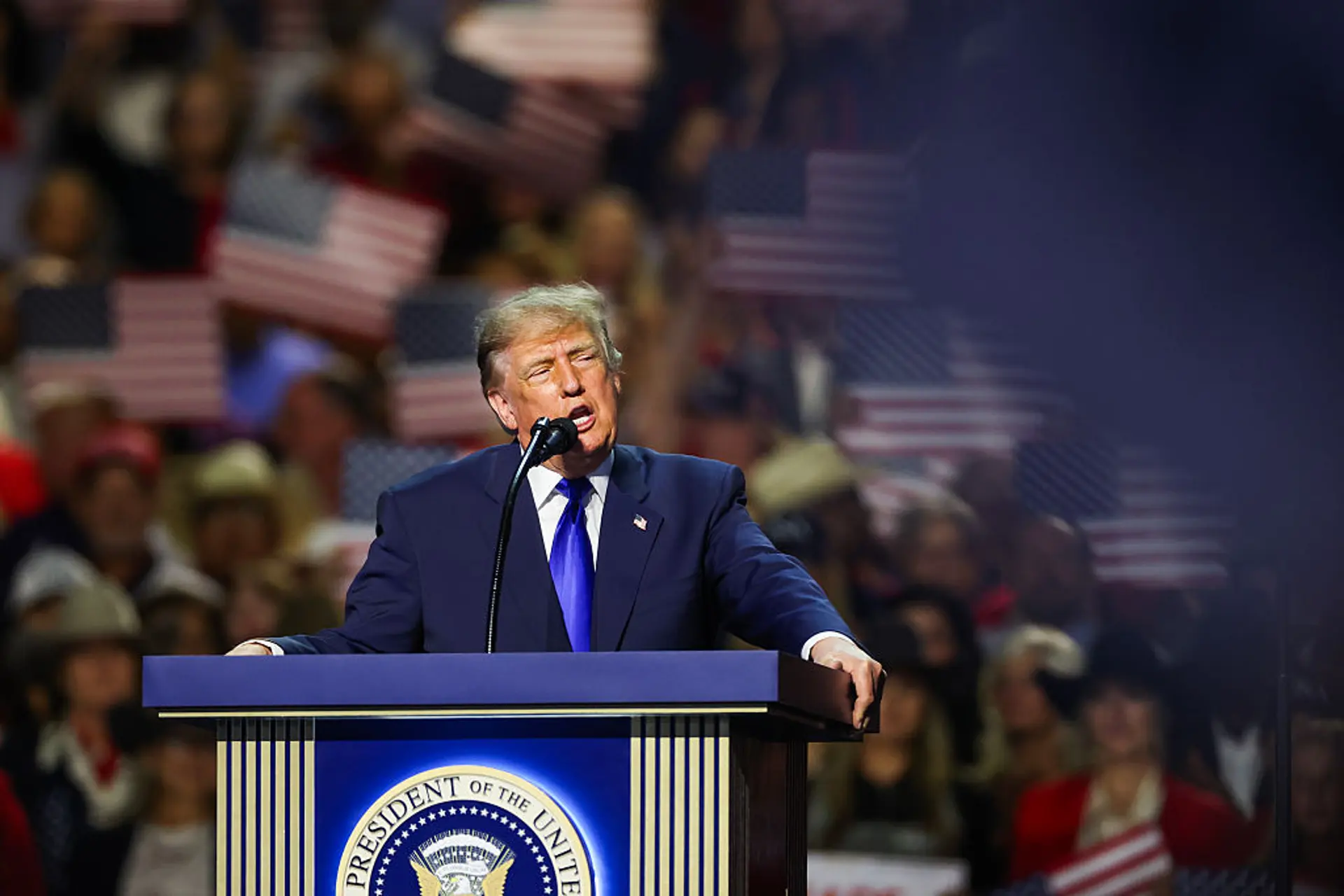
Donald Trump’s promise to give every American adult a $5,000 check comes at a revealing moment. His administration has been reshaping the federal government, cutting spending on some social programs, pursuing major tax cuts, and facing the growing fiscal costs of its military operations. Now, as Americans continue to face high living costs, Trump is offering a large and immediate cash payment. The problem is not simply whether $5,000 would help a household in the short term. It is what the promise represents. Instead of addressing the deeper causes of economic insecurity through stronger public institutions and long-term policies, Trump is offering a highly visible payment that is also tied directly to a political outcome. He has said that the payment would come if Republicans retain control of both the House and the Senate in the November midterm elections. That turns the proposal into more than an economic measure. It creates a direct connection between a promised financial benefit and the continuation of political power.
Trump calls the proposal a “dividend,” comparing it to a company returning money to its shareholders. But the numbers make clear how extraordinary the proposal is. that a $5,000 payment to roughly 240 million American adults would cost around $1.2 trillion. Trump and Vice President JD Vance have pointed to tariff revenue as a possible source of funding, but current tariff collections fall far short of what would be required. The proposal would also require congressional approval. Trump has argued that the money would be , but the scale of the payment raises obvious questions about deficits, borrowing and inflation. The important point is that the check is being presented as a simple answer to economic pressure even though the fiscal and economic questions surrounding it are anything but simple.
The proposal also looks different when placed next to Trump’s tax policies. In 2025, he signed the One Big Beautiful Bill Act, which made major parts of the 2017 Trump tax cuts permanent and introduced additional tax breaks for individuals and businesses. The law also increased the standard deduction, meaning that more income can be excluded from taxable income before federal income tax is calculated. For 2026, for example, the standard deduction is $16,100 for single filers and $32,200 for married couples filing jointly. The law also made several business tax provisions permanent or more generous. At the same time, the legislation reduced projected federal spending on Medicaid by about $1.2 trillion between 2026 and 2035 and reduced projected SNAP spending by about $211 billion, according to the CBO projections. This creates an important tension in Trump’s approach. A political movement that has long emphasized lower taxes and a smaller role for government is now putting forward a massive direct cash payment as a response to economic pressure. The $5,000 check does not fit neatly into the traditional conservative argument against large-scale government transfers. Instead, it suggests a different kind of politics: less emphasis on permanent public programs and more emphasis on a direct, highly visible benefit associated with the political leader who promises it.
The economic context makes that strategy even more significant. American households are still dealing with substantial price pressures. In August 2026, consumer prices were 3.4 percent higher than a year earlier, according to the Bureau of Labor Statistics. Gasoline prices were up 27.4 percent over the same 12-month period, while shelter costs increased 3 percent. These numbers do not mean that every increase in the cost of living was caused by Trump’s policies, and it would be too simple to attribute inflation to a single factor. But higher energy costs and the economic effects of military conflict can add another layer of pressure to household budgets. In that environment, a promise of $5,000 is politically powerful precisely because it is easy to understand. A family worried about rent, gasoline, food or medical bills does not experience the economy as a set of budget tables and policy debates. It experiences it as the amount of money left at the end of the month.
That is where the populist character of the proposal becomes clearer. Populist politics often gains strength by turning complicated structural problems into simple and highly visible promises made in the name of ordinary people. A one-time payment fits that logic extremely well. It is immediate, tangible and easy to communicate. But a $5,000 check does not make housing cheaper, reduce the underlying cost of health care, strengthen workers’ bargaining power or create a more stable system of social protection. It may temporarily increase a household’s purchasing power, but it does not change the conditions that made that household economically insecure in the first place. That distinction matters. If the problem is structural, a one-time payment can relieve some of the pressure without changing the structure itself. In that sense, the check can function as a political response to economic insecurity without being a solution to its deeper causes.
The political condition attached to the payment is perhaps the most revealing part of the proposal. Trump has explicitly linked the promised dividend to Republicans retaining control of Congress. , while Trump and his supporters present it as a way of returning economic gains to Americans. Those are competing interpretations, and the promise itself does not prove what Trump’s ultimate motivation is. But the political structure of the proposal is clear: a specific financial benefit is being connected to a specific electoral outcome. That changes the relationship between money and political power. Instead of citizens simply receiving benefits through institutions that exist independently of a particular leader, the political leader can present himself as the person who will deliver the money. The benefit becomes personal, visible and politically identifiable. This is one of the ways populist politics can reshape the relationship between citizens and the state: not necessarily by eliminating government, but by making government benefits appear to flow directly from the leader.
The real question, then, is not whether Americans could use an extra $5,000. Many certainly could. The question is whether economic insecurity should be addressed primarily through a large one-time payment or through institutions and policies that provide lasting economic security. A functioning social safety net, affordable health care, stronger labor protections, and policies that address housing and energy costs are less dramatic than a check with a large number printed on it. They are also much harder to turn into a simple political message. Trump’s proposal offers the opposite: a benefit that is immediate, personal and easy to associate with the person making the promise. That is why the $5,000 check is worth examining as more than an economic proposal. It is an example of economic populism in which a complicated social problem is reduced to a simple material promise, while the promise itself becomes part of a broader political relationship between the leader and the people. The check may put money in people’s pockets, but the larger political question is what happens when money itself becomes a way of organizing political power.
ZNetwork is funded solely through the generosity of its readers.
Donate