
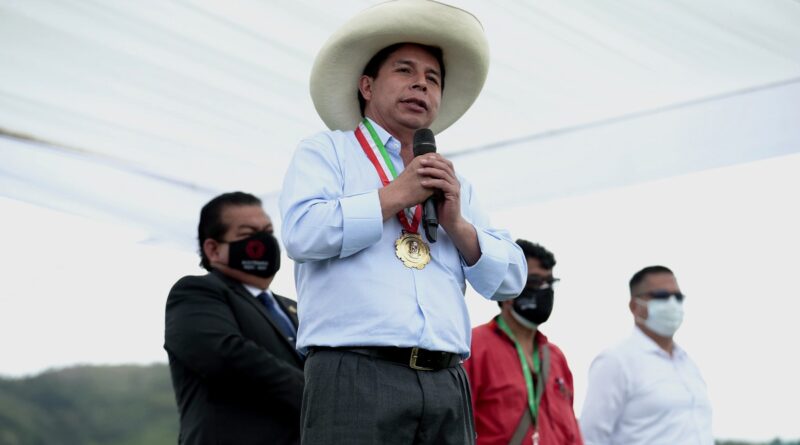
Unfulfilled campaign promises, accusations of corruption, and even an attempted self-coup cannot turn the many supporters of Peruvian President Pedro Castillo against him. The president has probably ceased to represent hopes for change, but he still symbolizes —perhaps more now than ever— structural discrimination in Peru.
In Lima, the political, economic, and intellectual elites are intrigued. They wonder why the majority of Peruvians in the streets are demanding Castillo’s release. They are even more disconcerted by the minority that insists he be reinstated.
Disconcerted Elites
It is not surprising that the ruling class is disoriented. For decades they have been isolated from the rest of the country, moving about comfortably in Lima’s de facto Apartheid, perpetuating a dynamic that tends to dehumanize Indigenous, working-class Peruvians. So, it is only natural that they should be incredulous onlookers, incapable of interpreting the national reality.
They promote theories of “subversive affiliation,” accusing people of being “mercenaries” and “lacking intelligence” to explain the support Castillo enjoys. “Some protesters do not have the right information,” said a newscaster on Cuarto Poder, a Sunday news show known for spreading false accusations of electoral fraud against Castillo’s victory. They are “terrorists” and “hoodlums,” said several members of Congress who had pushed unconstitutional laws to reduce the number of votes required to remove the president. “They are funded by Congressman Guillermo Bermejo,” suggested the Minister of Defense, who has called out the army, thus doubling the amount of State violence meted out on the protesters.
27 Deaths so far
The wounded and each of the 27 persons killed by the police so far come from the low-income, Indigenous or peasant population.
Many of those who still support Castillo lack the titles and university degrees that the newscaster, the Minister, and un-democratic Congress members have. However, Castillo’s supporters show a refined understanding in realizing that the defense of the president is linked to their own lived experiences of discrimination, and above all, their future as a social group. Forgetting that the tragic circumstance of Castillo is intertwined with the assorted forms of racism that all these “second class” Peruvians have experienced, would be to deny their own history of oppression. Allowing the idea of the “rural teacher elected president” to be shattered would prevent other low-income Peruvians from attempting to enter the presidential elections. Fear of meeting the same fate would discourage humble, provincial politicians from running, making it more unlikely to ever break Lima’s central control and the patterns of exclusion in modern Peru.
Racism Against Indigenous Heritage
Adding to concerns about a dim future is the tremendous empathy the social groups that identify with this rural school teacher have with Castillo. During his short presidency, Castillo was subjected to various forms of racist stigma, unleashing a “mirror effect” among his sympathizers. He was called a “donkey” and a “cholo de mierda” (“damned Indian”). His opponents mocked his wife, Lilia Paredes, for how she dressed and spoke.
It was natural for rural and Indigenous Peruvians to see themselves in him, even more so when the opposition constantly linked him to the phantom of the Shining Path guerrillas. The working class has been demonized with that false accusation for years. Precisely for this reason, conservative members of Congress repeated ad nauseum that Castillo was a “communist,” which meant he somehow was affiliated with a terrorist group. Little did it matter that early on the president had abandoned his progressive agenda, making it clear that he was not even a social democrat. In its endless efforts to depose him, the opposition organized dozens of protests under slogans like, “The Last Stand” and “Terrorism, Never Again!” These slogans evoked an atmosphere of civil war, “us against them,” that reverberated against the marginalized classes who knew they were “them”—the enemy.
The Judicial Branch of Government v. the Executive
The Peruvian system of justice played a key role in humiliating the president through lawfare—acting with unprecedented celerity, in contrast to its notorious sluggishness. The behavior of the Prosecutor’s Office was particularly aggressive. Prosecutor Patricia Benavides made history when she delivered the charges against President Castillo to Congress: this was the first time in the history of Peru that the Attorney General had filed constitutional charges against a sitting president. According to Benavides, Castillo was the leader of a “criminal organization” that hand-picked government contractors and took bribes for political appointments. Although superficially supported by evidence and legality, it was clear that it had political overtones, as she communicated this to the nation via a bizarre, televised press conference during which she seemed to call for his impeachment and removal from office.
Direct Attacks on Castillo’s Family
Perhaps the hardest thing for Castillo’s voters to swallow was the cruelty of the judicial proceedings. At the prosecutor’s request, the police raided the home of the president’s sister, without consideration of the fact that his elderly mother was there recovering from appendicitis. The mother was so traumatized she wound up back in the hospital. The Presidential Palace was also raided—unheard of treatment that did not happen even under administrations that stole tens of millions of dollars, such as that of former President Alan García. But perhaps the act that sparked the most outrage was that inflicted on Castillo’s daughter, when a judge remanded her to two and a half years of pretrial detention. Images of the young woman being arrested—without a trail—appeared in media outlets across the country, sending an unambiguous message of humiliation.
Every week there were news stories that diminished the standing of Castillo. These went from symbolic, such as when an officer disrespected him by snatching away a sword during a ceremony, to offenses that directly impacted his presidential duties. In an unprecedented move, Congress voted to prevent him from attending the inauguration of Gustavo Petro in Colombia. This was the first time the legislature vetoed a president’s right to carry out the fundamental task of representing the State abroad. Then it became habitual. Two more trips were blocked. The latest was when he requested permission to attend the Pacific Alliance summit; however, this event was canceled by Mexican President Andrés Manuel López Obrador in protest. All indications were that the opposition in Congress was happy to tip the balance of powers and pass unconstitutional laws to subjugate the Executive, pushing toward his overthrow. Once they succeeded, they joyfully captured the moment with group selfies, immortalizing what they had been working towards over the past 17 months.
The Oligarchy Celebrates
In the eyes of Castillo’s supporters, this triumphalist celebration, the constant insults, the obstruction of presidential functions, and the abusive way that justice was served, all show that Peru is stuck in an oligarchical past. There is a ruling class that resists allowing the poor and working classes to be represented in the highest echelons of power. The lesson is: Even if such Peruvians managed to reach the highest political spheres, they would still be treated like inferiors.
Today the judicial and legislative branches of Peru continue to perpetuate this attitude of contempt for the people, using their legal tools arbitrarily. In a clumsy attempt at self-preservation—hours before an impeachment vote—Castillo announced the dissolution of Congress. While his conduct amounted to a self-coup, the supposedly democratic institutions that remained standing broke the law themselves when they sanctioned him. Congress deprived him of his immunity in an express trial in which he had no right to a defense. The judiciary is holding him prisoner under inapplicable charges. One of them is the charge of “rebellion,” which even the former dictator Alberto Fujimori could not be tried for, even after consummating his dictatorship with tanks in the streets.
One only needs to review recent history to see why tens of thousands of Peruvians, having given up the high hopes they were holding in Pedro Castillo, remain by his side. Not only do they identify with the racial injustices the president suffered—and his arbitrary imprisonment—they also feel orphaned by structures that keep political representation out of their reach. They look around and only see institutions controlled by authorities that despise them and are now ready to kill them to maintain the status quo. The inability of the elites to understand this fact only proves that the demands of the protesters are right. Maybe it is too much to ask the architects of this political and social tragedy in Peru to stop misinterpreting it.
Francesca Emanuele is a Peruvian sociologist and a doctoral student in Anthropology at American University in Washington, DC and COHA Board member.
ZNetwork is funded solely through the generosity of its readers.
Donate


