
At the gleaming new Fruitport High School in Michigan, the entrance opens to a spacious atrium, with floating rows of lockers arrayed diagonally from the front door. They are noticeably short so students can peer over them. Overlooking the atrium is a walkway fenced with metal sheets and pockmarked with slits through which you can survey the space below if you were to crouch. Hallways bear “wing walls . . . to provide barriers for school children to hide behind.” Classrooms, meanwhile, each have a single window at the door and are designed so that exactly thirty-two students plus a teacher can be concealed from view if they huddle in the corner.
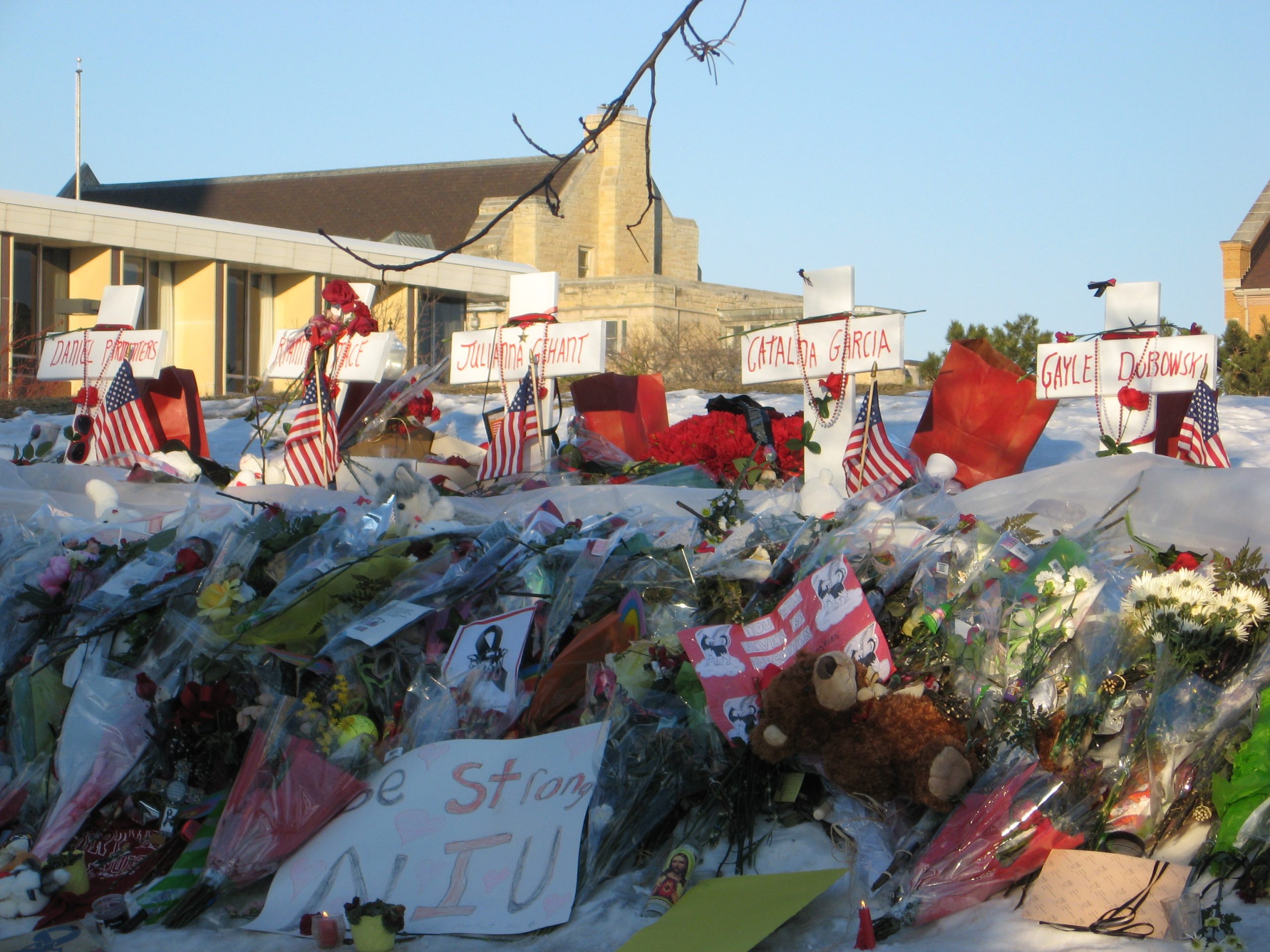
This is school design for the depressing reality of twenty-first-century America, where gun violence has become the leading cause of death for youths, and the number of mass shootings continues to soar — to more than one a day in 2023 so far. Among the most horrifying massacres are those at schools.
Reasonable societies would respond to these trends by curtailing access to guns and making it harder to carry them in public. We have decided instead to make it easier to access and carry guns — and use them — in public and to transform our schools into fortresses, traumatizing an entire generation in the process.
Gun rights advocates recommend “hardening” our schools: denying them windows, limiting the number of entrances, cutting down all trees, and erecting large fences. For those who deem these measures too jarring or bleak, Fruitport High is intended to soften or smooth over the defensive features. Hallways are gracefully curved; this is to “cut off a shooter’s line of sight.” There will be large windows all around the building, especially across the atrium — so you can see the shooter approach — which will be covered in bulletproof film. The entrance features an “educational entry panopticon” and a “sally port,” common in prisons, which is essentially two sets of doors that can lock someone within. It’s no surprise the school borrows features from prisons; the latter are the specialty of TowerPinkster, the firm hired to design Fruitport High School.
Defense-industry firms are pivoting to address the scourge of shootings. A manufacturer of “bomb resistant vehicle armor” now makes bulletproof doors for schools and boasts that it incorporates “the experience we gleaned from protecting the war fighter.” Military consultants have helped draw up plans for how school communities should act in the event of a shooting. Teachers have been outfitted with sharpies “to write the time they applied a tourniquet to a bleeding student,” and trained to use litter buckets for makeshift toilets in the case of a lockdown.
In training exercises, students are instructed to crouch along the wall in perfect silence, with lights turned off and shades drawn, as someone walks the hall jostling door handles. In one case, an unannounced exercise was taken for the real thing, prompting students to call family members to say goodbye.
Critics say these trainings do more harm than good, terrifying youths for incidents that are still rare. It’s all performative and hardly effective. The training and protective features make it seem like schools are being proactive, which is all we are allowed to do while gun control is blocked. And most school shootings are perpetrated by members of the community, who likely know the protective measures and how to circumvent them.
The Long Reach of Violence
“Violence has a long reach,” sociologist Patrick Sharkey says. Its impact is felt far beyond those who bear its brunt; its effects are seen in how we change our behavior, adapt, cower, and design our world accordingly, where its damage is reinforced and repeated.
In schoolchildren, researchers note a “constant back-of-the-mind stress,” which peaks with training drills that increase anxiety and depression. The terror is amplified by “media exposure to mass violence” — a special concern for teens glued to their cell phones — which fuels a “cycle of distress where persistent worry about future violence predicts more media consumption and more stress.” Researchers observe a higher incidence of Post Traumatic Stress Disorder in people whose social networks have been impacted by gun violence, and they are worried by studies that report the same for people exposed to repeated media coverage of traumatic events like mass shootings.
The stress and anxiety wrought by gun violence undermines the purpose of our schools. It impairs children’s ability to focus, listen, reflect, negotiate differences, collaborate, and get along. A study reports that the “heightened worry over safety even in the absence of gun violence rewires the brain at its most sensitive periods of development” because it compromises the prefrontal cortex, which “coordinates higher cognitive functions including working memory, attention shifting and executive skills . . . [and] also mediates empathy and self-regulation.”
With kids forced to contemplate the worst at any moment, mapping out their escape, or pondering death and final goodbyes, this is no way to liberate young minds. It is a surer way to crush them. Free and boundless thought is the seed and staple of autonomy. Our culture of mass shootings is rooting this out of future generations, who are left instead to think of mere survival.
Guns v. Democracy
The radical gun rights agenda enabling all of this is not the product of popular will; it is ascendent because its proponents are successfully subverting democracy. Majorities of voters favor stronger gun control measures; upward of 70 percent from both parties want universal background checks, for instance. But Congress ignores their views. It is in thrall to the powerful gun lobby, which commands a small but impassioned army of supporters who go to great lengths to advance their cause, even marching in public with assault rifles to intimidate opponents.
Many politicians are reliant on the National Rifle Association (NRA)’s financial generosity. The NRA was the biggest donor to Donald Trump’s presidential campaign in 2016, and it reaped the rewards, including three Supreme Court justices who would faithfully advance the gun lobby’s cause. In its landmark decision New York State Rifle & Pistol Association, Inc. v. Bruen, the Supreme Court majority declared concealed carry restrictions enacted by New York State unconstitutional.
More alarming, the justices asserted a new originalist standard that threatens what gun control regulations remain. The court now says we must look to the period between 1791 and 1868 (the years that the Second and Fourteenth Amendments were ratified respectively) to determine if gun regulations are constitutional — a period when there were basically none. A Texas judge subsequently determined on that basis that “red flag” laws, which many voters support and have approved across the country, and which prohibit domestic abusers from accessing guns, are unconstitutional.
In short, when it comes to guns, the Supreme Court doesn’t care what voters want. (This diverges notably from its position on abortion and environmental regulations, which, the justices say, should be up to the will of voters in each state.)
The ascendant gun rights movement is symptomatic of the problems with American democracy, in which anti-majoritarian institutions like the Supreme Court and the Senate allow the will of the few to be foisted on the many. To have a chance at stemming our runaway gun culture, we must organize to dismantle these institutions and build a genuinely democratic state.
American Carnage
This task is urgent because our hyperarmed society, enabled by our antidemocratic Constitution, undermines the basis for what little democracy we do have. Terror is an inherently undemocratic emotion and outlook. It does not dispose people to work together, communicate, collaborate, and compromise, as democratic deliberation demands. Thanks to the trauma of our armed culture, we are raising a generation of children to be instinctively mistrustful. They will be less inclined to reach out to neighbors and fellow citizens and more likely to retreat inward into private, fortified lairs.
The paranoia to which our children are being reduced sounds similar to the mindset Hannah Arendt described under totalitarian regimes. Authoritarian governments that aim for total domination, she writes, cannot suffer human freedom; they cannot tolerate citizens that are autonomous and unpredictable. They must be made uniform, as if part of a single body, immediately responsive to government demands. Reduce people to worrying over survival and you greatly limit the scope of their aspirations and expectations. You also make them easy to manipulate, prod, and shape at will.
Our armed society is nurturing an “authoritarian predisposition,” as political psychologist Karen Stenner puts it. This predisposition is “stable and enduring but normally latent — [and] is activated and expressed when triggered by perceived political and social disorder.” Future generations, weaned on trauma and buffeted by anxiety, will crave security. They will be unsympathetic to difference and intolerant of indecision when terror might strike. There is no shortage of “American carnage” for authoritarians like Donald Trump to cite to justify dispensing with the democratic traditions and institutions that we do have. If society becomes a war zone, we can hardly sit around while voters and elected officials dither and debate.
Reversing these trends will require challenging the individualism, atomization, and passivity that the culture of violence encourages. It will require collectively organizing and mobilizing en masse to demand a transformation of our government’s institutions, so that the majority’s preference for reasonable gun control laws may prevail over the preferences of the NRA, gun rights fanatics, and unelected judges. We can take inspiration from large-scale protests like the 2018 March for Our Lives, led by teenagers who survived the Marjory Stoneman Douglas High School shooting in Parkland, Florida, or the tentative moves toward gun control in deep-red Texas, provoked by popular outrage over the recent school shooting in Uvalde.
The task is not easy. But ending the epidemic of mass death, and the threat to democracy it poses, demands a radical, collective response, one that fights to make our country’s political institutions truly democratic — more than they were before.
ZNetwork is funded solely through the generosity of its readers.
Donate

