
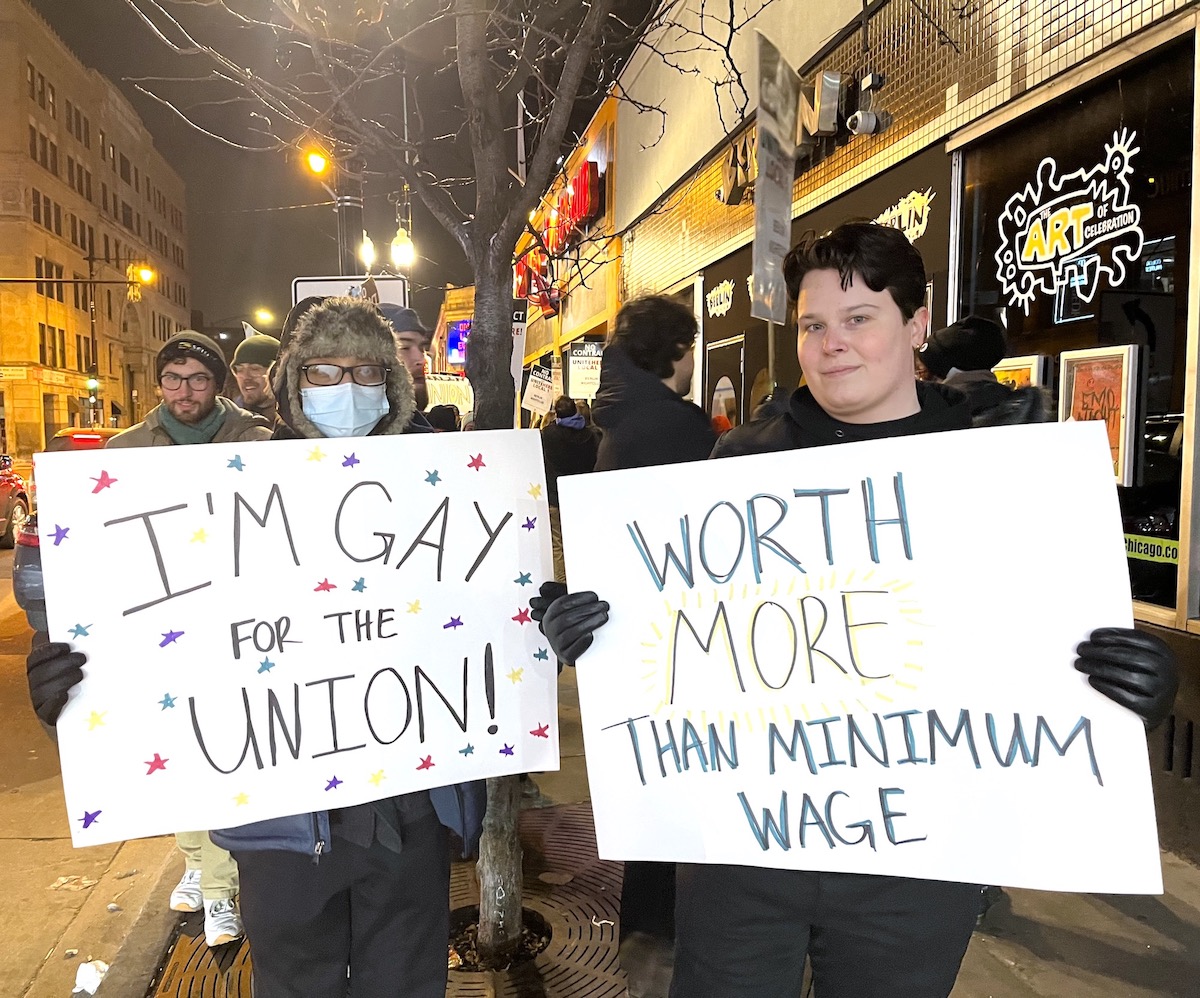
For nearly 40 years, Berlin Nightclub has set itself apart through its progressive, come-as-you-are atmosphere, late-night dance floor extravaganzas and bold, diverse drag performances. Now, workers at the club are seeking to set Berlin apart in a new way — by becoming the first nightclub in Chicago’s gay enclave with a unionized staff.
According to Jolene Saint, a bartender who has been working at Berlin for more than six years, on February 28th, workers at Berlin filed for union election with UNITE HERE Local 1 — a union representing more than 15,000 hospitality workers in Chicagoland. Two days later, staff notified management of their decision.
Saint says workers’ decision to unionize is “not personal, it’s not because we hate anybody — it’s because we know we could have better working conditions.” Two of Berlin workers’ key priorities resemble those of most union drives: better pay and healthcare. Saint, for instance, currently makes $9 an hour plus tips as a bartender, and does not receive health insurance from the club — both things she’d like to see improve. Workers In These Times spoke to said they would also like to see improvements such as proper breaks and consistent scheduling.
Yet other demands at the club have to do with its nature as a queer bar in a time when those spaces are under threat. As homophobic and transphobic rhetoric and violence increase nationally, Saint says she and her coworkers are also worried about violence coming towards the club from the outside. Workers In These Times spoke to mentioned security improvements they would like to see, including proper uniforms for all security staff as well as cut-proof jackets. Chelle Crotinger, who has been part of the club’s security staff for about five months, says they want to use the union as a way to ensure that security team members receive more in-person de-escalation and standard self-defense training.
“People often say that gay bars or queer bars are community spaces,” Saint says. “If they want to live up to that promise, they need to take care of the people who are making that happen … so that we can make people feel welcome, and loved.” Leo Sampson, who has been working at Berlin since fall 2021 and performs at the club as drag king Luv Ami-Stoole, sees fighting for the union as an act of community care.“In a time where the political climate is so anti-drag and anti-trans, I think it’s important to remember we are all we’ve got is this community and we have to support each other,” he says.
Berlin’s union drive follows other recent efforts to improve conditions in Chicago’s queer nightlife scene. During the summer 2020, Chicago drag queen Jo MaMa and other local drag performers held a Drag March for Change, which drew 15,000 protestors. In the wake of the march, a group of performers formed the Chicago Black Drag Council, which held town halls to address racism in the nightlife scene in Northalsted and launched a mutual aid fund for BIPOC nightlife workers. Since then, workers at two of the city’s largest LGBTQ nonprofit organizations, Howard Brown Health Centers and Brave Space Alliance, have been fighting to unionize, which Sampson says has made the community more aware of labor issues. On Friday, members of Howard Brown Health Workers United joined Berlin workers on a picket line outside of the club. “We’re sort of inspiring each other to fight for what is right,” he says.
Crotinger sees their union drive as a way to help ensure Berlin remains a safe space for future generations amid larger-scale systemic attacks on queer and trans people. “In queer communities, we don’t really have the privilege of relying on legacy because it’s largely been taken away from us, whether it’s been through legislation or been through neglect of medical intervention for the AIDS epidemic,” they say. “I feel it’s our responsibility now … to establish something that is going to last beyond us.”
“The appeal of a union is just inherent for me — the idea that these queer spaces that we are helping to keep safe, they belong to us, they are for us,” Crotinger adds.
And if the staff at Berlin successfully unionize, they hope to be a model for other workers in Chicago’s LGBTQ nightlife scene.“The way that Berlin handles it can really set the precedent for the rest of Boystown and the Northalsted area and all gay bars, even in Andersonville, of how workers should be treated and compensated for working in these bars and in these spaces,” Sampson says.
In an email to In These Times, Berlin co-owners Jim Schuman and Jo Webster write that they “are committed to the well-being of Berlin (our only business) and its employees” and that they “intend to follow the law and the legal process” outlined under the National Labor Relations Act.
On the same day they filed to unionize, Berlin workers launched an online petition with UNITE HERE to show community support for the union; within 72 hours of it going live, the petition had collected more than 2,000 signatures. One of those supporters, Jack Chylinski, has been going to Berlin a couple of times a month since the club reopened following its pandemic-related closure. For them, Berlin is a “diamond in a gold mine,” and a place where it’s easy to foster community while having a fun night out. They encourage their fellow club regulars to get loud about the workers’ union effort.
“The workers of Berlin are the lifeblood of the whole establishment,” Chylinski says. “They create a feeling of safety and such amazing experiences of queer joy, and they should have a say in how things are run.”
Crotinger says so far, even in-person at the club, patrons have been incredibly supportive. “If there’s any kind of reticence that happens, that’s immediately zapped when someone comes up and says, ‘Hey you don’t know me, but what I think you’re doing is really fucking awesome and I’m in,’” they say. “How can you not feel motivated to keep pushing?”
ZNetwork is funded solely through the generosity of its readers.
Donate