
As the sun streams through the windows of our New York apartment, I watch our now five-month-old son grab his newly found feet. He sways as he chats with the baby looking back at him in the mirror attached to the play gym. He breaks into a wide-mouthed smile when he turns and catches my gaze. My chest constricts with the enormity of my gratitude for his existence and joy.
And, as I have often done in the last 100 days, I think of Gaza.
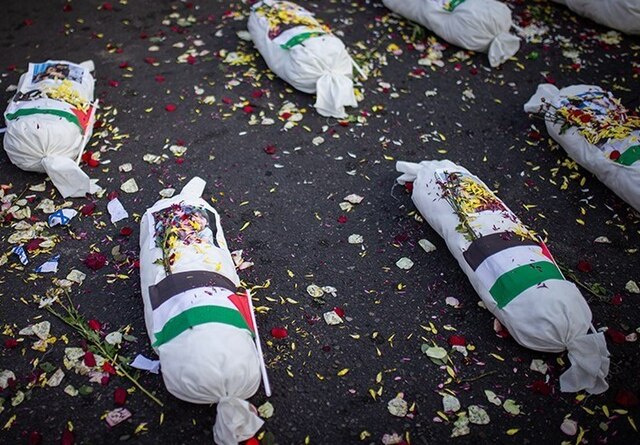
I think of the mother who, like me, struggled to have a child only to then lose him to the flippant brutality of bombs dropped from the sky. Of the father desperately clutching his soot-covered daughter, her fat arms and feet dangling limp against his chest. Of another father who tried to wrap a cookie into his son’s lifeless hand. He had been so excited to find his son a treat at the market only to come home to find him dead. Of the babies lined up in the NICU of a Gaza hospital under attack, who would soon likely not be wrapped in the muslin of a swaddle as my baby was, but in a white kafan (a burial shroud).
For the past 100 days we have witnessed a massacre of children, of childhoods. Of the roughly 24,000 Palestinians who have been killed, almost 10,000 are children. Each had a name. A favorite color. A favorite toy. Each cackled at a parent’s funny face.
The horrors befalling children of Gaza do not stop with death. Another 8,663 Gazan children have been injured. Each day, 10 children lose one or both of their legs — their limbs often amputated without anesthetic. Israeli forces have stripped young boys naked and paraded them in public. An estimated 25,000 children have lost a mother, a father — or both.
I am haunted by the images and videos of parents in Gaza with their children, by the love and grief comprising these figures. I am haunted because for the past decade I have worked with people who continue to endure the toll of war and displacement long after the end of violence. I am haunted because I am also the daughter of people who as children sheltered from Israeli bombs.
But most of all, and along with other parents who protest against the genocide and the mass murder of children in their identity as parents, I am haunted because I am a mother. Because I know what it is to feel a baby grow against my body, kick and hiccup against my ribs. Because I know the anxiety of watching a newborn’s chest rise and fall, the vastness of the dreams I hold for my son, the lengths I’d go for his joy, that there is nothing I wouldn’t do to protect him. I am haunted because if for some reason my son did not rise from his nap, I do not know what would become of me.
As a world we have failed the children of Gaza. We have failed our fellow parents. It is not a new failure. The vast majority of the 1.1 million children in Gaza were born behind a 17-year-old blockade which even in utero saw them as a danger to their colonizer, their lives and freedoms expendable for the sake of its stability. It’s something we’ve seen time and again with the Israeli military. After the 2014 assault on Gaza, the Obliterated Families project reported that one-fourth of the 2,200 Palestinians killed were children, with 1,000 other children permanently disabled.
We have long acquiesced to Palestinian children living in these conditions, to our tax dollars being sent to build the technology of their confinement. I live in a country whose leaders have long deemed Arab children like my son as less than human. In Yemen, in Syria and Iraq, in Libya, in Palestine — Arab children, our children, are simply ok to kill.
Against the horror of this assault, Gazan parental love, the most natural thing in the world, is resistance. On November 3, Doaa, a Gazan mother of two, and an Arabic teacher, tweeted a photo of her five-year old daughter beaming, holding a cupcake and wearing a sparkly tiara. She was proud to have managed a makeshift celebration for her daughter’s birthday in the midst of the violence, writing “her happiness was worth the world.” When Doaa was killed along with her other daughter 24 hours later, the image went viral.
Someone compiled videos of Gazan men playing with babies covered in soot to say “Look at how gentle our men are; look at how they are not terrorists.” As the daughter of a doting Arab father, I watched these videos and felt caught between my recognition of their sweet nothings and my offense at the need to share them.
I am angry any person would have to distract a baby covered in soot.
That any of these images of parental love and resistance exist is testament to Gazan strength and endurance. The photographs and videos are produced because grieving parents allow journalists to train their cameras on them as they kiss their baby’s eyes, kiss their baby’s feet goodbye. I am struck by the desperate rage of it, the unwillingness to break. I am reminded of Black mothers in the American south like Mamie Till insisting on open casket funerals to show their children’s mutilated bodies at the hand of white supremacists, their decades-long oppressors. The hope is that the world has a shred of shame, that if they look maybe they would be moved to act, to stop the violence. “Do not look away,” the videos and photographs instruct us. The parents are cognizant that what they have endured is too much for the rest of us to passively consider. I must admit, this piece about their loss is the hardest thing I have penned in a long career of writing. I know I can never do justice to the depths of this parental love and loss.
The crime of genocide is the crime of destroying a nation, a people. In Gaza, multiple generations of families have been killed at once, giving rise to a new acronym, WCNSF: Wounded Child No Surviving Family. I have never had a fear of dying before I had my son. If something were to happen to me, I’d count on my loved ones to take care of him. They’d know the airplane sounds he likes, how he likes to be burped. I’d count on them to remember me to him. But what if they were all gone, too? The massacre in Gaza is so much more than an aggregate count of lives. It is the loss of collective memories held in those lives — of events, of people, of places. A loss for which generations and generations to come will continue to pay the price.
In the face of a colonizer intent on the destruction of their nation, of 75 years of unrelenting violence, Palestinians have insisted on sumud, unwavering perseverance. That they will be free in their land. That they will grow and bear fruit like the olive trees that they plant.
Gazan children deserve more than survival. They deserve more than to simply be unmolested by the whims of tyrants. They deserve futures, joyful futures. They deserve to babble and giggle with their parents. They deserve to live free, from the river to sea.
ZNetwork is funded solely through the generosity of its readers.
Donate