

What is happening to the US dollar? Why has the Federal Reserve set up a ‘pawnshop’ on its estate? Why do Japan’s low rates of interest threaten the US? Why are Europeans angered by US Treasury Secretary Bessant’s not-so-stealthy hedge-fund-style moves? And what has that all got to do with the AI bubble and Silicon Valley’s vast mountains of debt?
Above all, what has that to do with you or me? Those are the themes of this post.
But first. Writing is hard for a woman of my great age when the reality and the expected outcome of our converging crises portends a grim future – one widely foreseen and understood.
Like many others, I am grieving.
Many of us know that both the economic and eco systems will soon confront societies, our children and grandchildren with even bigger, well predicted and destructive shocks. But who will lead? Where are the great economists that could follow in the footsteps of John Maynard Keynes? And how will societies mobilise to storm the gates of private power and put a stop to the giant, globalised roller coaster that is finance and fossil capitalism?
Professor Kevin Anderson reminds us that that civilisations have collapsed in the past and all thought they weren’t going to – until they did. Kevin Anderson is a friend. He can see clearly. I suspect that he too is grieving.
Just as I am keen to empower readers to move away from ‘the narrow… micro level” of the economy – the focus of all orthodox, misguided economics – and instead to take the macroeconomy into account, so Kevin wants us to do the same for the ecosystem. Despairingly he said:
We seem to lack completely any ability to step back and look at the system..We’re wonderfully clever at looking at the small parts of something – but the collective of the small parts of the system – the ecosystem – we’re appalling at that.
The climate is not a series of small parts. Its a system. The ecosystem.
One of the reasons we’re fending off climate change (is because) we have a reductionist form of economics that parrots physics but is not physics.
We have got to stand back and look at the economy as a system… the political economy if you like.
So let us stand back and look at what is happening to the global economic system right now.
To begin: the AI bubble.
My book The Global Casino – is not just about speculation in the financial system, but also about the way our elites are gambling on the risk of climate breakdown. Cory Doctorow explains it well: the Silicon Valley ‘bros’, he says, are gambling that AI will outrun the second law of thermodynamics – the law that states when for example, wood or fossil fuels are burnt they are not destroyed. Instead they’re transformed into something else – smoke and greenhouse gas emissions. Those emissions do not disappear. They form a blanket of heat enveloping and suffocating the earth. Understanding the second law of thermodynamics is vital to an understanding of the climate crisis.
General Artificial Intelligence, argue the AI bros, can and will outrun the law of thermodynamics. Society, they urge, must finance and build General Artificial Intelligence fast – before the ice caps melt, so that General AI will tell us what to do….. when the ice caps melt.
Its an incredible gamble with the planet…and their basis for asserting that making General Artificial Intelligence is just around the corner, deeply foolish…Its not just they’re making false promises, they’re discontinuing the actual promising things already happening….
The AI Debt Boom
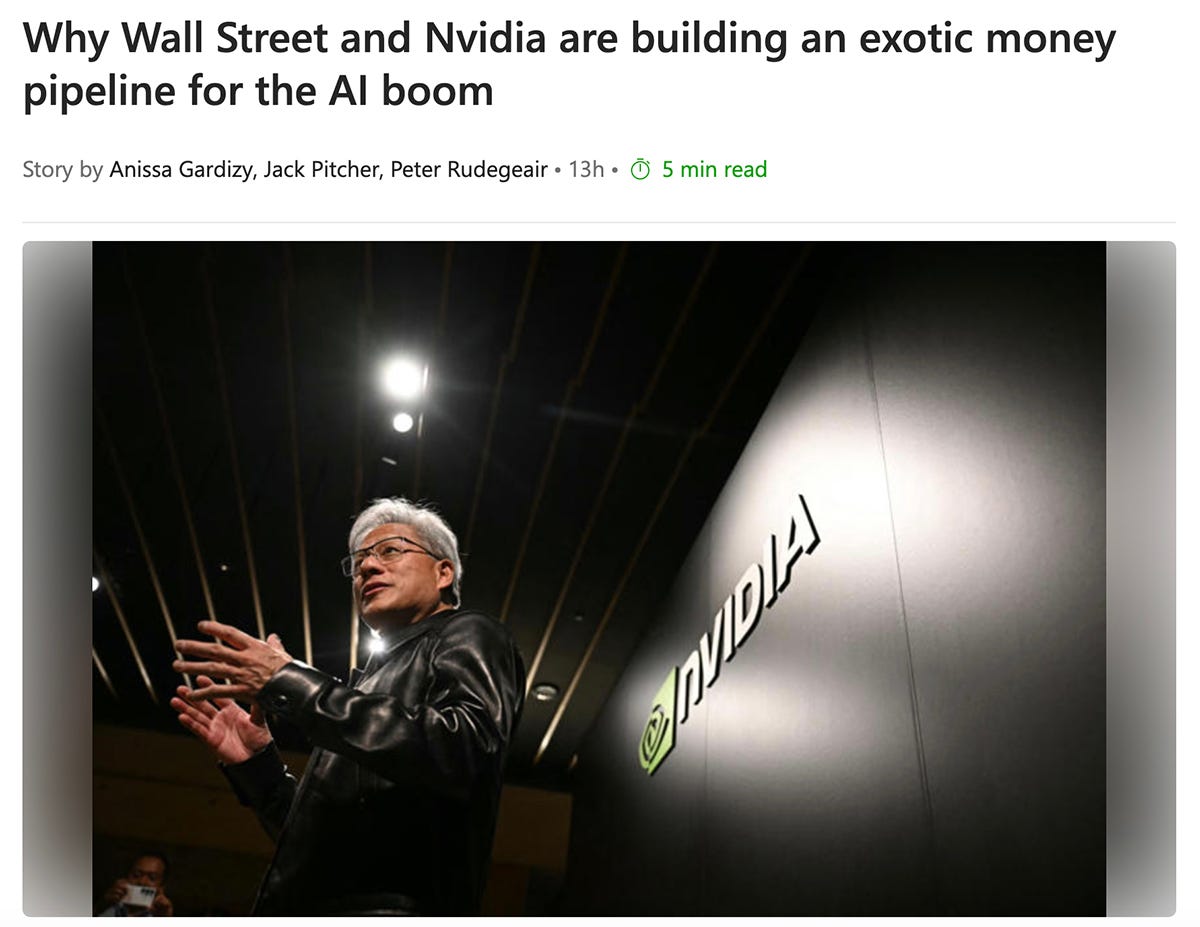
Silicon Valley AI companies are buried under an ‘exotic pipeline of debt’.
And just as in previous peaks of financial speculation, greed is now driving deceptions, fraud and rule-breaking. Especially about the extent of AI borrowing. Robin Wigglesworth of the FT’s Alphaville section has noticed
that the hyperscalers (Amazon Web Services, Microsoft Azure, Google Cloud , Alibaba Cloud, Oracle Cloud, IBM Cloud and Meta) have become increasingly inventive in how they raise the money required for a titanic series of data centres being built around the world.
Fortunately, Goldman Sachs’ analysts have gone through all the fine print for us, and totted up a massive $1.5trillion of lease commitments, of which about $1 trillion doesn’t appear in the financial statements of the hyperscalers. (Emphasis added)
And so on, and so forth.
Torston Slok of Apollo Management wrote a perceptive, if alarming piece last week:
…AI boom’s profits are currently being funded by investors rather than earned from customers. The upstream margins are real, but they are paid for out of capital raised by the layer losing money, not out of cash generated by end demand.
The bottom line is that the most profitable part of the AI value chain depends on the least profitable part continuing to grow revenue or raise capital. Capital can bridge the gap for a while, but not indefinitely. And therein lies the risk: will the ROI (returns on investment) show up for AI’s end customers fast enough to sustain the spending that is generating those upstream margins?
The point of all this is that all the money invested (by ordinary shareholders and bond holders as well as by big institutions like pension funds) in AI is both driving a stock market boom, while simultaneously threatening to crash that boom.
At the same time the all-powerful US economy is losing steam. As Dean Baker notes, the latest disappointing jobs report reveals a slower job growth path. That means slowing wage growth which means consumers are spending less.
Perhaps more concerning than the absolute number is that virtually all the job growth is in the health care and social services sectors. Growth over the last three months in these sectors has averaged 33k, more than 90% of total, even adjusting for the July education drop.
Outside of these sectors, there is very little growth anywhere.
Kevin Hassett, White House economic adviser is unmoved by these falling job numbers. Indeed he has boasted of the administration’s deliberate destruction of more than 300,000 public sector jobs.
The slowdown in the US economy owes a lot to President Trump’s illegal, escalation and de-escalation of a destructive war on Iran and his weaponisation of tariffs. That in turn is fuelling inflation, and raising prices at the pump – causing pain to consumers that are Trump’s voters. And US government borrowing is alarming the government’s creditors: the bond market.
The US state owes in total, $40 trillion in debt according to the St Louis Fed. That is more than 122% of US GDP or annual economic output of $30 trillion. The interest on that debt varies from about 4% on 10 year bonds and more than 5% on 30 year bonds. While that is costly, the US has a powerful and bountiful economy. Nevertheless, borrowing is costing the nation dear – and lenders are wondering if they will be repaid.
A weakening US economy and a weakening US dollar
Above all, Trump is actively undermining the global world economic and security order. Central to that order is the US dollar – the global economy’s reserve currency for eighty years now. Slowly but surely the Trump administration is eroding the rest of the world’s confidence in its own currency.
We know that his administration, and in particular his Treasury or Finance minister, Scott Bessent (who once traded currencies for the Soros hedge fund) is seriously worried about the weakness of the US dollar. Why? Because a weakening US dollar would encourage the world’s finance ministers to divest from US Treasuries.
In other words, the rest of the world could give up financing US debts by selling the Treasury bills (bonds) they own – on grounds they’re losing money on their Treasury assets, thanks to the weakening US currency. The sale of Treasuries (as they are called) would increase the number of Treasuries in the bond market, and because of the way that market works, would lower the price, but increase the yield (interest or rent) on those bonds. That would make US borrowing to fund for example, Pete Hegseth’s ‘warrior’ military, more expensive. A situation Scott Bessent will take extraordinary lengths to avoid.
How do we know this? By simply looking at the US’s unprecedented intervention in the weakening Japanese currency, the Yen.
The US constructs a ‘pawn shop’ at the Fed
The Yen is weak for a number of reasons, but mainly because the Japanese central bank and finance ministry are determined to keep interest rates low, to help Japan’s domestic debtors and borrowers finance investment. (A worthy cause – one denied to British investors by our hawkish Bank of England.)
Both Japanese and foreign investors can earn more by borrowing in low interest-rate Yen, then selling Japanese bonds to raise US dollars to lend to countries with higher rates of interest (like the US or UK). Thanks to the mobility of cross-border flows of capital, that causes money to flow out and weakens the Yen.
Plus thanks to the Iran war, the higher cost of energy (paid in US dollars) is depleting the resources of the Finance Ministry. In addition Japan has been hit by US tariffs. All that is made worse by a new Trumpian Prime Minister (who sounds a lot like Liz Truss) determined to cut taxes and increase government borrowing and spending.
To strengthen the Yen, the Japanese Finance Ministry can sell US Treasuries and raise more cash to invest (buy) Yen, thereby strengthening the currency.
It has already done so. To strengthen the Yen Japan spent an estimated $87 billion of its foreign exchange reserves to buy Yen over the last two days of July. In other words, it sold US Treasuries to invest more in the Yen.
That is problematic for the US.
Placing more Treasuries in the global bond market, as noted above, causes yields to rise on US government bonds (debt) – despite the attempts of the US Federal Reserve to keep rates low. Scott Bessent is determined that should not happen.
To avoid the sale of US Treasuries, Bessent persuaded the Fed to set up a new ‘facility’ – expressly designed to prevent Japan’s sale of US Treasuries. It was given an acronym designed to obscure its intention: the Foreign and International Monetary Authorities (FIMA) Repo Facility.
This ‘facility’ is nothing other than a fancy term for a US pawn shop. Japan is invited to deposit its ‘jewels’ – US Treasuries – in the Repo Facility in exchange for cash (US dollars) – and with the promise that the Treasuries can be retrieved in the future.
Then to help Japan, Scott Bessent invested $5-$10 billion in the Yen. But he did not do so by selling Treasuries and raising US dollars. Instead he used $5=$10 billion worth of Euros banked at the Federal Reserve. In other words, he sold Euros to finance the strengthening of the Yen, and did so without consulting his European allies. The sale of $10 billion worth of Euros will of course impact the exchange rate of the Euro. But the Trump administration has contempt for its European ‘allies’ and cares not a jot of the impact on the European currency.
We know that because as the note above shows, he called it Operation Economic Fury.
All this is dodgy and unusual behaviour by a US Treasury Secretary behaving like a an over-excited hedge fund trader. But it signals danger too. A loss of confidence in the US dollar and a shift to alternative currencies and assets (like gold) is shaking the global economic order.
It is now clear that we are living through the ending of the post-war economic order, established at Bretton Woods.
So what has this to do with you?
A great deal. The last time the world’s reserve currency was weakened and power over the global economy transferred to another was in the 1930s. The hegemon that wielded the power of the world’s reserve currency then was Britain, forced to give up that power to the new kid on the block: the United States of America. It was a period of financial instability, high levels of sovereign debt and economic failure. It was a transition that led ultimately to a catastrophic world war.
The next few months may be particularly risky. As opinion polls turn against the Republicans, President Trump and his allies are looking for an excuse to prevent, or overturn the US’s mid-term elections. Could a crisis for the US dollar, or any other form of economic failure, act as an excuse to cancel elections?
We do not and cannot know the future. But be warned. These are dangerous times.
Keynes had an answer to the problem of political, trade and financial instability caused by capital mobility and a currency tied to a single hegemon: his proposal for an international clearing union. Unfortunately then as now, his proposal was dismissed by the dominant hegemon.
It is in all our interests if we are to avoid converging economic and ecological systemic crises, that his proposal be resurrected once again, and given serious consideration.
ZNetwork is funded solely through the generosity of its readers.
Donate
1 Comment
All readers will certainly give this proposal a very “serious consideration”. Any more proposals to consider? It looks like in this country the radical Right are the most practical and reasonable people. TINA indeed.