

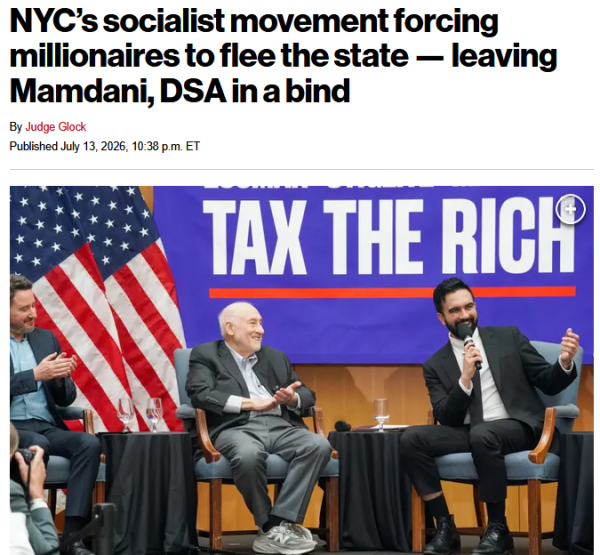
New York City Mayor Zohran Mamdani plans to increase income taxes for residents who make more than $1 million (1% of the population) and raise corporate taxes (on 1,000 out of the city’s 250,000 businesses, according to the Empire Center for Public Policy—10/30/25). The New York Post responded with a drumbeat of coverage claiming that rich residents and corporations will leave the state in a mass exodus, triggering an economic spiral.
The Murdoch-owned Post—the second-biggest paper in the US by web traffic—has published at least a dozen articles about rich residents and businesses “fleeing” New York, starting before Mamdani’s November 2025 election:
- “Bidding War Frenzy and Soaring Prices Hit Connecticut Homes as NYC Buyers Flee Amid Fears of a Mamdani Win” (10/29/25)
- “Florida Locals Rush to Buy Homes Over Fears New Yorkers Fleeing Mamdani Will Flood the Market” (11/6/25)
- “‘Mamdani effect’: Miami Realtors Report 166% Spike in Inquiries From Wealthy NYC Residents” (12/4/25)
- “Mamdani’s ‘Cuckoo’ Property Tax Hike Will Land Him ‘Real Estate Agent of the Year’ After Inevitable Exodus, Kevin O’Leary Says” (2/18/26)
- “Mamdani’s Corporate Tax Push Could Cause Exodus to Jersey, Business Honcho Claims” (2/22/26)
- “NY, California and Other High-Taxed States Losing Billions While Florida Prospers From Mass Migration: IRS” (3/28/26)
- “NYC Business Leader Warns Exodus Is Brewing Over Zohran Mamdani’s Tax Hike Crusade: ‘Exploring Options’” (4/5/26)
- “Exodus From NYC Spells Trouble for Mamdani’s Spending-Hike Agenda” (5/1/26)
- “Billionaire Bigwigs Launch NYC Exodus After Mamdani’s ‘Tax the Rich’ Antics” (5/6/26)
- “Mamdani’s Billionaire Bashing Could Cost NYC $12b, Data Shows, Triggering a ‘Death Spiral’ as Jobs Disappear, Residents Flee” (5/8/26)
- “NYC’s Socialist Movement Forcing Millionaires to Flee the State—Leaving Mamdani, DSA in a Bind” (7/13/26)
- “NY Sees Dramatic Exodus of Millionaires—Causing Nearly $11b Loss in Tax Revenue: Study” (7/13/26)
‘Taxpayers will flee’
In May, media watchdog Media Matters for America (5/27/26) gathered a list of news and opinion articles in US corporate media that covered the millionaire exodus trope. Media Matters’ list—and an additional Google search that I conducted—yielded articles by USA Today (11/6/25), the New York Times (5/2/26), Wall Street Journal (5/14/26, 4/26/26, 4/17/26, 3/15/26) and Fox News (7/15/26, 7/14/26, 5/8/26, 10/7/25).
It’s not just New York City. The New York Times (8/10/26) and Wall Street Journal (8/9/26) also questioned whether wealthy residents would flee from Wisconsin if Francesca Hong was elected governor, while the Washington Post (8/7/26) confidently asserted that “Wisconsin Taxpayers Will Flee” from a Hong governorship. (This threat was averted when Hong narrowly lost a Democratic primary after being massively outspent by dark money—FAIR.org, 8/12/26.)
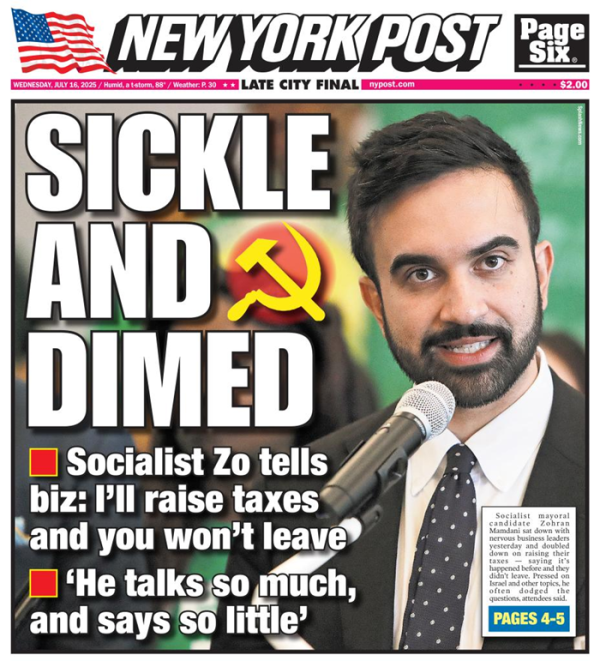
Seattle Mayor Katie Wilson provoked similar claims from Fox News (5/18/26) and the New York Post (6/8/26, 5/19/26, 5/14/26, 4/6/26, 3/11/26).
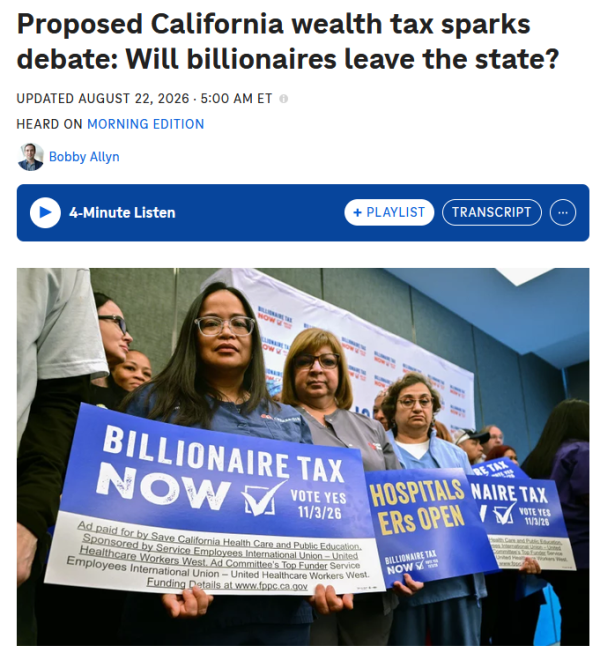
California has Proposition 40, a one-time wealth tax for state-funded healthcare, education and food assistance programs, on the November ballot. The widespread coverage of this initiative has included speculation that it might provoke the wealthy to flee California (New York Times, 8/25/26, 7/17/26; NPR, 8/20/26; LA Times, 8/17/26; Politico, 8/26/26, 8/2/26).
Mamdani’s retroactive influence
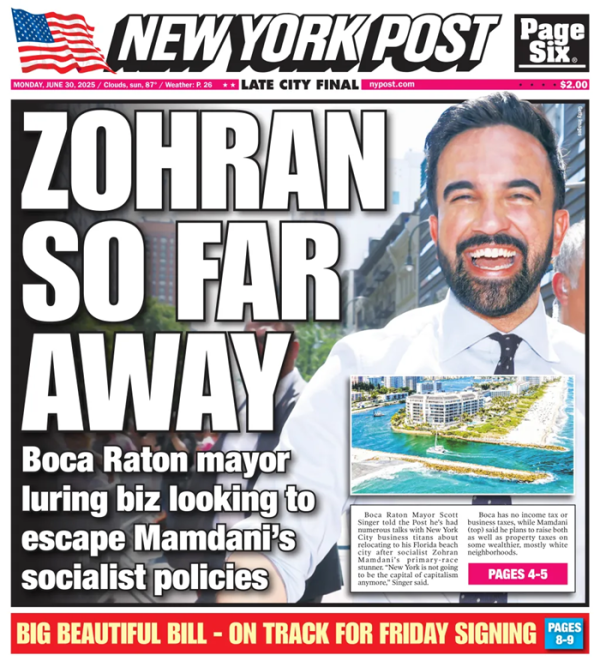
The New York Post was one of the most persistent outlets in spreading misinformation about the wealthy fleeing New York City. But the paper’s harsh criticisms of Mamdani’s tax policies fall apart upon even cursory examination.
The sources the Post relied on include the CEO-led Partnership for the City of New York (featured in four stories), luxury real estate agents and brokers (who appeared three times), a study by the corporate-funded Citizens Budget Commission (cited three times) and billionaires themselves, quoted twice speaking up on their own behalf.
A CBC report (8/28/25) cited by the Post, titled “The Hidden Cost of New York’s Shrinking Millionaire Share,” came out when Mamdani was still a candidate, and examined data from 2010 to 2022—three to 15 years before he was elected, as independent real estate media outlet the Real Deal (7/15/26) noted.
New York City had three mayors during that time period, two of whom—Michael Bloomberg and Eric Adams—generally opposed taxing the rich (Politico, 10/12/12; New York Times, 8/28/25). Neither Post article named Bloomberg or Adams, and one (7/13/26) omitted the CBC study’s time frame entirely:
A new Citizens Budget Committee report found that New York’s share of millionaires, those earning more than a million dollars a year, declined more than any other state since 2010.
‘Unravels under close inspection’
Not to mention, the “millionaire exodus” doesn’t actually exist, as Cornell University associate professor of sociology Cristobal Young recently noted in nonprofit policy journal Vital City (6/10/26).
After he and his colleagues analyzed “millionaire tax reforms in New Jersey and California, decades of IRS records tracking where Americans with million-dollar incomes actually live, the migration of Forbes billionaires and most recently the effects of the 2017 Trump Tax bill and the Covid-19 pandemic,” Young concluded:
The popular image of the “mobile millionaire,” constantly searching for the lowest-tax location, unravels under close inspection. Top earners often travel, but they rarely change where they live. More often, they are deeply rooted—and powerful insiders—in the places where they built their careers and businesses and raised their families. It is not so easy to walk away from these kinds of relationships.
Over the last several decades, US national tax policy “has shifted away from the taxation of the rich, sharply reducing tax rates on top incomes, capital gains and multimillion-dollar inheritances,” Young wrote in his 2017 book The Myth of Millionaire Tax Flight: How Place Still Matters for the Rich.
Since 1970, “total federal taxes on the general population are basically unchanged at about 23% of total income. But for the richest, federal taxes have fallen by half, from 70% to 35%.”
Today, only five states and Washington, DC, have adopted the millionaire’s tax (Newsweek, 12/24/25), while nine states don’t have state income tax at all.
Others who have looked into the issue concur that wealth taxes would have no significant impact on where the wealthy choose to live:
- Center on Budget and Policy Priorities (8/9/23): “The available evidence…fails to support claims that much interstate migration is driven by high-income people—or anyone else—moving because of taxes.”
- Economic Progress Institute (3/4/25): “There is simply no evidence…anywhere in the United States…linking changes in top tax rates with large-scale net migration of higher-income residents or of interstate migration in general.”
- Institute on Taxation and Economic Policy (5/18/26): “Like most other people, millionaires primarily choose where to live based on community ties, schools, and jobs, and are not likely to uproot their lives based on a marginal tax difference.”
‘Won’t create a single new’ NYC job
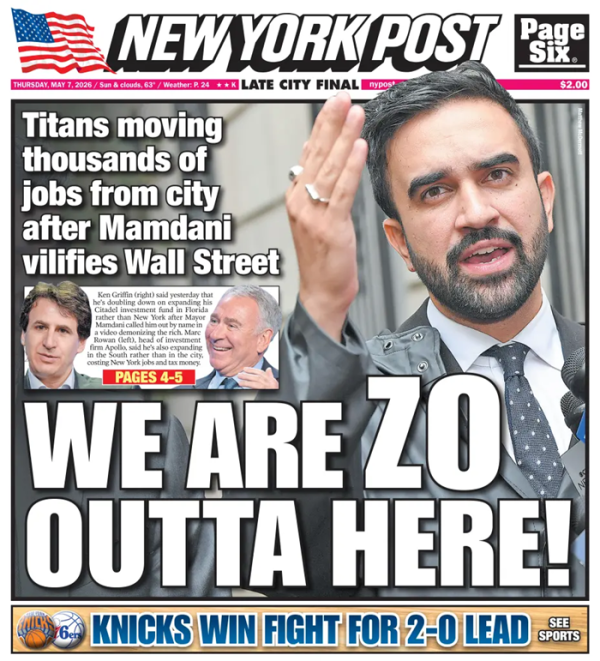
As for Mamdani’s corporate tax hike, Steven Fulop, CEO of the Partnership for New York City business alliance, claimed that it wouldn’t create new jobs (New York Post, 11/16/25) and would cause New York City millionaires to flee to New Jersey (New York Post, 2/22/26).
The Post (4/5/26) also reported Fulop’s assertion that “several [major companies] in the Partnership that have said they’re going down the same road [as Apollo], exploring options in Florida and Texas.”
When the Post contacted Fulop, he “declined to name the firms seriously weighing abandoning or de-emphasizing jobs in the Big Apple.” Jacobin (4/24/26) noted this detail in an article published six months after Mamdani’s election headlined, “The Rich Promised to Flee Mamdani’s New York. They Haven’t.”
Fulop’s admission would have likely dissuaded a serious news outlet from basing a story around him as the central source.
‘Extremely excited and bullish’
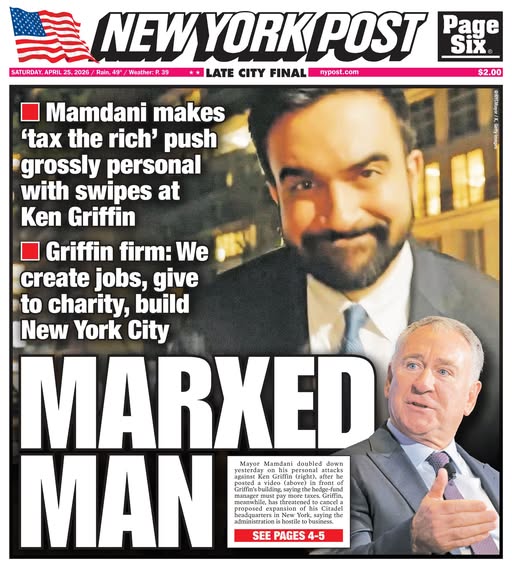
Finally, the New York Post (5/6/26) published an article about a Mamdani video (4/15/26) that explained his pied-à-terre tax, filmed on the street below the Central Park South penthouse that hedge fund billionaire Ken Griffin paid $238 million for. The tax would “levy an annual surcharge on one- to three-family homes, condominiums and co-ops valued above $5 million when owners have a separate primary residence outside of New York City,” according to a press release issued by Mamdani.
The Post reported that Griffin
threatened to scrap a $6 billion Park Avenue development for his Citadel hedge fund, then told CNBC on Tuesday that the “creepy” video spurred him to expand his firm’s hub in Florida.
The Post said that Griffin’s
rich reprisal is exactly the pull-up-the-stakes move that many New Yorker leaders, including Gov. Hochul, have publicly and privately warned Mamdani’s rabble-rousing will inspire.
Except Griffin’s threat was just that: a threat. New York magazine (8/4/26) reported that Vornado CEO Steven Roth signaled to investors that the Park Avenue skyscraper was continuing forward as planned, with Griffin as a 60% partner and Citadel as the tenant.
“We are extremely excited and bullish about the potential returns from this project,” Roth said, according to New York magazine.
‘Poor forced to flee Florida’
Although the New York Post is happy to platform billionaires and their luxury real estate agents and brokers, it’s the very people they exploit who are more likely to move states.
Workers who make less than $10,000 per year are twice as likely than millionaires to move states in a given year (4.5% vs. 2.4%), Young noted in the Vital City report (6/10/26). But how likely are you to see a headline like “Poor Forced to Flee Florida Due to Housing Inflation, Low Minimum Wage”?
Newspapers across corporate media are more likely to cover the ginned-up “millionaire exodus” than the actual forced migration of low-income workers, though most papers don’t follow the nakedly propagandistic style of the New York Post (or, increasingly, the Washington Post—8/7/26).
Many of these articles (New York Times, 5/2/26, 4/15/26, 3/11/26; USA Today, 11/6/25) even cite the academic research that has discredited the wealth exodus myth—even if these citations were buried in the latter half of those articles, rather than serving as the crux of the pieces. These stories typically use both-sides framing to give equal weight to the complaints of the super-wealthy and those who hope to use a bit more of their wealth for social goods. But most US corporate media outlets were vastly more skeptical of the NYC wealth exodus myth than the New York Post.
ZNetwork is funded solely through the generosity of its readers.
Donate