
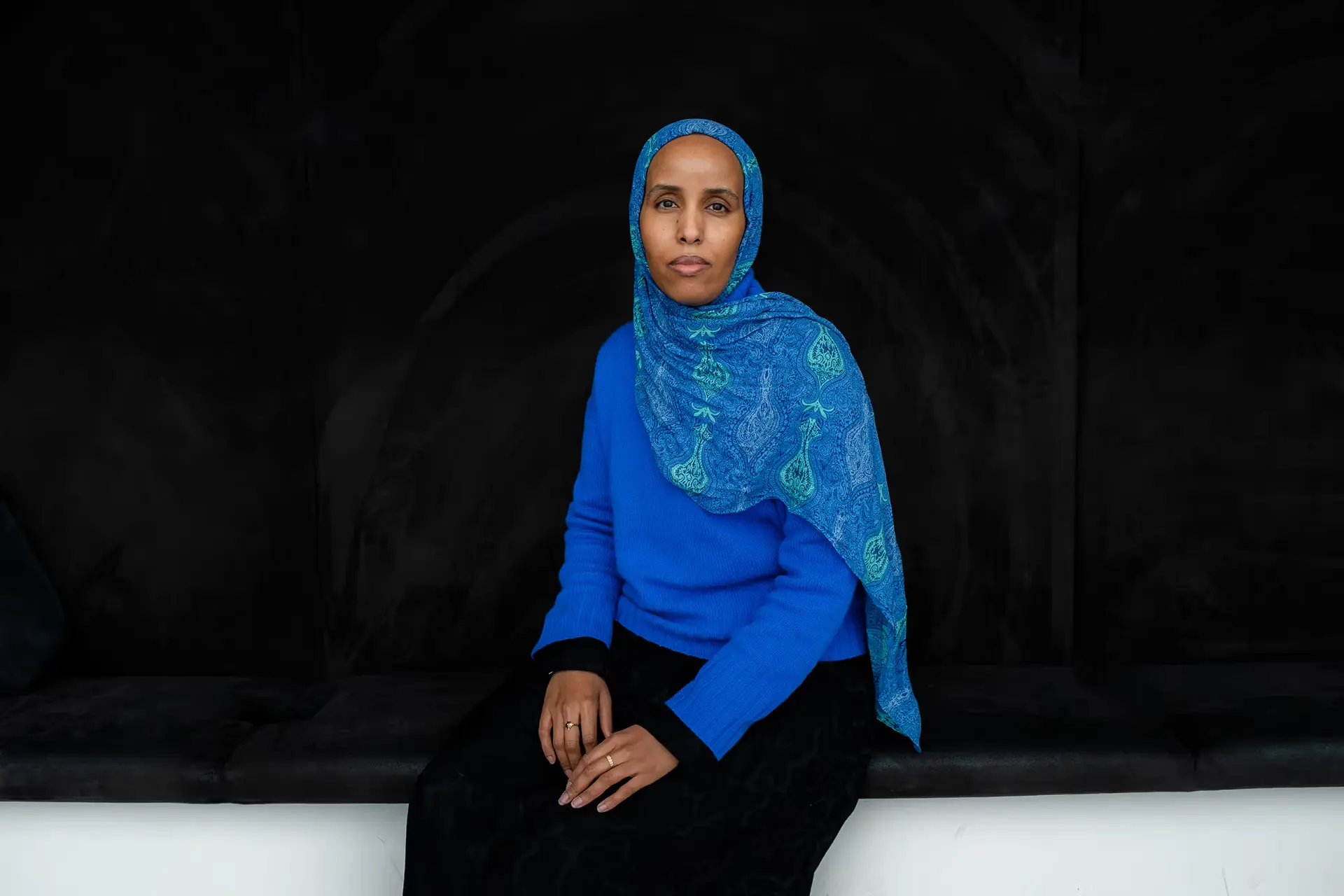
Maryan Sheikh Abdinur grew up in Somalia and Kenya, and moved to the U.S. as a teenager when her family was granted refugee status. She lives in the Twin Cities with her son and many beloved family and community members. These are her notes two months into the Department of Homeland Security’s “Operation Metro Surge,” which sent thousands of federal agents into her state and which the department called “the largest immigration operation ever.”
Tuesday, Jan. 27, 2026
Destabilization in areas where things had felt stable. My son takes Arabic and Quran lessons with a local group in the Muslim women’s community center. A few of us from the center are on a neighborhood group chat to track what’s happening in the community. I learned that on Sunday, someone joined in and recorded a Zoom hosted by organizers. People are recording and then making it public, with sensitive information and people’s real names. It creates a sense of being unsettled even in our protected spaces, while we are reeling from the murder of not only Renée Good but also Alex Pretti.
It’s making people feel a little more cautious about where we share information. Not every Minnesotan has the skills or knows the tactics of organizing. A lot of us are currently mobilized through emotion. Some are learning as they go. For some, this is their first time ever being in spaces like this or even having to think about information in this way — so worried about every car that is fully tinted out, that has its lights on in a parking lot, or that sits in front of someone’s house for hours or is moving through an alley.
A neighbor noticed a vehicle in her alley. She left for errands. Came back and the vehicle was in the same area. She called a few neighbors but did not have a contact for the neighbor who was most vulnerable. She realized her neighbor’s husband was being detained. She realized this car had been going back and forth for hours tracking this family. She tells me she’s going back over those hours, thinking about what she could have done. But people are not trained for this. We might talk ourselves out of it when we feel suspicious: Oh, you’re being crazy.
This morning I felt so raw. I could not drive my child to school. Today we’re going to do online learning; we’re staying home. I feel that my nervous system is not regulated. I need to recenter because I’m spending too much time trying to pay attention. Everything has come closer. My bubble of safety is much smaller, like it’s almost touching my skin. I’m constantly calculating scenarios of witnessing a neighbor being taken or being stopped and having to show my passport. My child is a Black boy whose voice has completely changed this year. How do I explain that he’s so young?
There was a sermon this past Sunday around noon. The first part was reading from the Quran a call for protection. A nurse who’s a community member shared her experiences working with Alex and how in her time working with him, he twice stood up for her as a Muslim woman and advocated for her. He had a meaningful impact on her career.
I had held a practice within myself where I would never watch recorded killings. I think Alex’s was one of the first I’ve watched. I saw it by accident, and it was very hard to turn away. It was surreal.
Some things feel slow, like under water, and some things feel fast.
Last week I spoke with my friend and teacher. Like many others, she carries her passport and her children’s documents everywhere she goes, and so does her husband. She told me a story about a friend of hers, a woman who had her passport in her bag when she was stopped by ICE agents as she was about to enter a building. In the rush, she got so discombobulated. They picked her up and took her to the federal building. During the processing, she remembered her passport and pulled it out. Why hadn’t she shown the document sooner? Then they released her. They walked her out to the fence. She was released without transportation and didn’t have proper shoes for the weather.
Even if you have what’s sufficient, you still go through all of that.
I also talked to this friend about the child-care fraud allegations and the Feeding Our Future case. She told me: “I will never forget reading the list of names of Somalis of multiple ages, again and again, and wondering, Why are their names everywhere? The way they were published — I have never seen that.”
She said her heart dropped when she saw the punishments for the Feeding Our Future defendants: “Very little is spoken about Aimee Bock, who is the ringleader. Very little is broadcast about all these other white people who commit fraud on a larger scale.” But Somalis are finding themselves in the public eye both nationally and internationally. She said, “I don’t want to be in the news this much. I don’t want to be known at this level.” She reads comments on Facebook or Instagram about us as Somalis. She’ll write a big reply and then delete. She said she gets so angry, but she can’t entertain those feelings. She has so much to say. But then the ear on the other side that you’re hoping will listen doesn’t really listen.
I’ve talked to so many mothers who are African, South Asian, from the Middle East. They’re all choosing still to come to some of the services, the book clubs at the Muslim community center. This is how they deal with things — in communal spaces. Staying home doesn’t make sense. This is a space that was created for women. It’s beautiful; it’s nice that it’s for us. There’s a bookshop that prioritizes Muslim women scholars as well as writers.
When I talk to them, most of the women express their concerns: It’s OK if I have to deal with ICE, but what if I’m with my kids? We’ve gotten the kids to memorize phone numbers. When we go to the grocery store or the gas station, they know that if anything happens to us, find a Black uncle or a Black auntie and talk to them.
As I’ve been supporting the community through the recent weeks, at first I was in the background helping with language, translation. This weekend, we had to go and be the ones who are dropping off supplies and running errands for families. We helped a young woman who is so worried and has a baby. She’s been out of a specific diaper that she needs because her baby has sensitive skin. She said, “Go to Target,” but there’s a boycott. I haven’t been to Target in a year and a half. A friend said to the mother, “You’re Somali. Stop worrying about wipes — take the baby to the bath! This is how we keep ourselves going. You also have to adapt to ensure that you have what you need, and we’ll support you.” I didn’t have the words for that. We did several of those supply runs this weekend.
There’s a woman who owns a cafe. I’d never been to that cafe until this weekend. She said, “You can buy in bulk. We’ll break it down and redistribute; people can come here.” Me and two other friends did the shopping and the drop-offs.
At one point I realized we’re near Lake Street and Stevens Avenue. Then I looked around and realized that corner used to have so many young men, mostly Hispanic. “The immigrant Taskrabbit” is what we used to call them. This was so filled with people. Now in the evening you don’t see anybody. The streets are empty. The restaurants are empty. My city looks so different.
Where there are no protests, it’s eerie. It’s quiet.
It’s also where ICE is picking up people. We were also keeping an eye out for suspicious cars. It’s so interesting to experience the city this way — in one way so strong, but also so eerie. The boarded-up places take me back to 2020, after George Floyd was killed.
The past two years, with what’s happening in Palestine, there’s a part of social media that makes you feel like being a Muslim is cool. I’ve never experienced that in the U.S. before. The only time when I would feel safe as a Muslim was when I was around Black people. There was a level of respect for Islam.
The way we grow up in Somalia, I know about my family going back to my 200th grandfather. I know their stories and where and how they lived. Someone recognizes you and can tell you who you are at least six generations back. Then you have to be down to two names and a birthdate in the U.S. No one in Somalia really cares about a birthday. You’re given this number and get one day of the year when you’re celebrated. For us, what was important wasn’t the day you were born but the year you were born and your birth order — that determined whether you can tell a kid to go get something or whether someone will get up and offer you a seat. A birthday is kind of an empty bowl you’re handed. It no longer mattered who my grandparents were — the interviewers at the U.S. consulate in Nairobi just wanted the two names and three sets of numbers. We were interviewed as a family and then individually. We were given blood and urine tests. We were tested for TB. I think we went multiple times and had security screenings before we were allowed entry. My knees hurt for the longest time because of how long the flight was. You could be delayed for years because of health checkups, vaccinations. Then we spent the first year in the U.S. getting checked up.
Thursday, Jan. 29, 2026
I don’t see a lessening ICE presence. They’re now staying in hotels more in the suburbs, 20 to 30 minutes outside the Twin Cities. I hear the calls from greater Minnesota saying, We’re spotting them here or They’ve abducted someone from somewhere.
We were being told Greg Bovino left with some of his team. It’s funny to have the narrative that Bovino is gone, but then you get Tom Homan. Homan is not going to save us, because he’s an architect of this violence. What Minnesotans want is for ICE to leave us alone and leave the rest of Americans alone.
In the first week, people needed food and rent. And then trainings for upstanders, trainings for families, teachers, and school employees to know their rights. Then the focus was security, managing demonstrations and protests. This week it’s getting security for mosques, churches, and places where people worship, ensuring that there is safety and legal support. And then the cycle repeats.
It feels like ICE is being closely watched here, and now they’re in the suburbs — Blaine, Columbia Heights. They’re now in west-central Minnesota. We saw a little in St. Cloud, possibly Moorhead. Rural Minnesota right now, they need food and rent. Next week, they’ll need support to train upstanders, families, and schools. Northern Minnesota is doing upstander trainings. There’s this ripple as the fragments move out. It’s like throwing a giant boulder in the middle of the lake, and the water is headed to the shores.
There’s Somali, Hmong; there’s Latino; there’s Vietnamese as well as Laotian and Cambodian communities. And then the Indigenous communities. There’s an area in Minneapolis called Little Earth, around Lake Street in the East Phillips neighborhood, and it is not classified as a reservation but is a predominantly Indigenous neighborhood.
The chats are reporting, If you come upon ICE, keep your distance. There are reminders to be more careful because the FBI director is threatening to investigate. The trainings are still happening for people who need it. Know-your-rights trainings are still happening. Upstander trainings are still happening. I feel like we have more people out there.
I don’t see any sense of “OK, I’m gonna sit out.” Rather: “We’re going to continue to do this, but it requires more caution for our individual safety.” If you’re going to respond to a call, don’t have minors in the car; don’t have pets in the car. Have a little bit more consideration. People are more and more frustrated and want to support.

A public memorial honoring Renée Good and others killed by state violence on Portland Avenue in south Minneapolis, March 8, 2026.
When the National Guard was deployed, they blocked off the roads in the Whittier neighborhood. Businesses in the area were supporting people as they showed up, cleaning them up after they were hit by gas and pepper spray. A lot of the restaurants became triage spaces. Leading up to the 7 p.m. vigil for Alex Pretti, the National Guard and Minneapolis police blocked off the perimeter of the neighborhood. It felt like they were protecting ICE agents.
At the vigil, families came out and lit a candle or put one in the window. That was across the metro area, including the suburbs. It was how people came together that night. Chats had reports of what people were doing to participate.
And then the next day the National Guard were passing out doughnuts. I was like, OK, what does that do for us? They were wearing neon-colored vests to differentiate themselves. But they already look different. They’re not masked. Whoever let you be in those pants and sweater does not care about you. You don’t look like a team. What secondhand store did you go to? Do ICE and Border Patrol even have matching tactical gear? It looks like they have matching weapons — that seems to be the priority. The demonstrators had much more cohesion in neighborly love than they did. Nothing about them showed continuity except the weapons they carried. They are wearing gloves — are they just for decoration? I think there’s this thing about face covering that brings a sense of safety or “I can do whatever I want.” They’re trying to instill fear. They’re not balanced. You can tell this person is not used to this weight of whatever weapons they’re wearing because there’s no stability. When I see videos of them I think, You are not supported in any way … and you’re so dependent on these weapons. There are magazines and canisters in the street, it seems like nothing is secure. Do you not know where to put it, what spot in your tactical gear it belongs in?
I’ve had these giant vans driving behind me, but I haven’t been stopped. When I see officers being really aggressive to the community, I cannot help but notice how they hold their bodies. I saw a video where two of them charge and slip, and one of their guns appears to fire. They’re all just slipping. Again, they’re not with their body. And then they retreat. Someone I know said, “God, send them bedbugs everywhere they go. Give them terrible body odor so they’re just uncomfortable with each other.” Yes, may their coffee never settle properly. May they have gas or be bloated all day long.
Are you so disconnected that your body doesn’t know you? The contrast to that is they’re trying to detain people who have crossed rivers filled with crocodiles, who have dodged snakes in deserts, who have survived some of the most unimaginable conditions to bring their children in search of a better life here. And you are deeming yourself more worthy. You are dragging a mother who through pregnancy, through childbirth, or with small children has come this distance. If you can appreciate and internalize her struggle, would you then still be dropping your magazines in the snow trying to get her?
Even the parents who have sent their children on a boat against the Mediterranean Sea, knowing just the week before another boat capsized — there’s something that makes a parent agree to do that. It’s not a choice that’s made overnight. Nobody gives up whole communities they know, their cultures, their traditions to do this. Those countries are not destroyed on their own. There are hands that are doing that, and that’s deeply rooted in American culture.
When I came to this country, I heard people say, “Eat your food — a child in Africa is starving.” Do you know why that child is starving? Because the food is on your table.
The sense of unity Minnesota is feeling right now — there’s this narrative that Minnesota has always been this way. No, it has not. We haven’t felt it. Minnesota is showing up for one another right now, and there’s a reason it’s easier. These are long-built coalitions, long-built questions since Jamar Clark was murdered in 2015. It’s the same questions we’ve asked as we navigate what the system looks like.
When Clark was murdered and the occupation of the Fourth Precinct started, I was in college. My first time going to the site, I didn’t go in. I’m uncomfortable in demonstration spaces; they remind me of the times we had to pack up for a run during my migration experience. I’m much better at “Let me cook food and drop it off,” or “I’ll mend this,” or “I’ll take the children.” But during those protests during college, I remember thinking, I did not know we can demand our rights. I knew it back home — I’ve seen the stubbornness my family had — but we also left. A portion of those groups from Kenya and Egypt came to the United States, but the majority are still back home. It was mainly the elders who said, “I will not leave my land.” But they felt they could not decide for the young people. Each generation, you learn your language, you learn your traditions, then you can be you anywhere. When you’re away from home, you don’t feel you can advocate for yourself. You just got here. You’re still trying to eat, to heal, find the medicine. This was 2015, 2016. I was like, I did not know we could do this.
I remember making the decision to learn how to be Black in America and what it means for my child to be Black in America. As a mother, I could no longer hide; I could no longer ignore it. That work is one of the most grueling things I’ve ever done in my adulthood after I had my child. Realizing I can say I’m Somali. I can say I’m African. I can pull out all these languages that I know. It does not cover up the way my Blackness is looked at in this country.
I needed that mind change. I can live as a Black American. This is also my fight. And then I can ensure my child lives in a world that he can be a part of and thrive in. That was really the activation, and since then it’s been learning historically about liberation movements.
One thing you could not get me to do in high school was read Shakespeare. I was so contrary in classes that my ninth-grade English teacher, when she realized I just did not value anything European, gave me the “dream deferred” poem by Langston Hughes. That was the pull of the thread. I started reading about the Harlem Renaissance and then the civil rights movement — Yep, they’re speaking my language. Langston Hughes, ancestral guide. That did prepare me, and so did understanding Black Lives Matter. I remember training myself so that if I saw a Black person, whether they were Somali or not, I would not look down. I would make eye contact whether they were the president or the janitor. Recognizing what power is in this new world and how to hold that and understand that our ancestors have held it for 500 years. And remembering this is not where the line breaks.
I had a conversation with three women at prayer circle, H., U., and B. These women are at the core of our community. They are the ones you call when you want a traditional dance; they will show up with drums and songs to make you feel right at home. They show up with Kitabs in hand to read the Quran at your home. They also show up when you need to cook for 50 people on short notice or when you need to find that Somali song you know only a phrase from. We sat around in prayer at our local community center. With the first questions, they break into jokes. I was laughing a lot as I talked to them, but as I listened back to our recorded conversation, I was crying, having a level of realization of grief for our narrative as Somali Americans.
I ask, “What are you currently witnessing/hearing in the community?”
B. immediately says, “Are you blind? Are you not in Minnesota? What do you mean? What are we witnessing?” She continues, “We are seeing a very selfish government entity. A government that is causing damage that will be felt for years to come. We’re seeing children being abducted…It’s like: Where am I? I’m not in a first-world country anymore. We are not in a democracy anymore! I feel like I’m not. I feel like I’m back home.”
H. told me: “I am not seeing anything. I purposefully avoid seeing things; I keep my head in the sand. But I hear a lot of businesses are closed. A lot of restaurants are closed, and a lot of people are out of work.”
U. adds, “We have been through this before; we know how to keep our heads down.” All three women were teens or kids when the civil war broke out in Somalia in the late 1980s.
B.: “I was very young when we left Somalia. But I have been having the urge to get out of here. Because that’s what we did when we were young. I’ve been thinking: Do I have enough savings to leave and come back when things calm down? Do I want to wait for things to get worse? Because if things get worse, I’ll be stuck, right? Right now we can still leave. I don’t want to be trapped. So that’s one of my fears — if we stay and things get worse, where do we go?”
H.: “I sent the kids a message the other day in our family group chat. I told them, ‘You guys, we have to leave,’ and they were like, ‘Oh, OK, calm down, H.’ Back home, when things got hard in the cities, we would leave for the countryside. But then, when you’re here in America, where do you leave to? Run to Africa?! And our children don’t want to leave. This is their country. They don’t know anywhere else, so they’re like, Where are we going to go? This is our home. Our kids want to continue their work; they want to normalize their lives again as much as possible.”
H. then shares this: “When the war in Somalia was brewing, my family started to talk about going to Ethiopia. My aunt actually said, ‘Let us go where? Ethiopia? God forbid that — I am never going to Ethiopia!’ I never thought Somalia would fall. Never. I thought it was just rhetoric, you know, things people were saying to scare us. Even when the fighting started, I thought it would end in a few months, and we would have a new president, and things would get back to normaI. I was in high school then. I could not even process the idea of going to Ethiopia.” Then she says in Somali: “It was the same to me if I was told I was going to outer space.”
She continues: “I remember standing on the border of Somalia and Ethiopia, crying, literally breaking, realizing that it’s actually happening. We were leaving home, leaving Somalia.”
Saturday, Jan. 31, 2026
Spoke with two women, J. and K.
K.: “I’m seeing 2020 all over again, but this time it’s different. The white people are finally stepping up here, because it’s impacting them, and kind of saying, You guys sit out and stay home. We got you. It’s kind of inspiring. They’re saying, We got this fight for you.
“But it’s scary because ICE is being very lawless. You don’t know what’s going to happen. It reminds me of 9/11. I had very racist neighbors back then who used to chase us and harass us. I lived by the convention center, and I had an old white man chase me. I was smart enough as a nine-year-old to run toward the convention center.”
J.: “I often sat with my grandmother as she used to tell me horror stories about Somalia. How the war started, how they fled, the paths they took. I always thought that PTSD meant that you had to have been there and experienced it firsthand. I didn’t realize that I had feelings that were hidden deep inside me. That came out as I watched the news, TikTok.
“Recently, my grandma called me. She has been hearing about everything that is happening here. She told me, ‘At least we were on land and could go to another country. You are surrounded by water. Where will you go? Into the sea?’ My brain went into survival mode and fight-or-flight. The country that we went to to have a better life and that became our home is ordering us to leave. Now we don’t know what home is.”
K.: “I grew up here. This is our home, but now I find myself questioning that. When I think of 9/11, it was the religion then. It wasn’t a certain targeting of one ethnic group; we were not the only ones. But now it’s this blatant attack on the Somali community, and it’s been a consistent attack; it’s everywhere. Just two days ago, I was leaving the store, and I got in my car in the parking lot. And this guy walking by, an Asian man, profiled me. He said, ‘That’s a very nice car — scared of it getting stolen?’ I asked, ‘Why would my car get stolen?’ He said, ‘It’s not my country or your country. This is America.’ I’m like, ‘Sir, I’ve been here since I was six.’ It feels like open season on Somalis. There is this assumption all of a sudden that we did not work for what we have. But I’m a struggling teacher. I’m an educator. I’m a special-needs mom. I work very hard. The feeling I am getting is we’re not wanted here. Not allowed here.”
J.: “I started having paranoia about my neighbors because they didn’t come up to me and say, ‘Hey, I’m with you. I’m sorry that this is happening.’ So I started having doubts about everyone. Who’s with us, who’s not with us, who’s against us? Who can shoot you while you’re sleeping in the middle of the night? People are being encouraged to report on each other.”
I asked if it would have made a difference if they came up and said, “We are sorry this is happening to you.”
J.: “Yes! I was scared for the two seconds that I was going to and from my car into my house. Then my husband told me he ran into a neighbor in front of our house who said, ‘You know, I’m sorry about what’s going on. Here’s my number. You guys need anything, let us know.’ OK, there’s one person I don’t have to worry about now, but the rest were still suspicious.
“Every single day I evaluate: Should I send my kids to school today or should I keep them home? And the entire time my kids are at school, I think: Should I park in the school parking lot and wait for them until they get out to make sure that they’re not kidnapped, that they’re safe? What will the teachers think?
“One day, I went to go pick up my kids. In the car line, they call through the walkie-talkie so that by the time you pull up to the front, your kid’s already outside. They hop in your car, and then you go, right? One day my daughter wasn’t standing there as she normally is. I panicked. They told me to move up, she’s probably inside. The entire time I stared at the door. Other kids kept coming out. She’s not coming out. I noticed her teacher standing there. She’s also staring at the door. She’s staring at me, staring at the door. Finally, she spotted my daughter and knocked on my window. She said, ‘I know, I know. I’m sorry. It isn’t fair. We should have made sure that she was out here.’ She knew what I was doing. She was also doing the same. And then tears started flowing down my eyes. Now she’s also crying. My daughter gets to the car by the time we’re wiping away our tears. My daughter’s eyes widened. And so I go to her, and I hug her. I was like, ‘What’s wrong? You OK?’ She’s like, ‘Why are you crying? Did ICE take Dad?’ That’s her first thought.”
Me: “Oh, my God. Is this middle school or high school?”
J.: “Elementary!”
Monday, Feb. 2, 2026
My son is drawn to listening to Minnesota Public Radio. Will ask to listen during dinner. Has the schedule memorized. When I talk to my mom, she tells me I was like that, obsessed with BBC as a kid. Every drive, we’re listening to MPR. He used to want to listen to Beyoncé.
A couple of weeks ago, on our way to school, we heard the MPR News host Angela Davis talking about how kids in Minnesota are experiencing this moment, how confusing and overwhelming it is for them. He said, “I don’t feel that way.” I do believe him, because we talk about it a lot. And I talk about strategies: “If this and this happens, this is what you’re going to do.” He also lives in two households. He has our numbers memorized. He has addresses memorized. He grew up around organizers. There’s a level of understanding systems that maybe makes him feel not as terrified. He has gone to protests — at least the ones he can go to. Larger protests make me nervous because it takes me back to moving from city to city in large groups as we fled the war. Sign-making and dropping food off are also not new because we went through it in 2020.
When I’m driving around with my son, he now looks closely at all the cars that pass by and the cars at the stoplights, especially the black ones. I consistently run through in my head the scenario of being stopped by ICE with him in the car. I have a copy of his birth certificate on me at all times. I have my passport within easy reach, yet I still worry they will not care and detain me and leave him in the car. Or worse, they will take him and separate us, or take him without me knowing and then take him to another state, as they have done to other children. All of a sudden, all the ways we can be harmed are endless.
He’s insistent on having a whistle in the car. He wants to put a sign on the car that challenges ICE. I tell him, “If you’re with me and something happens, this is what you do: Pick up the phone and start recording.” Last week, as we were coming home from school pickup, he asked, “Mama, would you prefer ICE take me with you or leave me in the car?” I told him, “I’d rather you come with me. I couldn’t live with not knowing where you are.” We were talking about Liam Ramos, and I said, “I’m so glad his dad is with him.” At least they took him with his dad.
Friday evening I was at a gathering talking to a friend who had just returned from Medina. She has two young kids. We share a spiritual teacher. Your teacher touches on everything. We engage with our teachers on so many levels, and to share a spiritual leader means a sisterhood. She said, “I haven’t been coming to events and places. I’m so sorry I’m not coming lately. My biggest fear is that I’m going to get stopped while I have my babies in the car.” She looked at me and said, “Isn’t it amazing that less than three generations later, we have to deal with this again? Here we are, having to figure it out again in this way. We’ve never really been attacked as Somalis in the U.S. before.”
Thursday, Feb. 12, 2026
St. Paul was quite interesting yesterday. In the morning as I was driving my son to school, I knew there was a lot of ICE activity. Right as I was coming back from dropping off my son, ICE went on a high-speed chase through Selby, which is in Cathedral Hill, one of the most walkable neighborhoods in St. Paul, near one of the colleges. There are restaurants, our local co-op, a coffee shop that I often stop by on my way back from dropping my son. I came home and looked it up, and it turns out they had chased someone down a block with a lot of pedestrians. There’s a YWCA there. I think of the area as Rondo, a historically affluent Black neighborhood that was cut through by a highway, but at some point it got rebranded. ICE was chasing a driver, he then crashed into two other vehicles. It caused a lot of chaos. The person they were chasing got out and ran.
I also cracked a molar and needed emergency dental care. I learned that I need a root canal and a crown. This is the second time in my life that this has happened, and the first time was just after the murder of George Floyd. I think my body is reacting. It was very chaotic yesterday.
It’s weird because this morning, I was at the auto shop to get my tires rotated and an oil change. I was listening to MPR, and Tom Homan announced that more agents are leaving. But they’re still not acknowledging everything that has happened. There’s a sense of wanting to tell a story. Yay, you’re leaving, but where are you going? There’s no acknowledgment of what has happened, the murders of Renée Good and Alex Pretti. There’s no acknowledgment. The damage has changed Minnesota. In a lot of ways it’s brought us closer, but it’s also created a lot of fractures.
It’s almost like death by a thousand tiny cuts. Every day you’re making choices: Do I donate to this group that’s in my neighborhood or another group? Every day you may be driving and notice this ICE activity at a school bus stop while you’re driving your child. Do you stop or do you safely take your child to school and come back? Do you lock your door tighter when it’s your neighbors they’re after or do you go outside and go together? It’s this constant choosing. Do I feed myself or do I feed my neighbor? Do I go do my job, which is really critical in making sure that our communities are taken care of, or do I help this one person? Where is the care? Who am I giving the energy to? Every minute feels like a choice between all of that. I don’t know if that’s heroic. That feels devastating to me.
We’re just simply refusing for our neighbors to be kidnapped, to be denied a due process that is already established. If I let you be taken in broad daylight, I’m not going to feel safe. If I turn around, tomorrow it’s going to be me. I may as well fight while I have someone to fight alongside versus wait until it’s just me.
When we prepare for the month of Ramadan, which is in less than a week, it is meant to be a time of reflection, preparedness, a time of joy. We look at Ramadan as a guest that comes and reflects with you once a year. You prepare yourself as if you’re welcoming a guest. You make space in your home. But how do you do that in this moment of chaos and uncertainty?
There’s a lot of conversation about safety in the Muslim community right now as we go to congregational worship, especially at night. Sometimes we’re there three hours. The last ten days, we’re there all night long. Who’s keeping an eye on things?
You’re fasting all day long, but you’re unable to go to the grocery store or the community iftar where we break our fast together. It’s a lot of questions.
How do we translate that for the rest of our neighbors who are not Muslims, who maybe do not feel the weight of this moment? It’s all those layers.
What’s been happening with Friday prayer so far is that the mosques have had community members come and be outside during prayer time. A few of the members of our local community space are part of a choir group, and other choir members have volunteered to come and sit with us for six or seven hours. They bring projects or they work from there. Some are trained as upstanders; some are not. Some have never done anything like this in their lives.
One woman said, “I’m so glad my kids are grown.” I told her the fact that you feel like your children are adults and so they’re safe — we don’t have that. There’s not a moment when we feel like that. The mothers here don’t feel that. They feel like even when they’re in their 50s, they’re still worried.
Our non-Muslim community members are showing up for Ramadan to sit with us and keep an eye out, and I wonder, Do you understand it has to be overnight? People have been amazing, not worried about the time. But we don’t know when it’s going to end.
ZNetwork is funded solely through the generosity of its readers.
Donate

