
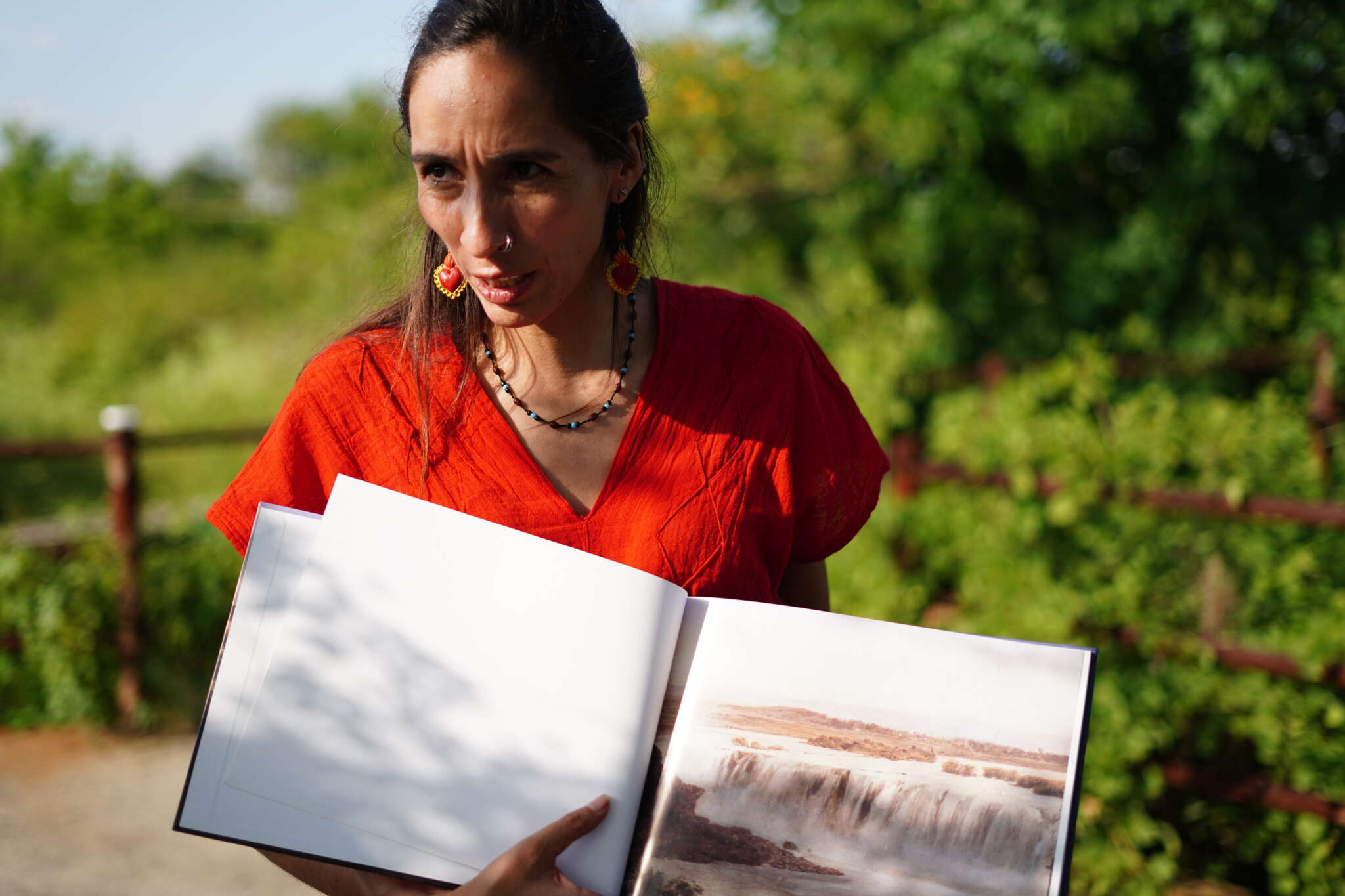
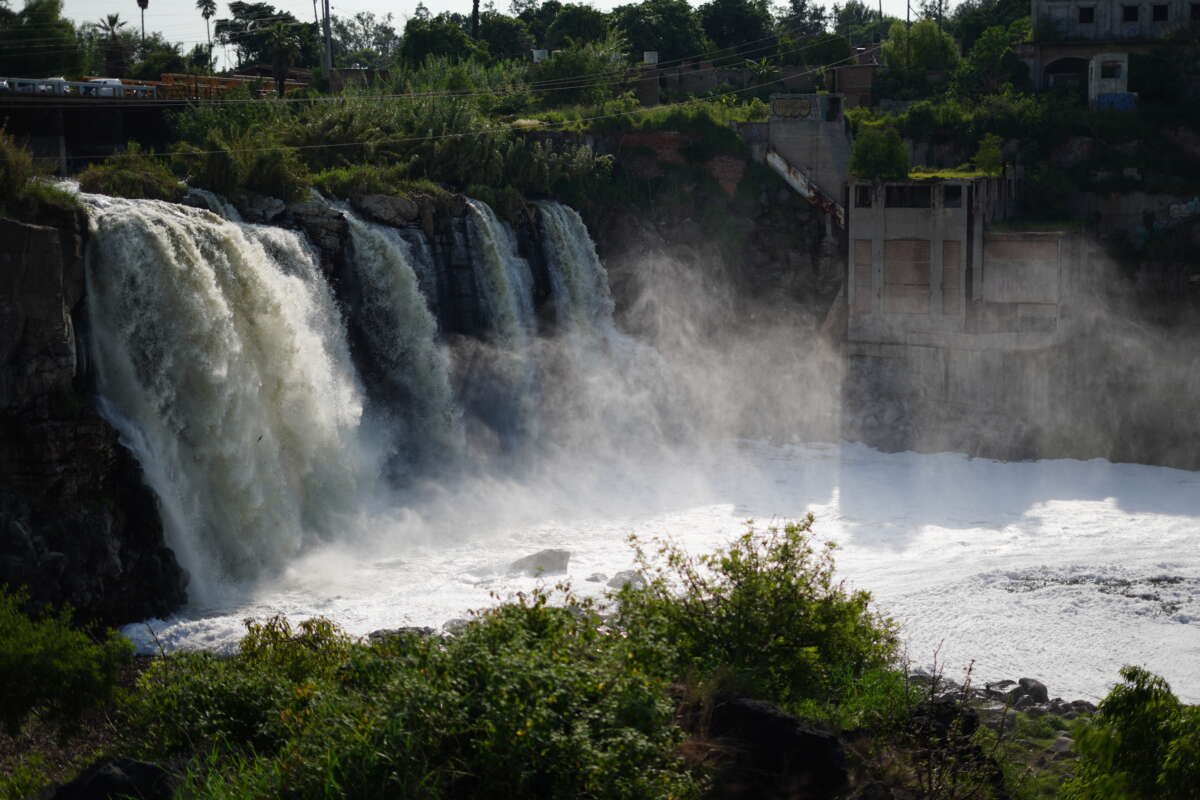
Atahualpa Sofía Enciso’s children don’t know what a normal river is, she says. Living by the Santiago River in the state of Jalisco, Mexico, which overflows with dense white foam from the hundreds of industries that pollute it, she notes that the area is also getting hotter.
“My father talks about how when he was younger, he didn’t need sweaters, because it was never that hot or cold, but now there are these extremes, because the river is polluted and it can’t regulate temperatures as it used to,” she tells Truthout.
For activists like Enciso, the term “climate change” is insufficient for describing such violence perpetrated by industry against the environment and against residents. Indigenous activists like Nahua grasshopper farmer Miguel López Vega describe the severe droughts, water scarcity, crop failure, and hunger that Mexico is experiencing as “signs of death” of the planet, and say any solutions have to involve direct care of the land while stopping the harm.
Meanwhile, President Claudia Sheinbaum is pushing for “sustainable” fracking around the country just as Mexico’s oil company Pemex has finally extinguished a gas leak at an exploratory oil well in the state of Veracruz after it burned for 150 days. In August, Sheinbaum ratified her push for fracking with a report by 54 government-chosen specialists recommending that fracking proceed, so long as only salt water is used.
Violence Against the Land
Most activists here see “sustainable” fracking as only more greenwashing.
“In Mexico, we live in a system based on the exploitation of our Mother Earth and the imposition of megaprojects, mining, illegal logging, water hoarding … and violence against those of us who defend our land. This represents a permanent war that threatens our existence as communities and as humanity,” wrote hundreds of water defenders in the final declaration of the 7th National Assembly for Water, Life and Land, in August.
Anti-fracking activist Yesenia Jocabet Antonio Pérez argues that respect for nature is key. Antonio, who is also a Nahua community judge and a member of Sedepac Huasteca, which is in the Mexican Alliance Against Fracking, says, “Mother Earth provides for us, and we should also care for and respect her. The people who don’t respect, who just go ahead and loot and plunder the land, water — They are abusing the earth.”
López, who lives among volcanoes in the Cholulteca region, where the Spanish committed massacres in 1519, says, “We organize in this region because corporations have come here to plunder and pollute … which we don’t permit.”
He describes a giant sinkhole in the area, some 45 meters deep, that appeared overnight in 2021, following over-exploitation of local water, especially by companies like Danone, owner of Bonafont.
“These changes are signs of [planetary] death,” says López. Describing things merely as “climate change,” he argues, makes the process sound passive and abstract, whereas pointing to specific events like the sinkhole indicates that “our Mother Earth is screaming about the huge dispossession that is occurring to our people.”
To the north of López, in Chihuahua state, Canada’s Silverco Mining has just announced it will re-open its Cusihuiriachi silver mine. The government announced in August that an unnamed company will spend a billion dollars in the state on silver mining. Mexico is the top silver producer globally, but this mining causes severe environmental harm, including water pollution, excessive water and electricity consumption, emissions, and land clearing.
Transnational mining and energy corporations treat Indigenous and farmer communities as “expendable obstacles,” Luis, a small farmer from Tepetixtla, Guerrero and a member of the National Indigenous Council, tells Truthout. His full name has been withheld for his safety.
Signs of Death in Mexico
In Luis’s region, people are now going hungry or eating less due to climate changes, he says. Irregular and sparse rain is causing beans, corn, and Mexican squash harvests to fail, and families are eating fewer tortillas.
In his state of Guerrero, on September 8, Indigenous families were forced to leave their communities and migrate in three buses to the north of the country to work for the agro-industrial company Divemex, after the current drought meant they couldn’t grow enough corn.
There is almost no climate denialism in Mexico, with polls showing that only 8 percent of the population does not acknowledging human-driven climate changes. The reality here, is all too clear. Only 52.5 percent of people in Mexico now access potable water daily in their homes, due to longer droughts, insufficient infrastructure, and corporate exploitation of water. From 2001 to 2024, 4.89 million hectares of forest were lost due to fires, land use conversion to agriculture, public and private construction, tourism, and organized crime. Mexico is also facing intense heat waves, shrunken harvests, and intensification of hurricanes,
Thousands of small farmers recently told the Spanish news agency EFE that they were on the verge of bankruptcy due to drought over the past few years.
“The droughts are affecting us in serious ways, the plains are burning, the trees don’t grow back in time for the rain, the land has eroded a lot,” Florentino Rodríguez Bustamante, a Naayeri comunero (common land owner) in El Nayar, Nayarit, tells Truthout.
Rainfall patterns were more reliable a few decades ago, he recalls, but deforestation and the burning of land has stripped the topsoil, increased erosion, and caused droughts. In El Nayar, Indigenous farmers in 500 towns are currently reportingtotal loss of their corn and bean harvests — crops they depend on to eat — due to the lack of rain.
López, in Puebla state, is experiencing the same thing. “The plundering, the trafficking of our water, we can see that reflected in our food. In my area, there are 10 hectares of land that now don’t produce anymore, we don’t have the food that we used to have.”
“You don’t know when it’s going to rain,” agrees Antonio, who lives in San Luis Potosi state. “If it does, it’s a storm that ends up destroying our crops … There are also plagues.” She says community organizing has kept most companies out of her region, but the ones that did get in promised employment that then went to foreigners and outsiders.
“These companies bring us illness, drought, and water contamination,” she says, mentioning the agro-industrial company Citrofrut, owned by Grupo Proeza, which is headquartered in the U.S. and Mexico. Locals accuse the company of dumping its waste in the nearby rivers.

The Smell of an “Industrial Hell”
Despite living within walking distance of the Santiago River, Enciso says she never takes her children there. A member of the Un Salto de Vida collective, which defends the river and the El Salto area near Guadalajara city, she describes taking one of her children to the river just once, when he was three. “It was intense to see his reaction, because his eyes went red and got irritated, and he was crying and saying, ‘It’s choking me, I want to leave.’”
“I don’t want my children to believe this is what rivers look like. A few years ago, we were in Veracruz and there was a clean river there, and my children were impressed at how people swam in it, and they asked why it doesn’t smell like a river does. They think rivers typically smell disgusting,” she says.
Some 741 chemical, food, and beverage companies discharge wastewater directly into the Santiago River. Others discharge improperly and the runoff ends up in the river. Key contaminating companies include Hershey, Honda, Nestlé, and Zoltek. Their actions have led to serious health problems for local residents, including cancer, and renal and respiratory illnesses.
“I don’t want my children to believe this is what rivers look like … They think rivers typically smell disgusting.”
El Salto and the industrial corridors of Guadalajara are one of the 30 “industrial hells” or “environmental emergencies” that Mexican public institutions have identified in the country. Workers and residents in these areas experience alarming rates of cancer and renal insufficiency, as transnationals exploit relaxed laws and lax monitoring to pollute rampantly.

Rejecting False Solutions
Thirty Mexican organizations have responded critically to the idea of “sustainable” fracking and the recent report backing it, saying the report only seeks to do something highly destructive “with less guilt.”
Rodríguez is also weary of these non-solutions. He criticized the government’s tree-planting program, Sembrando Vida, for using irrigation-dependent fruit trees rather than water-retaining native species, and for transplanting trees rather than protecting forests.
“Easy and quick solutions won’t cut it. We need to protect nature from threats, from fire, from logging companies that only want money,” he said.
Similarly, current plans to expand EV production don’t address Mexico’s fossil fuel dependence. The country generates 77 percent of its energy from fossil fuels, and transport — almost entirely buses and cars — accounts for 18.6 percent of greenhouse gas emissions. The government’s new Olinia project to manufacture mini EVs doesn’t address the public’s need for better public transport.
Instead, petroleum represents violence for Mexicans: not just the pollution, but also huachicol — fuel theft from pipelines or storage, usually by organized crime groups.
The state of Jalisco, where Enciso lives, is a key region for petroleum storage. “So there are a lot of security forces here and organized crime … the violence, the surveillance, has become part of our everyday lives,” Enciso says. At the same time, she describes a dependency on fossil fuels for transportation and food. While confronting the whole industry isn’t yet possible, Enciso adds, “we can achieve a lot by breaking the monster into pieces, chipping away, so that in the future, it is no longer viable.”
“The key is to leave consumerism behind,” says Antonio.
“Green capitalism” is a distraction, concludes Luis. “The real problem is the exploitation of all natural resources.”
What Mexican Land Defenders Are Doing
As members of the communities that are most affected by the climate crisis, Indigenous and water activists are also taking the biggest steps to defend the environment.
“Maybe right now we aren’t able to close oil wells, but we are heading toward that. The more we organize, the more we convince others that our movements for life are for everyone, and we can get to the point where we are able to stop these types of [extractive] projects,” says Luis.
Rodríguez has planted a small forest which is bringing water into the area. He said three decades ago on his land, there were only a few small trees, so he decided to plant native trees. “I looked after them, and with time they grew until they were over 10 meters tall and very thick, and at that point, water began to appear in a stream. The trees kept growing, and more water came. And now I have 24 hectares of forest.”
Such patient stewardship is how ecological damage is reversed, he says. “I’m in love with my dear trees. They attract clouds when they are this big.”
In Topolobampo, Sinaloa state, Mayo-Yoreme people and others have been directly resisting a giant ammonia plant, camping outside for over 100 days to stop it from opening. But their resistance has continued for 13 years, preventing the building of the plant — owned by Proman GPO, headquartered in Switzerland but with assets in the U.S. The plant would threaten protected wetlands, local wildlife, and fishing communities.

López describes similar long-term direct actions. He says that in the Cholulteca region, they have stopped a toll road and a tourist project that “was distributing our land to a few people for profit.” They also stopped the construction of high-tension electricity towers and industrial corridors, as well as prevented the contamination of rivers. And they camped outside a rubbish dump for two years, successfully shutting it down. In April this year, communities signed an agreement for the permanent closure of the plant and for the private company to carry out remediation for the soil contamination caused.
“I’m convinced that just as our rivers in different parts of the country join together, if we join our struggles … our commitment to caring, defending, and loving [the environment] will prevent more harm,” he says.
In Antonio’s community, she says they are looking at solar panels as an energy source that is owned and managed by the community and “doesn’t depend on the electricity grid.” Further, her community is reforesting after fires, and holding assemblies and forums.Enciso adds: “We don’t know what it is like to live alongside a healthy river. We don’t know how to swim, how to fish. But that is a call for hope; it tells us what we have to build toward, on a daily basis. Hope isn’t a distant future, it is what we do now, every day.”

Tamara Pearson is an Australian-Mexican journalist, editor, activist, and literary fiction author. Her latest novel is The Eyes of the Earth, and she writes the Global South newsletter, Excluded Headlines.
ZNetwork is funded solely through the generosity of its readers.
Donate