
An electoral turnaround is possible, however difficult. But the illusion that the left can govern without a long-term project, without confronting the powerful, and without popular mobilization must be left behind
Defeats become deeper and more prolonged when we misunderstand what caused them, avoid correcting course, and embrace “solutions” that only compound our mistakes. Lula’s government and the Brazilian left suffered a disaster in Sunday’s election. Contrary to every poll, the president finished the first round 2.2 million votes behind Flávio Bolsonaro—and, more significantly, 3.4 million votes below his total four years ago, when the machinery of the state was working against him and in favor of his opponent. His vote share declined in 98 percent of Brazil’s municipalities.
The PL, the main party of the far right, elected 121 deputies and 28 senators, becoming the largest caucus in both houses of Congress. The parties aligned with the Centrão—Brazil’s bloc of transactional center-right parties—were somewhat diminished, but will still hold roughly 250 seats in the Chamber of Deputies and 35 in the Senate. That will make it easier to assemble the majorities needed to amend the Constitution or impeach Supreme Federal Court justices. If elected, Flávio Bolsonaro could appoint four members of the Court, substantially altering its internal balance of power.
What produced these results? How can the far right be prevented from consolidating them into a prolonged political hegemony? And what is the essential change of direction the left now needs?
Explaining the Disaster
Across the commercial media and the exuberant chaos of digital platforms, interpretations are multiplying. Some focus on specific episodes: Lula’s absence from the Globo debate, his very close relationship with Alexandre de Moraes, or his emphasis on issues supposedly remote from most people’s everyday concerns, such as rare earth minerals.
Among the more systemic interpretations, three seem especially questionable.
One argues that the principal defeat was not the left’s, since its congressional representation declined only slightly. The decisive movement captured at the ballot box, according to this view, was a shift within the right itself—from the more moderate and transactional forces of the Centrão toward the more ideological and radicalized forces of the PL and Novo.
A second interpretation holds that the nature of electoral and political processes has changed. The material interests and aspirations of society, it argues, no longer play the central role they once did; they have given way to forms of subjective self-identification that the left has yet to understand.
And a third concludes that, because of these two developments, we should expect a political winter: a prolonged period in which the far right and the broader right dominate Brazilian political life.
There are important elements in all three interpretations. The problem lies in what they deny or leave out: Lula’s third government was a small-bore government. It offered the majorities that elected it neither a clearly better life nor reasons to believe again in politics and its power to transform society.
These failures flowed from two fatal accommodations, which I will examine below. As a result, the government suffered a slow but steady erosion of support. And, as has happened in so many Western countries, it gave the far right the opportunity to present itself as anti-system and to benefit from popular frustration and distress.
The interpretation that emphasizes the migration of votes from the center-right and traditional right toward the far right has been advanced, among others, by the courageous journalist Leonardo Sakamoto. In his UOL column on Monday, October 5, he highlights the miserable behavior of the traditional conservative parties.
Over the past four years, they repeatedly joined forces with the “neo”-fascists, helping to “normalize” them—a criticism that could equally be directed at almost the entire corporate media. Believing they could use the far right as a stepping stone, they instead ended up partly devoured by it. This was especially true in the Senate, where the PL’s gain of 13 senators and Novo’s gain of two came at the expense of the PSD, which lost nine; the MDB, which lost two; the PSDB, which lost two; and the PP, which lost one.
Sakamoto’s observation is accurate and necessary, but it leaves uncomfortable questions unanswered. Why did the erosion of the Centrão benefit the far right rather than, for example, producing growth for the left—as has happened so many times before, both in Brazil and elsewhere?
The answer is not difficult. Throughout its four years in office, Lula’s third government was almost invariably associated with the Centrão. Here lies its first accommodation: accepting the limits imposed by conservative institutions; avoiding, as much as possible, any attempt to strain those limits through popular pressure; and believing only in the modest changes that could be squeezed through openings in Congress.
The failure of the campaign to end the six-day workweek is emblematic. Lula could have electrified the presidential race by pairing it with a popular campaign for passage of the measure. Instead, he chose to place his hopes in the hands of Senate president Rodrigo Alcolumbre. He generated no mass mobilization, did not force his opponents onto an uncomfortable defensive, and won no victory.
In September 2025, the government squandered the greatest of its many opportunities to shake up conservative power in Congress. Popular opposition to the so-called Shielding Amendment—which, if approved, would have restricted criminal proceedings against members of Congress—brought crowds into the streets, mobilized primarily by artists and social movements.
This opened the possibility for a broader political education: a campaign that could begin exposing the limits and dysfunctions of Brazil’s political system while putting Bolsonaro’s movement on the defensive for its predictable support of political privilege.
The amendment was defeated. But the executive branch then backed away from the fight. It remained associated with an institutional world widely seen as corrupt, elitist, and indifferent to ordinary people’s struggles. In doing so, it forfeited its credibility as a vehicle for the protest vote.
On Sunday, it reaped the bitter fruits.
Are We Doomed?
Taking a different approach from Sakamoto, the philosopher Moysés Pinto Neto and other writers have drawn attention, in their first analyses of October 4, to the fragmentation of the public sphere produced by Big Tech platforms. Through their algorithms, these platforms present each person with a different view of social reality.
As a consequence, it becomes much harder to identify common material problems and demands—for example, the fight for labor rights or for a properly funded public health system. Voters no longer embrace such demands, these authors argue, because they no longer see themselves as part of a collective. Instead, they tend to value the identities assigned to them by neoliberal subjectivity—the role of the entrepreneur, for example. On this interpretation, the left’s possible error lies in clinging to outdated illusions.
Moysés’s warning is highly relevant and resonates with arguments such as Naomi Klein and Astra Taylor’s “Apocalyptic Fascism and the Billionaires’ Bet.” Unlike a century ago, the far right no longer promises a radiant future. It concentrates instead on resentment—especially that of young men.
“They belong to a generation that fears it may never own a home, but compensates with the pleasure it gets from constantly provoking progressives online. Convinced their future has been stolen, they share memes romanticizing historical authoritarian regimes,” the authors write.
But Moysés seems to confuse this danger with inevitability. He fails to see that the left’s answer cannot be adaptation. On the contrary, it must strengthen the possibility of politics as collective action.
Nor does he recognize that precisely such a reversal is already becoming possible in some of the most promising mobilizations of the twenty-first century: the election, at the end of 2025, of the young Muslim Zohran Mamdani as mayor of New York, on a platform centered on the intensely material fight for an affordable city; the Left Party’s victory in Berlin two weeks ago, built around the demand to expropriate private real-estate corporations; and the very recent wave of demonstrations in Spain—including an occupation of Madrid’s Puerta del Sol—in which tens of thousands of young people mobilized by the Tenants’ Union have demanded limits on rents.
By putting itself in the straitjacket of the “fiscal framework” in the first months of 2022, Lula’s third government adopted the second fatal accommodation of its term.
Faced with conservative institutions and a country devastated by four years of Bolsonaro, increased public investment was the government’s remaining weapon for offering a more dignified life to the majority and forging an anti-conservative pact with them.
The same state that disburses 1 trillion reais a year to enrich a small class of rentiers could instead spend money to extend the Family Health Strategy to every Brazilian, at a cost of 30 billion reais; provide full-day public schooling and childcare to all adolescents and children—and, especially, relief to their mothers; achieve universal sanitation while cleaning up polluted urban rivers; multiply metro systems; begin transforming the urban peripheries; and undertake many other urgently needed projects.
In April 2023, an article in Outras Palavras warned that the fiscal framework could “shrink the Lula government and preserve the forces that condemn the country to inequality and regression.” A year later, another article showed that restraints on public spending were strangling policies vital to ordinary people and undermining the president’s popularity.
In November 2024 came a reality check, in the form of the government’s humiliating defeat in the municipal elections. Even then, the fiscal lock was neither removed nor loosened. On the contrary: throughout the government’s four years, fiscal restraint remained central to its political narrative. The administration proudly proclaimed that it had “put the state’s accounts in order,” without grasping either how misleading that phrase was—given the payment of 1 trillion reais in interest—or how badly the message was hurting it politically.
Lula finally woke up in September 2026. The increase in Bolsa Família benefits, after four years of being frozen; the announcement that anti-obesity drugs would be offered through Brazil’s public health system; and the ban on online betting showed that the state has the power to act decisively on behalf of the majority when those in government are willing to confront obstacles.
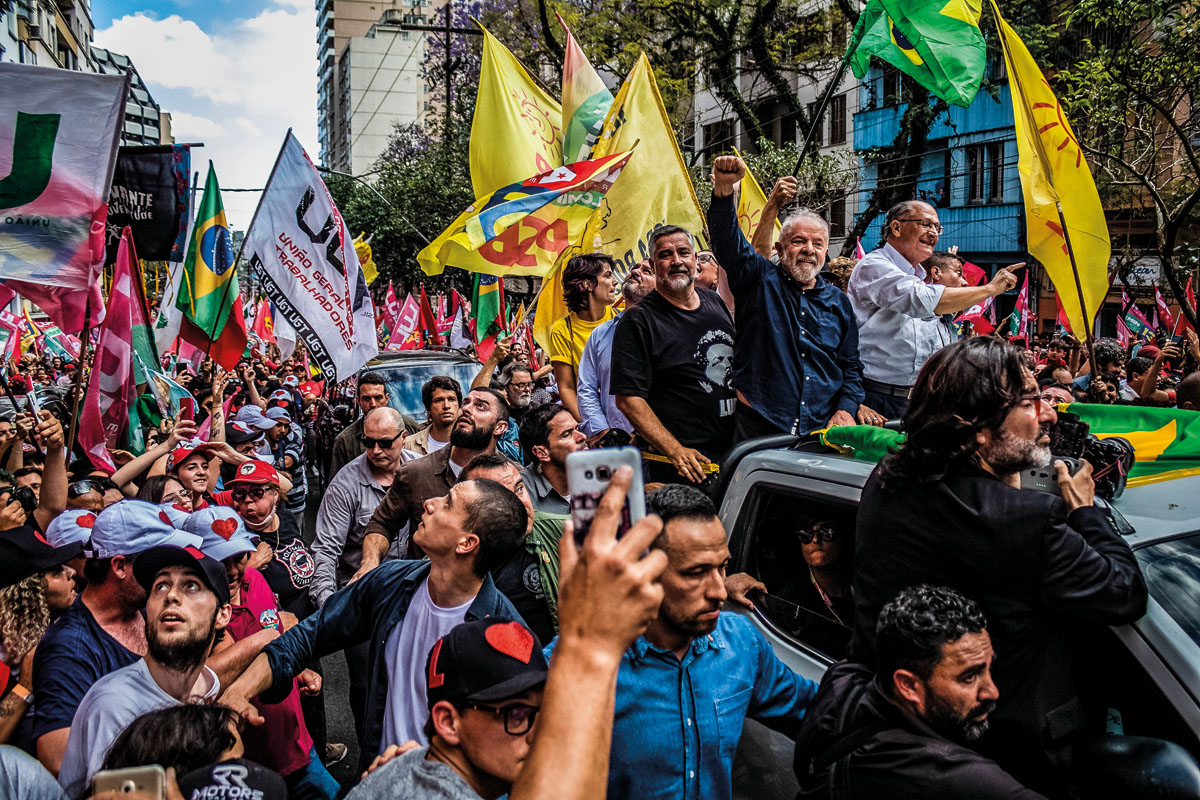
The huge marches that closed the campaign in Fortaleza, Salvador, Rio de Janeiro, and São Paulo on the eve of October 4 showed how such initiatives can mobilize activists and the broader public.
But it was too late—and too little to change the outcome of the first round.
History Hasn’t Ended
The possibility of a turnaround in the three weeks leading up to October 25 cannot be ruled out. It will not be simple or easy. Lula must not only make up a deficit of 2.2 million votes; he must also offset the movement of voters who backed other right-wing candidates in the first round, most of whom are likely to move toward Flávio Bolsonaro.
Pulling that off will require a broad, grassroots effort to win over voters, potentially reinforced by new initiatives from Lula. The coming hours and days will be decisive.
If Bolsonaro’s movement also wins the presidency, the result will create a high-risk situation for Brazilian sovereignty and democracy. The enormous challenges posed by such an outcome would require the left to reexamine, in depth and with a genuine willingness to engage in self-criticism, its political projects—or its lack of them—and its practices.
But would that mean we are condemned to the long winter of far-right hegemony that some analyses are beginning to forecast?
It is far too early to say, suggests a recent text by Álvaro García Linera, the thinker who served as vice president of Bolivia under Evo Morales.
His central hypothesis is that this political current will prove short-lived. At a moment when the entire world is once again talking about sovereignty and protecting national economies, the far right offers a stale, recolonizing neoliberalism. Its submission to the United States is as blatant and pathetic as Flávio and Eduardo Bolsonaro’s overtures to Donald Trump.
Its project amounts to something like every man for himself: greater inequality, capitalism without limits, devastation, and supremacism.
Will it work?
In the United States, just two years into his second term, Trump himself is reaching record levels of unpopularity and may be on the verge of losing Republican control of both the House and Senate in November.
Every new beginning is difficult. Whatever the outcome of the second round, the defeats of October 4 show how profoundly the Brazilian left will have to rethink and rebuild.
But just as it would be foolish to underestimate the seriousness of its mistakes, it would be equally foolish to conclude that rebuilding a political project is no longer possible.
History has not ended. The times are moving faster than ever.
Originally published in Portuguese by Outras Palavras. English translation by Eric Blanc/Labor Politics.
ZNetwork is funded solely through the generosity of its readers.
Donate