
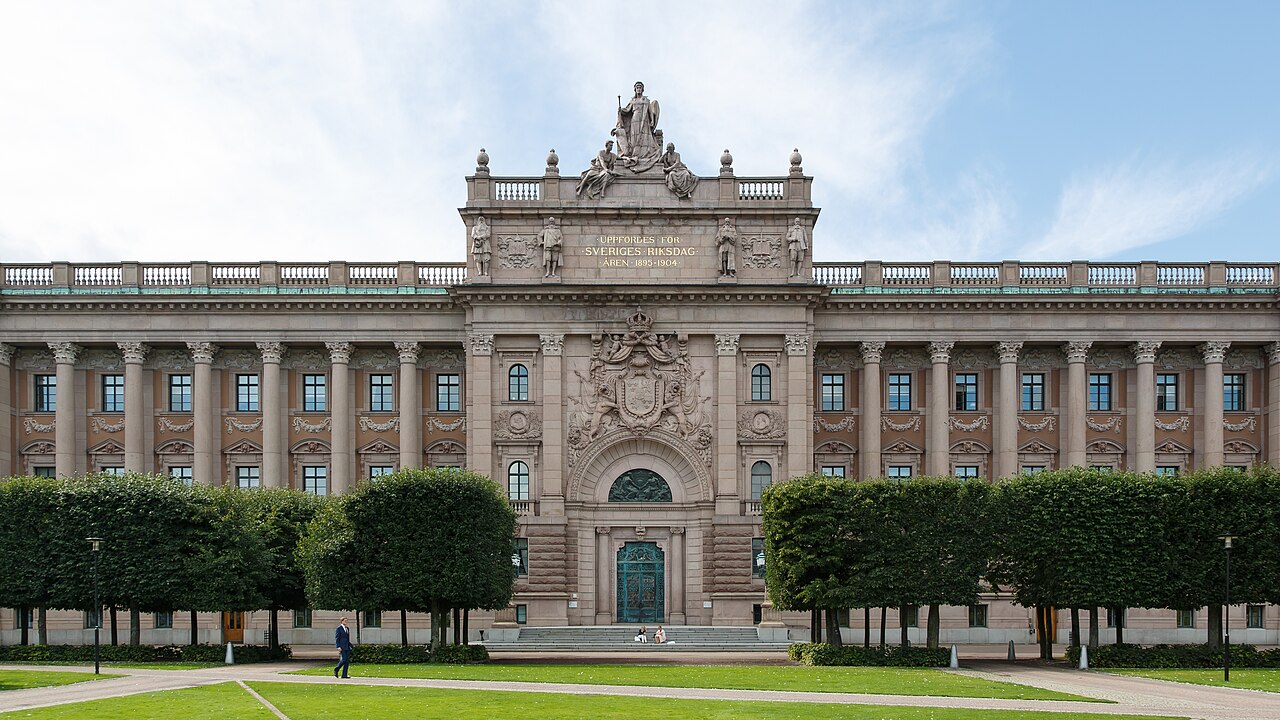
The mood at the hard-right Sweden Democrats’ (SD) election-night gala on Sunday was sombre. Earlier in the evening, party faithful had swayed to ‘Dancing Queen’ under purple and pink lights, and mimicked Trump’s signature fist pumping to ‘YMCA’. But as exit poll results started to trickle in, the atmosphere turned. The news was disappointing, if not entirely unexpected: on 17.5 per cent of the vote, the SD had for the first time lost ground in a Riksdag election. Four years ago, as supporters gathered at a waterfront hotel in Nacka to celebrate the party’s historic breakthrough on 20.5 per cent – making it the second-largest party in Sweden after the Social Democrats – exuberance reigned. Led by Jimmie Åkesson, whose modern, relaxed presentation is credited with bringing it from the far-right fringe into the mainstream, the SD seemed unstoppable. But on Sunday, the sorry sight of disco lights on an emptying dance floor seemed worlds away from that insurgent energy.
In 2022, the party’s strong finish gave it considerable bargaining power in negotiations with the traditional bourgeois parties – the Moderates, Liberals and Christian Democrats. The resulting arrangement was formalized in the Tidö Agreement: the centre-right parties formed a government, led by the Moderate Party’s Ulf Kristersson, while the SD would remain outside the cabinet but support it in parliament in return for substantial influence over policy. Åkesson later made it clear that he did not expect to remain on the outside forever, and during this year’s campaign Kristersson pledged that if the Tidö coalition prevailed, the SD would at last be awarded ministerial portfolios.
After a nail-biting vote count, the SD’s ministerial dreams were not to be. The governing right bloc lost to the centre-left opposition headed by former Prime Minister Magdalena Andersson’s Social Democrats – together with the Left Party, Greens and the Centre Party – by less than a percentage point, 48.9 per cent to 49.6. The distribution of seats was a mirror image of 2022, with 173 going to the Tidö parties and 176 to their opponents. Yet given the razor-thin margin of victory, the winner was also a loser of sorts. The Social Democrats may have secured the most votes, but they nevertheless registered their worst election result in nearly a century. Just this spring, Sweden’s traditional party of government was polling around 34 per cent; they finished with 28 per cent on Sunday, down 2.3 per cent from 2022 and short eight seats, for a total of ninety-nine.
Novus polling indicated that healthcare, education, and law and order ranked as voters’ top three concerns. Against this backdrop, the Social Democrats also campaigned on voters’ fear of the SD entering government. A recurring campaign message was, ‘if you don’t want twelve SD ministers after the election, then you should vote for the Social Democrats’. (The figure originates with Åkesson, who told Aftonbladet that if the Tidö alliance won the election, ministerial positions should be doled out in proportion to popular support.) The Social Democrats sought to triangulate with segments of the bourgeois right. The party aggressively courted the so-called ‘Magdamoderater’, Moderate Party supporters willing to vote for Andersson. This cohort of well-educated, high-income urban voters is firmly right-wing on economic issues but dislikes the Sweden Democrats’ uncouth racism. Such revulsion is partly rooted in class contempt for the SD electorate, with their penchant for Viking tattoos, hillbilly Americana and biker kitsch. As one editorial in the liberal Dagens Nyheter read: ‘Do you want bourgeois politics? Then you shouldn’t vote for the Tidö parties.’
Throughout the campaign, Andersson emphasized ‘broad coalitions’ and said she would be open to cooperating with any party besides the SD. To court centrists and traditional conservatives, her party adopted a tougher ‘law and order’ posture – an issue that has paid off well for the right – and embraced traditionally right-wing positions in favour of nuclear energy. This was a gamble that cost them at the ballot box: by tacking right they managed to alienate parts of their base, losing voters to the Left Party and Green Party, both of whom enjoyed a modest increase in vote share. The socialist Left claimed 8.4 per cent (up from 6.8 per cent in 2022) – and an additional six seats, the biggest gain of any formation – on a platform that calls for rebuilding the welfare state, ending profit-seeking in healthcare and education, and a climate-friendly jobs policy. Not far behind, the socially liberal centre-left Greens took 6.1 per cent (up from 5.1 per cent) and added four seats to their total.
Meanwhile, many of the ‘Magdamoderater’ ended up voting for the neoliberal Centre Party, which received about 7 per cent. In the end, the SD’s 17.5 per cent was edged out by the Moderates, the largest formation in the right bloc, which won 19.8 per cent, reversing the outcome of four years prior. The pro-market Liberals eked out 5.3 per cent – clearing the 4 per cent threshold for representation in the Riksdag, likely buoyed by ‘tactical votes’ siphoned from the Moderates and the SD – while the Christian Democrats secured just over 6 per cent. Kristersson fought for re-election on the grounds that his Moderate Party had ‘cleaned things up’; he frequently cited asylum numbers, which have dropped to their lowest in forty years, and claimed that deadly shootings are down by three quarters since the coalition took power. The SD, not altogether implausibly, vied to take credit for these same accomplishments, positioning the party as the ‘guarantor’ of the Tidö government’s restrictive immigration policies.
Indeed, the slump in Sweden Democrats’ vote share may in part reflect their very success in pressing their signature issue. In 2022, immigration ranked first among voters’ main concerns. For years, Stockholm had some of the most generous asylum policies in the EU. At the height of the refugee crisis in 2015, Sweden took in 163,000 asylum seekers in a country of less than ten million – 12 per cent of all those who sought protection in Europe. The SD capitalized on the backlash that followed, demanding Swedish welfare for Swedes at a time of significant budget cuts. In 2010, the year the party first entered the Riksdag, Sweden’s unemployment benefits fell below the OECD average; twelve years later, voters went to the polls amid a cost of living crisis, caused in part by the war in Ukraine. The subsequent four years of right-wing rule transformed Sweden from among the most welcoming countries for refugees to one of the most restrictive. From their 2015 high during the refugee crisis, asylum applications have plummeted by 96 per cent and the number of refugees accepted for resettlement cut from 5,000 to 900. In 2024, the Tidö government announced that for the first time in over half a century, the number of people leaving Sweden exceeded the number of those moving to it.
A number of controversial policies have been introduced as part of the new immigration regime. Refugees are now offered £27,000 to leave the country. More contentious have been the so-called ‘teenage deportations’. The Swedish Migratory Agency now states that residency based on parental ties is granted only in exceptional cases involving ‘special dependency’ after the age of eighteen. In practice, this means that teenagers who haven’t acquired permanent residency permits by their eighteenth birthday can now face deportation back to their family’s country of origin. The government has also targeted teenagers from immigrant families as part of its promise to get ‘tough on crime’, particularly drug-related gang violence. On 1 July, high-security adult prisons began housing prisoners as young as fifteen; last month parliament voted to lower the age of criminal responsibility further, to fourteen. In June, the Riksdag passed the controversial ‘snitch law’, which requires employees in social insurance, employment service and other public agencies to report suspected undocumented immigrants to the police. Legal scholars say that the legislation represents the ‘internalization of border governance into welfare infrastructures’.
Like their counterpart in neighbouring Denmark, the Social Democrats have followed the right in adopting a more restrictive approach to immigration. ‘We had one of the most generous asylum systems in Europe’, Party leader Andersson has said, ‘and that was wrong’. While the SD failed to obtain the votes they’d hoped for on Sunday, they have succeeded in durably altering the Swedish migration policy – with the centre broadly in agreement, only the Left Party and Greens still defend Sweden’s traditional approach to welcoming refugees. Alongside this development, Swedish criminologists have identified a ‘paradigm shift’ in perceptions of danger and social risk. The classical Social Democratic notion of security – trygghet in Swedish – is rooted in access to work, welfare, pensions and healthcare. In recent years, the Tidö parties have attempted to reconceptualize trygghet in terms of safety from crime. The Social Democrats have effectively acceded to the right’s interpretation; ‘security’ now means safeguarding the nation from foreign and domestic threats, through harsher sentencing and police surveillance.
Although the Moderates enjoyed a slight uptick in their vote share from 2022 – mostly by poaching SD voters – outgoing Prime Minister Kristersson’s tenure has been marred by a run of decidedly un-Swedish scandals, which did not help the Tidö coalition on Sunday. Sweden regularly ranks among the least corrupt countries in the world; in their heyday, the Social Democrats were famous for returning their pencils to parliament upon retirement. This made Kristersson’s missteps all the more shocking. In late 2022, the newly elected PM appointed a close childhood friend, Henrik Landerholm, to the role of national security adviser. Landerholm proceeded to demonstrate near comical negligence: he left his phone overnight at the Hungarian embassy during tense negotiations over Sweden’s NATO accession; mislaid a notebook at Radio Sweden and had a taxi deliver it to a Stockholm café; and, more seriously, left classified documents in a hotel locker where they were later discovered by cleaning staff. All the while, Kristersson defended his childhood friend, who finally resigned last year. Kristersson’s wife, Birgitta Ed, an ordained Lutheran priest, has also attracted controversy. In June, the Church of Sweden launched an inquiry into her conduct after reports that her spiritual foundation recruited volunteers to do unpaid fundraising and renovation work on a property she co-owns for ‘networking’ opportunities. The foundation promotes ‘existential health’, which posits that meaning and purpose are as essential to well-being as physical health; Aftonbladet reported that the head of Sweden’s Public Health Agency was sacked after questioning a government directive to incorporate the concept into its work.
Notably absent from the campaign was any major disagreement on Sweden’s foreign policy direction. Whereas Left and Green MPs voted en bloc against NATO membership in 2023, today a hawkish consensus prevails. The Left Party’s former leader Jonas Sjöstedt, currently an MEP, has been depicted in Swedish media as a ‘reluctant militarist’: though its official programme states that it is against ‘militarization and the arms race’, the Left now backs Swedish rearmament and maximalist support to Ukraine, joining the Greens in a Riksdag-wide consensus. Notes of dissent are still heard – Left and Green MPs opposed the Defence Cooperation Agreement with the US, allowing the American military access to more than a dozen bases across the country – but compliance can be demonstrated in other ways. When the centre-right tabloid Expressen launched an ‘antisemitism’ witch-hunt against Left Party members during the campaign, the leadership was swift to strike those accused from its lists.
During the run-up to the election, the Left Party made it known that it would seek ministries for the first time in its history. Unlike in neighbouring Finland, where the Communist Party served in coalition governments during the Cold War, and where its successor the Left Alliance has been part of several cabinets since the 1990s, in Sweden the Left has never been in government. Having secured the greatest increase in vote share of any party in this election, the Left will surely feel emboldened in negotiations. But there are also powerful countervailing forces at play. The Centre Party, which abhors both the Sweden Democrats and the Left, campaigned for a centrist administration to shut out the two ‘fringe parties’. Before the election, its preferred formula was a government composed of the Social Democrats, Greens and the Christian Democrats, though that combination now falls short of a majority. Andersson herself has shown little enthusiasm for bringing the Left into cabinet. Relations have been strained since 2021 when the party helped to bring down her Social Democratic predecessor, Stefan Löfven, over plans to liberalize rent-setting in newly built housing. But excluding the Left introduces its own difficulties, and a centre-right-leaning government would be highly unpopular with the Social Democratic base.
ZNetwork is funded solely through the generosity of its readers.
Donate

