
Wars, conflicts, and crises continue to spread and persist in dozens of countries around the world, particularly across many parts of the Middle East. We are experiencing a period in which international law has been rendered ineffective, institutions such as the United Nations (UN), which are supposed to uphold it, issue ineffective statements favoring those who escalate conflicts, and policies of war have become “normalized.”
In recent years, philosopher and professor of political theory Sandro Mezzadra and American philosopher Michael Hardt have drawn attention to the concept of the “War Regime” (Global War Regime) in articles and writings they have co-authored.
Mezzadra and Hardt point out that war is no longer simply a military conflict occurring periodically between two or more states; instead, it has become a permanent mode of governing society, the economy, and politics. Mezzadra, who teaches at the University of Bologna in Italy, focuses his work on globalization, capitalism, war, migration, and postcolonialism. He argues that the struggle against the “War Regime” should not be limited merely to stopping existing wars, but requires broad social transformation and a comprehensive rejection of the system. We conducted a two-part interview with Mezzadra.
In the first part of our interview (also published in Turkish in Yeni Özgür Politika), we discussed who could lead such a struggle, the role of the institutional left and the media, and the inadequacy of solidarity with peoples under oppression.
Wars have now become a form less between two states and more one where proxy powers, armed groups, regional crises, and resources are plundered through international agreements or transnational corporations. Are the struggle methods based on statements of anti-imperialism, anti-capitalism, and anti-colonialism sufficient against the “war regime” you and Michael Hardt describe?
Wars and warfare change over the course of history. And you are right: the traditional definition of war in modern European international law as the exclusive business of states does not help us to grasp the key characteristics of contemporary wars and of the emerging global war regime. Even if you consider the Ukraine war, the regional dimension, the involvement of foreign powers, and the key roles played by corporate actors like Elon Musk’s Starlink confront us with a situation that is in many senses new. What does not change, it is even banal to observe, is the unbearable degree of devastation and death wars impose on territories and populations. This is something we need to keep in mind when we speak of an emerging global war regime that spreads across countries and regions, even where no war is directly fought on the ground.
Nonetheless, it is important to take the war regime as a standpoint from which at least some of the new characteristics of war can be illuminated. In my work with Michael, I stress both the reality and the limits of current forms of imperialism, starting with US imperialism. And this is the basis of what we call a global war regime. To this one should add that the contemporary processes of militarization of the digital and digitalization of warfare add further complexity to the situation you describe, blurring even more the boundary between public and private actors and logics. Having said this, contemporary wars and the war regime are key to the working of capitalism, and they have imperialist and colonial implications that are no less real because they take highly variegated forms. Struggling against war today necessarily implies a struggle against capitalism, imperialism, and colonialism. But statements and general positions are not sufficient. The challenge is to translate them into new forms of organization and struggle capable of confronting the heterogeneous forces and scales that constitute the global war regime.
The war regime acts in an organized way. You propose weaving an internationalism of resistance and liberation against its organized destruction. How will this happen? Who will take responsibility and lead — do such organized structures already exist?
An internationalism of resistance and liberation is urgently needed today. It is clear that, as your question implies, we confront a disproportion between the forces that promote war and destruction and the power of those who oppose them. One of the reasons for this is that today, in many parts of the world, there is a widespread awareness that things cannot continue as they are while there is no sense that they could be otherwise. A Brazilian friend, Rodrigo Nunes, contends that the ensuing impasse is precisely the ground on which contemporary forms of far-right politics and even of fascism thrive.
When I speak of a politics of liberation as the key stake of a new internationalism, I emphasize that a “positive” horizon for our struggles within and against the global war regime can emerge only at the international level. This does not mean, of course, that a politics of liberation must be forged as a kind of abstract blueprint and imposed “from above” on local and national contexts. The opposite is the case: only the myriad struggles, practices of resistance, and experiments with new forms of social and political organization – always grounded in specific contexts and territories – can provide the basis for a new internationalism.
But the latter is desperately needed to translate heterogeneous experiences and languages into a power capable of effectively confronting the global processes that compose the contemporary war regime and sustain the operations of capital across the world. This is for me the general framework within which the discussion of internationalism today must develop. And I think that this is an awareness that is widespread within movements and political forces of the left. I do not think that a single organization or political subject can take responsibility for or lead this process. Leadership must emerge through cooperation and convergence among movements, organizations, and political forces rooted in different contexts. Existing organized structures have important roles to play in this process, while new ones need to be established.
The parliamentary left is both weak and unable to produce an alternative, strong politics. Rather than limiting resistance and struggle against the war regime to the institutional left, how can it be expanded through social movements and grassroots activist initiatives?
I agree, the parliamentary left is weak, and its politics is limited and contradictory in most of the world today. Speaking of a new internationalism implies a project for a general reorganization of the politics of the left, beyond the institutional level but without dismissing the possibility of including in that project forces of the institutional left. The political tradition from which I come, revolutionary operaismo, has always emphasized the primacy of struggles. And I continue to do so, since I am convinced that the creative force we need to imagine and build a new internationalism can emerge only from social struggles and movements. But we should avoid any simple opposition between the autonomy of the movements and the logic of institutional politics. It is time to experiment with new forms of articulation between what appear to me today as the two necessary dimensions of a renewed politics of the left.
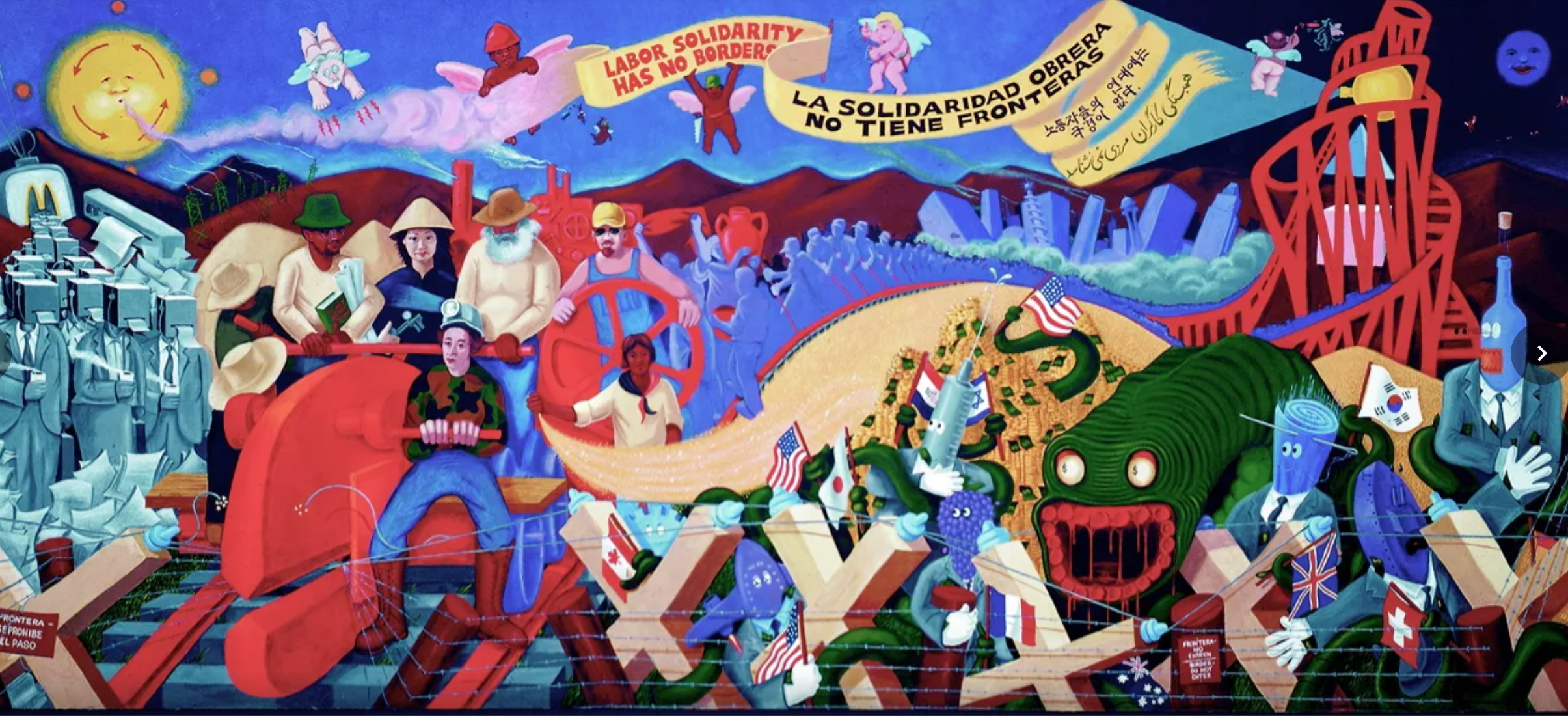
Regarding internationalism, however, maybe it is more important to stress something else. In my writing with Michael Hardt and Brett Neilson, I have emphasized that we are living through a conjuncture of war. The struggle against the war is a strategic issue for a new internationalism, and international campaigns against the wars that proliferate in our present are urgently needed. However, internationalism today cannot be reduced to a movement against the war. Precisely because of the ubiquity and pervasiveness of what we call the war regime, internationalism must rather draw its strength from a mass refusal of this regime at the level of everyday life. This means connecting anti-war mobilizations with struggles over labor, social reproduction, migration, climate, and the militarization of everyday life.
For structures that value left and internationalist solidarity, issues of solidarity tend to enter their agenda largely depending on whether mainstream media covers them. How can these structures set their own agenda independently of mainstream media and established (parliamentary) politics?
You raise an important question. Let me start by saying that mainstream media and parliamentary politics of course play an important role in setting the agenda of internationalist solidarity, but they do not have a monopoly over it. A myriad of alternative media, platforms, and channels of communication and exchange exist and shape both the ways in which solidarity is imagined and its concrete practices. This concept of solidarity is, of course, important in the history of internationalism and in its present forms. But again, as important as solidarity continues to be today, I think we should move beyond an understanding of internationalism that reduces it to solidarity.
What matters more is the multiplication of exchanges, encounters, and experiences that lead us to identify with a struggle taking place far away from our hometown or country. And this is something that cannot happen through an agenda set by mainstream media and parliamentary politics. I repeat, solidarity continues to be crucial, but we should problematize any rigid boundary between those who express solidarity and those whose struggles they support. This is an important step toward an internationalism of liberation, which requires stable infrastructures of communication, direct relations among movements in different parts of the world, and a capacity to circulate knowledge and experiences independently of the cycles of media attention.
There are peoples in need of solidarity because of the oppression and exploitation they face, yet who remain unseen: Kurds, Tamils, the Tigrayans and Amharas in Ethiopia, Amazighs (Kabyles), Sahrawis, Baluchis, Afghans, and countless indigenous peoples in South America… Who can be a voice of solidarity for these peoples at the international level?
In a way, this is a follow-up question to the previous one. It raises the crucial question of the visibility of oppression and war, massacres and destruction, which is obviously tied to the attention they receive from mainstream media and institutional politics. I would start by noting that heterogeneous and often powerful forms of solidarity have long supported the struggles of the Kurds, the Tamils, the Sahrawis, and the indigenous peoples in Latin America. In each of these cases, there have been and continue to be material connections with movements in other parts of the world. These practices of support confront deeply entrenched power relations, which at least partly explain their varying degrees of success.
You are also right that some of the other struggles you mention never entered the global left’s agenda (whatever this may mean) – they remained “invisible.” If I think of the war in Tigray conducted by the Ethiopian state between 2020 and 2022, in which more than 600,000 Tigrayans lost their lives, I see a terrible instance of that invisibility. It is not easy for me to say who can be a voice for these peoples at the international level, considering that the crisis of international institutions and of the UN is a defining feature of the current conjuncture. The first answer that comes to my mind is that we should listen to these peoples as they speak in their own voices.
The task of internationalist networks is not to speak for them, but to amplify those voices, create spaces in which they can be heard, and build material connections with their struggles. This does not alter the fact that there are situations in which it is difficult to speak and to make one’s voice heard. Speaking of a new internationalism also implies imagining the emergence of new fora, organizations, and even institutions at the international level. These could effectively monitor situations of war and genocide, providing information and impetus for mobilization campaigns and practices of solidarity. But again, even in difficult situations, the main task is to establish concrete connections on the ground as a basis for solidarity.
Concretely, between November 2020 and November 2022 the Ethiopian state committed genocide, killing more than 600,000 Tigrayans. This did not enter the global left’s agenda, nor did any solidarity develop. Where does the problem lie?
As I mentioned in my previous answer, the invisibility of the war in Tigray demonstrates that the gravity of a situation is not in itself sufficient to generate international attention and solidarity. Political relations, channels of communication, and internationalist infrastructures must already exist or be actively constructed. Their weakness or absence is a central part of the problem. This is not to deny that there is also a problem within parts of the global left, which read the struggle against imperialism through a selective geopolitical lens, with the result that violence and war become less visible when they cannot be fitted into a familiar narrative that attributes responsibility to the Western “camp.” As I have often contended in my work with Michael and Brett, the critique of “campism” is a key aspect of any new internationalism.
To be continued in Part Two: An integral part of the new internationalism; Democratic Modernity
ZNetwork is funded solely through the generosity of its readers.
Donate


1 Comment
wvwvwvwwwwwww