

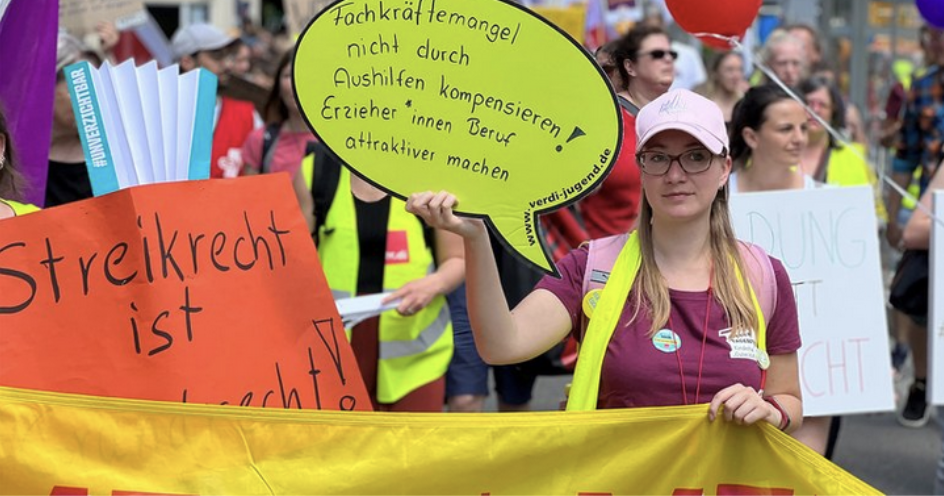
The more recent history of strikes in Germany dates back to 1945 with the victory over Nazism. Yet many strikes quickly came – and still come – into the media limelight.
Since many, if not most, media organizations are profit-making businesses, they rarely focus on workers, trade unions, and their demands, but rather on the “negative” impacts of strikes on the public or the economy.
Despite this, strikes are all too often forgotten just as quickly again. Nevertheless, there have been many labor struggles in East and West Germany – and in the unified post-1990 Germany – that have remained in the collective memory.
Such industrial disputes have a peculiar quality: they become public dramas almost instantly, but just as quickly fall back into oblivion.
Perhaps media capitalism needs to ensure that a collective memory of what strikes have achieved is avoided – or at least diminished.
Today, few still remember the strike at the packaging manufacturer Neupack – lasting more than a hundred days and causing a nationwide sensation just ten years ago.
During the spring of 2024, many strikes in what Germans call “system-relevant areas” echoed a “Strike Republic of Germany” rather than its official name, the “Federal Republic of Germany.”
In a public domain heavily shaped by corporate media, work stoppages are made to appear like whales – surfacing impressively, then disappearing again into the depths of the sea.
However, unlike whales, strikes are almost always framed negatively. This is done, for example, by pairing the word “strike” with something undesirable, in the hope that the strike itself becomes associated with negativity. It is a communication strategy that often works: strikes become “bad.”
Worse still, industrial disputes are portrayed as a “nuisance,” sometimes even a “danger,” but always as a “loss.” This framing is reinforced by the misleading category of “lost days” – rather than “strike or off days won.” Even Germany’s supposedly neutral Federal Statistical Office counts them as lost.
In reality, industrial disputes achieve improvements – they make working and living conditions more humane, and often more sustainable and ecological. Strikes can also enforce a living wage.
Despite the best efforts of corporate media, many labor disputes have retained a stable place in the collective memory of workers and trade unions – and in Germany’s history.
Some strikes can indeed be considered signposts or milestones, while thousands of minor industrial disputes are hardly ever mentioned.
The history of these signpost strikes begins in November 1948. The first strike after Nazism was driven by union demands for denazification and for transforming the economy and society toward democracy.
Yet even before that, industrial disputes immediately after May 8, 1945, were marked by chaos and by a relatively open situation. Many German businesses continued – spontaneously – often in the temporary absence of their owners.
This created a structure in which workers’ committees – sometimes drawing explicitly on the Weimar Republic’s tradition of works councils – and newly founded trade unions could develop local initiatives.
In retrospect, these were a kind of “self-administration in times of need.” They could have had a lasting influence on the democratic foundations of the western occupation zones (France, the UK, and the USA). Meanwhile, in Germany’s eastern zone, occupied by the Soviet Union, democratic structures did not arise.
While few administrative organizations initially existed in all occupation zones, local self-organization in the Soviet zone was quickly absorbed “from above.” In what became East Germany, the Free German Trade Union Confederation (FDGB) was founded in 1946.
In contrast, the establishment of trade unions in the three western zones was delayed out of fear that they could foster communist or socialist tendencies.
The ideology of anti-communism seems to have transcended from the Nazi regime into the new “democratic” one – even though many communists had been killed by the Nazis or disappeared into Stalin’s gulag.
In Germany’s western zones, early strikes centered on the unequal distribution of goods – between social classes and between city and countryside.
With the founding of the Federal Republic (West Germany), the Allied economic policy was initially focused on dismantling the Nazi war economy. During the 1950s, this policy shifted toward building an export-oriented economy within the framework of the East (bad) – West (good) conflict.
Until the early 1950s, however, the situation remained dominated by hunger and severe shortages of goods, services, and housing. At the same time, mass migration from East to West created a labor market defined by low wages.
The “November strike” of 1948 was an attempt by German trade unions to keep up with widespread social unrest, leading to numerous industrial disputes with strong political overtones. The strike movement began in response to sharply rising prices for everyday goods, particularly in the American and British zones.
Against a backdrop of high inflation that eroded workers’ incomes, a series of protests took place in the summer of 1948 with up to nine millon workers on strike.
A local strike in Stuttgart on October 28 1948 turned into mass demonstrations with hundreds of thousands of participants and escalated into open street battles with the police – until the Allied military intervened on the side of capital. The military “intervening” (code word for: shooting workers) on the side of capital – what else is new!
On November 12, 1948, a long-prepared general strike took place, with almost 80% of all workers in the two western zones participating out of discontent with the economic situation.
This labor struggle is now seen as one of the milestones in the history of Germany’s post-war labor movement. It contributed to a policy that accepted welfare-state measures in the form of pensions and secured the institutional power of Germany’s trade unions.
With the subsequent Collective Agreement Act of 1949, the Montanmitbestimmungsgesetz, and the Works Constitution Act of 1952, the scope for strikes became significantly restricted.
Yet Germany’s unions traded the right to strike for legally secured institutional power and incorporation into the country’s economic system.
Trade unions were granted a “strike monopoly,” yet their ability to strike became increasingly limited by the rulings of Germany’s labor courts. Strikes were sacrificed on the altar of an invented “duty to keep the peace.” Collective bargaining became regimented, and political strikes were forbidden.
In the early 1950s, large sections of Germany’s organized labor movement criticized co-determination and works councils, demanding genuine cooperation with management. There were protests and strikes against the Works Constitution and the ban on political strikes.
The strike in North German shipyards (1956) saw strong mobilization. The IG Metall union tried – and failed – to stop it, calling it “excessive.” Yet the labor struggle, ending in February 1959, gradually achieved workers’ demands. It established principles that would remain at the core of Germany’s trade union movement for decades.
By the late 1990s, Helmut Kohl ’s conservative government was voted out after questioning regulations dating back to the 1959 strike.
Meanwhile, in the GDR (East Germany), workers’ organizations were built and centralized much faster than in the West. A latent conflict existed between state policy and the FDGB’s official line versus workers’ independence. Economic development in East Germany was long hampered by reparations to the Soviet Union.
When labor standards were increased by 10% in June 1953, a wave of strikes erupted without support from official trade unions. Symbolically, it began on a construction site at East Berlin’s Stalinallee, the showcase boulevard of the capital.
The movement spread into a general strike in over 700 cities and towns, expanding into rallies against the Stalinist SED’s dominance and Soviet control.
The uprising was crushed militarily, leaving at least 55 dead. It shocked the SED leadership, which responded with a kind of appeasement policy – a limited social compromise – while simultaneously tightening repression and control.
During the 1960s, both German states saw a deterioration of labor militancy. In the West, unions became more institutionalized; in the East, independent workers’ organizations were eradicated.
By the mid-1960s, wildcat strikes reemerged in West Germany’s industrial core – against excessive workloads, poor conditions, and low pay.
Two decades later, in 1984, a milestone strike erupted over the demand for a 35-hour workweek in the metal and printing industries.
Unions argued that rapid automation, robotization, and “lean” management were destroying jobs. Sharing work, unions argued, could prevent layoffs and mass unemployment.
In the short period from 1980 to 1983, rationalization had eliminated one in ten jobs in the metal industry, and one in five in printing.
Workers of the IG Druck und Papier union went on strike from April 12 to July 5, 1984. There were clashes at factory gates, with many injured as picketers tried to block newspaper deliveries. The reactionary Frankfurter Allgemeine Zeitung, for instance, had to fly its papers out by helicopter.
Meanwhile, IG Metall workers struck from May 14 to September 4 in Baden-Württemberg and Hesse. In the end, both unions won shorter working hours – but at the price of greater flexibility, especially in the metal sector. Germans call this KAPOVAZ (kapazitätsorientierte variable Arbeitszeit, or “capacity-oriented flexible working time”): workers must work whenever management demands.
With the fall of the Berlin Wall in 1989 and reunification in 1990, West Germany’s labor-relations framework was simply transplanted into the East – a kind of Anschluss even in the field of labor.
This was accompanied by the West’s a deliberate demolition of East Germany’s industrial base, at a speed exceeding that of the 1970s and 1980s in the West.
Mass unemployment reached unprecedented levels. The DGB tried, briefly, to mitigate the mass privatizations and liquidations, but capitalism won – hands down.
In 1993, potash miners in Bischofferode (Thuringia) fought to save their jobs with occupations and hunger strikes – and lost: bitterly.
A decade later, in 2003, a kind of “desolidarization” between East and West emerged during the metalworkers’ strike for equal working hours. The strike was undermined by powerful West German works councils in major car plants – the so-called “Pinces” [Fürsten].
Setting East against West split the working class and ended in one of the most serious defeats in Germany’s labor history. For the first time, IG Metall had to end a strike without any gains — a devastating loss.
The works council bosses won; the union and East German workers lost – to the utter delight of Germany’s reactionaries, it was a bitter defeat.
In recent years, Germany’s strike culture has both diversified and renewed itself. While traditional sectors like metal and auto manufacturing still matter, other – often more conflict-prone – sectors have become increasingly important.
Recent strikes at Amazon, Coca-Cola, in the kebab industry, daycare centers, and hospitals have taken up long-standing demands for higher pay and better working conditions.
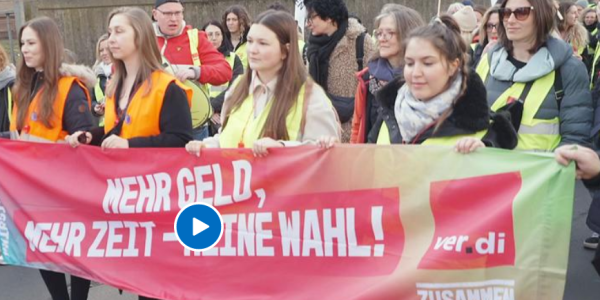
Screenshot: German public TV: https://www.hessenschau.de/tv-sendung/streiks-in-kitas–4000-teilnehmer-bei-kundgebungen,video-208086.html
They also reflect the immense burden faced by workers in the health and care sectors, demanding better staffing and humane conditions.
This has led to a new composition of strikers – a shift toward the service sector and a growing feminization of strike action.
What these “new strikes” – no longer rooted in traditional industries – ultimately mean for Germany’s labor movement remains open.They may well indicate that a renewal of Germany’s trade union movement is underway – with strikes that, in the coming years, could themselves become milestones.
ZNetwork is funded solely through the generosity of its readers.
Donate