

Iowa contains only 4.5% of the land and contributes 5.9% of the water to the Mississippi River watershed. Yet it contributes to 29% of the nitrate and 15% of the phosphorous that travels down to the Gulf of Mexico, making it one of the largest polluters of the Dead Zone. The nitrogen and phosphorus deplete the Gulf’s oxygen levels, creating algae blooms that kill off marine life. Commercial fisheries and the Gulf’s tourism industry are both damaged by Iowa’s manure pollution.
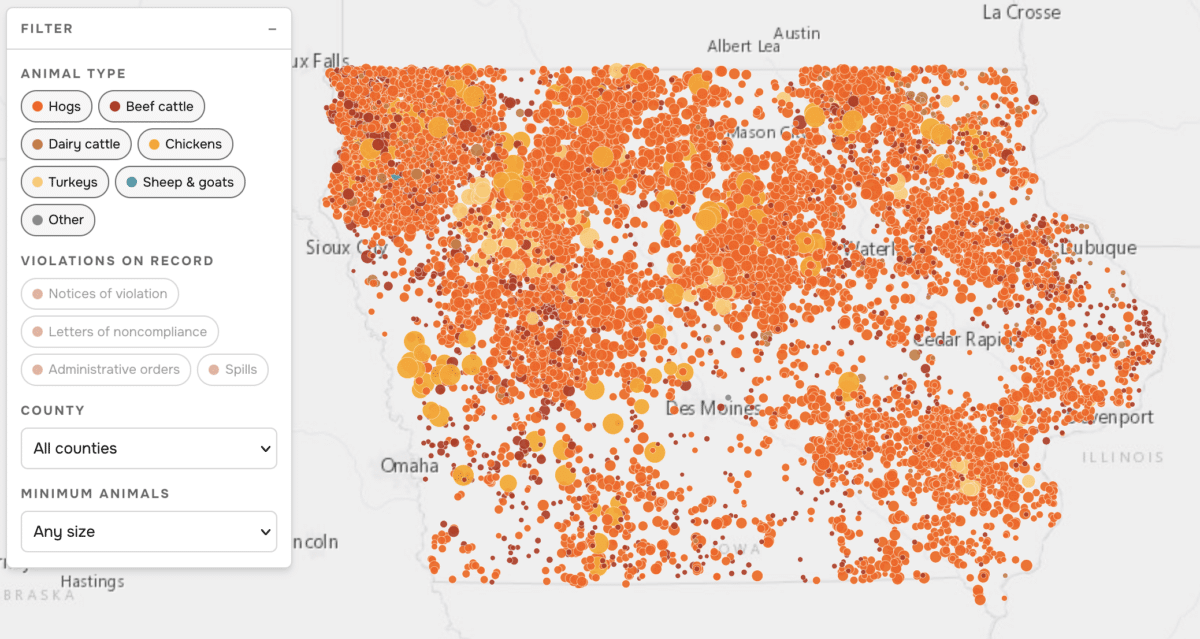
Sentient Media’s year-long analysis of Iowa Department of Natural Resources (DNR) records found Iowa produces approximately 170 billion pounds of manure from an estimated 126.4 million animals in 10,830 factory farms. Every year.
The public is entitled to know where it all goes, but the DNR only requires manure management plans (MMPs) and not real-time reporting. These plans are subject to change at any time and, by law, are only reported after the fact on a yearly basis.
The under-funded agency doesn’t monitor manure applications, so it doesn’t exactly know if farmers are following MMPs as written. Reported application rates typically aren’t analyzed. Because MMPs are submitted as paper copies, it would be a herculean effort to double check for fields showing up in multiple MMPs. When we map out MMPs in Jefferson County, we find numerous fields slated to get manure from as many as three, four or five CAFOs.
CAFO owners/operators theoretically work with each other to determine who is using what field in what year. DNR attorney Kelli Book and other DNR employees have repeatedly told me that the DNR entrusts them to “do the right thing.” The whole system is self-enforced.
While CAFO owners maintain their manure application records, Iowa law deems them confidential and not for the public purview. The DNR only sees them if investigating a complaint or possible violation.
A questionable accounting of factory farms
We really don’t even know how many CAFOs exist or how many animals are raised in Iowa. The 10,830 factory farms that Sentient Media found doesn’t include small animal feeding operations (SAFOs) because by law, the DNR doesn’t track those. Iowa state legislature says it’s not necessary. Therefore, the DNR doesn’t collect location or other data on operations under 500 animal units, which translates into 1,249 hogs, 499 feeder cattle, 27,776 turkeys or 49,999 chickens.
The Environmental Working Group recently used satellite and aerial imaging to determine there are actually 15,300 factory farms in Iowa. That 4,470 difference aligns with DNR’s estimate of 4,000 SAFOs reported during a presentation at the 2017 Iowa Groundwater Association Conference.
SAFOs aren’t required to submit MMPs but they still generate manure, and that manure is going someplace. We just don’t know where.
In fact, there isn’t one reliable source of data on farm animals or factory farms anywhere in the U.S. The EPA only collects data on large CAFOs with Clean Water Act permits. In Iowa, that’s fewer than 4% of all confined animal operations.
Figures from the USDA Agriculture Census conducted every five years are unreliable, as well. It reports that Jefferson County, where I live, has 61,147 hogs. My count from active manure management plans is 188,850. I’ve seen similar discrepancies in other counties across Iowa.
With 170 tons of manure produced per year, one would hope political leaders would give the DNR better tools than just relying on trust to monitor manure application. But agribusiness interests have lobbied the state so heavily to support the corn/soy/livestock industry, that most politicians don’t have the courage to go up against them.
The state even took away local county control for siting CAFOs in 1995 that increased CAFO development 400% between 1995 and 2020. The DNR director is a political appointee who follows the governor’s bidding.
Don’t drink the water?
Iowa currently has 723 impaired waters, of which 576 a need plan to clean up the pollution. The DNR developed a mere 20 plans between 2020-2026.
Out of 3,074 water segments in Iowa, only 1,134—a third—were tested by the DNR between 2024-2026, and more than half are impaired. The problem is undoubtedly worse that it appears. The DNR issued a record-breaking 182 beach advisories in 2026 because of high E. coli from fecal waste or dangerous microcystin levels.
It’s no secret Iowa is plagued with high nitrate levels, a result of a saturating mono-cropped fields with nitrate-laden hog manure, anhydrous ammonia—or both. Many municipalities struggle to provide safe drinking water below the 10 mg/L EPA limit to their residents. As I write this, the University of Iowa’s IIHR real-time nitrate sensors in the Central Iowa Watershed report nitrate levels between 8.6 – 14.5 mg/L. In Southwest Iowa, the East Nishnabotna River is running at 26 mg/L and in Northeast Iowa, home to Supreme Beef, Bloody Run Creek’s Headwater sensors read a whopping 39.7 mg/L.
Central Iowa Water Works has a denitrification plant, but most Iowa municipal water systems don’t and are challenged to keep the nitrate levels below 10 mg/L. Too many Iowans are drinking water with levels around 5 mg/L or more yet some cancers are associated with drinking water with as low as 3 mg/L and birth defects like spina bifida are linked to pregnant women drinking water with 5 mg/L of nitrate.
It’s not just public waters. Many of Iowa’s 250,000+ private wells are also polluted. The Iowa Environmental Council and Environmental Working Group published this interactive map in 2019 showing the high number of wells containing unsafe levels of bacteria and/or nitrates.
So here we are in the Wild West of Iowa agriculture with a corporate livestock industry that feels like a runaway train.
Is it any wonder why Iowa has a water pollution crisis? That people drinking water with high nitrate levels are getting colorectal, kidney, stomach or other cancers?
Is it any wonder water quality has finally, finally, become a major election issue in Iowa?
This is an industry that has significant and consequential health impacts on all Iowans, and our state legislature can’t do better than this?
Or is the operative word here “won’t?”
For the past three years, the state legislature refused to fund IIHR’s state-of-the-art real-time nitrate sensors despite the demands of thousands of Iowans who want to know what’s in their water. That’s a slap in the face to Iowans in a state with growing cancer rates.
What it did fund was a $1 million University of Iowa/Iowa Department of Health and Human Services study that focused on behavioral and demographic risks in its first year, such as binge drinking and radon. Only in its second year – after the midterms – is it scheduled to consider agriculture. Yet a 2025 Iowa Environmental Council/Harkin Institute report, deemed a “landmark report” by the Des Moines Register, linked numerous cancers to nitrates, pesticides and PFAS.
The Iowa state legislature has too many members beholden to the golden dollars of Big Ag campaign donations and not its citizens’ public health.
It’s now time to say enough.
We have a consequential election this November. Water quality is on the ballot in Iowa, but these are issues that other states face as well. Nationally, we need a Congress that will stand up to the gutting of our federal agencies like the EPA, one that would allow the EPA to fully implement the Clean Water Act, rather than try to pass legislation like the PERMIT act that would greatly weaken it. One that would expand the Waters of the United States (WOTUS) definition to include ephemeral streams that flow periodically but still transport pollutants to drinking water sources when they do.
Locally, Iowans can find out where legislators and candidates stand on this critical, public health issue and vote their personal interests. Nationally, water quality is a public health issue, too, and constituents can do the same.
We can all put the brakes on this runaway train. Let’s get that going in November.
ZNetwork is funded solely through the generosity of its readers.
Donate