

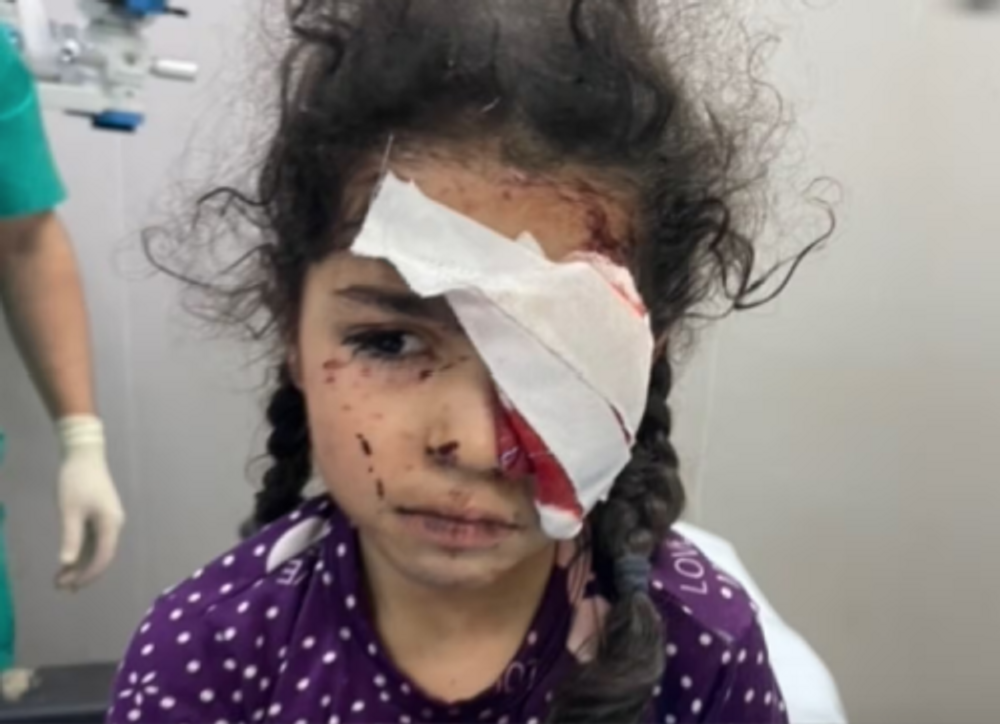
Harrowingly, confoundingly, Gaza’s horrors grow. Israel kills 250 people a day, attacks hospitals, bombs survivors in tents, blocks over 75% of humanitarian aid from reaching a place where “every single person is hungry,” a quarter are starving, most are cold, 60,000 are maimed. At a beleaguered hospital, a visiting Canadian doctor just saw 15 amputations a day; he himself removed 10 eyeballs ruptured by shrapnel from children as young as two. As we watch, he mourns, “Humanity has failed these people.”
By now the litany likely numbs, but still: To date, Gaza’s Ministry of Health estimates over 25,490 people have been killed, at least 10,000 of them children, and over 63,354 wounded, many permanently disabled. In the last 24 hours, at least 195 Palestinians were killed and 354 injured. Intent on “suffocating” Gaza’s health system – after having razed hundreds of medical clinics, killed over 340 doctors or nurses, and left 350,000 ill patients without medication – Israeli forces have now encircled Khan Younis and are bombing areas around Nasser Hospital, the only major hospital still functionial in the south. Doctors Without Bordersreport a “catastrophic” situation: Wards packed with thousands of injured patients, hallways full of displaced, traumatized people, bullets striking inside the hospital, staff feeling the ground shake under heavy bombardment as debris falls on them from ceilings, shrapnel hitting the grounds and a sense of panic” made worse by the presence of Israeli tanks and forces blocking all exit routes.
The savagery goes on. Israeli troops also stormed smaller Al-Khair and Al-Amal Hospitals, run by the Palestinian Red Crescent Society, where they arrested medical staff and blocked ambulances from recovering bodies. Israel’s project of “systematically obliterating” Gaza hasn’t stopped with hospitals: They also destroyed 1000 of about 1200 mosques and recently blew up Israa University, Gaza’s last surviving institution of higher learning, in their march toward cultural genocide. This week, they bombed displaced families living in tents in Al-Mawasi neighborhood outside Khan Younis, killing at least 40 and injuring more; they also bombed families sheltering in Al-Mawasi school and four other nearby sites housing up to 30,000 homeless people. So far they’ve somehow refrained from bombing the million Palestinians, half of Gaza’s population, crammed into plastic tent camps in Rafah – a “pressure cooker environment (of) utter chaos, pervasive fear and anger (where) everyone is hungry and cold” – but give them time.
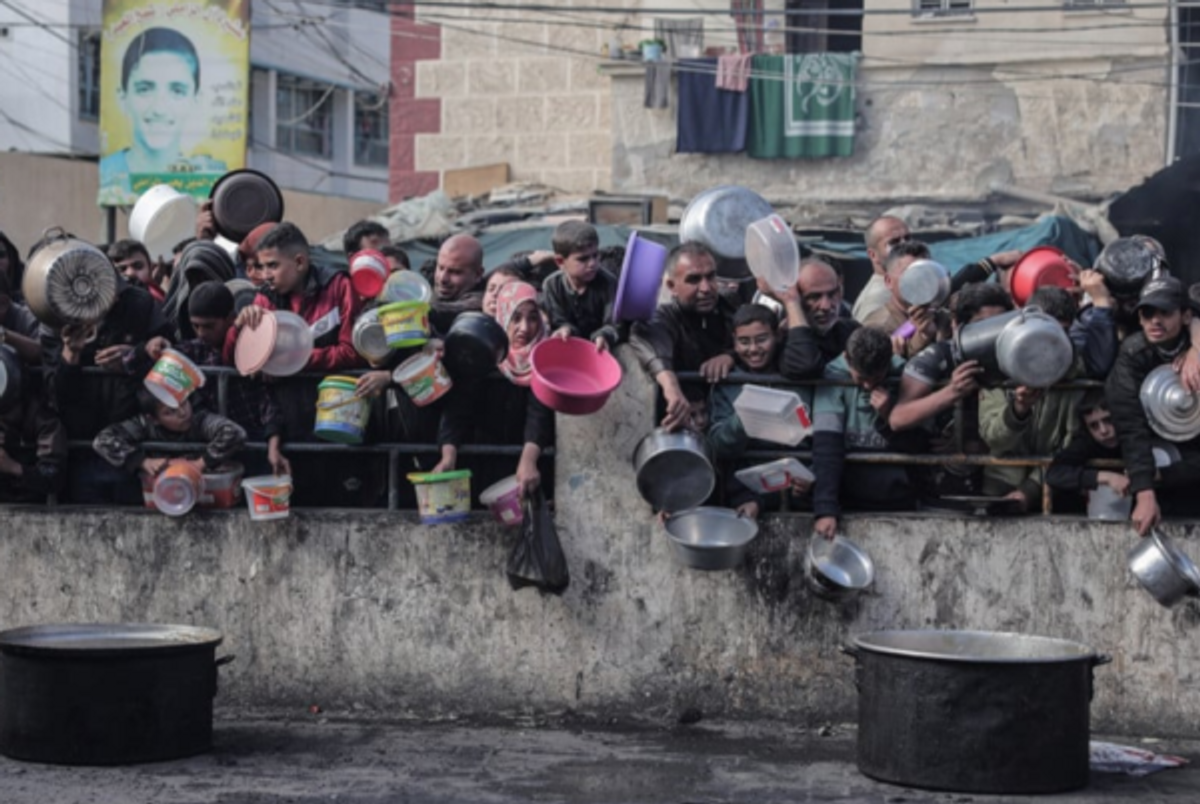
Other things “the most moral army in the world” has done: Fired on desperate, displaced people trying to bury their murdered relatives on hospital grounds or in any space they can find; dug up and vandalized graves in cemeteries, claiming to be looking for hostages; and with widespread famine imminent, fired on hundreds of starving civilians outside Gaza City who’d gathered to await U.N. trucks carrying food, killing and injuring a number of them. One father said he’d walked for 8 miles to find some food for his five hungry children; he survived, but didn’t get any flour. With the genocidal rhetoric of Israel leaders inexorably oozing down to soldiers on the ground, troops have also filmed themselves gleefully plundering houses, smashing toys and setting fire to humanitarian supplies meant for desperate Gazans – who receive such an obscenely miniscule fraction of what’s required to save lives that one UNICEF director likens the situation to “trying to drip assistance through a straw to meet an ocean of need.”
One UN official says Israel this month has blocked 18 of 21 deliveries of food, medicine, water and other supplies to Northern Gaza. Others say it’s turned back 22 of 29 aid convoys, denied access to 95% of fuel and medicine deliveries, and allowed in just 98 truckloads in three months vs. 500 trucks a day before Oct. 7. One expert warns Israel has so brutally used food, fuel and especially water as “weapons of war” that more Gazans could die of thirst and diseases from contaminated water than from military attacks, rendering Gaza, now more than ever, “the most dangerous place in the world to be a child.” Meanwhile, despite proof of their charges, Israel lies: “Find someone that loves you as much as Israel loves lying.” COGAT, the bureaucratic arm of the Occupation, insists there’s no limit to aid getting in, or any other problem. “There is no hunger in Gaza, and for sure the population is not being starved,” said “Col. A.” He helpfully added, “Don’t forget this is an Arab population whose DNA is to hoard, certainly when it comes to food.”
Racist Israeli leaders offer the same blind denial on a Palestinian state – “The blood of our sons was not spilled so a terrorist state would be established” – and Netanyahu has repeatedly doubled down on Israeli control “over the entire area west of Jordan,” aka “from the river to the sea.” His genocidal intransigence persists despite Biden’s sporadic, disingenuous “handwringing” about the devastation he somehow never acknowledges is wrought by billions in American arms; despite fiery Israeli protests – “Only Graveyards Will Be Named After Netanyahu”; despite analysis from even the Wall Street Journal that Israel has killed just 20-30% of Hamas’ fighters and will never destroy even most of their tunnels; despite global condemnation and a lawsuit at the Hague. Still, confoundingly, infuriatingly, the U.S State Department, which has twice bypassed Congress to facilitate the slaughter and plans to continue, declares, “Our supprt for Israel remains ironclad.” Oh grievous, bloody, complicit America. Wrong side of history, again.
And so we witness the awful, scorched-earth remains of “one of the most beautiful cities in the world,” of a resilient people who even after years in an open-air prison sought “hope for a life that is worth living,” but who now mourn, “There is nothing left here.” Except, of course, suffering and unending loss. “I don’t think people understand the human tragedy, the scope of it,” laments Dr. Yasser Khan, a Canadian eye surgeon who just returned from an eight-day humanitarian mission, organized by WHO and NGO Rahma Worldwide, at European Hospital in Khan Younis. For the last 18 years, Khan has worked in 40 countries around the world. Gaza, his first active war zone, yielded the worst devastation ever: Drones humming, bombs dropping, mass chaos, screams, “the most gruesome injuries imaginable” – skull fractures, burn injuries, multiple limbs missing, eyes gouged, “shrapnel faces” – in a deluged hospital full of children shaking, starving, bleeding, blinded, in shock, everywhere: “That’s what a war on civilians does.”
European Hospital once held 250; it now tries to tend over 2,000 critical patients, along with 20,000 displaced people camped on floors and in halls under impromptu plastic shelters. Exhausted doctors sleep when they can in on-call rooms, as did Khan; they have all lost families, friends, homes. They work amidst incessant blasts; they’ve learned to identify drones, tanks, missiles. Without beds, most patients lie on the floor, in pain, getting infected, with respiratory and GI illness rampant: “Everyone has that Gaza cough.” They arrive stunned, bloody, pulled from rubble, carried from explosions; doctors first focus on head injuries, missing limbs, other trauma damage. Khan saw many amputations – 15 on one day – usually without pain medication. Two teenage boys had massive injuries; doctors did an an above-groin amputation on one; both died, “but they tried.” A woman caught in a blast was burned, with both arms fractured; she had both legs amputated. She’d lost her husband and three children; when she died; Khan thought it “a mercy.”
After trauma cases, doctors turn to shrapnel faces – red dots with fragments of steel, wood, concrete from explosions that come too fast to cover the face – and, often, eyeballs. Skin can heal, notes Khan, but once a foreign object hits an eye, “it’s basically gone.” About 90% of those caught in blasts get eye injuries; Khan took out about 10 eyes – 6 in one day – all shattered by shrapnel. Many he removed from children – 2, 6, 11, 13, 16 years old – left blind or disfigured. The most difficult for him was a six-year-old girl, the same age as his daughter, named Aseel: “I saw this tiny soul sitting there…A piece of concrete shrapnel had lodged in her socket. I took the eye out…Her whole life has changed. What did she do to deserve that?” He also treated a two-year-old boy with cerebral palsy and no remaining family; he’d already had an eye removed, but the wound was infected. Above all, he says, “It’s a war on children. And Israeli forces know this – that when a bomb’s going to drop, children are going to die or get maimed or lose arms and legs and parents.”
In the face of “a dehumanization (of) historic proportions,” Khan says, Palestinians retain their humanity. At a hospital full of orphaned, injured, still-buoyant kids, adults who’ve lost everything vow to care for them like their own. Amidst the blood and chaos, depleted health care workers “treat each patient as the only patient, and do their best to save them, no matter how bad it is.” Khan, meanwhile, will never again look at numbers – like 200 dead a day – without thinking of “each individual who died in front of me.” And he agonizes over the fate of the many thousands “abandoned by the world, their whole civilzation destroyed…What will happen when this is over? It is unacceptable.” We thank Dr. Nozhat Choudry, cousin to Dr. Khan, for reaching out to share his story. And we thank them both for their grace and heart, for their unwillingness to follow a mandate to “give life for life, eye for eye.” “I pray for peace for both Israelis and Palestinians,” Choudry wrote at the end of his last missive. “God bless you, Nozhat.”
ZNetwork is funded solely through the generosity of its readers.
Donate