

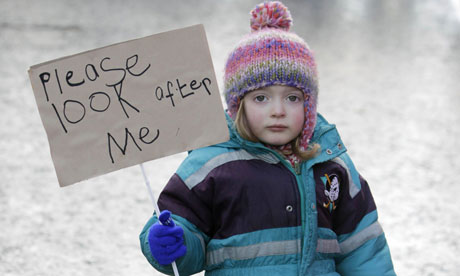
Sionnach Langan, aged three, was taken on the march
(Dublin, Nov. 27) — One of the largest demonstrations in the Irish Republic's history brought more than 100,000 people onto Dublin's streets yesterday in protest over the international bailout and four years of austerity ahead.
As European officials thrashed out the finer details of an €85bn rescue package that could be rubber-stamped by finance ministers as early as today, huge crowds braved freezing temperatures to gather in central Dublin to demonstrate against the cuts aimed at driving down Ireland's colossal national debt.
The main march to O'Connell Street passed off peacefully but there was an uneasy stand-off last night outside the Irish parliament as two lines of Garda Siochána officers hemmed in around 100 leftwing demonstrators who had broken away from the trades-unions organised protest. Fireworks were thrown at gardai who were guarding the gates of the Dail as the protesters shouted: "Burn it down, burn it down." Extra garda units were rushed to the scene yesterday evening to surround the ad hoc demonstration by an amalgam of leftwing and anarchist groups, who also set fire to a picture of the taoiseach, Brian Cowen.
Among those on the main march there was deep anger that most of the €80bn-plus from the EU and the International Monetary Fund will be used to shore up Ireland's ailing banks.
Builder Mick Wallace, who has had to lay off 100 of his workers due to the crash in the construction industry, said it was time the Irish became more militant. "We are far too quiet. We should be more like the French and get onto the streets more often. Because our politicians go over to Europe and tell the EU that our people do not demonstrate, they don't take to the streets. It's time we changed that and openly opposed what is going on," he said.
Jimmy Purdy, 77, from Dublin's Ringsend area, was at the demonstration outside Dublin's GPO – the scene of the 1916 Easter Rising. "I have lived through three recessions and I think this could be the worst one yet," he said. "I'm here because I'm angry that the EU are telling us to cut euros off the minimum wage and boss Irish workers around while the people that caused this crisis get off scot-free."
As the protesters took to the streets, sources said negotiators were keen to announce a rescue deal in time for the opening of financial markets on Monday.
Britain's share of the bailout is likely to be close to £10bn, although Whitehall insiders say the money will not add to the Treasury's budget deficit; instead a bilateral loan to Ireland will be treated as a "financial transaction", similar to an investment.
The chancellor of the exchequer, George Osborne, is expected to hold talks with his European counterparts today. The Irish government is likely to get a loan contingency of about €50bn and a further €35bn will be extended to support the country's ailing banks. "It will be a long-term facility offering the Irish the opportunity to draw down funds over a number of years," said a source close to the negotiations.
The money will be provided through a variety of routes. A chunk of it will be from the IMF, a further sum from a eurozone fund and from a Europe-wide stability mechanism, plus bilateral lines of credit offered by Britain and Sweden. But there were objections in Dublin at the prospect of a punitive interest rate. Ireland's RTE broadcaster reported that the country may have to pay a rate as high as 6.7% on some of the money, a price described as "very disturbing" by opposition finance spokesman Michael Noonan.
"This rate is far too high and is unaffordable on any reasonable projection of growth," Noonan told the Irish Independent. A diplomatic source told the Observer that the rate would be lower than 6.7%, but above the 5.2% paid by Greece for its €145bn bailout.
ZNetwork is funded solely through the generosity of its readers.
Donate

