
The diplomatic overture was dispatched to Hu Yaobang, chairman of the Chinese Communist party, on 29 October 1981. A near-identical letter was sent to the Kremlin, for the attention of Leonid Brezhnev, general secretary of the Communist party of the Soviet Union.
“Like an unconscious and uncontrollable force, our planet appears to be drifting toward self-destruction,” the newly installed socialist leader of somewhere called Burlington wrote. He urged them “in the strongest possible way” to disarm militarily and begin immediate negotiations with other world leaders.
Bernie Sanders, the ardently leftwing mayor of Vermont’s largest city, dispatched similar missives to Downing Street, the Élysée palace and the White House, before releasing a statement declaring: “Burlingtonians cannot calmly sit back and watch our planet be destroyed – with hundreds of millions of people incinerated.”
The correspondence, unearthed by the Guardian, confirms what has long been said of America’s longest-serving independent member of Congress who, at the age of 73, recently launched a bid for the Democratic nomination for president. Bernie Sanders is unafraid of punching above his weight.
Never has that been more the case than now. Six weeks into his campaign, Sanders has gained the kind of momentum few expected from the Vermont senator, establishing himself as the primary obstacle between Hillary Clinton and the Democratic ticket for the White House.
His national poll rating has more than doubled, to over 10%, in little over a month. His rallies in Iowa and New Hampshire have been attracting crowds larger than any other candidate, Democrat or Republican. Hard copies of his memoir – mostly a dry recitation of a 1996 congressional race – are suddenly selling for more than $250 on Amazon.
The race for the 2016 presidential nomination is in its infancy, and Clinton remains the clear frontrunner by a margin most political analysts believe is all but unassailable. But Sanders is changing the contours of the race: the rise of a hard-left politician, long battling to to be heard from the sidelines, is now the first unexpected twist in the Democratic primary contest.
The Guardian has spoken to close to a dozen of Sanders’ closest friends, family, confidants and operatives. They paint a picture of a politician who has spent a lifetime obsessed with the same issues that still drive him today, and is now wrestling with the demands of a 2016 presidential race.
For his part, Sanders suggested in an interview with the Guardian that some of his policies remain a work in progress, but rejected the notion that his surge in popularity should come as a surprise. “I am a United States senator, I did win my last election with 71% of the vote,” he said last week. “So it’s not just like someone just walked in off the street and suddenly they’re Hillary Clinton’s main challenger. We’ve been doing this for a few years.”
The unquenchable optimism of an electric young politician
Sanders was born in Brooklyn, New York, in 1941, into a family struggling to get by on the low wage of his father, a Polish immigrant and paint salesman. “That created tensions for our parents, and that was an important part of our life,” said the senator’s 80-year-old brother, Larry, who now lives in Oxford, England, where he recently stood as a parliamentary candidate for the Green party.
Larry Sanders recalled his brother’s first foray into politics, some time in the late 1950s, when he ran for election to be class president at James Madison high school. Sanders lost, but found consolation in defeat. “The student who won ended up adopting Bernie’s policy about raising money for Korean orphans,” Larry said.
The consensus in Washington is that the best Sanders can hope for is a similar outcome in 2016, using a campaign that will almost certainly end in defeat in order to pull Clinton to the left. The MIT academic Noam Chomsky, who was personally invited by Sanders to give a speech at Burlington city hall in 1985, gave a similar assessment.
“I am glad that he’s doing it,” Chomsky said, arguing that Sanders’ presidential campaign would promote ideas that are rarely part of mainstream political discourse. “But the chances of him winning at the primary, or even at the national level, are virtually nil in our system, which is not a democracy but a plutocracy.”
Sanders told the Guardian he was “not as pessimistic as Noam is”. “He’s right, we live in an increasingly oligarchic form of society, where billionaires are able to buy elections and candidates, and it is very difficult, not just for Bernie Sanders but for any candidate who represents working families,” the senator said. “But I think the situation is not totally hopeless, and I think we do have a shot to win this thing.”
That unquenchable optimism has always been a part of Sanders’ career, and was perhaps forged in the 1970s, the first major chapter of his political life. Working as a youth counsellor and carpenter, Sanders ran in four consecutive US senate and gubernatorial elections, representing Liberty Union, a socialist party born from the anti-Vietnam war protests.
He lost every election he stood in, never winning more than the 6% of votes he secured in a 1976 gubernatorial race. But these early campaigns gave Sanders an opportunity to advance his stridently progressive agenda.
One press release – from a Senate race he contested in 1974 – proposes a radical solution to rising energy prices. “Bernard Sanders, the Liberty Union candidate for the United States Senate, today called for the public takeover of all privately owned electric companies in Vermont,” it stated.
The press release discovered by the Guardian is annotated and could be a draft, and it goes on to describe the policy as a “dollar and cents” proposal rather than a forced appropriation of the means of producing energy. (Electricity in other municipalities in America was, at the time, administered by public bodies.)
But that was never the kind of policy likely to win a statewide election in Vermont in the 1970s, which was still in a process of transitioning from a Republican-leaning state to the liberal haven it has become today.
Around 1976, Sanders left Liberty Union and spent a couple of years as an amateur historian and film-maker, selling educational film strips to schools across New England. His main project was a short documentary about his hero, Eugene Debs, an early 20th-century union leader who was a six-time presidential candidate for the Socialist party. (Sanders remains fascinated with historical figures and, sources close to the senator confirm, on the rare occasions he is not working, the senator spends hours on YouTube watching political documentaries and biopics.)
But that interest in the history of politics has rarely crossed over into theory. Then as now, according to friends, Sanders had a secret disdain for what he believed were doctrinaire academics who failed to ground their ideas in the real world.
Huck Gutman, the senator’s longtime friend – and, until 2012, his chief of staff – recently tried to persuade Sanders to engage with the work of Thomas Piketty, the French economist whose research into wealth inequality has received widespread acclaim. Sanders rolled his eyes and replied: “I got 30 seconds.”
Three 70-something Vermonters walk into a park
Given his aversion to intellectuals, it is ironic that two of the senator’s best friends are leftwing academics at the University of Vermont.
One is Gutman, 71, an English professor. The other is Richard Sugarman, 70, who teaches Jewish philosophy and existentialism. Two Sundays ago, the trio was on a picnic bench in Burlington’s Ethan Allen park, reflecting on the hectic turn of events.
The previous day Sanders had been in Keene, New Hampshire. Like every other event the senator has attended since announcing his campaign, the town hall was packed.
Sanders spoke for an hour, railing against growing economic inequality, the corporate media, millionaires and billionaires, global warming, Barack Obama’s Pacific trade deal and the Iraq war. The Vermont senator promised equal pay for women, tuition-free colleges and universities, an equitable tax system, the right to healthcare for all, an expansion of social security for the elderly, and tough action against Wall Street banks.
Those lucky enough to have a seat spent much of the hour on their feet, in wave after wave of standing ovation, as Sanders laid out his platform in his trademark Brooklyn twang; sober, exasperated, always impassioned.
“The best president in the history of the world – somebody courageous, smart, bold – that person will not be able to address the major crises that we face unless there is a mass political movement, unless there’s a political revolution in this country,” Sanders told his approving audience of more than 700 people.
The next day, on the picnic bench, Sanders was upbeat as he regaled his friends with a rundown of the event.
“It was busy in Keene,” Sanders told the professors, according to Sugarman’s account of the conversation. “You wouldn’t believe how many people showed up.”
“OK, good. Did they seem sympathetic?” Sugarman asked.
“Yeah, they seemed to get it,” Sanders said. “They really seemed to get what was going on.”
Not far from the park, Sanders’ presidential campaign team was in the process of working out how best to tap into that surge of energy.
Money is pouring into the campaign coffers – in the first 24 hours after his campaign launch, Sanders raised $1.5m. The funds mostly came from small-money donors, but he still raised more than any other presidential candidate who has disclosed their first-day tally.
The donations have allowed the campaign to scale up in New Hampshire and Iowa, where Sanders opened an office this past weekend. The campaign has hired Revolution Messaging, the digital and social media firm that provided groundbreaking support to Barack Obama presidential campaign in 2008.
But the operation remains a fraction of the team hired by Clinton; one senior aide described the process of building a large campaign apparatus as “a very big challenge and one we’re still working out”. The top operatives on the Sanders team are – with one exception – Vermont old-timers who have been at the senator’s side for most of his career.
The senator is anxious about expanding too quickly, and is reluctant to hire the many Washington-based political consultancies that have been knocking on his door. “He has concerns that as you run for president, everybody who is president wants business from you and dollars from you,” Gutman said. “Both Richard and I said he should depend on his own good sense.”
But winning election in the tiny state of Vermont is not the same as a nationwide presidential race. One of Sanders’ campaign operatives, talking on the condition of anonymity, spoke of the moral incentive for a “50-state strategy”, spreading resources more equitably across the country. Another acknowledges the difficulty of managing the boon in grassroots support, suggesting that Sanders supporters may need to be left to their own devices and “self-organise, organically”.
Even Sanders, a disciplined politician who rarely deviates from his script, can give the impression he is still working out the finer points of the campaign.
Asked how he would transition the country from the Affordable Care Act, toward the universal, single-payer system he prefers for healthcare, Sanders seemed unsure. “That’s a good question,” he told the Guardian. “I can’t give you a definitive answer.” He added that he envisaged a system “kind of modelled on what the Canadians are doing”.
Pressed on his taxation policy, Sanders said he would “absolutely” make the income tax system more progressive, but declined to say precisely how much top-rate earners should pay on their income. “I don’t want to develop policy off the top of my head,” he said, pointing to the extensive work he had already done on legislation to close tax loopholes for corporations and tax Wall Street stock transfers. “We will come up with a progressive individual tax rate as well.”
It is hardly uncommon for presidential candidates to avoid taking detailed policy stances early on in their campaigns, although their hand can often be forced by rivals. On the picnic bench with Gutman and Sugarman, the senator discussed one of the more peculiar issues on which he may be asked take a stand: Rhode Island’s governor, Lincoln Chafee, was ridiculed earlier this month when he launched his campaign for the Democratic nomination with a pledge to transition America toward the metric system of measurement.
Both Gutman said Sugarman said they talked to the senator about whether he too should adopt the policy.
“No, absolutely not,” Sugarman said he told the senator. “Fight it. That will be our conservative, traditional, issue. You have got to have a few dialectical issues or you really are going to be a liberal moron.”
Michael Briggs, Sanders’ campaign spokesman, insisted the senator had “no recollection” of any discussion about the metric system.
‘It wasn’t Trotsky. It was Bernie’
It was Sugarman who, in 1981, persuaded Sanders to run for mayor of Burlington, the rural city 40 miles from the Canadian border where the pair were roommates.
Running as an independent, Sanders ended up winning the election by just 10 votes, dislodging the incumbent Democratic mayor in a victory that made national news.
Sanders was the only mayor in the entire country who was neither a Democrat nor a Republican, and one of the few self-described socialists to gain public office. Burlington’s political establishment was aghast. “It was like Trotsky had been elected mayor,” Sugarman recalled. “But it wasn’t Trotsky. It was Bernie.”
Sanders was re-elected mayor three times, laying the foundations for the statewide election that made him Vermont’s only congressman in 1990.
It has often been said that Sanders’ eight years in city hall, redeveloping Burlington’s waterfront and spurring a civic initiative to clear snow from the streets, turned him into a pragmatist attuned the needs of everyday people. But that is only half the story.
The University of Vermont’s library has a collection of archived papers from Sanders’ mayoral years. The documents, which include notes scribbled on the yellow legal pads that he still uses today, are contained in 50 boxes that, remarkably, have not been inspected since the senator announced his candidacy for president.
The files confirm how Sanders spent much of his time as would be expected of a small-city mayor, solving a garbage disposal problem, building a bike path and securing a minor league baseball team for Burlington. But they also reveal a concerted effort by Sanders to leverage his modest power base to affect change in places far away from Vermont.
The letters he sent to the Soviet Union, China, the UK and France, urging military disarmament in conjunction with the UN’s international disarmament week, was just one example of dozens of diplomatic initiatives from Sanders, who used his perch at city hall to influence issues as diverse as apartheid in South Africa and the US invasion of Grenada.
In July 1981, the UK’s prime minister, Margaret Thatcher, was informed that Burlington was “deeply disturbed” by what Sanders said was her government’s abuse, humiliation and mistreatment of prisoners in northern Ireland. And when François Mitterrand announced a visit to the US later that year, Sanders wrote to the French president’s wife, Danielle, inviting her to his “struggling socialist municipal government” in Vermont to speak on any topic of her choosing.
President Ronald Reagan was the recipient of several Sanders letters relating to international affairs, most of which concerned Nicaragua, where the US was covertly funding a guerrilla war against the leftwing Sandinista government. In 1985, Sanders actually travelled to Nicaragua, for the sixth anniversary of the Sandinista revolution, and met the country’s president, Daniel Ortega.
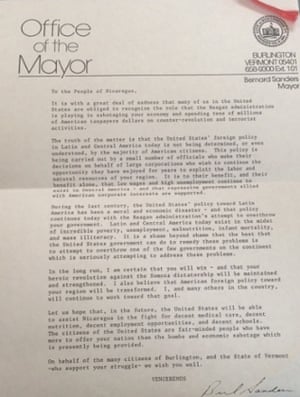
In a letter addressed to the people of Nicaragua, penned in conjunction with that trip, Sanders denounced the activities of the Reagan administration, which he said was under the influence of large corporations. Burlington’s mayor assured the Nicaraguan people that Americans “are fair minded people” who had more to offer “than the bombs and economic sabotage”.
“In the long run, I am certain that you will win,” Sanders wrote, “and that your heroic revolution against the Somoza dictatorship will be maintained and strengthened.” Sanders was the highest-ranking American official to visit Nicaragua at that time, and returned to the US intent, it seems, on acting as emissary between the two countries.
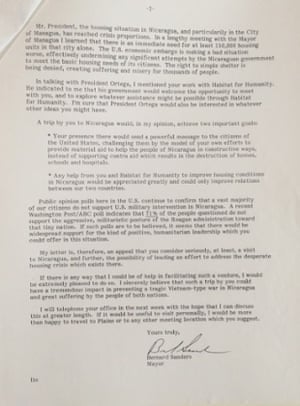
In a letter to the White House, Sanders relayed that Ortega was willing to meet with Reagan “at any time or any place” to resolve the conflict. He also sought to enlist the help of the Democratic former president Jimmy Carter, telling him in a letter that he was highly thought of in Nicaragua. Sanders even invited Ortega to Burlington; the Nicaraguan leader politely declined.
The mayor’s international expedition was hailed by leftwingers across the country, and cemented Burlington’s reputation as a magnet for anti-establishment types. Chomsky was one of a long line of liberal thinkers, musicians and artists who flocked to the mountain city.
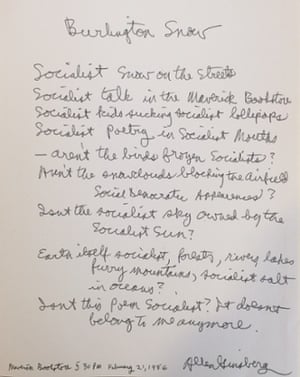
Another was Allen Ginsberg, who visited Burlington in February 1986; a handwritten and signed poem composed by the beatnik writer is also contained in Sanders’ mayoral archives. (Entitled Burlington Snow, it begins with lines about “Socialist snow on the streets” and “Socialist kids sucking socialist lollipops”, and ends: “Isn’t this poem socialist? It doesn’t belong to me anymore.”)
Not everyone in Burlington appreciated the town’s transition, under the supervision of a travelling, socialist mayor, into a people’s republic. The WMNY-TV station put out an editorial that decried the mayor’s “vacation” in Nicaragua as “absolutely shameful”.
Sanders told the Guardian that he still stands by the international approach he took in Burlington, which was summed up in the mantra “think globally, act locally”. “What you want to do is use your capabilities, whether you’re a mayor, governor, senator or president – whatever it is – to make this world a better place,” he said. “During my time as mayor, the United States was involved in the support of the contras in Nicaragua, something that I thought was part of the long-term Latin America policy in support of rightwing oligarchies and against the needs of the poor people of the continent.”
Burlington’s solidarity with the Sandinistas was cemented the year before the mayor’s trip, when it formed a sister city relationship with the Nicaraguan coastal town of Puerto Cabezas.
When Sanders was mayor, Burlington formed an alliance with another city – in the Soviet Union. When Sanders traveled to Yaroslavl, 160 miles north-east of Moscow, in 1988, the trip doubled as a honeymoon with his new wife, Jane. Not much survived in terms of paperwork from that trip, although the mayoral archives do contain a tape recording of Sanders interviewing Yaroslavl’s mayor on a boat somewhere on the Volga river.
After receiving a rundown of central planning, Soviet-style, from Yaroslavl’s mayor, Alexander Riabkov, Sanders notes how the quality of both housing and healthcare in America appeared to be “significantly better” than in the communist state. “However,” he added, “the cost of both services is much, much, higher in the United States.”
The ‘one percent’ – 20 years ago
Burlington was by no means the only American city to develop cultural and education exchanges in the Soviet Union as the cold war drew to a close. But Sanders’ broader embrace of international politics during his mayoral years was by his own admission unique, standing him apart from local elected officials elsewhere in the country.
He even visited Cuba – a highly unusual journey for any American in the 80s – hoping to meet with Fidel Castro. The encounter did not take place, although he did meet Havana’s mayor at the time.
“A number of cities have nice waterfronts, good streets, honest police departments, and even minor league baseball,” Sanders wrote in his memoir. “But how many cities of 10,000 have foreign policy? Well, we did.”
Today it is rare to find Sanders talk about the plight of people overseas. That, friends say, is perhaps the most significant change he has witnessed in the senator’s political career, as he has become less interested in international affairs.
Sanders has gradually taken a less keen interest in foreign policy; his politics have become more parochial, focused on the needs of everyday Americans. Gutman described the senator’s evolution as becoming more aligned with the bread-and-butter interests of voters. “The way to succeed in politics is not to be excessively concerned about the people far away,” he said.
Foreign policy barely got a mention in his presidential announcement speech in Burlington at the end of April, except for a reference to the senator’s opposition to “an endless war in the Middle East”. Sugarman said he recently discussed with Sanders the idea of making his campaign’s foreign policy “an extension of his economic policy”.
On the domestic front, in contrast, Sanders has remained resolute through four decades of political campaigning, sticking to the issues that underpinned his mayoral years. The central thrust of Sanders’ message – about economic inequality and the corruption of political power – has never really changed.
Take almost any excerpt from his announcement address, and the thread can be traced back in time, often to a speech or article that is decades old but adopts the very same language.
He was comparing soaring corporate profits and the accumulation of wealth at the top with a decline in real terms wages of average workers in 1974, as a Liberty Union candidate for the US senate. He attacked “giant banks and multimillion-dollar corporations” in his inauguration speech in Burlington in 1981.
Sanders first started speaking about the richest “one percent” – language now synonymous with the Occupy movement, since co-opted by mainstream politicians – as far back as 1996.
Asked on C-Span in 1988 what the socialist mayor of Burlington would like to see from the next president, Sanders replied that the ideal candidate would “recognise that we have an extreme disparity between rich and poor, that elections are bought and sold”. Those issues are the pillars of his bid for the White House in 2016.
Anguish, a choice, and a breakthrough at long last
So committed is Sanders to his beliefs about economic injustice that it almost convinced him not to stand for president.
In the months during which he was contemplating his run for the White House, Sanders reflected on the careers of other progressive politicians, past and present.
Despite a highly successful career defined outside the Democratic party, Sanders never contemplated following Ralph Nader’s example and running for president as an independent. Sanders was adamant he did not want to be a “spoiler”, sapping votes from whoever the Democratic presidential candidate is, in much the same way Nader did to Al Gore in 2000.
Another politician on his mind was Elizabeth Warren, the populist Massachusetts senator who was under intense pressure from the progressive wing of the Democratic party to mount a challenge against Clinton. Sanders’ friends remain divided over whether he would have run if Warren had decided to be a candidate. Sugarman suggested his friend would not have entered the race, saying that had Warren run, she would have saved the Vermont senator “a lot of anguish”.
“People needed to feel as though they had a choice,” Sugarman said, explaining his friend’s thinking. “He felt these issues had to come to the fore.”
Yet even then, there was a third politician Sanders had in mind when he was considering whether to run. “He didn’t want to be Chris Dodd,” Gutman said, referring to the Connecticut senator who came last in the 2008 Democratic primary contest.
Sanders was not worried about what an embarrassing defeat would mean for him personally – his concern, friends say, was the damage such a defeat could inflict on the cause of economic justice in America.
“What he was saying over and over again was that he had a responsibility to the ideas that he represents,” his brother Larry said. “If he went in and he was badly beaten and humiliated, he could take it. But it would be a setback to those ideas, and the people who need those ideas.”
That fear, so far at least, appears to have been unfounded. In just the latest example of his rising standing among Democrats, a Suffolk University poll released on Tuesday showed the Vermont senator receiving 31% of support among New Hampshire primary voters – just 10 points behind Clinton.
It is a stunning endorsement of Sanders, who has been beating the same drum, mostly in vain, for close to half a century. Now, in the twilight of his career – and very possibly at its pinnacle – the reverberations are starting to be heard.
“Sadly enough, I suppose, the world has caught up with what I have been saying for many years,” the senator told the Guardian, adding that he was, perhaps, “a bit ahead of his time”.
“People are now saying, wait a minute, this is absurd, this is unsustainable, this is a rigged economy,” Sanders said. “And people are now demanding change.”
ZNetwork is funded solely through the generosity of its readers.
Donate

