
After centuries of suppression, Indigenous languages have made a comeback in the United States and in Ireland. Chronicling this success are a new book, Irish writer Manchán Magan’s Thirty-Two Words for Field: Lost Words of the Irish Landscape (Chelsea Green Publishing, 2026), and a new video project from the Native American Rights Fund (NARF), a Native-run nonprofit law firm.
Magan, who died in October 2025, explored Gaelic’s 3,000-year-old lexicon and its connection to the natural world, such as its 32 words for a tract of open land. The NARF videos will examine Native languages and their relevance to peacemaking, or traditional Indigenous dispute resolution.
A statue in County Cork, Ireland, commemorating what Ireland calls “a sacred bond”—the Choctaw gift to Ireland in 1847 to help Irish people during the Great Famine there. Tribal members took up a collection, raising $170, just a few years after the Trail of Tears, when they were force-marched from their southeastern-U.S. homeland to Indian Territory, now Oklahoma, causing many deaths. (Choctaw Nation)
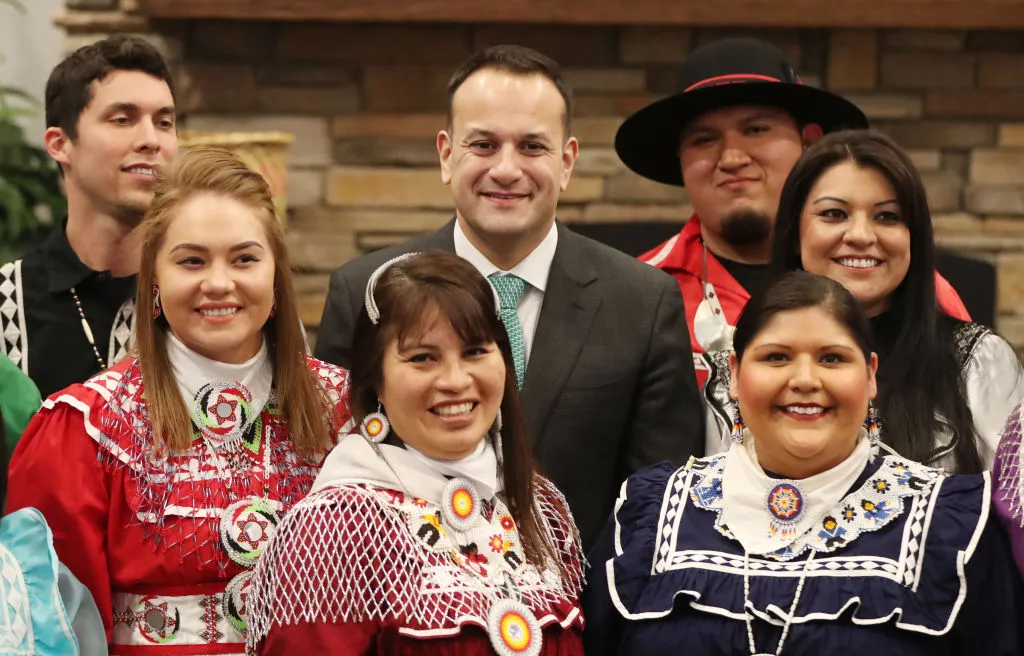
The timing is auspicious, and a comparison is revealing. “A sacred bond which has joined our peoples together for all time” is how an Irish taoiseach, or prime minister, characterized the Irish–Native American connection during a visit to the Choctaw Nation in 2018. The bond arose in 1847, at the height of Ireland’s Great Famine, when the Choctaws learned of the Irish plight.
Potatoes, a centerpiece of the Irish diet, had become afflicted with a blight and were inedible. The blight was arguably exacerbated by the aggressive, financially driven land management and ineffective relief policies of the British government, the colonial rulers of Ireland. These factors caused some million people to starve to death and forced the migration of millions more.
Choctaw survivors of the Trail of Tears, when thousands of tribal members died on a forced march from their southeastern-U.S. homeland to Oklahoma, took up a collection. They sent to Ireland a $170 donation—worth tens of thousands of dollars today, according to the BBC.
The Irish have commemorated the Choctaws’ gift with a splendid statue, scholarships for Choctaws to study in Ireland and Covid-era relief for other tribes.
NARF senior staff attorney Brett Lee Shelton of the Oceti Sakowin Oyate (Oglala Sioux Tribe) says that in his language, Lakota, the Choctaws’ action can be described with a word that means literally “taking them into their hearts.” The Irish understood, and still understand, that the Choctaws took the Irish into their hearts. That’s why the relationship is sacred, Shelton says.
Shelton is supervising NARF’s new peacemaking video project, which will present speakers of traditional languages from several tribes in panel discussions convened in California on the homeland of the Tule River Tribe. During the discussions, Shelton says, the participants can be seen describing what advice and inspiration their languages offer peacemaking. They express the many ways in which Indigenous languages contribute to it, including their focus on kindness and inclusiveness and their constant reiteration of belonging—to each other, to the land and to all of creation. The discussions have been videotaped; editing is ongoing and will result in two videos.
Peacemaking is a traditional Native activity by means of which Indigenous people seek to resolve a dispute. A group gathers and discusses ways to gently, collaboratively and effectively heal transgressor, victim and community. When members of the group speak their Native language, it supports the relationships among them, according to Shelton. It gives them a sense of security and helps them come to a communal decision based on respect and understanding.
The speakers who appear in the Tule River panel discussions presented in the NARF videos told Shelton that using their heritage language on a regular basis, not just during peacemaking sessions that arose on their reservations, led them to find peace in their own lives.
For existing NARF videos on peacemaking-related topics go here for the descriptive and heartfelt Peacemaking in Practice and here for Pokagon Band of Potawatomi and their lived experience of cultural revival and peacemaking’s place in it.
Crushing the Irish language
Destroying the local language was central to England’s conquest of Ireland, undertaken in the 12th century and completed in the 17th. The English didn’t just scoop up land and resources and starve and kill the Irish. The Irish language, also called Gaelic, was forbidden in schools, courts, commerce and public life.
The ban, wrote Magan, damaged what he calls a “profound and sacred unity between people, the natural world and the cosmos.” This distanced the Irish people from the meaning and magic of ancient lifeways and replaced them with “the exploitation of people and landscape to maximize profits for the elite.”
“Ultimately, what old languages communicate most clearly,” Magan wrote in Thirty-Two Words for Field, “is that we are far more than biddable drones or clones to be sold things to: we are independent beings with our own dreams, motivations and power.”
According to Magan, the Irish language encodes “the accumulated knowledge of a people who have been living sustainably on these rocky, verdant Atlantic islands for millennia. As a result, it is profoundly ecological, with an innately indigenous understanding that prioritizes nature and the land above all things.”
In an example related to the title of his book, he told us that the Irish words for “field” include geamhar, a field of corn-grass; tuar, a field for cattle at night; reidhlean, a field for games or dancing; and cathairin, a field with a fairy-dwelling in it.
“These are not linguistic curiosities,” he wrote. “They are remnants of a culture rooted in reciprocity—with land, ancestors and the unseen.” Magan called Thirty-Two Words for Field a “revelry”—a joyous celebration of the linguistic legacy that Irish speakers fought to keep alive for centuries. His own passionate fight included best-selling books, an acclaimed television series and documentary films, including one in which he traveled Ireland striving to speak only Gaelic.
Across the Atlantic
In recent centuries, as the United States invaded and occupied what is now its portion of the North American continent, eliminating the Indigenous people it encountered was paramount. Destroying their languages became a critical technique.
The subjugation of the continent was expensive. Carl Schurz, a Union Army general who was Interior Department secretary from 1877 to 1881, calculated that warring against the tribes was costing the federal government $1 million for each dead tribal member. However, Schurz estimated, shaping an Indigenous child to white norms in off-reservation boarding schools would set back the government just $1,200 per child per year, cheaply and effectively demolishing their tribal identity.
“We must either butcher them or civilize them,” declared an expert of the time.
To achieve this, speaking tribal languages was forbidden at the notoriously abusive schools that Indigenous children were forced to attend from the late 1800s until the late 1970s. Heritage languages were literally pummeled out of them. Many did not survive the vicious beatings, crowded conditions, minimal food, epidemics, lack of medical care and sexual abuse. Incomplete and lost records mean no one knows how many Indigenous students died in the schools and what happened to babies borne by girls who were repeatedly raped and impregnated.
If Indigenous parents refused to relinquish their children to the typically distant schools, the federal government might withhold the food, health care and other goods and services the treaties had guaranteed the tribes in return for ceding land. Or, the children might be rounded up, as a witness on the Navajo reservation observed: “The children are caught, often roped like cattle, and taken away from their parents, many times never to return.” The 1922 Congressional Record described this process in blunt language as the “collection and transportation, and so forth, of pupils.”
“I was always trying to escape,” a former student recalled to this writer. “We all did. We weren’t trying to get home because we didn’t know where that was. We were completely disoriented. We just took off and took our chances in the world, hitchhiking down the road. Then they’d find us and bring us back.”
Language restoration
Natives have always recognized the importance of language to their cultures, Shelton says. “Even while the boarding schools were eroding languages, there were efforts to keep the languages alive.” As opposition to Indigenous languages faded in the dominant world, these were among the first things tribes worked to recover, according to Shelton.
In the 1970s, when the federal government moved management of the schools to the tribes, they immediately began teaching children about their languages, he says. In 1990, the Native American Languages Act established federal policy encouraging schools’ use of heritage languages to educate Native children. Over the years, additional laws further supported the health of Indigenous languages.
“Language is bigger than you or me,” says Anahkwet, a community organizer and traditional-language advocate of the Menominee Indian Tribe of Wisconsin, of which he is an enrolled member. He founded Menikanaehkem, a local group that encourages the use of heritage language during many activities in order to foster what Anahkwet identifies as identity, hope, belonging and purpose and the physical and mental health that result. These activities may include gardening classes, plant identification walks, maple syrup gathering, lacrosse and other traditional games, feasts that involve prayer and storytelling, blessings of group meetings and more.
At the beginning of Anahkwet’s language-advocacy work, he wanted to understand what it means when a heritage language is gone. He worried that during his lifetime he’d watch the death of his language in real time.
But, he says, “As I’ve grown in my life and work, I’ve started to understand that before the language, there were the ways. I find comfort in that, and in the fact that our language is tied to our land.”
Speaking in Menominee, he gives the example of a musically lilting word that means “a hilly place.” “When you close your eyes and listen to the word spoken, you know what it’s describing,” he says. “To me, Menominee is a language that is of this land, this place. It exists here. It’s not abstract. It lives.” He describes the language as given to them out of love by the Creator. “It’ll always be here … accessible to those who are looking for it.”
Indigenous languages arise from tribal peoples’ homelands, concurs Shelton. As such, they embrace not just humans but other beings as well. Most tribes can communicate with animal relatives, or have oral histories recounting this, he says.
For example, according to Lakotas, says Shelton, meadowlarks speak their language. “When they come in the spring, it’s the start of the new year.” He speaks in Lakota, then translates, “What that means is, ‘Be happy, it’s a new year, I’m here.’ ”
Indigenous language schools and classes
There’s much attention to heritage language at Menominee, including a language-immersion school and a language-revitalization organization called Menomini yoU. “There are lots of opportunities for people to hear it, be around it, live it,” Anahkwet says.
Additional tribes around the country have language classes and programs within regular schools as well as full-fledged language-immersion schools, according to Shelton. These include a Cherokee school that appeared in Barn Raiser earlier this year.
In September 2026, the Choctaw Nation announced a traditional-language app, available online. “Engage in immersive language through fun, meaningful and interactive lessons and videos that feature Choctaw elders and community members speaking authentic language and experiencing Choctaw culture,” says the tribe’s message about the app.
“Preserving our language is one of the most important ways we can honor our ancestors and strengthen our future,” Choctaw chief Gary Batton said during the message. For more on Indigenous language programs nationwide, see First Nations Development Institute’s Native Language Immersion Initiative with publications, programs and grantmaking in support of Native languages.
The Menominee endeavors come with quiet guidance, according to Anahkwet. “We can’t speak our language and live someone else’s … We have to live [ours] and its values.” These include the ways the Menominee language continually maintains positive relationships. “The roots of our language include respect, understanding, gentleness and connection,” he says.
Anahkwet reflects on the Menominee word often translated as “grandmother.” To a Menominee speaker, the English word makes her seem unconnected, floating in space. In contrast, he says, “The Menominee word means literally ‘the one who keeps us together.’ The understanding is that this being is the glue that binds us.”
Examining additional common mistranslations reveals the Menominee language’s reverberant complexity. The word usually rendered as “bear” means not just the animal but “the original being,” according to Anahkwet. “It refers to our creation story, when that first bear came out of the earth and turned into a Menominee. If you teach the Menominee word as meaning just ‘bear,’ you miss out on a much larger understanding.”
In another example, the Menominee word translated as “religion” should really be known as “the way of the heart,” he says. He calls English a “pitiful” language, unable to express not just complex ideas but even simple ones that Menominee can handle easily.
Whispers of the past
Harkening back to the Irish language, we find that the word sanasaíocht offers an example of what modern English has lost. The term derives from sanas, meaning a whisper, a suggestion, a secret or occult knowledge.
Today’s English speakers ordinarily translate sanasaíocht as “etymology,” an academic study of words’ origin and evolution. In doing so, they miss the English word’s own enchanting etymology. Its very first meaning was based on the idea of unwrapping a word “to find the message the namegivers have placed inside,” according to Rachel Barney, in the series of volumes, Oxford Studies in Ancient Philosophy.
When Native people explain what one of their words really means—perhaps one translated inadequately as “grandmother” or “bear” or “religion”—they’re unwrapping it for its inner message, says Shelton. “That’s what Native speakers do when they unpack tribal words for us. They unwrap the intended meanings. It has to do with relationships to the rest of the world and between things, and natural law. All the instructions are in there.”
In Thirty-Two Words for Field, Magan lauded Gaelic’s complex and detailed descriptions of the natural world, saying that its vocabulary reminds us “of just how wide, deep and nuanced our forebears’ understanding of the world was.” Even in today’s Ireland, “there are people united to the Sun, to the stars, to the seasons and to the trees,” Magan said in an interview published in the Irish journal Meon just before his death last year. The article notes that he passed at the beginning of the traditional time known as Samhain, when the threshold between this world and the next is thinnest.
“Every word [in Irish] rings out with the notion that we are creators connected to a panoply of gods and beings that may exist between the rocks, beneath the seas and inside the trees,” Magan wrote at the end of Thirty-Two Words for Field. His intention, he said, was not to despair of the fate of the Irish language but to summon forth a “rambunctious celebration” of it and its layers of wisdom and insight.
Anakwet is sanguine about the future of the Menominee language, saying: “This language is alive, it has a spirit. We can’t stop it. It’ll always be in us. Take one step toward it, and it’ll step toward you. It’s a connection that can never be broken. Take heed of that when the days are tough, and the times look bleak.”

Stephanie Woodard is an award-winning reporter who covers human rights and the rights of nature. She is the author of American Apartheid: The Native American Struggle for Self-Determination and Inclusion.
ZNetwork is funded solely through the generosity of its readers.
Donate

