
In 2006, Hugo Soto-Martinez was just weeks away from becoming the first member of his family to graduate from college when something happened that changed the course of his life.
Soto-Martinez grew up in South Los Angeles as the son of two immigrant parents who worked as street vendors. When Soto-Martinez was sixteen, his father hurt his back and became unable to work, forcing Soto-Martinez to drop out of high school and get a job at a hotel in downtown Los Angeles to help support his family.
Soto-Martinez kept the hotel job for years. He worked shifts as a food runner as he made his way through high school and then college, after which he planned to attend law school. But by 2006, things at the hotel had taken a turn for the worse. Working conditions had quickly deteriorated under new management, and eventually one of Soto-Martinez’s colleagues asked him if he wanted to try to unionize the place. He did.
“When we went to the boss and said we wanted a union . . . and then we won, the confidence, the knowledge, the strategies that I gained from that very short experience — that was a rebirth in that moment,” Soto-Martinez said. “I was a new person. I saw the world differently.” Suddenly law school was no longer in the cards.
“My mom was pissed,” Soto-Martinez said. “I was prepping for the LSAT exam, the classes that people take, and I was like, ‘I’m going to be a lawyer.’ And then all of the sudden, I was like, ‘I’m going to be a union organizer.’ She was not very happy.” But Soto-Martinez wasn’t looking back.
Now, nearly two decades later, others in Los Angeles are having similar experiences of awakening in the resurgent local labor movement. The movement is building knowledge from strike to strike and campaign to campaign — learning what is required, and what it feels like, to take on and win big fights. In the process, it’s creating new leaders like Soto-Martinez, who is a member of the Los Angeles City Council as of late last year.
Movement Knowledge
Last winter United Auto Workers (UAW) 2865, the academic student employee union representing workers in the massive University of California system, walked out of classrooms in the largest higher education strike in American history.
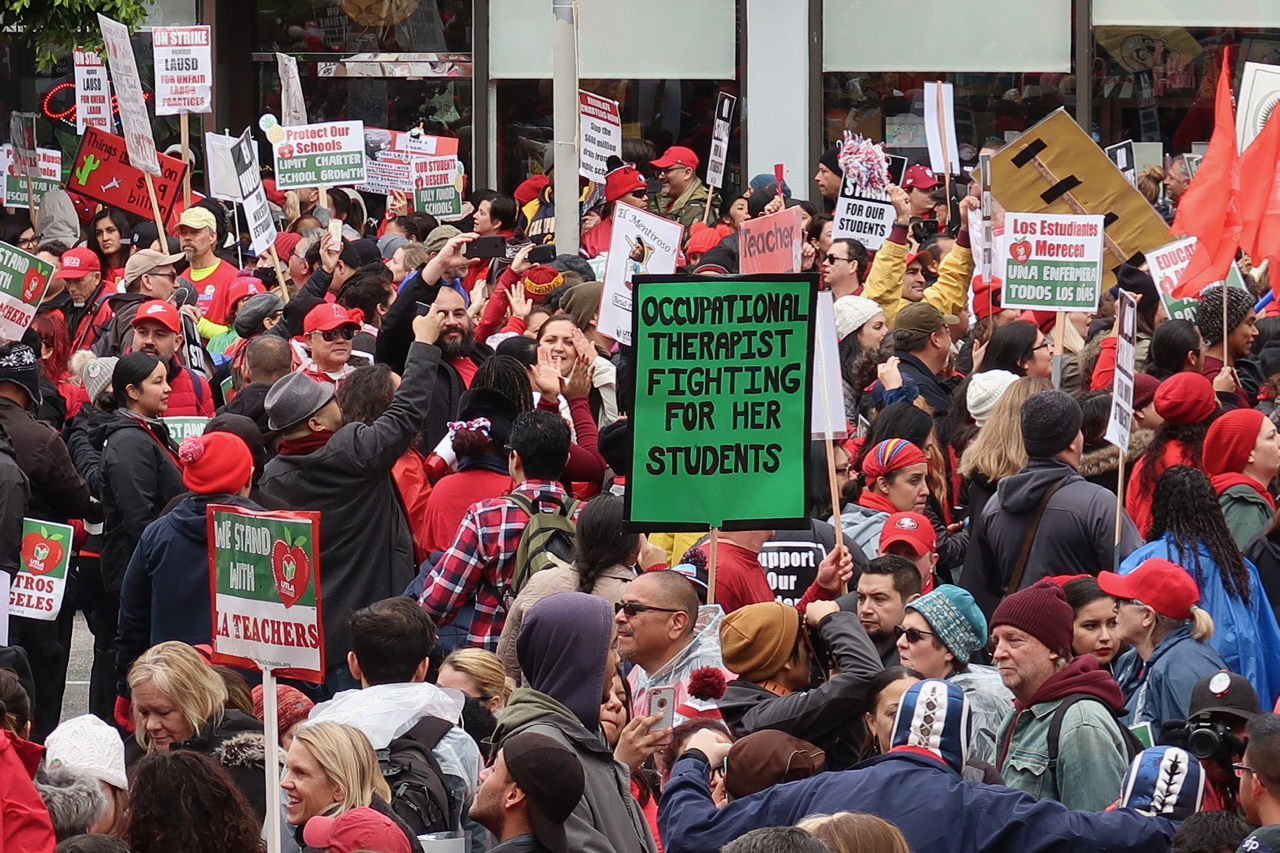
Several Los Angeles–based members of the union said they were inspired to strike when over thirty thousand teachers represented by United Teachers of Los Angeles (UTLA) went on strike in January of 2019. During the teachers’ strike, members of UCLA graduate student Michael Dean’s UAW local adopted a nearby school, Clover Avenue Elementary in West Los Angeles, where they delivered food, water, and ponchos. They also walked the picket line with the teachers and showed up to rallies.
“It showed you what could happen when you took the time to build a really broad and strong structure in your union that was rooted in mass action and one-to-one organizing,” Dean told Jacobin. “You could get fifty thousand people into the streets of downtown Los Angeles, and you could get Mayor [Eric] Garcetti to force the superintendent to give into the union’s core demands.”
Three years later, UAW graduate workers won 50 percent base pay raises and a host of other contract improvements after a five-week strike.
Unions for Housing
One of the items that UAW workers did not win, at least directly, was extra money to help offset the cost of exorbitant rent in California cities — the foundation of a housing crisis that has become the state’s most animating political issue.
“When we’re in a membership meeting and we talk about housing, it might be the most boring meeting ever, but you mention housing, people come alive,” said Kurt Petersen, the copresident of Soto-Martinez’s union UNITE HERE Local 11. “Because everyone is struggling with it.”
That includes the California Democratic establishment, which has thus far been unable to get its arms around the extent of the crisis. Governor Gavin Newsom has signed legislation limiting rent hikes and making it easier to build duplexes and fourplexes, but his administration has fallen dramatically short of his goal of building 3.5 million units of new housing. Meanwhile, cities like Los Angeles have leaned on sweeps of encampments to try to shield the worst of the crisis from the eyes of the city’s more privileged residents.
Soto-Martinez has seen the consequences of the housing crisis for his neighbors. He pays $1,700 per month for his rent-controlled apartment in East Hollywood, while across the street, a one-bedroom apartment in a new building is going for $3,400 per month — or 77 percent of the neighborhood’s median household income.
Soto-Martinez’s campaign was first and foremost a broadside against the city’s abject failure to deal innovatively or humanely with the housing issue, and it was backed to the hilt by a coalition of progressive unions that saw Soto-Martinez not just as a staunch union ally but a proponent of a pro-worker housing agenda. Just a month after taking office, Soto-Martinez announced that a chain link fence around Echo Park Lake — a symbol of the callousness of the city’s response to the housing crisis — will be removed.
“We’re starting to see unions enter into fights that traditionally are not theirs, because their members are affected so much by it,” Soto-Martinez said of the Los Angeles labor movement’s growing interest in tackling the housing issue.
As evidence of that shift, Soto-Martinez pointed to the fact that the push to pass Measure ULA, a tax on real estate sales of more than $5 million, was led in part by Service Employees International Union (SEIU) Local 2015 and the Los Angeles/Orange County Building Trades. When the Americas Lodging Investment Summit came to town in January, UNITE HERE workers marched downtown and put up billboards demanding that the city and the hotel executives build new housing.
Meanwhile UTLA, in the midst of another contract battle, is also talking about housing. “What we’re seeing is an actual wave of people demanding better of their employers — in regards to working conditions, in regards to learning conditions for our students, as well as living conditions [for] not only our students but the community at large,” UTLA president Cecily Myart-Cruz told Jacobin.
Local unions are also seeking to address the abuses of the criminal justice system. In June 2020, Andres Guardado, an eighteen-year-old Salvadoran-Angeleno who had just graduated from high school, was shot in the back and killed by a Los Angeles County deputy sheriff. The killing sparked outrage in the city. Within UNITE HERE, that outrage was personal — Guardado’s father Cristobal is a member who worked with Soto-Martinez years ago as a cook at the Marriott hotel.
After Guardado’s killing, Petersen told Jacobin, the union had to act. UNITE HERE was the first union to call for the resignation of the county’s notorious sheriff Alex Villanueva, and it was Soto-Martinez who cochaired the union’s campaign to oust him. Last November, Villanueva lost his reelection bid to a progressive challenger by more than twenty points in the same election that put Soto-Martinez on city council.
“That’s another example of where we’ve tried to learn from and follow and support movements that obviously impact our members,” Petersen said. “[These issues] aren’t the bread and butter of the labor movement, but we want to do more of that.”
The Labor Left
November’s election marked a potential turning point in Los Angeles politics. Between Villanueva’s ouster, the passage of measure ULA, and the election of two democratic socialists to the city council —Soto-Martinez and fellow Democratic Socialists of America member Eunisses Hernandez — it looks like labor unions and the organized left are on the rise, joining together and posing a real political threat to the city’s entrenched powers.
In few circles was that threat revealed more candidly than it was in the Los Angeles County Federation of Labor in October of 2021, where federation president Ron Herrera, then councilmembers Nury Martinez and Gil Cedillo, and still-current councilmember Kevin de León were recorded discussing in overtly racist terms how best to keep their grip on political power in the city. The setting of that meeting was not lost on organizers like Soto-Martinez, nor was the meaning of the change in leadership at the labor federation after the recording was leaked.
“It’s a new thing,” Soto-Martinez said of the burgeoning alignment between labor, progressive nonprofits, and the Left. “We’re still figuring out how we work, how we strategize, but I do think that the potential of those three big blocs coming together is going to be amazing.”
Victories like those won by Soto-Martinez and Hernandez, as well as the progressive new city controller Kenneth Mejia, have Petersen convinced that the city’s “labor left” is poised to establish itself as a new power base in local politics.
For Soto-Martinez, it all connects back to his formative experience in 2006. “It’s continued to be a sort of defining moment as to who I was as a person,” Soto-Martinez said of his first taste of union power. “And everything I’ve done since then, including this election that we won, was the same blueprint — the blueprint of that union fight.”
ZNetwork is funded solely through the generosity of its readers.
Donate