
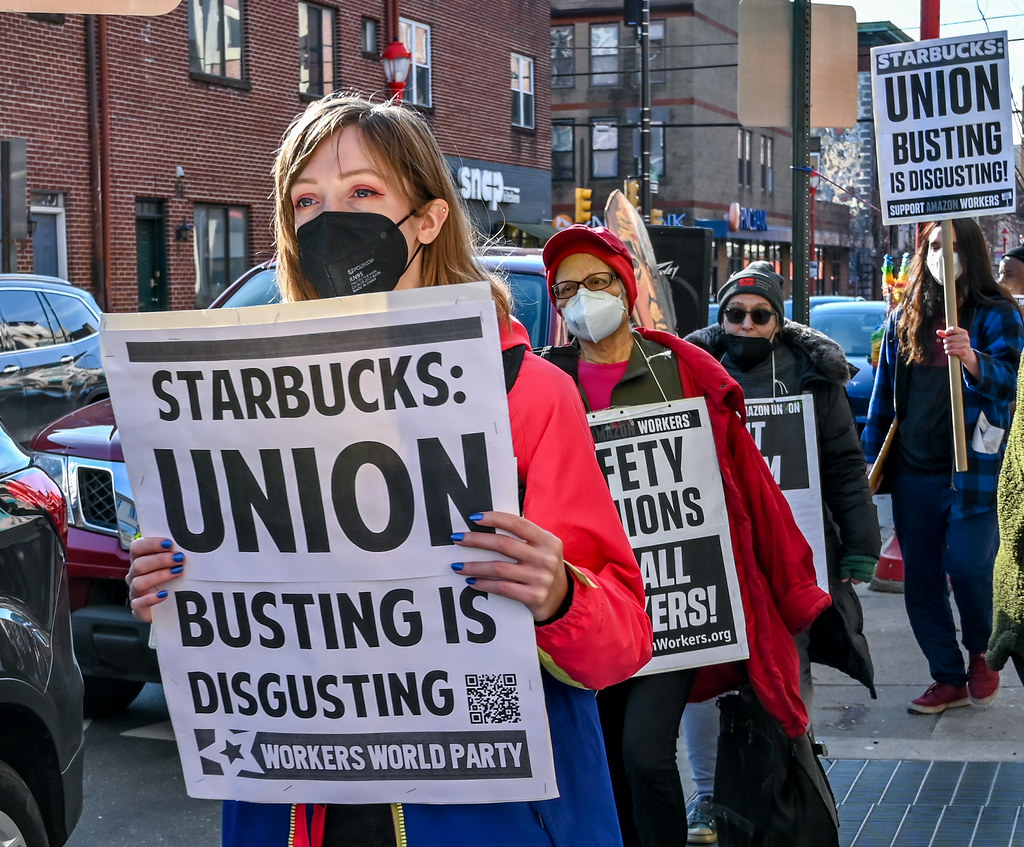
As big brands like Amazon, Starbucks, and Chipotle lash back at worker organizing, union-busting is getting long overdue exposure in the press. But while the stories graphically depict the problem, they don’t offer any solutions.
Though many of the common tactics of union-busting are illegal, there are only insignificant penalties that fail to discourage its lucrative practice. This is the only area of law where attorneys can advise clients to commit perjury in federal court without fear of disbarment or even censure.
A union leader who understands leverage and human nature, though, can unmask their deception.
EXPOSING CORPORATE LIES
Union-busting on a plant-wide scale usually takes place under three circumstances: organizing drives, first contract negotiations, and attempts to decertify an existing local.
The National Labor Relations Board (NLRB) is a law enforcement agency created by Congress and President Franklin Delano Roosevelt in 1935 to protect the rights of workers to form unions and engage in union activity. It violates federal law for employers to interfere with those rights, spelled out in National Labor Relations Act
Management is prohibited from threatening or coercing workers for union activity. It’s illegal to show favoritism to anti-union employees while discriminating against pro-union employees.
Unfortunately, American labor law is filled with loopholes that are easy to exploit. When employers wish to demolish an organizing drive or union local, they attempt to maintain the appearance of neutrality by using a select group of anti-union employees to carry out their dirty work. They often hire union-busting firms whose lawyers are experts at playing this game.
Under our system of justice, everyone is innocent until proven guilty, including companies and the union-busters they hire. It becomes the union’s job to prove that management is pulling the strings.
MANAGEMENT’S DIRTY TRICKS
The most common ways companies engage in illegal union-busting are:
- Allowing anti’s free run of the plant during work hours to criticize the union or circulate a petition to get rid of the union: legally referred to as free reign. The union’s challenge is proving the company knew and didn’t take action. This requires multiple witnesses putting management on the scene.
- Management talking with workers, saying they’d be better off without a union
- Management coercing workers to sign a decertification petition
- Threatening to close the plant if there’s a union
- Promising raises or other improvements if there’s no union
- Interfering with the right to show union support in any way, so long as it doesn’t interfere with production: including leaflet distribution at the plant gate or in the canteen, or wearing union stickers and T-shirts. The NLRB defines this as protected activity.
- Threatening, firing, or disciplining workers for engaging in protected activity.
Immediately notify the union at the first sign of these illegal activities. An experienced union rep or lawyer will file charges with the NLRB. But it becomes the job of local union officers and stewards to investigate within the workplace to gather evidence supporting the charges.
CONDUCTING AN INVESTIGATION
Investigations should be considered covert operations. Management and anti’s should never be confronted about their violations; it only serves to make them more careful. Better for them to remain arrogant and feel above the law, leading to mistakes that can be documented. (If given a heads-up about the union’s efforts, management will keep committing the same violations, only be more discreet.)
It’s essential to understand what distinguishes evidence from hearsay or common knowledge:
- “Everybody knows….” isn’t evidence. We need to present witnesses to tell what they directly experienced.
- “Somebody told me” isn’t evidence. It’s hearsay. We need witnesses who personally saw or heard something illegal.
- There are two types of evidence: cumulative and corroborative. It’s best to have both. Cumulative is many people testifying about the same type of violation. Corroborative is the most powerful: several people testifying about the same incident.
This is where the magical blend of organizing and legal tactics comes into play. Many potential witnesses will be frightened. That’s the whole point of company tactics; management targets people they consider weak links. But some end up feeling shamed and angry, instead.
The first step is convincing each witness to meet privately with a union rep or lawyer. If their information is good, the union will then have to persuade the witness to provide a sworn affidavit to an NLRB agent. All the legal knowledge in the world is useless if one doesn’t know how to talk to people and gain their trust.
WITNESSES HAVE RIGHTS
During this process, it’s important to explain the protections granted by the NLRB to workers who testify: Affidavits are confidential. Agents are prohibited from revealing the identity of witnesses to management.
The moment a worker sits down with an agent, they are no longer the union’s witness. They become a witness of the United States government. The government doesn’t like its witnesses being tampered with.
It’s a serious violation of federal law to discipline, fire, or even harass a worker for testifying. A big corporation may have lots of power, but the US government has more power.
While charges are being investigated, keep workers informed, boost morale, and discredit management. This, in turn, will inspire witnesses to come forward.
Leaflet frequently. Distribute union T-shirts and stickers. Ongoing shop floor presence of a labor dispute puts employers in an awkward position with customers and lending institutions.
The best way to keep people involved in a long-term campaign is to make it entertaining. Humor is a powerful weapon. Poke fun at management in leaflets, and cut the anti’s down to size.
UNILATERAL CHANGES
In situations where a union has been certified but is without a contract, another important aspect of employer violations kicks in: unilateral changes.
Under a contract, terms and conditions have been negotiated, including areas where the company can make routine changes.
Without a contract, on the other hand, management remains frozen in the status quo. Every minor job change, temporary layoff, reduction in hours, etc. must be negotiated.
Employers pay little attention to this. Document each instance, as it often leads to major back pay awards.
One of the most fulfilling days of my career took place in the conference room of a textile mill in 1996, after an illegal decertification was shot down by the Board. Management wasn’t present as I handed out checks totaling more than $50,000 to workers who’d been affected by unilateral changes over a three-year period when the employer refused to bargain.
GETTING THE NLRB ON THE UNION’S SIDE
Presenting a good case backed by solid evidence isn’t enough. Most Board agents are decent people who understand what’s really taking place. But they are overworked, underpaid government employees who may take shortcuts and overlook some of the most important aspects of a charge.
The NLRB needs to see the evidence through the union’s eyes, and that requires knowing how to play the inside game. The union rep or attorney who filed the charges must meet regularly with the lead agent, follow up with briefs and position papers, and understand when it’s appropriate to go over the investigator’s head to the U.S. attorney supervising the case or the Board’s regional director.
IF THE UNION WINS ITS CASE
When federal agents and attorneys feel the union has met its burden of proof, they issue a complaint against the company. It’s the equivalent of an indictment in a criminal case and will overturn any election tainted by management involvement. Workers fired illegally will be reinstated with back pay.
Employers can appeal this, in a process that takes a couple of years—but if the union has a strong enough case, the employer will often make a business decision to cut its losses and negotiate.
This usually happens when decertification attempts fail; sometimes it happens during first contract campaigns, too. I experienced this outcome at major corporations trying to decertify a local, such as Mohawk Industries and Kmart, and during first contract negotiations at a Serta Mattress manufacturer.
However, large companies that are being newly organized tend to milk the appeal process for all its worth—while committing new violations.
Don’t buy into their efforts to break your spirit. Board charges give you a foundation for press coverage and to portray self-righteous management as the outlaws they are. Combine this with a solid organizing strategy, and there may come a tipping point when management realizes the ongoing campaign is hurting profits.
Every labor dispute is a battle between hope and fear. Unions are at their best when we help people find the courage to become their brothers’ and sisters’ keepers.
Union-busters think they know human nature—but in fact, they understand only weaknesses and how to exploit them. They always underestimate what can be accomplished by a group of workers whose higher instincts have been inspired.
ZNetwork is funded solely through the generosity of its readers.
Donate