
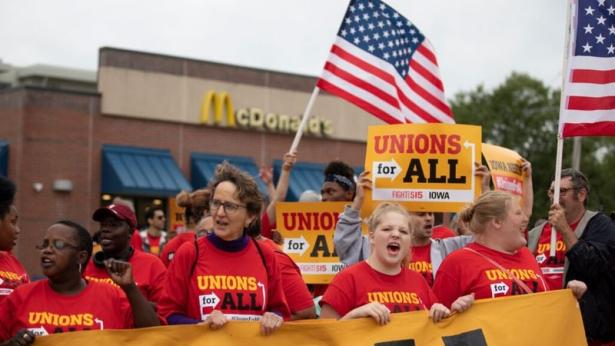
The last two years have brought dramatic changes to the restaurant labor market. A scarcity of workers drove up wages, sometimes faster than inflation, while high turnover indicated continual worker dissatisfaction. The result? Thousands of restaurant employees are trying to reshape the industry on their terms, sparking political activism in the space.
The Service Employees International Union is the muscle behind many of these campaigns, from California’s FAST Recovery Act — which would form a council to regulate fast food wages and working conditions — to organizing at Starbucks stores. At 1.9 million members, SEIU is likely the largest private sector union in the U.S. and Canada. The organization’s scale has been a powerful tool in changing restaurant labor dynamics across segments.
In 2020, delivery and rideshare companies spent hundreds of millions of dollars on Prop 22 to defeat a California law (AB 5) backed by the SEIU, which classified gig workers as employees rather than independent contractors. As a similar referendum battle shapes up over California’s fast food labor council, which would be required under the FAST Recovery Act (AB 257), SEIU says workers are more fed up and more militant and voters are more likely to support them — opening the possibility of dramatic labor law changes.
“Coming out of the pandemic and being called essential, but being treated in the way these workers are treated, has galvanized more public support than I’ve seen in my entire lifetime,” SEIU President Mary Kay Henry said. “We have elected leaders willing to stand with workers in ways that I’ve never seen before.”
Restaurant Dive spoke with Henry about the union’s strategy, political priorities and plans for the restaurant industry.
This interview has been edited for clarity and brevity.
RESTAURANT DIVE: From SEIU’s perspective, what will it take to get Starbucks Workers United a contract with corporate?
MARY KAY HENRY: I actually think the workers’ leadership and bravery in continuing to do militant and disruptive actions, like the strikes [in late March] around the shareholder meeting, and the plans they have to do a global day of action on April 11, are the most important ingredient.
Workers’ leadership in making a bold demand, like “we want a national contract from Starbucks” and in demanding that Starbucks cease and desist the union busting activity and repair the damage they’ve done inside of stores and to individual workers, is really important.
Along with the worker strikes, the Senate hearing, having our government hold this corporation accountable, and the shareholders passing a resolution, we want to figure out ways that consumers at Starbucks can make our voices heard in support of the workers in a more ongoing way.
The current idea is for customers to wear a sticker of support and take a photo and post it and make clear to the new CEO that we expect him to take this moment of opportunity, and create a national [contract] and a path forward for the workers at Starbucks.
Do you think CEO Laxman Narisimhan presents a strategic opening for this campaign?
HENRY: We do. We don’t know whether he will seize the moment, but we want to create the conditions, which I think we’re well on our way.
The fast food industry is going to fight you pretty hard in California on the FAST Recovery Act. What’s the path to winning at the ballot box there?
HENRY: We have to operate on multiple fronts. We’ve introduced joint liability legislation and referendum reform legislation. And we want to figure out a way to make a wage demand even as we’re battling to the ballot box next November, so that we can actually change workers’ lives in this two-year period of galvanizing the electorate to keep the law.
We’re going to continue to organize. Workers have [collected] 20,000 [worker] signatures to send to the Department of Industrial Relations. We’re going to continue to litigate against [the backers of the referendum]. We will start to do labor movement member education and begin voter mobilization in 2023 so that we can run a grassroots campaign against the fast food industry through 2024. Then win the ballot and then get the table set in 2025 to sign up permanent members of a fast food workers union in California.
What makes this political and economic climate different than during the fight around Prop 22?
HENRY: Coming out of the pandemic and being called essential, but being treated in the way these workers are treated, has galvanized more public support than I’ve seen in my entire lifetime.
We have elected leaders willing to stand with workers in ways that I’ve never seen before. Gavin Newsom, signing AB 257 [The FAST Recovery Act] in spite of companies spending $6.5 million to lobby against it last year and announcing that they’re willing to spend $200 million to overturn it, is an indication that some elected officials are willing to stand with workers.
The Starbucks victories fuel the fast food victories, and the Los Angeles Unified School District workers being on strike and then getting their pay increase, is inspiring to workers. So that’s happening all across the economy, and that’s very, very different than when Prop 22 was on the ballot.
The status quo of labor law is shaped by the National Labor Relations Act, and the Taft-Hartley bill, a 1947 law intended to weaken unions. What advantages does the FAST Act offer for workers over that legal paradigm?
HENRY: If workers organize under the National Labor Relations Act, store-by-store, they aren’t bargaining with the person that actually creates the economic conditions. So fast food workers, in our 12 years of backing them in the fight for 15 and a union, have never believed that they could organize in the way that the Starbucks workers are organizing, because [Starbucks] workers are directly employed by the corporation.
This model was meant to be a way for workers to aggregate their power and be able to solve problems so they could actually raise wages, deal with discrimination, deal with health and safety issues, across employers within a geography.
Ultimately, our vision with them is to have a national bargaining table, like the fast food industry does in other countries around the world. But we should do a U.S. model. We don’t have to replicate another country. We should create our version. We call it rewriting the rules, in a way that would allow workers to have a voice on the job and really solve the problems of the inter-generational poverty that is enforced on primarily communities of color who are doing these jobs.
How do you decide that something like The FAST Act is worth risking a $100 million referendum battle?
HENRY: We see the FAST Act as a gateway to building a national fast food workers union. It doesn’t stop there in our minds, because if we can make that happen in fast food, why not Amazon warehouses and retail workers? It doesn’t have to be our union, but we would back those workers to build their union in the 80% of the service and care economy [who are not unionized].
We want to do it for 2 million homecare workers and childcare workers. That’s why The FAST Act has such significance and why it’s the top priority of our union, to raise those funds and to galvanize the California electorate to push back on corporate takeover of our democracy.
The question for California voters is “are we going to continue to allow corporations to override what our democratically elected state legislature and governor are trying to do to improve the lives of all Californians?”
How did some of the amendments end up in the FAST Act, such as expanding fast food brands from 30 units to 100 units, or the removal of the joint liability and addition of the sunset clause?
HENRY: The governor’s office and the Senate Pro Tem and the chair of [one of the committees] were basically asking us “what matters most?”
What matters most is for workers to have a seat at the table and be able to raise wages and address the terrible conditions on the job. And [legislators] were getting pounded on by franchisees in their districts about joint liability.
The governor’s office thought that if they compromised joint liability out, that it would keep the owners from putting it up for a referendum. And we were all wrong. As we know today, [the restaurant industry] decided they’re going to proceed anyway.
Aside from The FAST Act, what are some of the opportunities in the next two or three years to start raising standards in foodservice and restaurants?
HENRY: One opportunity would be to raise minimum wages at the state or federal level. Another opportunity is for employers like Starbuck to decide, “okay, I’m going to stop the union busting and bargain with our workers” and embrace standards that would then impact the rest of the sector. A third way would be for workers in other parts of the restaurant or food sector to also organize unions, either across [multiple] employers or with big, signature employers.
Do you think there’s going to be a shift more toward shop organizing and elections now that Starbucks Workers United and several other unions have made inroads in coffee and, to a lesser extent, restaurants?
HENRY: I think that will happen when we achieve a national settlement with Starbucks. What is happening both to the Amazon Staten Island workers and to the 300 stores that [SBWU] actually [organized] is giving workers pause, like, “I wonder if this is actually going to work?”
But we got 13 organizing leads from Starbucks workers just during the first 30 minutes of Howard Schultz’ testimony [before the Senate HELP committee] because people were like, “Okay, wait a minute. I know for a fact that’s not true, so let me call that union.”
More workers are going to want to organize, but people understand the system is broken. Even when an NLRB judge orders the reinstatement of a worker and get back pay, that is not a significant enough price for Starbucks to change their approach. They’ve really written union busting into their business plans. The big multinational corporations in the U.S. just see it as the cost of doing business.
And I think [the March 29 HELP committee hearing] is the beginning of a turning point where a multinational CEO is held to account by the U.S. Senate. It is something that’s going to create a sea change. I hope we can make union busting as disgusting as sexual harassment and assault, in the way that the “Me Too” movement did. We want to make it unacceptable for U.S. businesses to retaliate against workers.
You mentioned the possibility of pushing for a national fast food standards council, and for a national fast food workers union. What would that process look like?
HENRY: It could go two ways. One thing we could do is beat back the referendum in California, build the union and press for those workers, which as you can imagine, would inspire workers in other places. And then we could replicate the council in states where we have the political will of electeds to do it: New York, Washington, Illinois.
That would begin to create pressure on the companies to make a different decision and create a national framework, because it would be easier to do business if there were the same standards all across their workforce. So that’s one path: state-based pressure and change that creates a private national settlement.
Another path is to leapfrog from California to a legislative change at the federal level that requires employers to do something different.
A third path is a private agreement, if companies don’t want government involvement and they want to have a labor-management collective bargaining agreement.
So those are the potential paths forward that we see from California.
Are there other labor reform ideas you think should be pursued?
HENRY: We’d love for states to be able to innovate so that you have federal labor law, be the floor but allow states to figure out additional things…. we have to rewrite the rules so that workers have the power to bargain where the economic decisions get made, not down at the frontline where the employment relationship has gotten “fissured.”
SEIU has several long-running campaigns, such as Fight for $15 or Local 32 BJ’s Chipotle organizing efforts, that are designed to influence industrial conditions, rather than add new union members through NLRB elections. How do you measure the success of these sorts of campaigns compared to traditional organizing?
HENRY: Our union was born by immigrant flat janitors who fought for 10 years before they were recognized as real workers because they had housing provided to them. The AFL didn’t want to give them a charter because they were primarily immigrants and women. It wasn’t seen as real work.
So written into this union’s DNA is that we don’t give up or give in, even if it takes more than 10 years [to organize and reach a contract]. Homecare in Los Angeles took 15 years, family child care in California took us 16 years. But we really believe that there’s a way to build to make a breakthrough in this sector.
Our current members can’t do better unless we raise wages in low-wage jobs, like fast food and the gig economy. Our members see this in their self interest to continue organizing these workers.
The only benchmark that has mattered is that 26 million people are on a path to $15 an hour. Our bargaining for low-wage workers was totally transformed by the Fight for $15. That, frankly, was an unintended consequence. Our leaders have a lot of pride in how it drove wages up for other parts of the union.
When New York and California passed $15, this nursing home owner in Illinois said to our bargaining team: “Listen, I know you’re going to be demanding $15 an hour.” Workers were at $11. He said “we can’t get there in one year.”
The workers were not intending to demand $15, they were going to demand $13. The workers ripped up their initial $13 proposal, and that’s the sea change.
With The FAST Recovery Act, we see another benchmark being to sign up 150,000 of the half million [workers impacted by AB 257] as a way to begin the union of fast food workers in California and then eventually nationally.
So we’ll create the fast food sector council, workers will elect representatives, and then they’ll have a voice in what the council is going to demand, by signing up to be a member and paying dues, not from their paycheck probably, but from a debit card or bank account. That’s how we’re going to establish the union. It’s a different model.
What other campaigns or factors are likely to influence organizing in the restaurant industry?
HENRY: We really think organizing in the South as a geography is key to laying the foundation for a national breakthrough. When you look at the federal minimum wage hikes, the legislators who prohibited us from kind of taking it over the top when we had a trifecta were southern. They got very pushed and pulled by small business owners in rural communities who thought they would go under, if they raise wages step by step to $15.
We need to figure out a way to unite with other labor unions and think about how we do cross industry geographic organizing. Take the fast food sector council but have it be across service industries.
What we’re really trying to do is establish a new model of unionism in blue cities in the South. But it will require private agreements, because the state legislatures have prohibited legislative innovation in the cities.
It is the next generation of the Fight for $15. Southern cities were the most militant and the most responsive as the Fight for $15 was growing. We had to figure out a longer term southern strategy not just for fast food. A lot of the fast food workers do multiple jobs; they’re a gig worker, they’re a homecare worker, because that’s how they’re stitching together a life. So for those workers it’s necessary to think about a union that represents them across all the jobs that they do.
We have to experiment and figure out how to cooperate with other parts of the labor movement that either want to innovate or want to [organize] the traditional way. Those two approaches can exist alongside each other while we’re trying to figure out the breakthroughs.
The union is focused on four states right now: North Carolina, South Carolina, Georgia, Alabama. That’s where worker interest is the highest. And right now, what we’re doing is using state labor boards, state OSHA, state EEOC, to do group grievances, [alongside] direct action on employers to try and solve problems on the job, which we think will fuel more workers wanting to join. But the wage question in the South will be the toughest [part of organizing].
ZNetwork is funded solely through the generosity of its readers.
Donate

