
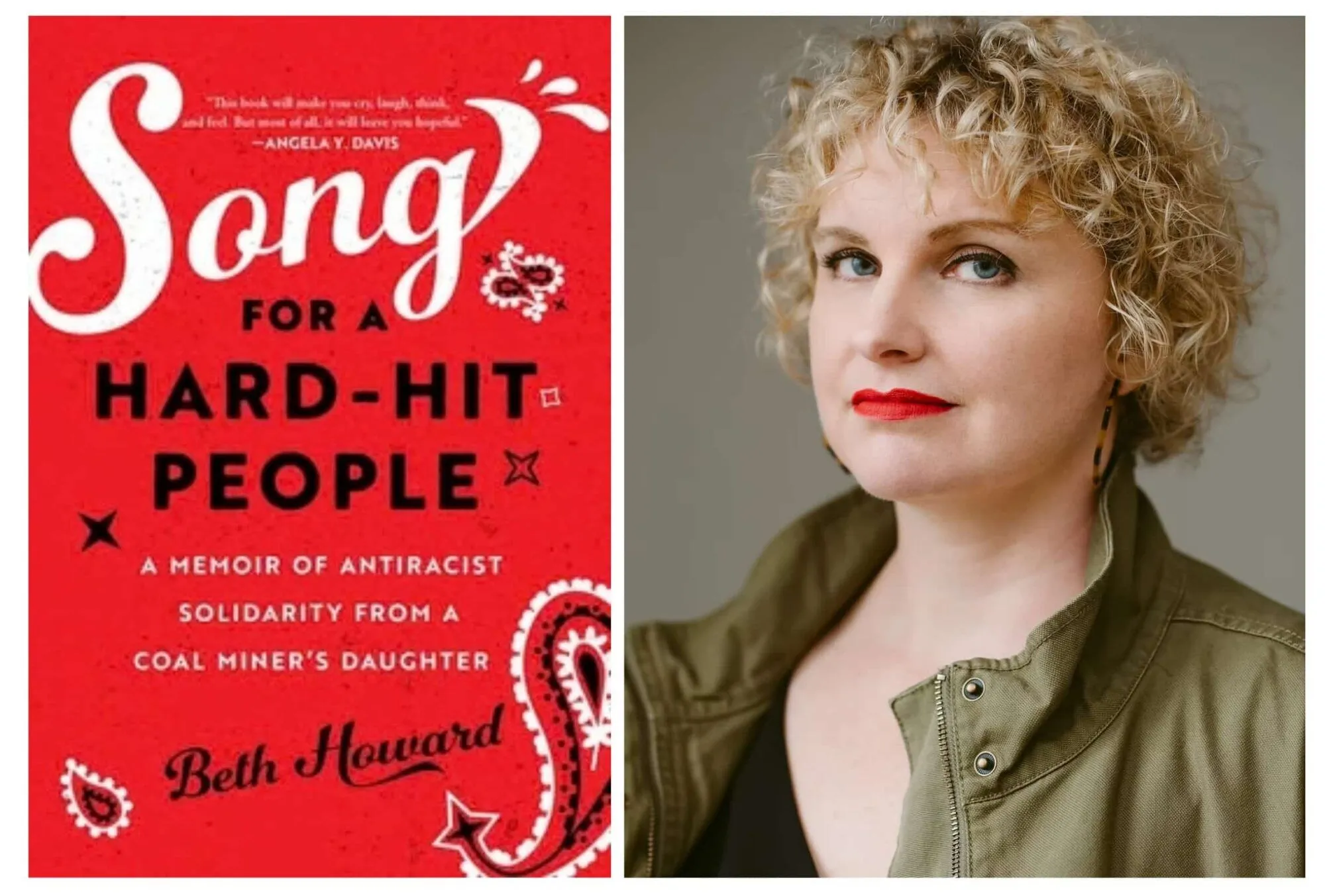
Confronted as a young adult with his terminal cancer diagnosis, she sorts through a morass of competing values and emotions. Supporting her family is a core value but one that her father didn’t consistently live up to. “Dad loved us the best he knew how, but his love was limited,” is how Howard puts it. On the other hand, codependency was a real concern: “Healthy boundaries weren’t a thing my family was good at. Hell, I didn’t even know what that meant.”
For all his faults, Howard admired her father’s intellect and populist political instincts and was strongly influenced by them, so much so that she led a hunger strike in her sixth-grade school cafeteria against a sadistic “no water refills” policy. “Like Dad, I wouldn’t eat shit for no one. I didn’t have the taste for it.”
I won’t give too much away, but Howard’s ability to wrestle with this dilemma effectively foreshadows her political organizing philosophy and reflects something very admirable—her ability to see the good, the bad and the ugly in people, and to love and accept them despite their imperfections.
Grace and loyalty are themes that infuse Howard’s book. Her work as an organizer requires opening her heart to white working-class Appalachians who don’t check all the correct social justice boxes. She’s a fierce defender of her “hard-hit” people and an outspoken critic of liberals’ habit of stereotyping, demonizing and denigrating them. She’s open about their foibles but adds a great deal of context that helps the reader understand what drives some in Appalachia to self-destructive behavior and bouts of meanness. She also makes clear that her people are not to be pitied. Even in the face of intergenerational poverty, exploitation and trauma, they’re resilient and creative and take care of each other as best as they can.
“[W]orking class white people have dignity, and we matter. We are worth saving, too,” she writes. After a decade-plus of cultural commentators and political leaders blaming and shaming white people, especially poor “white trash” folks, “toxic” white men, and rural “rednecks” (a slur Howard reclaims as a badge of honor connecting back to the striking West Virginia miners who wore red bandanas), Howard is a breath of fresh air.
As an organizer, Howard looks to understand and affirm people’s fears and anger. Where there’s hate, she looks for the hurt underneath it and, in Appalachia, there’s plenty. She also seems to be highly skilled at making common cause with working people across lines of difference. Most white Appalachians aren’t about to acknowledge their so-called “white privilege” but they sure as heck have landlords and debt collectors breathing down their necks.
Much of the book chronicles Howard’s evolution as an organizer, from her sixth-grade hunger strike (spoiler: they won!) to her first job as a community organizer with the Direct Action Training Network (DART) on through to her current work with the Kentucky People’s Union, a project of Showing Up for Racial Justice, which describes itself as the largest national organization bringing white people into the fight for racial and economic justice. The book is rich with inside stories of a skilled organizer—stories that are few and far between in a time when our social discourse is dominated by the relentless, polarizing hot takes of keyboard warriors, many of whom have little to no experience talking to regular, working people.
It’s apparent that Howard has strong organizing chops and is bringing together people who are customarily overlooked by politicians, advocacy groups and foundations. There are many lessons to be gleaned from Howard’s recounting of her organizing trials and tribulations—how to invite people into movements and keep them engaged, how to listen with an open heart and mind, how to create a forum where people can hold their elected officials’ feet to the fire, how to hang on to hope in the face of failure, and how to take care of yourself and stave off burnout. (Albeit, she wasn’t that great on that last count, pushing herself to the brink at times.)
Howard’s first job with DART involved recruiting a mixed white and Latin American immigrant Catholic church in Jacksonville, Florida, to join an interfaith social justice network. Though Howard was a non-Catholic, white, English-speaking young woman from Kentucky, she immediately felt at home at the Spanish-language Catholic mass.
“Being Appalachian didn’t make it harder for me to relate” she writes, “it actually made it easier … They wanted many of the same things that my family and community wanted: dignity, good jobs that pay a living wage so they can support their families, and safety.”
From there, she recounts how she evolved away from purely class-based organizing toward a politics that combined race and class. In grad school, at Morehead State University, she observes how her white Appalachian classmates resisted acknowledging their white privilege. According to Howard, they “saw themselves in competition with Black and brown people, instead of on the same side working together.” Howard was frustrated by their stance and by her inability to show them what they weren’t seeing. Later, she realizes this experience gave rise to feelings of moral and intellectual superiority—she got it, they didn’t, and she judged them for it, an attitude she came to characterize as “bullshit … I was more like them than not.”
She also acknowledges the validity of her classmates’ perspective:
Just because people were white didn’t mean they had class privilege, and not all people of color were economically disadvantaged … My classmates’ reactions to white privilege were about pain, the suffering they felt, and they were falling into the trap our dominant culture creates for them: Fight each other, not those in power.
Ultimately, Howard’s fusion of race-class politics led to the launch of the Kentucky People’s Union, a multi-racial organizing project in a state that’s 84% white. The organization focuses on material issues like affordable housing but through an explicitly racial lens. A conversation at the doors usually starts with financial woes but, at some point, the organizers segue into explaining how elites are scapegoating racial minorities in order to keep working people divided.
“Our strategy is to organize white people away from whiteness,” Howard told me in a recent interview. Right-wing scapegoating, she explained, stokes a scarcity mindset that causes white people to side with rich whites instead of poor and working-class Black and brown folks. By explaining to white working Kentuckians how the right-wing divide-and-conquer playbook operates—and who it serves—organizers try to defuse its power and build multi-racial working-class solidarity.
I agree with Howard that scapegoating is doing the devil’s work, but I am skeptical about the usefulness of calling it out. White voters in other states have demonstrated a willingness to support measures that materially improve their lives. Missourians, Floridians and Arkansans approved a minimum wage hike in 2024, 2020 and 2018 respectively. Majorities in Oklahoma, Missouri, Idaho, Nebraska, and Utah voted for Medicaid expansion under the Affordable Care Act. Missouri, Montana and South Dakota approved marijuana legalization. These voters were acting in their own self-interest and didn’t seem overly concerned that non-whites too would benefit from these new laws.
Some white working class (and affluent) Americans have anti-immigrant and anti-Black prejudice, but their numbers are dwindling. In 1996, 57% of white working-class voters agreed that “most blacks just don’t have the motivation or willpower to pull themselves out of poverty.” By 2021, that number had fallen to 33%. In 2010, only 32% approved of granting “legal status to all illegal immigrants who have held jobs and paid taxes for at least 3 years and not been convicted of any felony crimes?” By 2020, it was 62%. There’s room for improvement on those percentages but, from my perspective, they’re good enough to call into question the utility of anti-racist consciousness-raising.
This year, my organization, the Rural Urban Bridge Initiative, collaborated with the Center for Working-Class Politics on a large messaging survey. We found that rural folks, Republicans and undecided voters disliked hypothetical candidates who combined race and class in messages that explained the right-wing’s divide-and-conquer playbook (a messaging framework known as the “Race Class Narrative”). Instead, what landed best with them is what we call “kitchen table populist” rhetoric that affirms the unfair reality at the center of their lives: They’re working hard but barely getting by while the rich and powerful get more rich and powerful.
It could be that the Race Class Narrative is more effective in non-electoral contexts. And it could be that canvassers having one-on-one conversations get more traction than what we can capture in an online survey. Still, I can’t help wondering what would happen if the Kentucky People’s Union and other rural organizers dropped the racial angle and simply appealed to people’s shared economic interests.
Politics is messy. Race and class are messy. Families too, especially families hit hard by poverty and addiction. Howard has lived it all and tells an important story well worth hearing.
Her vision is this:
[O]ne big working-class multiracial Southern family reunion with the best recipes, hugs and radical welcome, where no one is turned away…When we have conflict, when we hurt each other, we don’t throw each other away. We stay through the hard parts. We apologize. We make amends. We change. We grow. We love harder and try again.
Sounds good to me.
ZNetwork is funded solely through the generosity of its readers.
Donate