
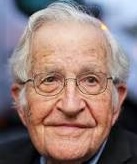
For over half a century, Noam Chomsky, celebrated linguist and current Laureate Professor of Linguistics and Agnese Nelms Haury Chair at the University of Arizona, has provided intellectual and moral leadership to critics of American foreign policy. In the interview below, conducted in his office at the University of Arizona on August 7, 2018, Chomsky discusses the American obsession with Iran, and why the Trump administration seems ready for a confrontation. He also addresses the disappointing trends in two Latin American nations, Venezuela and Nicaragua. Above all, Chomsky expresses his concerns over nuclear weapons, especially in the unpredictable hands of Donald Trump. Reprinted below is the entire text of the interview.
In the larger sense, do you believe that there is still a reservoir of untapped anti-Semitism in the United States?
It’s not even untapped. Take the strongest supporters of Israel, the Christian evangelicals. That’s the most anti-Semitic group in history. I mean, even Hitler didn’t say that all Jews should go to eternal perdition. Can you be any more anti-Semitic than that?
But what about mainstream American society? Less so?
I mean, it was true up until, I’d say, about mid-1950s. So, I was a student at Harvard in the 1950s. I mean, you could cut the anti-Semitism with a knife. It wasn’t—one of the reasons MIT became a great institution is because people like Norbert Wiener couldn’t get jobs at Harvard, literally. Paul Samuelson, Bob Solow, so they came down to the engineering school down the street. Didn’t care. But, so there was plenty of it. But it’s pretty much—I mean, it could easily—it could be an upsurge. These things are always right below the surface. But right now, I think there isn’t much, except for groups like Christian evangelicals or white nationalists, you know, they don’t like anybody.
Can you see Democrats taking a less pugnacious stance toward Iran in 2020? It seems that they’re showing a little bit less sympathy for Israel’s treatment of the Palestinians. Perhaps that will be replicated in other places in the Middle East, like Iran. Is there any hope for that?
That’s really hard to predict. I mean, the hatred of Iran is such a deep-seated part of modern American culture. To eradicate it is going to be very hard. I mean—take this morning’s New York Times. It’s pretty interesting, take a look at the lead story. It’s about Trump canceling, you know, the withdrawal of the—reinstituting the sanctions against Iran. And the headline says, and then the story says that Trump thinks that reinstituting sanctions will cut back Iran’s weapons production and cut down the—their repression inside Iran, and stop their meddling in the Middle East. I mean, first of all, does Trump think that? Probably not. Is there any truth to it? There isn’t a particle of truth to any of it. The most repressive countries in the Middle East are the ones we support. By comparison to Saudi Arabia, Iran looks like Norway, you know. As far as violence in the Middle East is concerned, the Saudi Arabian [and] UAE actions in Yemen, which we’re supporting, are much worse than anything. But here’s the—here’s the framework of discussion, you know. To break through that kind of, you know, just presuppositions, they don’t even say it, it’s just the presupposition …
Is it about—merely about hegemony? How do you explain the virulent disgust and hatred for Iran?
It’s very simple: in 1979 Iran moved towards independence. And worse than that, they overthrew the U.S.-imposed tyrant who had been ruling the country and U.S. interests. They’re not going to forget that. In fact, immediately right after the Iranian revolution, the U.S. began supporting the Iraqi invasion of Iran, which was devastating. Iraq was using chemical weapons, was killing hundreds of thousands of people, it was supported all the way through. In fact, at the very end it won the war for Iraq by closing the Persian Gulf to Iran.
So, could you say we’ve already had a war with Iran by way of the Iran-Iraq war?
…we didn’t really go to war with Iran because they’re not dumb enough to send troops to Iran. They’re pretty dumb, but not that dumb. What they’ll do, if they feel like it, is bomb from a distance, you know, missiles from the gulf, which could be pretty awful.
Speaking of bombs and missiles, I recently read The Doomsday Machine by Daniel Ellsberg. I found it riveting.
It’s a very important book.
Yeah. And he [Ellsberg] talks about key transition points and what is acceptable barbarism in war. He starts with the traditional notion that soldiers kill only soldiers, and then the bombing of civilians, and the way “Bomber” Harris worked it down to a science, and then the incineration of cities was the next step, and then the atomic bomb, and the savagery of Curtis LeMay; it’s really a beautifully-written book, very moving. But it made me think about Trump. Are we at another one of those key pivotal moments [featuring] a president with a trigger finger, and more and more nations with nuclear weapons?
Well, you know, Trump is a deviation from standard political history. He doesn’t give a shit about geostrategic issues. He doesn’t care what the hell he’s doing. If he smashes up the international economy, fine. If he throws out NATO, who cares? The only thing he cares about is himself, literally, and everything he’s doing follows from just the recognition that he’s a narcissistic megalomaniac who wants to make sure that, you know, he’s on top. He wins everything. And he has to keep his base under control. And he’s very good at it. He knows exactly what buttons to push to keep angry people—angry for good reasons, for the most part—to keep them sort of following him. He’s shafting them at every turn. Just take a look at wages. Since he’s come in, real wages have declined. They were actually starting to rise under Obama, and they’re starting to decline. But he’s keeping them in line. And the way he does it, by just doing one crazed thing after another, which looks as though he’s defending us. And they’re passionate. They revere him. So, you take a look—and on nuclear weapons, actually he’s got the best position of any politician in the country. He’s saying, we should reduce tensions with Russia. And he’s making moves to allow the Koreans to move slowly towards denuclearization, and it’s perfect. And that’s what everyone, including the Democrats, is denouncing him for.
Do you think those gestures are sincere?
No, of course not. Nothing is sincere. But, you know, it’s like a clock that nobody wound. It’s right twice a day. So, these are the—they should be praising him for that and supporting it, but instead, the liberals are so insane that they’re attacking him for the few things he’s doing which makes sense. Of course, we should reduce tensions with Russia. Of course, we should allow Korea to move towards denuclearization in a sensible way. I mean, try to find one liberal commentator or political leader who’s supporting him on that. I mean, the person—the one person who’s supporting him on that is the nuttiest guy in congress, Ron Paul. I mean, it’s crazy.
Do you think Trump is more likely to use tactical nuclear weapons than other presidents?
Well, I think the danger with Trump and nuclear weapons is something else. If this Mueller investigation ever comes up with something, which I doubt very much, but if it comes up with something that implicates Trump, everybody’s in trouble because he’s going to react like a maniac. Might try to start a war in the United States. He might start nuking people. He might do anything. Anything that goes after him personally is very dangerous. So, again, I think the liberals are out of their minds on this. What they want to do is implicate Trump, you know, threaten to impeach him, at which point he could go crazy. And he has a lot of power. Maybe the military wouldn’t follow his orders, who knows, but they might, you know.
You don’t trust “Mad Dog” Mattis to control him?
“Mad Dog” was named that for a reason.
What is your reaction to President Trump’s recent call for the creation of a new “space force” in the United States military establishment? Does this proposal represent yet another escalation in the nuclear arms race—as Daniel Ellsberg describes the stages of escalation in nuclear war planning in his book The Doomsday Machine—or is it merely another Trumpian diversion and fantasy?
Looks to me like a significant escalation of dangers. There’s been discussion for years in Air Force documents about militarizing space, and some steps have been taken, but this could be a sharp escalation—which could, for example, have the effect of increasing vulnerability to first strike and therefore raise even further the great danger of preemptive strikes.
What has happened to Maduro, Maduro’s revolution, the revolution in Venezuela? Is it merely a matter of corruption?
Well, Chavez did a lot of good things, but there were some fundamental problems which are clear all the way through, that’s why I never wrote anything about it. For one thing, it was top down. He was seriously interested in creating grass roots organizations, but you can’t do that from the top. They have to grow out of something in the community. You can’t order a popular revolution. So, it was always very flimsy. The other thing is, he never moved to diversify the economy, and that’s lethal. And it ended up with 95 percent of the economy based on oil. And so as soon as the oil prices dropped, everything collapsed. The other thing is he—he wasn’t corrupt himself, which is pretty rare in Latin America, but he tolerated a lot of corruption, I mean, just tons of it. So, the thing was pretty rotten all the way through. And when Maduro came in, it just collapsed.
Is the situation in Nicaragua analogous?
It’s not quite that bad, but it’s similar. I mean, the Sandinista leadership, Ortega, Borge and the rest, they were pretty corrupt. Even in the ’80s, it was pretty obvious. I mean, what’s his name—Wheelock, the Minister of Agriculture, he was a militant Sandinista. He was one of the—became one of the biggest landowners in Nicaragua. My daughter lived there for years. Her husband’s Nicaraguan. We went to visit once; right across the street, there’s a huge wall which surrounds a big area in central Managua. Inside it is an estate owned by Humberto Ortega [brother of Daniel Ortega], who lives in Costa Rica where he’s a rich businessman. I mean, the amount of corruption. You have to look at their mentality. The guys who are the Sandinista leadership, not the fighters, but the leadership, they came from the Nicaraguan elite, you know. Their feeling was, “Look, we should have it now. We should have what those guys had.” And they took it, you know. And it’s—they’ve done some good things, but with a lot of—they’re very authoritarian, and a lot of corruption all the way through. So now it’s beginning to collapse.
I remember great optimism in the ’80s regarding Nicaragua, and I don’t see any cause for optimism in Latin America right now.
Well, Nicaragua was a very exciting place in the early ’80s, but the U.S.—one of the great Reagan achievements was to destroy hope, literally. By the time he got to the late ’80s, people had basically just given up. We can’t fight this. I could see it even in simple ways; my daughter lived in a fairly poor area in Managua, you know, not—you know, not deeply poor, but by our standards, very poor. There was a park there which had playground equipment which was all rusted. So, the kids in the neighborhood couldn’t use it. They couldn’t use the sliding boards. And half the people that live in the neighborhood are, you know, welders, machinists, and so on. They could have taken out an afternoon and fixed up the playground equipment so their own kids could have a place to play, but they’re just sitting in the bar drinking, you know—the women pulling them off the street in the evenings, because they’d just given up hope. The Contras war was very effective that way. It—and if you think about the early ’80s, it was people were really excited and engaged doing things and so on. It’s very hard to withstand something like brutal sanctions, terrorist war from the biggest thug on the block, you know. It’s not easy. It was a major U.S. success.
Is there any place in Latin America right now that inspires hope?
Well, you know, there are things everywhere. Like, take Brazil, where we’re going to go in a couple of weeks. We’re going to go actually to try to see Lula. But there’s an international conference we’re always speaking, which is pro-Lula. But there’s huge popular support for him. I mean, take a look at the—if you can pick up a Nicaraguan video, you know, right wing, but they show the pictures, there’s massive demonstrations supporting—and he’s still, despite all the attacks, he’s by far the most political—popular political figure. That’s why they have him in jail, they’re afraid he might run… Well, he’s the one person who did anything for the poor majority. The class hatred of Lula is astonishing…
Saul Isaacson is an English teacher at Trinity School in New York City. His interviews of Noam Chomsky have appeared in Truthout, Counterpunch, and Foreign Policy Journal.
ZNetwork is funded solely through the generosity of its readers.
Donate
1 Comment
Interesting (to me) quote from Noam in here. I am wondering what Michael Albert makes of it. Quote is:
“Well, Chavez did a lot of good things, but there were some fundamental problems which are clear all the way through, that’s why I never wrote anything about it. For one thing, it was top down. He was seriously interested in creating grass roots organizations, but you can’t do that from the top. They have to grow out of something in the community. You can’t order a popular revolution. So, it was always very flimsy. The other thing is, he never moved to diversify the economy, and that’s lethal. And it ended up with 95 percent of the economy based on oil. And so as soon as the oil prices dropped, everything collapsed. The other thing is he—he wasn’t corrupt himself, which is pretty rare in Latin America, but he tolerated a lot of corruption, I mean, just tons of it. So, the thing was pretty rotten all the way through. And when Maduro came in, it just collapsed.”