
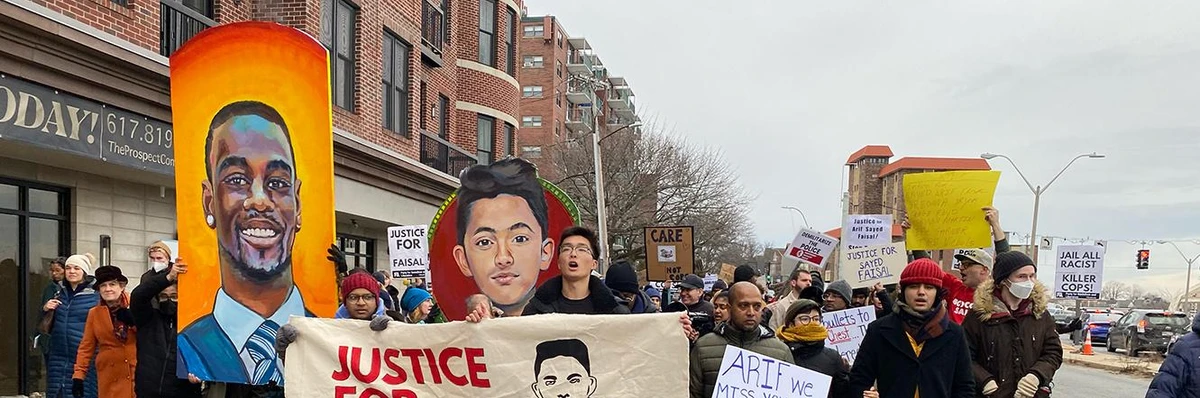
Just four days into the new year, 20-year-old Bangladeshi immigrant and student Arif Sayed Faisal was shot and killed by police in Cambridge, Massachusetts, after appearing to have a mental health crisis. The Cambridge Police Department was quick to call the killing an “officer-involved shooting,” using language that police departments across the US use to shift the blame off of officers who kill or maim civilians. Cambridge police claimed that Faisal advanced towards officers with a knife in hand, implying that the police had no choice but to shoot him dead.
Faisal’s death sparked a level of movement that Cambridge city officials didn’t expect, Suhail Purkar, a local activist and organizer with the Party for Socialism and Liberation (PSL), told Peoples Dispatch. Purkar was a central organizer for a march of hundreds to the Cambridge Police Department headquarters on January 29, when protesters delivered a list of demands to police. These were: release the names of the officers and the unredacted police report; fire, indict, and convict the officers; fully fund alternative emergency response programs separate from the police; disarm and demilitarize the police; and reallocate police funding into community support and safety.
Since the killing, Cambridge Police Commissioner Christine Elow made a point to describe the Cambridge Police Department’s high level of training and claim that it is one of the most progressive departments in the country. “It goes to highlight that no amount of ‘training’ for the police, different curriculums, etc., are going to stop them from being an oppressive force and murdering people in the streets,” said Purkar.
“Initially [Cambridge authorities] were expecting both the Bangladeshi community and the Cambridge community at large, the Greater Boston community at large, to essentially just hold vigils, and paint murals, or basically make [the community response] something that’s very easy to ignore,” Purkar said. But Greater Boston immediately launched into a flurry of protest actions, fueled by the legacy of the anti-police brutality movement in the United States; the knowledge that, in 2022, US police killed more people than ever before; and the January 7 police killing of Tyre Nichols.
The movement for Faisal had international repercussions: demonstrators in Bangladesh protested the arrival of a US official in Dhaka, holding signs that read “Human Rights are Violated in the US Today” and “Justice for Faisal.”
Purkar, a young Indian immigrant and a resident of Somerville, a neighboring town, spoke to Peoples Dispatch about Faisal’s case and the state of the movement. “This is actually something that’s very personal to me,” he said. Purkar has lived in the greater Boston Area for two decades, and graduated from University of Massachusetts Boston, where Faisal was studying. Purkar also attends a mosque in the same affordable housing apartment complex that Faisal’s parents live in. “It could have easily been me,” Purkar said.
“How many stories like that?”
A key demand of organizers is to release the names of the police officers responsible for Faisal’s death, “so that we can investigate whether they have a history of racism, discrimination, and abuse of force,” said Purkar.
Purkar compared the movement for justice for Faisal to the movement for Tyre Nichols, a 29-year-old Black father beaten to death by Memphis police within a few days of when Faisal was killed. Protests against Nichols’ murder erupted in the last weekend of January after the footage of his beating was released to the public. In Nichols’ case, authorities in Memphis quickly fired, arrested, and charged five officers responsible for the beating, and disbanded the notorious “Scorpion Unit” that the officers were a part of.
“When the names of the police officers who murdered Tyre Nichols were released, members from the community came forward in Memphis and they said, hey, we’ve been brutalized by these same cops,” said Purkar. “We’ve been brutalized by the ‘Scorpion Unit,’ which has now been deactivated. [Scorpion has] a history of racism. They have a history of abuse of force. They have a history of brutalizing poor communities of color. How many stories like that [in Cambridge]? How many residents have been brutalized by these same officers in Cambridge that haven’t come forward so far? So that’s something that we really need to know.”
“It’s shocking that in Memphis, the names of the officers have been released, that they were fired and that criminal charges were brought against them,” Purkar said. However, for Purkar, this rare move was not because of “altruism” or “the righteousness of their heart.” He believes that Memphis officials released the officers’ names “they were scared of essentially another wave of upsurge against police brutality like we saw in this country in 2020.” The summer of 2020 saw the largest protest movement in US history following the police killing of George Floyd.
It is indeed rare that US police are charged with a crime as a result of a police killing—this has only happened in 2% of such cases from 2013 to 2022. According to the AP, when Derek Chauvin was found guilty for the killing of George Floyd, he was only the eighth police officer to be convicted of murder since 2005, despite the thousands of deaths at the hands of police in the US every year.
“It’s only because there has been such public pressure, because activists, including the PSL and other community members, actually shut down their City Council meeting and said that you can’t have business as usual, that they started to even respond more,” said Purkar, referring to the disruption of the January 23 Cambridge City Council meeting. There has since been a second disruption by activists on Monday, February 6.
“I can’t tell you exactly why Cambridge hasn’t released the names. But I think the motivating factor in Memphis was certainly that they were afraid of people expressing righteous indignation.”
Activists are also fighting to fire the officers responsible for Faisal’s death. Immediately following the shooting, the officer who killed Faisal, who had eight years of experience on the police force, was placed on paid leave. “In no other profession on this planet can you murder somebody in broad daylight and then go on paid vacation the next day,” Purkar said.
“[Faisal’s] family hasn’t received restitution, they haven’t received reparations,” Purkar said. “They’re grieving. They’re a very working class family. So that’s a central demand, to fire these officers right away, to not have these killer cops still working as public servants.”
Another demand is to prosecute the officers responsible, charge them, and convict them. “Those five officers [who killed Tyre Nichols], they have been imprisoned already and criminal charges have been brought forth against them. And that’s exactly what needs to happen in this case. And every case as well,” Purkar said.
A “cover-up” in progress
In response to the actions to demand justice for Faisal, eight days after Faisal’s murder, Cambridge city officials held what they called a “community meeting” to share the results of their own investigation into the incident with the public. The meeting was attended by the Police Commissioner Christine Elow, City Manager Yi-An Huang, Mayor Sumbul Siddiqui, and other members of the Cambridge City Council. Hundreds of residents of the Greater Boston community gathered to demand transparency regarding Faisal’s killing.
At this meeting, Elow and Huang responded to these demands by claiming that there was a city policy preventing officials from releasing the names of the police officers responsible. The response was not acceptable for protesters who, according to Purkar, argued that the policy should be changed, “Policies are made by human beings,” he added.
“The whole world knows that George Floyd was killed by Derek Chauvin. We deserve to know who killed our brother!” Sharik Purkar, another Greater Boston anti-police brutality activist, addressing officials at the meeting on January 12. “You are the people with the power to make the policy. Supposedly you reflect our will. Do we wanna know who killed our brother?” The gathered crowd responded with a resounding “yes!”
Elow told the assembled crowd that the police department must wait for the internal investigation into Faisal’s murder to complete.
Six days later, city officials met at a special session of the City Council on January 18. At this meeting, both Elow and Huang appeared to directly contradict their assertion that not releasing the officers’ names was an official city policy.
Mayor Siddiqui directly asked Commissioner Elow at the Council meeting, “We believe we heard at the community meeting that it was city policy not to reveal the officer’s name after the investigation is completed. Is this a policy passed by the previous Council, Cambridge Police Department policy, or part of the union contract?”
To which the Commissioner admitted, “It’s not a policy that is in writing, It has been past practice not to release names. There is no uniform, agreed upon standard.”
“It’s more of a practice, and not a policy,” Elow said.
Purkar said that Elow’s admission, appearing to contradict what was said on January 12, came as a result of public pressure by activists. At the City Council meeting, Elow essentially confessed that officials simply “don’t want to release the names,” Purkar told Peoples Dispatch.
At the January 18 City Council meeting, City Manager Huang acknowledged the community’s desire for the release of the names of the officers responsible for Faisal’s murder. “I can understand the desire for greater transparency,” he said. “At the same time, I think that there is also a reality that that level of transparency will increase the amount of public scrutiny, and potential harassment to the officer involved.”
In Purkar’s view, Huang had declared that “public scrutiny and transparency is bad.”
At a January 9 rally in front of Cambridge City Hall, the legal counsel for Faisal’s family announced that an inquest into the murder may not begin until 2024. “So that’s really [the City’s] game plan, to wait for people to forget, wait for the energy to die down so that they can have a long cover up,” Purkar said.
“We’ll be back!”
The Cambridge Police Department has yet to comply with any of the wider community’s demands. No names of officers have been released to the public.
But the movement for Tyre Nichols could positively impact the struggle for justice in Cambridge, Purkar said. “We see in Cambridge that there is this deep connection that is drawn between Faisal and Tyre Nichols. More and more, people are coming off the sidelines.”
“Initially in the community there was sadness, outrage, confusion. A mix of emotions, as you can expect, when a young person has been taken from us. It’s been a little more than three weeks now. In those [several] weeks, the reaction has turned into outrage as a result of the empty rhetoric of the politicians.”
After city officials refused to release names on January 12, members of the Greater Boston community successfully shut down the January 23 City Council meeting, afterwards chanting, “We’ll be back!” Community members once again shut down City Council on February 6.
On January 29, when demonstrators delivered demands to the Cambridge Police Department, Commissioner Elow was not present to receive the demands in person. Purkar speculated that she was “too cowardly to face her own constituents.”
Purkar and his fellow organizers have more actions planned in the future, especially focused on organizing university students. “But that’s the state of the movement, is that it’s actually growing,” he said. “More and more people are joining this fight and joining the struggle.”
ZNetwork is funded solely through the generosity of its readers.
Donate