
On the whole, German labor relations are defined by two systems: one is based on trade unions – as found in most countries – while the other is a rather legalistic system based on legally established participation, known as co-determination.
Roughly speaking, trade unions engage in collective bargaining at the industry level, while works councils – which are not union bodies – engage with what we know as enterprise bargaining, and what the Germans call “Betriebsvereinbarung.”
Inside companies, the second system includes works councils elected by workers “as workers” – not as union members.
Together with union-based collective bargaining – where trade unions meet employer federations at industry and regional levels – company-based works councils form the institutional cornerstones of Germany’s so-called dual system.
This system is far from perfect. Just under 40% of all workers are still represented by works councils. Worse, only about 50% of workers are entitled to the benefits of union-based collective agreements.
Worse still, Germany’s “model” has become “a minority model” in many sectors of industry – with notable exceptions: Germany’s still mighty manufacturing industry (including Tesla), large corporations, and the sizable public sector.
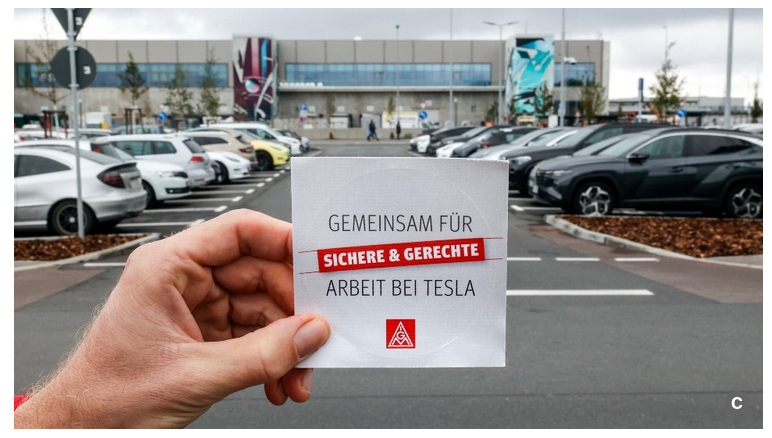
In recent weeks, Tesla’s Grünheide boss attacked the works council – perhaps with the intention to escalate the dispute and further his anti-worker fight against the works council and Germany’s metalworkers’ union, IG Metall (IGM).
In the freshly held works council elections – where all workers vote as workers, not as union members – Tesla’s German boss reportedly told workers, “Pay attention, where are you making your cross?”
A coded threat – urging them to vote for a council that is “in Tesla’s pocket” and not union-based. The aim: keep Germany’s most powerful union – the IGM – out of Tesla.
Just before the elections, IGM and Tesla management clashed again. Legal action by the union is now on the table.
This targeted dispute – engineered by Tesla’s management at the Grünheide plant in the East German state of Brandenburg – is entering its next round.
The trigger: a tape recording. In it, Tesla’s German boss – André Thierig – launched an aggressive tirade against IGM. The immediate cause? The upcoming works council election.
Conflicts at Grünheide have flared repeatedly. Last autumn, a worker and IGM representative on the works council was fired without notice. At the time, IGM called it an attack on co-determination and an attempt to intimidate union members.
Tesla’s German boss has since claimed the union is focusing on the “wrong topics” at the Gigafactory – especially galling given Tesla’s well-documented violations of occupational health and safety standards. For a boss, caring about workers’ well-being is, apparently, the “wrong focus.”
Ahead of the elections, Thierig threatened: “Pay attention, where are you doing your cross? You should know exactly what IGM stands for… if you vote for IG Metall.” Obstructing and even just interfering into works council elections is illegal in Germany.
Not surprisingly, labor lawyers see this as a potential violation of the Works Constitution Act. In fact, Tesla’s management is required by law to remain neutral. Anything else is a violation of German labor law.
The composition of the works council is crucial for cooperation between the council and management. That’s why some managers are tempted to manipulate elections – by backing compliant candidates, undermining others, or eliminating union lists altogether.
The Works Constitution Act is designed to protect workers from such manipulation. It mandates strict neutrality from management. But law-breaking by corporate bosses is hardly new – it has been with us since the dawn of capitalism.
Where there is inadmissible bullying or manipulation by management – especially in undermining council elections – German labor law allows for serious consequences, even criminal liability.
The question of unacceptable influence has occupied Germany’s labor courts up to the Federal Labor Court. There are many cases. But each must be adjudicated – individually.
Meanwhile, Tesla has had to swallow a setback. Despite 45,000 new electric car registrations in September 2025, Tesla saw a 9.4% drop compared to the same month last year. Nearly 1 in 5 new cars in Germany is now battery-powered, but fewer of them are Teslas.
That decline might have pressured Grünheide’s management to ramp up its anti-union rhetoric.
Tesla’s leadership has consistently taken a negative view of IGM and the works council. But this time, the plant’s boss may have gone too far. His union busting may bring serious legal consequences.
Under the Works Constitution Act, any attempt by management to influence works council elections – even subtly – is illegal.
Still, Thierig is reported to have said Tesla would be “better off without unions.” According to him, IGM “deals with topics that do not suit us.”
Worse, he allegedly attacked IGM head Christiane Benner with fabricated quotes. Thierig claimed she said electric vehicles “basically didn’t work.” In reality, she only highlighted the lack of charging infrastructure – a known fact.
Even worse: Thierig blamed unions for the automotive industry’s troubles. Yet, IGM is one reason Germany is still Europe’s top car-producing country, ahead of Spain and the Czech Republic – and the 8th largest globally, despite being only the 19th most populous.
Worse still, Thierig claimed: “This is what we see in the rest of the automotive industry – how successful collective agreements are: jobs are being cut everywhere.”
In reality, job cuts stem from Trump’s tariff madness, high energy costs, and corporate mismanagement – especially in electric vehicles, where China is pulling ahead.At Tesla, it might also have something to do with a corporate boss – Elon Musk – allegedly giving the Hitler salute and openly supporting Germany’s far-right AfD – a party rejected by about 75% of Germans.
Back in Grünheide, the confrontation is likely to escalate. Jan Otto – IGM’s district manager for Berlin, Brandenburg, and Saxony – put it plainly: “We’ve treated Tesla cautiously. Now we’ll have to get more serious.”
He criticized management for pressuring employees and creating a culture of punishment. Work intensity is brutal. Sick leave is often questioned to pressure workers into quitting.
One common tactic: firing employees during probation. No surprise, turnover is high. Workers involved with IGM face discrimination, intimidation, and forced one-on-one meetings with Tesla’s intimidating management.
Yet, despite all this, IGM won Tesla’s works council elections. Despite strong headwinds, IGM received 39.4% of the vote and secured 16 out of 39 seats. It became the strongest force on the council. Immediately, it called for more humane working conditions.
IGM ran a remarkable campaign in a short time – with a clear, convincing platform for better work at Tesla. Many congratulated them for their victory, and many more thanked them for standing up to the company.
There were nine lists with 234 candidates. IGM’s list stood for healthier, more predictable working conditions and humane shift structures.
Before the election, even mainstream German media had reported on Tesla’s high accident rates. Workers’ demands were simple:
- Longer cycle times on the assembly line
- Adequate breaks
- No more understaffing
Many said they could no longer endure the inhuman conditions. “I joined three years ago… I wanted to change things. But now, I’m exhausted,” said a worker. In response, Tesla’s PR machine tried to spin the story, while management doubled down on bullying.
Tesla’s union-busting even included distributing anti-IGM buttons: “Giga YES – union NO.” A blatant violation of German labor law, which prohibits management interference in council elections. Globally, a false narrative paints unions as lawbreakers. Tesla shows the opposite is true.
Workers with pro-union views saw their lives made difficult by Tesla’s management. Worst of all, Elon Musk himself warned employees about collective agreements in a speech in Grünheide. He called unions an “external authority” whose interests may not align with Tesla’s.
Even Handelsblatt – Germany’s most influential pro-business paper – reported on it. A previous anti-union works council chairman – backed by management – also attacked IGM. Still, the union prevailed issuing a 10-Point Program:
- The works council stands with the workforce – without compromise.
- Reorganize production for humane conditions: longer cycles, proper breaks, adequate staffing.
- Your free time belongs to you: 20+ vacation days, plan-able weekends.
- No more temp work – full-time jobs only.
- Protect the sick – no pressure, no wage cuts.
- End nepotism – fair promotions, equal opportunities.
- Safety first – stop Tesla-speed injuries.
- Equal opportunity for all – regardless of background, gender, or identity.
- Freedom of expression – no more suppression of criticism.
- A collective agreement: better pay, shorter hours, more time off.
All of this is to be secured in a legally binding agreement between IGM and Tesla – backed by a re-election of the works council, necessitated by Tesla’s workforce growing to 12,500. IGM followed the provisions of Germany’s labor law.
Despite all union-busting, the election went ahead. German labor courts had already found serious violations – including breaches of the Codetermination Act (Mitbestimmungsgesetz – MitbestG) during the supervisory board’s formation.
IGM has stood by Tesla workers from the beginning – supporting both the plant and its expansion. But it insists on conditions that match German industry standards.
For that, IGM and Tesla workers have shown incredible passion and resilience. Despite management’s bullying, workers held the line. They voted. They won.Now, IGM can continue its fight – not from the sidelines, but from within the works council. Management tried every trick in the book – and lost. Workers and their union had won a decisive victory.
ZNetwork is funded solely through the generosity of its readers.
Donate