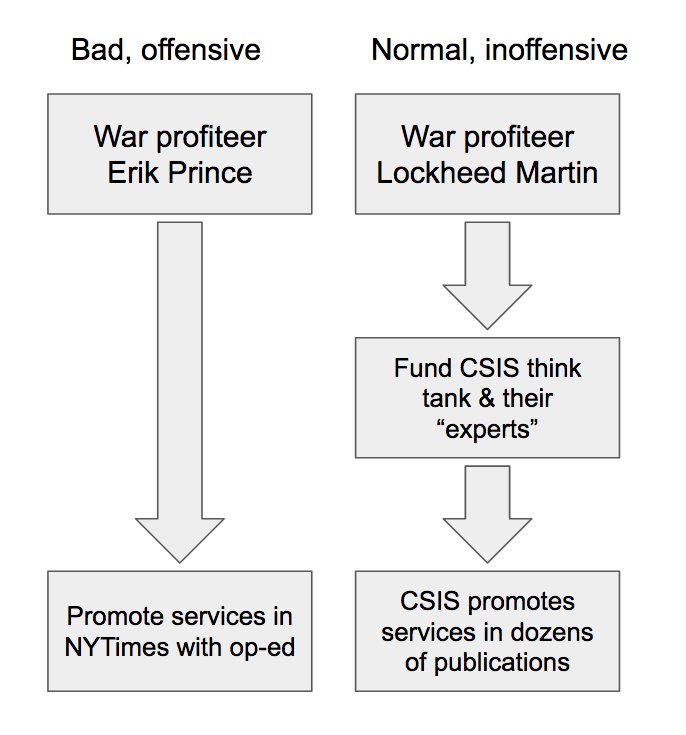
The New York Times (8/30/17) decided to turn over a large chunk of the most precious opinion space in the English-speaking world to mercenary entrepreneur Erik Prince, so he could promote his plan to privatize and profit from the US occupation of Afghanistan.
Though the Times did disclose in its bio of Prince that he was “the chairman of Frontier Services Group,” and “founded the company formerly known as Blackwater, a security contractor,” it never specified his direct profit motive in the plan. Perhaps it was thought to be implied, since Prince says the strategy is his, but the average reader could understandably miss what, exactly, “Frontier Services Group” does to generate revenue.
Far more egregious than a simple conflict-of-interest problem is that the New York Times decided to give an opinion column to someone linked to murder, money-laundering and a whole host of other legally and ethically repugnant behavior. As the Times presumably turns down hundreds of request for op-eds a week, it’s curious that it chose to give a platform to someone who is, at best, a war profiteer, and at worst a war criminal. (This comes a day after the Times opinion section ran an op-ed—8/29/1—by neoconservative demagogue and US government–funded writer James Kirchick, who defended the imprisonment of one of the Times’ former sources, Chelsea Manning.)
The media’s love affair with the Blackwater snake-oil salesman isn’t limited to the New York Times. In the past three months, Prince has published op-ed pieces in the Wall Street Journal (5/20/17) and USA Today (8/8/17), and been allowed to pitch his services on CNN (8/8/17), Fox News (7/30/17) and NPR (7/24/17). (Though most of this coverage was fluff, NPR at least bothered to ask him about the civilians wantonly killed by his death squads in Iraq.)
As there were vague reports that President Donald Trump was considering engaging Prince’s services, one could argue that this makes his plan newsworthy. But one can cover a war strategy without giving uncritical coverage, let alone op-ed space, to the person who stands to profit the most from it.
Of course, as FAIR (5/8/17) has noted before, war profiteers using the media to promote their wares is nothing new; it’s just usually laundered through a third-party think tank or “expert,” instead of having the CEO make an outright pitch in the opinion section. This latest iteration is certainly worse—if not in substance, certainly in degree and sheer crassness. The Times has stripped away any pretext of impartiality, turning its column inches into a QVC for a greasy war pitchman, without any apparent news rationale for doing so—maybe the biggest PR victory so far for Erik Prince’s 2017 corporate press tour.
CNN media reporter Oliver Darcy got a non-response from a New York Times spokesperson:
We would not have published the piece if it did not meet our editorial standards and we don’t discuss the editorial process for op-ed submissions.
If you’d like to discuss the New York Times‘ editorial process, you can send a message to [email protected] (or via Twitter:@NYTimes). Please remember that respectful communication is the most effective.
ZNetwork is funded solely through the generosity of its readers.
Donate