
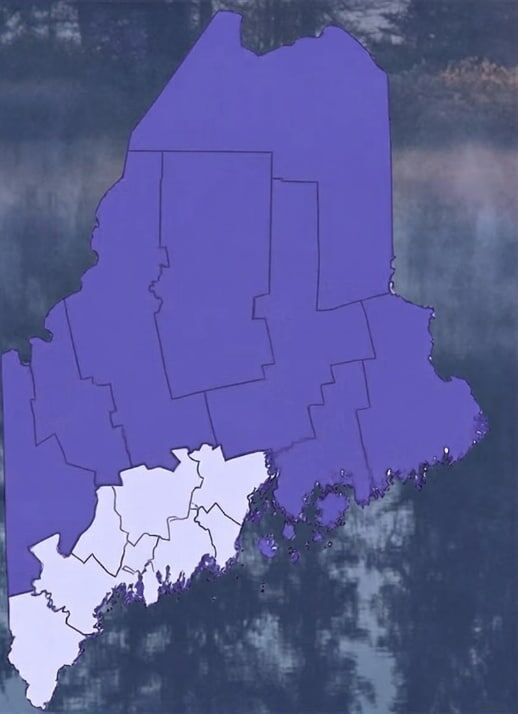
In Aroostook County, Maine’s largest and northernmost county, youth organizers are attempting to reach young people, ages 15-30, which make up 15% of the population. The county, population 67,000, is more than six times the size of Rhode Island. With an average of 10 people per square mile, an organizer’s job is hard.
I’m a high school senior working part-time with 18 other rural organizers across nine Maine counties under the umbrella of the nonprofit JustME for JustUs. My colleagues and I struggle with unique challenges. Due to the hundreds of miles between youth organizers themselves, most collaborate online, causing many to struggle with isolation. Additionally, most of the organizers aren’t working directly with passionate, like-minded people. Instead, they are trying to organize students who are disconnected from politics and voting.
Young people often wonder why they should even speak to organizers. It can be hard for people our age to know where and when to speak up, and even harder to know how.
Our work shows our peers that young people can help uplift each other’s voices. Whether that means voting, participating in clubs, protests, petitioning, or even posting on social media, young people do have a voice. Organizers are simply the people who make sure students know that they do.
For young rural organizers, not every conversation ends in action. Some end with, “I will look into it” or “I am not sure yet.” Progress is slow, but somebody considering using their voice is further along than someone who never tried in the first place.
However, even with a plethora of opportunities for youth to speak out, Maine does not always welcome our voices, especially when the older generation dominates the current political world. The average age in Maine is approximately 45, making it the oldest state in the nation. Whether intentional or not, youth are pushed out of the political world instead of brought in.
Organizers try to remain positive and keep working to bridge the divide. They start by speaking to the youth who are willing to speak to them. That can be harder than it looks. Our training gives us a series of steps: remain professional, answer questions clearly, and have a serious love for what we do. In one-on-ones, whether in person or online, youth share how they feel about their communities and the world around them.
Most rural youth will never leave their hometown. Nationally, an estimated 28% will leave. Others want to but never can. In Maine, around 67% of all young adults remain in this rural state, on par with national statistics.
Maine has historically lacked a strong education system. In fact, Maine has faced the sharpest declines in education for K-12 in the country, with 74% of fourth graders below proficiency in reading. Families who value their children’s education are faced with a choice: a strong foundation for their children, or their hometown roots.
For those who cannot leave, it is likely their children will lack the educational experience needed to succeed in college or future jobs. Without quality education, students often cannot choose the futures they want. Colleges or jobs outside of the state become more difficult or unachievable. In an era where technology and learning are supposed to be more accessible, Maine fails to implement better systems for students.
Education is only a byproduct of bigger, systemic issues in Maine.
Poverty in Maine is well-documented. Nearly half of all families cannot afford their basic needs, according to a study released in June by the Brookings Institute. Maine’s affordability has decreased by about 11% since 2022. Mainers cannot afford to leave, yet they cannot afford to stay. Stuck in this cycle, they are forced to live with increasing costs and decreasing job opportunities, especially in the rural areas of the state.
To combat this, organizers try to bridge the gap between rural Maine realities and the policies that can change it. One way is by helping people submit written testimony, something organizers and nonprofits are equipped to teach citizens. Although it seems small, people’s voices matter, especially when those voices may not have ever been heard before.
One thing is clear to me and my colleagues. Many people are in love with Maine, its nature, its sense of belonging and its tight knit communities. One common sentiment organizers hear from residents is: “It is not everywhere that people have each other’s backs the way Mainers do. If you are struggling, the community steps up for you.” Organizers like me, with the same love for Maine as everyone else, try to make it so rural Mainers will never have to choose between their home and their futures.
Of course, to support our work, youth organizers deserve funding, and better infrastructure. Since we are some of the only people that physically show up in schools and community spaces, we are a big part of Maine’s future. On top of working with young people, organizers plan and implement campaigns to educate Mainers on policies, laws and bills across the state. This nonpartisan education is fundamental to the future of the state and its residents.
The state of Maine needs to give youth the chance to learn how to get involved through better civic education and government classes. This way, citizens will grow up knowing the importance of their voice and their vote. If young people can learn how to participate in democracy, the government can give them a seat at the table while policy is being made. The younger generation deserves to feel connected personally to the policies that change their futures. We should not have to search independently to find resources about Maine policy and electoral processes. It should already be in the curriculum.
Ultimately, the state is in the hands of its youth. Instead of just encouraging them to stay, the state must change. We need to see that leaving Maine is not the only path to succeed. Staying can be just as rewarding.
ZNetwork is funded solely through the generosity of its readers.
Donate