

Back in the relative calm of January, as the media fixated on American threats to invade Greenland, the British government quietly published an intelligence report. Written by a committee of the country’s top spy chiefs, the report warned that within just a few years, the UK could face food shortages and social breakdown.
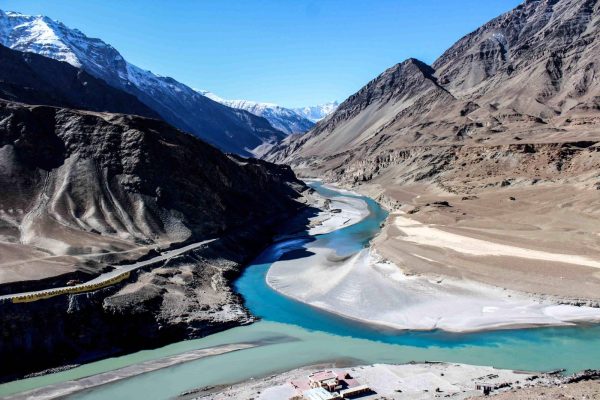
The cause was the imminent collapse of six key ecosystems abroad, including the Amazon rainforest, Himalayan rivers and Asian coral reefs. The report found that the irreversible decline of these habitats risked destabilising the planet, triggering competition over diminishing food and water supplies, and then soaring food prices, regional wars and mass migration. The collapse could start as soon as 2030.
For a country like the UK, which currently imports 40% of its food from overseas, and heavily relies on global markets for its fertilisers and animal feed, the results could be catastrophic. The report warned that self-sufficiency would require “very substantial” food price rises, extensive improvements across food production, and a “wholesale change” in diets – there simply isn’t enough land to feed people and rear livestock.
Yet this bombshell intelligence report, framing nature depletion as a threat to national security for the first time, was uploaded to a government website without fanfare or even a press release. In fact, the only person that the government notified after publishing it was a woman named Ruth Chambers.
Chambers, an environmental campaigner at the charity Green Alliance, had read about the report in the press a few months earlier. Journalists had been tipped off about a landmark launch event that had been suddenly cancelled because the government felt the report was “too negative.” Chambers felt the report was clearly in the public interest, and submitted a Freedom of Information (FOI) request to see it.
Anyone can ask to see information held by public authorities in the UK, thanks to the FOI Act passed by Tony Blair’s Labour government in 2000. Blair spent the next seven years of his premiership trying (but failing) to block its implementation then curtail its powers. In his memoir, he framed the FOI Act as empowering journalists to unearth government scandals, and called himself a naive, foolish idiot for backing it.
Chambers’ FOI request was refused by the government on the grounds of national security. She appealed, meaning the government would have twenty days to complete an internal review of the decision. In 2024, just under 9% of these reviews resulted in a decision being overturned. Yet on January 20th, the deadline day for a response, the government emailed Chambers with a link to the published report.
“Sometimes freedom of information requests can make governments hold on to information even more tightly. But, in this case, it appears my request enabled some within the government to make – and win – the case to publish,” she later wrote.
Chambers quickly passed the link on to journalists, and short articles about the report started appearing later that day. In response, a spokesperson for the Department for Environment, Food and Rural Affairs (DEFRA), whose website hosted the report, said its findings “will inform the action we take to prepare for the future.” Considering the future now credibly involved millions of Britons going hungry, the response felt oddly subdued.
The response also felt oddly subdued in parliament. Two days after it was published, Green MP Adrian Ramsay called for a parliamentary debate on the report, and the Leader of the Commons promised to make time for it. Twelve weeks later, the debate still hasn’t been scheduled and Ramsay remains the only MP to have mentioned the published report in parliament.
Three days after the report went public, The Times revealed that the government was still keeping parts of it secret. The newspaper had seen a more substantial internal version of the report, with sections on how ecosystem collapse could trigger nuclear war in Asia over diminishing water, war between NATO and Russia over arable land, and mass migration, extremist politics, and eco-terrorism in the UK.
Asked about the report, a government spokesperson said: “We are already investing a record £11.8 billion in sustainable farming and £10.5 billion in flood defences at home, as well as £3 billion to protect vital habitats around the world: all part of our commitment to understand and prevent nature loss.”
They don’t want to scare people
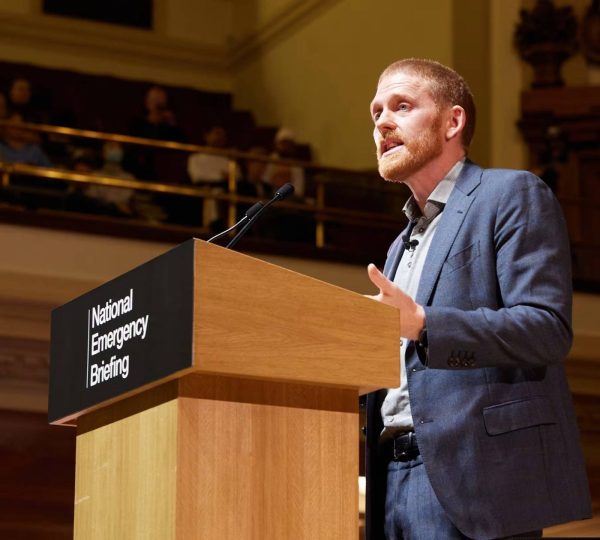
Chambers wasn’t the only campaigner trying to lay eyes on the report. Concern over its initial suppression started spreading across climate activist networks, and was further fuelled by the National Emergency Briefing (NEB). This series of talks, given by climate and nature experts to a large audience that included politicians, provided some of the unvarnished truth that the government had been sitting on.
One of the NEB speakers, Richard Nugee, a retired British Army Lieutenant General, focused on the national security threats of the climate and nature crises. Nugee quoted the maxim that “there are only nine meals between mankind and anarchy,” and warned that the UK could become “an ungovernable state” if the government didn’t take these threats more seriously.
When it became clear that the released report was actually abridged, dozens of activists started firing off their own FOI requests for the full version. This time the government stood firm, even on appeal, and refused further disclosure on the grounds of national security. In a Kafkaesque twist, it also refused to confirm or deny whether this fuller version of the report even existed. When activists appealed to the Information Commissioner’s Office (ICO), the final stage of an FOI request, the independent regulator found in favour of the government.
Activists also pushed their local MPs to try and access the full report. The politicians fared no better – at least five were denied access, including, incredibly, a current government minister. One of those turned away who was happy to go on the record was the Labour MP Alex Sobel, a former shadow minister for nature recovery. Sobel wants to see a copy of the full report placed in the House of Commons library, where it can be read by MPs but not taken away.
“We have to vote on legislation. We have to make decisions on behalf of our constituents. So we should have the right to every single report the government makes, unless… if we divulge that information, it would create a risk to individuals,” he said. “That’s certainly not the case here. This is about ecosystem collapse.”
Asked to explain the government’s reluctance, Sobel put it down to fear: “The government hasn’t said this, but what you surmise is they don’t want to scare people. But we’re not scaring people, we’re preparing them… creating a society resilient to climate shocks. We’re failing people by not doing that, failing the whole country.”
The day the report was originally meant to be launched, October 9th 2025, was the same day DEFRA published data showing England had endured its second-worst harvest on record. This made the previous year’s harvest the third-worst. The government may well have felt that announcing domestic farming was “unable to cope” at the same time that global farming faced collapse could panic the public.
But fear around this issue goes both ways. No government would savour the task of telling its electorate to eat a more plant-rich diet or go hungry, and this is already the most unpopular government in the country’s history. Plus its main political rival, Reform UK, is a party led and funded by climate deniers who won’t even accept curbs on fossil fuels are necessary, let alone meat and dairy.
Publicising the report would also highlight just how incoherent and counterproductive the government’s approach to nature overseas has been. In November 2025, two weeks after blocking the report, the government pulled out of a flagship forest fund that would have protected two of the six key ecosystems identified within it. This February, it announced plans to slash aid to countries that house four of them.
Considering that the full, unredacted report apparently predicts ecosystem damage will have caused a 12% drop in national GDP by 2030, more than double the impact of the financial crisis, the short-termism of the funding cuts is breathtaking.
Of course, the longer the government keep the public in the dark about these threats, the longer the far-right can circulate their fantasies unchallenged. Another MP who was denied access to the full report, but who didn’t want to be named, told me: “The public are just not being told how serious the climate crisis is. To hide this away plays into the hands of those who still deny climate change and use that denial for political and personal gain.”
It’s our information. We pay for it
In March, The Times unearthed another government report warning of food supply collapse, this time written by experts in DEFRA before the 2024 election. It also concluded that Britain’s food security was so undermined by habitat loss, climate change, and geopolitical instability that it could collapse by 2030.
Incredibly, the report was then shelved and the team of civil servants who wrote it were disbanded. When the climate campaigner Rupert Read submitted an FOI request to see the report, the government claimed to have no record of it.
It begs the question, just how many disastrous environmental reports is the government sitting on? One man striving for an answer is the environmental campaigner Ben Webster, a former environment correspondent for The Times. Webster submitted an FOI request asking the government for just the titles of the environmental reports that it had produced over the first half of 2025. The government refused, claiming it would be too difficult and expensive to find out.
The FOI request was part of preparations for a legal challenge that Webster will launch against the government with the help of Peter Lockley, a barrister specialising in environment and information law. The pair have spent the last six months uncovering how the government is failing to comply with UK law over the release of its environmental reports.
The government is obliged to be more transparent with environmental data than any other kind thanks to Environmental Information Regulations that were included in the Aarhus Convention, an international environmental treaty which the UK joined in 2005. FOI requests about environmental issues are automatically processed under these more stringent regulations, and they likely tipped the government towards disclosure after Chambers’ original appeal.
Webster and Lockley believe that ministers are ignoring a clause in the regulations that requires environmental information to be proactively made available to the public. They sent two government departments a series of information requests to test their compliance with the clause, and found no evidence for it. They have since set up a case crowd funder and applied for a judicial review.
For Webster, the intelligence report was “a classic example of a report that we shouldn’t have to ask for,” though it wasn’t what triggered his legal case. In 2023, he was tipped off about a series of reports on hydrogen for home heating that the government was sitting on. At the time, hydrogen was being sold by the gas industry as a green alternative that used the same infrastructure, and the government was considering major trials in the north of England.
Webster’s FOI request was repeatedly rejected on the grounds that the reports were part of an incomplete policy process. But the ICO, the information regulator, found in his favour, because the reports themselves were complete. The government took the case to tribunal, and after two years of legal exchanges, released three of the four reports. They showed that hydrogen was a high cost, high emission solution that was inferior to electrification. Webster’s battle for the final report is ongoing, with another hearing scheduled for later this year.
After all this legal wrangling, and three decades as a journalist, Webster believes a culture of secrecy pervades the entire government, and it is motivated by convenience rather than necessity. He talks of officials who have become used to avoiding scrutiny, and micromanage how policy is presented to the public: “And I’m saying, no, sorry. Give us the facts. Information is power. It’s our information. We pay for it. Give us it as soon as possible. By all means then go away and work out your sales pitch based on all these reports. But, no, you can’t wait until that point.”
Asked about their approach to environmental data requests, a government spokesperson said: “We recognise the importance of transparency in building public trust and consensus for delivery of our environmental, clean power and net zero goals. We are proactively taking an open, clear and accessible approach to data and statistics – as set out by the Office for Statistics Regulation.”
Stuck in a doom-loop
Now that the British government has (reluctantly, and only partially) divulged evidence of a looming national food crisis, what should ministers be doing about it? Professor Paul Behrens, a food systems scientist at Oxford University who spoke at the National Emergency Briefing, has identified four essential next-steps for the government.
The first is to follow in the footsteps of Denmark, and create an action plan to get more people eating plant-rich diets. The second is increasing domestic food production and resilience by investing in farms and farming technology. The third is to stop cutting international climate finance and recommit to protecting critical food producing ecosystems overseas. And the fourth is to develop civilian food preparedness, including food stockpiles and emergency food provision plans.
On first learning about the report, Behrens felt a sense of relief that the intelligence services were taking the threat to food supplies seriously. But that relief has been supplanted by frustration at the delays, censorship, and inaction of the government – a sentiment that he says is widespread across academia.
Behrens highlighted how an estimated one third of the recent food price inflation in the UK was driven by climate change, and is worried that rising food prices will trigger a negative feedback loop, where they induce more political upheaval that creates less effective governance. “Reform UK are nowhere on the environment, and voting them in will only exacerbate these issues as we become more exposed to risks and have to deal with more extreme weather events,” he said.
“Life will be so much better if we do make these changes. We’ll look back and wonder why we didn’t do it sooner. But unfortunately all the signs show we’re stuck in a doom loop.” Behrens now personally believes there is a “high” chance that complex society will collapse this century. “But there is an outside chance that it won’t, and that chance is worth pursuing,” he adds.
Asked about the UK’s food security, a government spokesperson said: “This government is investing billions in the development of new technology to increase yields, develop climate resilient crops as part of our commitment to maintain food production levels and help farmers produce more food. Alongside this, we are increasing our water supply by building new reservoirs for the first time in 30 years, ensuring our food and water security is safeguarded for the future.”
With the ongoing war in Iran severely disrupting the transit of raw materials needed for fertilisers, the UK and much of the world could be about to experience an early shock to a system that looks destined to suffer an earthquake. The UK government have known what’s coming for at least two years now. The UK public are still waiting for the unvarnished truth that they paid for.
ZNetwork is funded solely through the generosity of its readers.
Donate